Episode Transcript
[00:00:00] Charity Stutzman: One of the things that stood out to me was Data collected comparing
2023 incoming students to 2025. Right. There was a significant jump in 2023. 55% of students
indicated negative health consequences as kind of a determining factor right of not drinking or
engaging in high risk drinking behavior. Substance use, it jumped in two years to 64%. So that
shift from 2023 to 2025 in a matter of three years, two years, but three cohorts of students.
It surprised me and I think validated this need to use data to drive the decisions you're making
because things can shift so quickly for students.
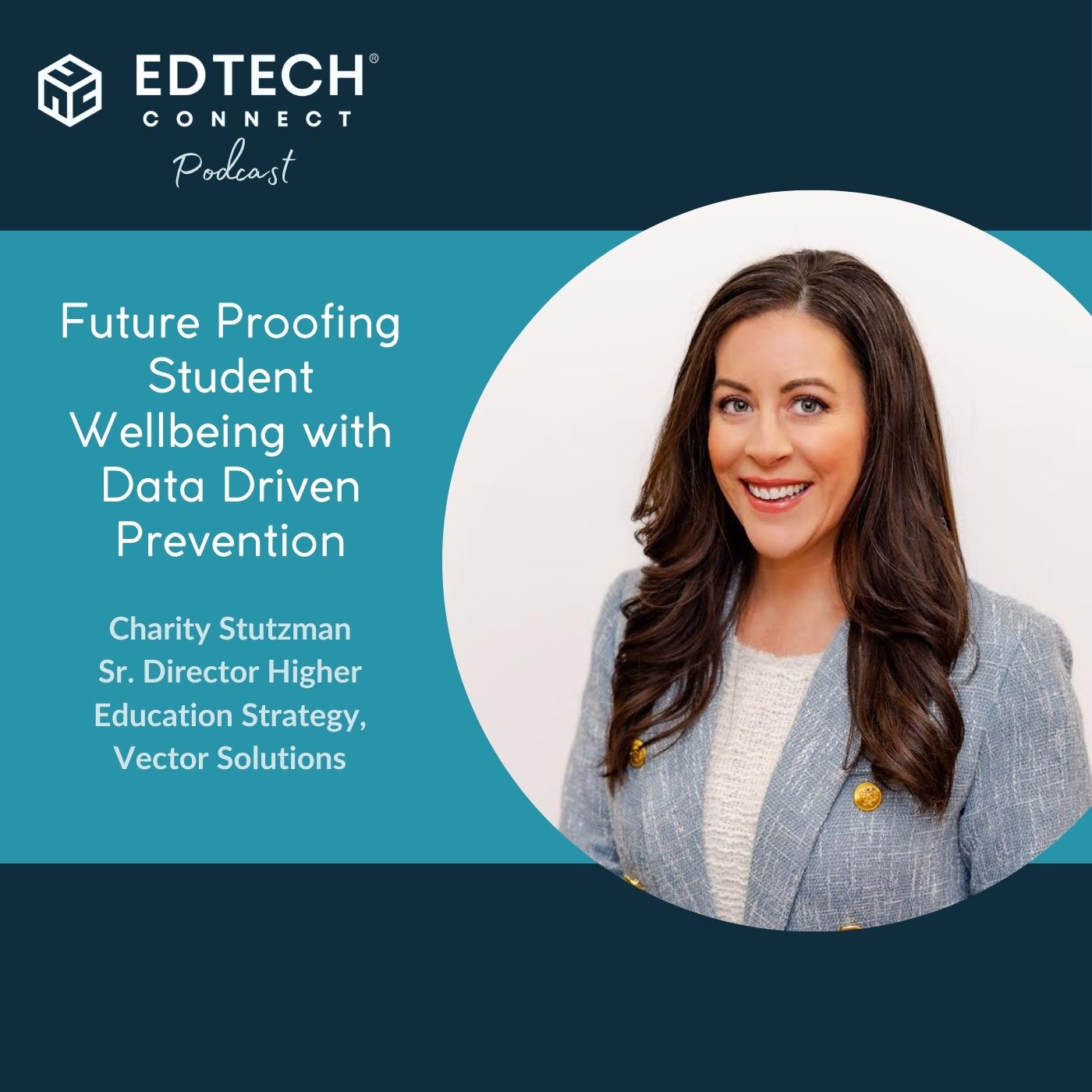
[00:00:51] Jeff Dillon: Welcome to another episode of the EdTech Connect podcast. I'm Jeff
Dillon and today we're unpacking some eye opening new insights from the just released Campus
Prevention Network National Insights report by Vector Solutions. This year's data reveals a
dramatic cultural shift among college students challenging decades old assumptions about
alcohol use, peer pressure and student well being. My guest today is Charity Stutzman, Senior
Director of Higher Education Strategy at Vector Solutions and a driving force behind the report.
Charity brings more than 15 years of experience in student affairs. Most recently as assistant
Dean of Students at the University of Texas at Arlington. She now leads national strategy to help
institutions rethink how they approach prevention, belonging and student success.
Charity's work is shaping the way campuses nationwide understand and respond to emerging
trends. From the rise in cannabis use to the growing number of students choosing not to drink at
all. This conversation is packed with data, strategy and insight you don't want to miss.
Welcome to the show, Charity. It's great to have you today.
[00:02:20] Charity Stutzman: Thank you for having me, Jeff.
[00:02:22] Jeff Dillon: Well, let's go back and talk about your college experience.
How does that shape how you approach your work today?
[00:02:30] Charity Stutzman: Oh, I love this question. Of course, everyone has, I think, that pivotal
moment in their college experience that, you know, shaped their life and set them on a path. So I
think not unlike many college students, right. I was struggling with big life questions, right. What
should I do? Who should I be?
It all feels very enormous. You carry so much weight and in true to form to myself, I walk into a
faculty member's office and this individual, she had been kind of an academic mentor in a way.
She was my English lit professor first year, right. That English 101, and I walk into her office, this
is my junior year and I break down in tears. And I'm crying, right? I did not yet, had not yet
determined my major. I probably had five different minors.
But I was at a point where I clearly needed to declare A major and start taking those upper
course classes. And so I'm in tears and, you know, all of those big questions. I don't know what I
need to be doing. And she was a wonderful woman and very eclectic. Had a very calm
demeanor and, you know, your kind of stereotypical English professor, right? And she says, oh,
Charity, dear, just keep crying. Life only gets harder. And you know, it snaps you out of this
moment and that's not what you want to hear as a young college student. If life gets harder, it's
supposed to get better. And so she proceeded to say, you know, Charity, you are making big life
decisions and the weight of that feels very heavy and you don't yet know who you are. So those
decisions are hard and difficult. Just that in your 30s they get much easier, right? You know
yourself, you know who you are, you know what you believe, your values, you learn to lean on
those and life will be hard and decisions will still come to you that will be difficult, but you will
know yourself. And so that was such a, I think, a pivotal moment for me and I think certainly
highlights the idea that faculty members, an academic advisor, a counselor, anyone who's
working in higher education has the ability to change someone's life and that's why they do this
work. Right? And so she brought that connection with me. She also created a safe space. And
so when you think about higher education, and now where I have landed, of building out
programs and services and thinking critically about the environment and creating spaces where
students can belong are so critical. And then lastly, right, it's that life is hard and it reinforced
decision making is grounded in purpose as you navigate kind of the world around you. So, yeah,
that was a moment. And I use that story with students often when they come to me in crisis or
just with uncertainty of what's next. And I'd say that same thing.
[00:05:20] Jeff Dillon: I love that.
[00:05:20] Charity Stutzman: Keep crying.
[00:05:22] Jeff Dillon: I can remember a handful of mentors in college, some of my most vivid
memor stories of their faces now, what they're telling me in college, it was really a great
transformative time and it's fun to look back on. I love that story. You've had an impressive
journey from student support roles to leading higher ed strategy. What inspired your transition to
Vector Solutions?
[00:05:43] Charity Stutzman: Yes. So I think like many administrators and faculty, the pandemic forced
a shift, right, for us. Work modality, engagement with cost, colleagues, workforce readiness,
expectations of students.
And I think, you know, that prompted some critical self reflection, right. Of who am I as a person,
as a professional, what do I want to be doing, and I will. I can clearly and confidently say during
that period of time, I never wanted to leave higher education.
I am passionate about education. I see my role as an educator and always have and always will.
I believe in the mission of higher education and its purpose and the role that it serves. And so I
didn't want to leave higher ed and there was a great migration out of higher education. But I
wanted to continue to work in and on higher education.
And I also coupled it with my early experiences in the field. Meeting one on one with students
and building out prevention programs and thinking critically about the environment. Right. I
thought about those early conversations I had one on one with students, students and how I
pivoted that to larger programmatic decisions. And I was passionate about that. I was very proud
of the work in my 10, 15 years at my institution where, you know, I started as one single kind of
person in a department and grew to multiple departments. It was multiple staff. And so building
those programs out, closely aligned. And so I got to a point, I think those two coupled. I wanted
to go back to doing prevention work and working towards creating those safer in campus
environments, supporting campuses, building out strategy. I'm passionate about that. Vector
Solutions was one of those kind of, I'll say a uniform job for me. Right. It merged those. And I
was able to marry that passion for higher education, my role as an educator with strategy and
building out prevention programs, supporting student success, thinking about institutional
transformation in critical ways, and Vector Solutions, you know, that's part of their mission of
what they do, of creating those safer communities for all individuals. So it was one of those
unicorn kind of closely aligned opportunities. And I took full advantage of it. It was hard. It's a
hard transition, of course, directly out of direct practice and higher ed. But it's a joy to meet with
campuses now in that capacity.
[00:08:09] Jeff Dillon: Let's talk about this report, the CPN National Insights report that was just
released.
I thought it was fascinating because it gives such a clear read on how student behavior is
shifting nationwide. I think what really surprised me was how strongly it breaks the old
stereotype of college drinking culture. And it's not at the fringe. Students are choosing not to
drink for reasons tied to mental health, finances, wanting more control over their lives. So it feels
like a cultural shift. What stood out to you in the report?
[00:08:42] Charity Stutzman: Many things. You know, I think certainly the trend of increased abstainers
we had noticed kind of slowly throughout the years. One of the things that stood out to me was
Data collected comparing 20, 23 incoming students to 2025. Right. There was a significant jump
in 2023. 55% of students indicated negative health consequences as a determining factor right
of not drinking or engaging in high risk drinking behavior, substance use, it jumped in two years
to 64%. So that shift from 2023 to 2025 in a matter of three years.
Two years, but three cohorts of students.
It surprised me and I think validated this need to use data to drive the decisions you're making
because things can shift so quickly for students in a matter of that two years.
I think another surprise obviously was the younger students driving that this shift. And so I think
the stereotypes, like you said, the traditional assumptions of high risk drinking for those younger
students, those younger students are making different decisions and weighing their risks as well
as identifying potentially those protective factors.
So again, not surprised so much by the trend because we saw it year over year and all
campuses were curious and kind of skeptic about the data and is this really happening? And so
we were pleased to actually dive in and look at the data in full kind of year over year, but it was
the past three years. That immediate shift certainly surprised me at how quickly things can
change for your students.
[00:10:26] Jeff Dillon: You know, what really struck me is the shift forces us to rethink the whole
foundation of traditional prevention work.
If students are already moving toward moderation and abstinence on their own. The old fear
based or risk focused models don't really match where they are now. So it pushes campuses to
focus more on support, belonging, well being then on warning labels. How do you see the shift
challenging the classic prevention approach?
[00:10:57] Charity Stutzman: I talk a lot about engaging the healthy majority and those students are still
on your campus. And so while there may need to be less of a focus on risk reduction, there
needs to be a focus on reinforcing those positive decisions that students are engaging in and
maintaining. I think in the prevention space we talk about risk reduction, we talk about primary
prevention, but a piece of that is the ongoing efforts that need to take place to maintain those
positive decisions, those healthy decisions. And so prevention work, I think in two ways should
shift to very skills based on those personal self reflections, reinforcing those positive decisions
they're making as well as kind of the long term strategy that an individual needs to engage in
that personal self reflection, understanding kind of their environment, how what's influencing
them, and reinforcing and affirming those decisions.
[00:11:55] Jeff Dillon: What I'm seeing is that rising cannabis use puts colleges in a kind of a
tricky middle space. It's legal in many states, it's normalized socially, but still disruptive when it
comes to academics, health and community life. So campuses can't really rely on the old alcohol
centric playbook. They have to rethink education. Right. Like policy, clarity, support services in a
way that meets students where they are. I guess my question is how are you seeing institutions
respond to this trend?
[00:12:29] Charity Stutzman: And it varies, I think, as you've touched on, based on state location,
because of legalization, social norms, access, I think so. I see this as both a challenge and
opportunity for campuses. It will be unique to their environment, which is standard principle of
effective prevention is understanding the environment.
But it's an opportunity, I think, for campuses to increase some knowledge and safety and some
risk reduction. I think there's interesting data and research being done elsewhere, right. About
intersections of mental health and comorbid diagnoses and how the use of cannabis can
accelerate some mental health concerns. Increased likelihood of other substance misuses,
along with so early use of cannabis may increase the likelihood of other substance misuse and
then safety kind of, and the risks associated with that. And so there's an interesting. I think it's a
challenge and opportunity immediately. Jeff, as you can imagine, as we're looking at our data,
we have a cannabis. Edu course and Mike Martinowitz, our lead researcher and I, we
immediately opened up our cannabis. Edu survey and said, are we asking the right questions?
Right. It's important that institutions see this kind of as a challenge and an opportunity that we
continue to understand and use data to drive those efforts on the perceptions and the attitudes
and the behaviors around cannabis use and those motivators. Right. What. Why are you
choosing to. And not. Or choosing to not use? And those are important kind of factors to zero in
on. And that will be unique, I think, to certainly to the campus, into the institution.
[00:14:12] Jeff Dillon: One other thing that stood out to me was how many protective factors, I
guess I would say are stacking up in a. In a positive way. You see students prioritizing mental
health, tighter friend groups, financial pressure, even a stronger focus on academics. All that
makes not drinking a pretty logical choice. But from your perspective, what factors are.
[00:14:37] Charity Stutzman: Are driving that shift the negative health consequences? And so that's.
That was an interesting data point there, right. That there is this increased kind of awareness of
health and engaging in positive things for physical health, mental health, you know, campuses.
For years I actually was reflecting on. I don't know, Jeff, when you were in college, was your
campus recreation a big department where they hosted a lot of programs and outreach, and they
were a central hub I don't know. For me it would not.
[00:15:06] Jeff Dillon: No.
[00:15:07] Charity Stutzman: Right. Yes. And I think more now than ever, it's interesting. Campus
recreations are kind of becoming this integral part of an institution. So when we think about
protective factors, engaging students in healthy habits and engaging in. With peers in healthy
ways, I think some, I know, at least my institution that was the most utilized resource and service
on our campus was the campus recreation. And so we, you know, adapted some of our
programming and we used the facility and the site for a counseling center and I hosted programs
in there. And so it became this hub for us. So I know that's a bit of a shift, but I think certainly
engages students and reinforces those positive behaviors and it's more than risk reduction.
Right. To your earlier question about how we can shift our prevention programs or the work that
we do with students is meeting them where they're at and it's health. They see that as a
consequence. Then let's engage them in healthy behaviors. Let's get them physically healthy,
get them mentally healthy and reinforce again those positive decisions. Jeff, I don't know if you,
you know, the end of our report, we kind of debated and we went back and forth. Towards the
end of the report, we listed out three elements. It was the course modality. And so we have
breakdown of course modality. So students who participated in the course and completed the
surveys, the courses, the modality. So online, solely hybrid in person classes. We looked at
living environment and arrangement and then we looked at campus involvement. And so I think
that also is a great place for campuses to begin to think through those protective factors. So
those three buckets alone, right. Are you creating living environments or providing opportunities
for your students to engage in healthy ways in their living environments? And is that a protective,
protective factor for them? Will that keep them, you know, safe and healthy and. Well, I think
engagement in co curricular activities. Right. Can be both a risk and a protective factor. So
thinking about as you work to increase belonging and engagement on campus and the role that
student organizations play in supporting those healthy behaviors. And then lastly, that course
mortality, right. Like how are students engaging with their peers and with faculty and
administrators online, solely virtual offerings for your programs and your services, all of that, I
think together is a great place to start.
[00:17:37] Jeff Dillon: When you talk about seeing students as whole individuals, that really
resonates, I think in practical terms, I think it means looking beyond isolated behaviors,
understanding the mix of stress, identity, finances, mental health, the academic pressure that
shapes their choices. I think it pushes the schools to coordinate support instead of working in
Silos. How do you think campuses can put that into practice?
[00:18:07] Charity Stutzman: Certainly, yeah, I think through maybe that story I told in the beginning of
that interaction with that faculty member. I think first and foremost upskilling your faculty and
staff to engage with students in those eight dimensions of wellness. Right. That you're asking
and inquiring about students overall wellness and upskilling professionals. Faculty may not be
comfortable to engage directly with critical situations, but they certainly should be kind of a
space where students feel safe to engage. Right. And then you can direct them to those
appropriate services. So I see an element of institutions need to upskill and provide some
professional development. I've also noticed some positions kind of pop up here and there at
institutions and certainly right prior to me leaving my institution of this case management
approach, of highlighting kind of this expectation that a student may have to have a very
personalized experience where every interaction they have, it feels as if they are being taken
care of in a very intimate way. That that person knows me, that they understand who I am and
what I'm coming with, what my challenges are. You know, they don't want to go to five different
offices and retell their story or retell their, you know, situation. They want that case management
approach of I'm meeting with one person. And that may not be a realistic, that's kind of an ideal
situation and institutions don't have the resources. But I think certainly when we talk about
integrating wellness into every aspect of a student experience experience, there should probably
be a shift in that as well. So not only upskilling, but do you take a case management approach
from academic advising to the non academic concerns that may arise for a student? Again,
building off of that, let's talk.
[00:19:56] Jeff Dillon: About the Vector Solutions tools, the training tools in my research and
looking at what you're doing at Vector Solutions. What stands out to me about the tools like
Alcohol Edu and Cannabis Edu is how they give campuses real time insight instead of waiting
for issues to surface. And they're not just one time training. They help schools spot trends, tailor
support, adjust messaging based on what students are actually experiencing. So tell me if I got
that right. But from your view, how are these tools helping institutions respond in real time?
[00:20:26] Charity Stutzman: Absolutely. I mean the data is certainly one of our value adds right data to
drive not only your programs, but your overall strategy for your campus and real time insights.
So being able to build out kind of those surveys and those assessments, I think certainly we
have within our capabilities is direct benchmarking so campuses can go in and benchmark with
other like institutions. And there's some great capabilities we have for institutions to benchmark
themselves, which I think certainly both for myself, when I was doing the work and meeting now
with our campus partners, there's often I'm seeing this trend, are you seeing this elsewhere?
And so to have that capability within our data is great. So campuses can benchmark. I also, you
know, I think the content, we often talk about the content and I feel deeply about the content.
So we're more than just checking that box, right? It's more than just a compliance. And when we
even what we've talked about briefly today, building out skills and reinforcing those positive
decisions, those critical skills that students need to be successful, those are embedded into all of
our courses, that we want to derive the behaviors, those positive behaviors. We want to
influence what students know, feel and do on these critical issues. And so we follow that
framework. And so we certainly are proud of the content that we produce. But we also know that
it drives efficacy of the course. It has impact that students learn and walk away with significant
impact knowledge gains. We see increased shifts in perceptions and attitudes, shifts in their
assumptions of what their peers are doing.
And so we have, you know, the data has real time insights, but then from a national perspective
now we can pull these national trends of how students are engaging with their peers and with
their campuses.
[00:22:22] Jeff Dillon: So yeah, I imagine the real proof comes from what campuses are
experiencing on the ground after using these programs. The combination of education data and
earlier insight has to create some meaningful wins. What kinds of success stories have you
heard from institutions that have implemented these programs?
[00:22:43] Charity Stutzman: Yes, absolutely. The campus is really thinking about this national insight
report as well. We work with a campus who has been tracking their data.
Partners with us for over 10 years have been tracking their data year over year, and they
identified this increase of alcohol abstainers as well. So they called us and we had great
meetings to say, is this what we're seeing? Yes, we are.
And so I will say that they have embraced the training as fundamental and kind of foundational
to their students experience that it's been used on their campus to create a common language
on these critical issues.
They recognize that these trainings are used largely at scale and then using that data to build off
in person programs a lot of campuses struggle right with. They want high impact, high quality
programming, but they also want high touch. And so we see ourselves as providing that
foundational kind of piece for campuses where you develop that common language, you set
those standards for talking about these difficult topics for incoming students, and then providing
Those ongoing educational opportunities based off of that, that high, that in person event. Right.
We also, you know, the courses allow, which is it's hard to do this in person programs. Right. We
have unique pathways, Jeff. So we for our sexual assault prevention course, if you are a survivor
of sexual or interpersonal violence, you can take a separate path that is trauma informed and
caring for your experience in the course. For our alcohol Edu course, if you are abstaining or
choosing to not drink, there's a pathway to engage you in those critical messages and education
you need as an incoming student while reinforcing those positive decisions that they're making.
And so that's also a unique interesting campuses use that data, right. To say here are my
students, here's what they're experiencing, here's what they're coming in, here's their baseline
knowledge and here is a metric now to guide us to where we want to be and where we want to
go. So I would say that year over year definitely has been impactful.
[00:24:54] Jeff Dillon: So what I keep noticing is that the biggest challenges aren't just the
behaviors themselves, but the pace of change.
Universities are trying to adapt policies and prevention models and support systems that were
built for a different era.
It takes coordination, updated training, a willingness to rethink these long standing assumptions.
From your perspective, what obstacles are campuses running into and how can they move past
them?
[00:25:26] Charity Stutzman: Jeff, I think you've named them right there. Right there's the obvious
budget constraints and resources and limiting resources and competing demands. And I think
institutional leaders are making difficult decisions to make about where time, money and
resources go. So there's difficulty in deciding how and when to prioritize prevention and well
being programs at the institution. I think as you touched on job, Higher ed moves slowly by
nature and we have deeply institutionalized our policies and procedures and those often can act
as those barriers to adapting those programs, services and budgets. And so I think having
mechanisms in place where you can pivot quickly. I talked about the pandemic earlier, but
certainly I think that was a key word pivot. You need to learn to adapt and move quickly and it
might feel uncertain, you may not be sure of what that outcome will look like. But we were in a
point institutions of higher education where we're being asked to transform. And so part of that is
moving quickly and adapting. You have to be okay with that.
[00:26:33] Jeff Dillon: Student affairs teams are often closest to the day to day reality of student
life, but they're not always given the authority or resources to drive the change.
So how do we empower them? With, I don't know, clear mandates, better data, is it at the
strategy table? So I'm just wondering, how do you think campuses can strengthen their role in
leading these efforts?
[00:26:57] Charity Stutzman: Empowering the student affairs leaders in these efforts, it can be very
isolating work, Jeff. I think it can feel as if it's not institutionalized and you don't see your work as
a part of the strategic plan that's out on the university website. Right.
And so if you are in a position as a university leader where you have staff doing this work day to
day, it's critical to empower them, to let them know that there is a bigger picture and that they do
play a critical role in the student success. So if your outcomes are retention, then telling your
staff you play a role in that, if our outcome is increasing for your graduation rates, then your work
plays a role in achieving that outcome. If our outcome is to drive student engagement and
belonging, then your work in increasing student membership and organizations, you have a role
to play. And so I think reinforcing that staff who are doing this work are central to student
success and are needed. So I think the conditions, right. Clarity of the role in place within the
largest strategy of the institution that the work you do directly ties to student success and
prevention and retention of your students.
Support resources and tools at scale, right? So often folks on the ground doing this work, Jeff, I
did, right? It was. I had to meet one on one with students, serve as an advocate, triage mental
health crisis and build programs. You know, those are two very different jobs. And so there's
burnout, there's lack of recognition and so finding resources and tools to engage to support their
work, to complement the work that they're doing. You know, we used these modules for my
students, right. We used these educational trainings for my students which helped alleviate that
burden of reaching all of our students at orientation programs in one big talk. Right. But it's
important to empower.
[00:28:58] Jeff Dillon: Well, to wrap it up, is there any final insight you want higher ed leaders to
hear? Or if you have to narrow it down to one piece of advice for future proofing student support
systems, what would it be?
[00:29:10] Charity Stutzman: Future proofing student support resources and services. I'm going to level
that up. I think higher ed in general is having to future proof their role and who they are. And so
there is, I think, increased transparency, increased accountability for what institutions of higher
education are doing. And so I think trickle that down to the work that student affairs
professionals are doing and prevention space, well being space that it does directly tie to
Retention, it directly ties to the success of students. But if you're not doing this work and
addressing the needs of students. So when I talked about future proofing higher education, there
need to be direct outcomes. Students go to college to get a job, to have opportunity for a better
way of life. Right? That's why students are seeking out higher education.
And so if you, if your programs and your services and your educational opportunities are not
closely linked to those skills that students need to earn a job to get a living or a better quality of
life, then I think you're missing the mark. And so all of the programs, my advice is look at all of
your programs that you are delivering. If you don't see the skills and the outcomes directly tied to
the career readiness that students will need, then you're missing the mark. And so embedding
kind of student success prevention, well being and safety deeply into your program services and
student support structures and tying that to career readiness, I think that you're missing the
mark. So that would be, you know, my advice. Institutions at a highest level, right. Have
accountability now, the roi. And I think if you're in a position where you're leading prevention and
well being work, tie that work to career readiness.
[00:31:01] Jeff Dillon: Great advice. Thank you for being on charity. This is really a powerful
topic and I'm excited to share that research too. Where can someone get the research if they
want to look at this recently researched report?
[00:31:12] Charity Stutzman: We have a right front center on our Vector Solutions webpage and drill
down about the higher education team, but it should be front and center right there.
[00:31:21] Jeff Dillon: All right, we'll put a link in the show notes to Vector Solutions as well as
your LinkedIn bio charity. So thanks again.
[00:31:27] Charity Stutzman: Thank you, Jeff. Bye Bye.
[00:31:29] Jeff Dillon: Bye.
We wrap up this episode. Remember, EdTech Connect is your trusted companion on your
journey to enhance education through technology.
Whether you're looking to spark student engagement, refine edtech implementation strategies,
or stay ahead of the curve in emerging technologies, EdTech Connect brings you the insights
you need. Be sure to subscribe on your favorite podcast platform so you never miss an
inspiration, inspiring and informative episode. And while you're there, please leave us a review.
Your feedback fuels us to keep bringing you valuable content.
For even more resources and connections, head over to edtechconnect.com your hub for edtech
reviews, trends and solutions. Until next time, thanks for tuning in.