[00:00:00] Christy Heid: We're building into those simulation programs a host of modalities that
better replicate those real world experiences and in some ways are better than real world clinical
experiences because you can actually do a lot of the things in simulation and in VR that you
can't do in clinical practice as a student.
So I think part of it also allows us to have a scalability that you can't. Especially in immersive VR,
we're able to standardize the experiences and scale them to broad numbers. You know, we can
go all over the world and be in the same room taking care of the same person in VR and you
simply can't do that, you know, in your physical simulation space.
[00:00:56] Jeff Dillon: Welcome to another episode of the EdTech Neck podcast where we
explore how technology is transforming education.
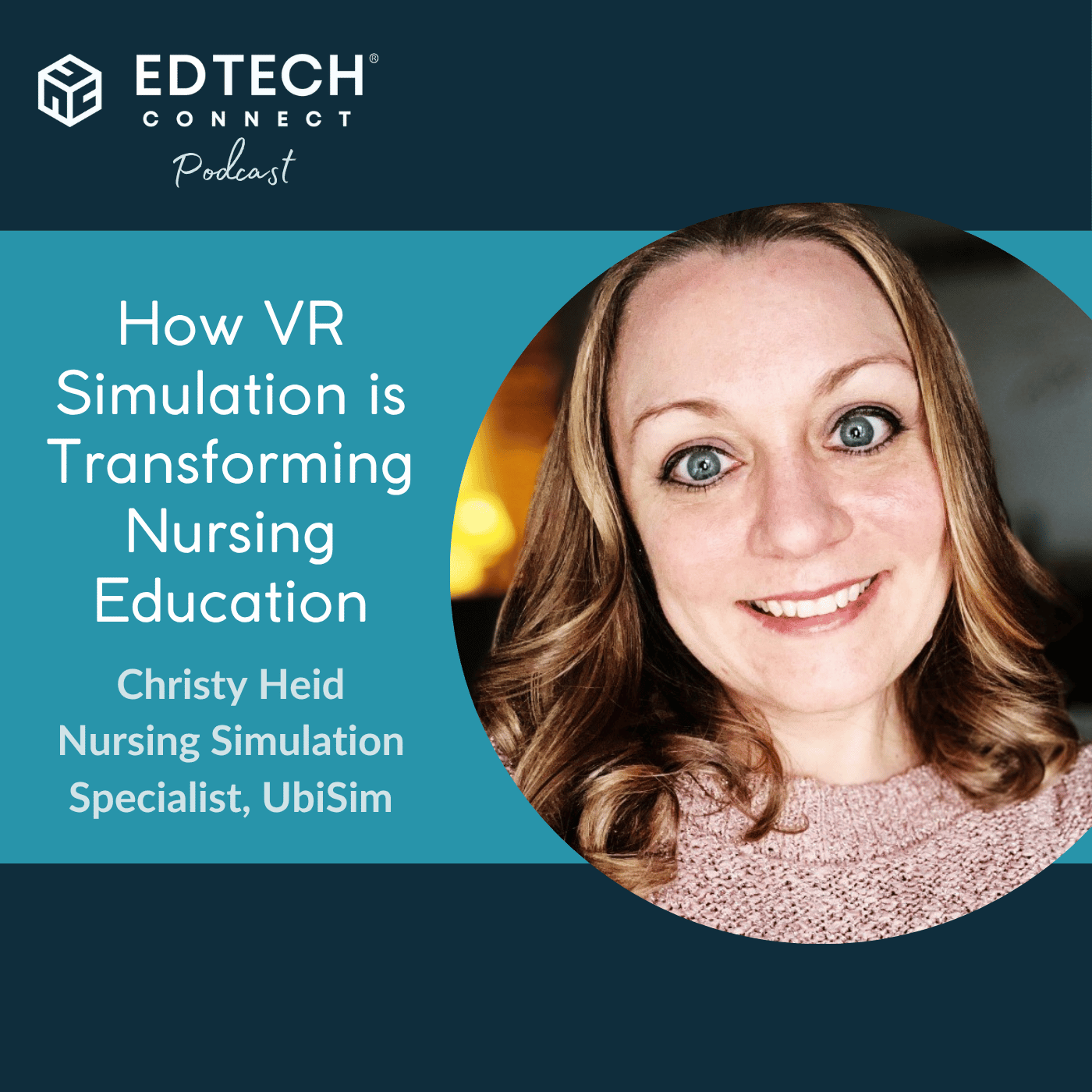
Today's guest brings over two decades of experience at the intersection of nursing, teaching and
innovation. Dr. Christy Hyde is a nursing simulation specialist at Ubisim, a leader in VR
simulation for nursing education that's helping prepare the next generation of nurses for a high
tech AI driven healthcare environment.
A PhD prepared nurse educator and simulationist, Christy has taught at both community college
and university levels, led research on clinical learning tools, and helped institutions nationwide
adopt cutting edge teaching strategies. Most recently, Christy helped release UBSIM's Practice
Ready in the Age of AI report which revealed that 65% of hospital leaders believe new grads
aren't ready for day one patient care.
Highlighting the urgent need for smarter tech enabled education, we'll dive into how simulation,
AI and innovative teaching methods are bridging the readiness gap and reshaping how we
prepare tomorrow's healthcare workforce.
Welcome to the show, Christy. It is great to have you today.
[00:02:15] Christy Heid: Thanks for having me.
[00:02:16] Jeff Dillon: So let's start by first hearing about what first sparked your interest in
nursing education. How did that journey lead you to ubisim?
[00:02:26] Christy Heid: So this is an interesting question, Jeff, and I think I share this in different
ways each time, but my interest in nursing came from my grandmother who always wanted to be
a nurse but didn't realize her dream until I became a nurse. And she always taught me that you
needed to really make a difference in others lives. You know, it's a gift to be able to care for
people.
And so in order to kind of double down on that, so to speak, I decided I wanted to help new
nurses have better experiences than those that came before them. Right. So some of some of
the experiences that we have as nurses aren't always, you know, what you see on TV or what
you imagine they're going to be and really Nursing education gives us an opportunity to serve
the next generation of nurses who then continue to serve our communities and ultimately the
reach is more extended, I guess than one little nurse can do on his or her own.
[00:03:29] Jeff Dillon: Yeah, I love that. Yeah, we need to reach so many people. You often say
UB SIM is built by nurses for nurses. How important was that nurse led origin in shaping the
product and its mission?
[00:03:43] Christy Heid: So we are very proud about our origin and UB SIM really gives us the
opportunity to serve nurses in a way that is generated to meet their specific needs.
So we're very proud of our focus on nurses. Our nurses, our staff use the standards of best
practice. We use the NCLEX test plan clinical judgment model and of course we adhere to an
actual healthcare simulation standards of best practice.
So our platform really allows us to meet nurses where they're at and help them extend their
education and their competency truly throughout their career.
[00:04:28] Jeff Dillon: You recently released some survey data showing 65% of hospital leaders
say new grads aren't fully practice ready. What stood out to you in that research?
[00:04:41] Christy Heid: So this is really exciting research for us. We know that nursing education
and employer expectations don't always match. Right. We have this academic practice gap. And
one of the things that we found was that it's not that academia is completely responsible and it's
not that practice is completely responsible, but what we're finding is what it means to be day one
ready looks different than it did 20 years ago when I became a new nurse.
So in our research we found that in order to help really prepare our nurses for the practice
setting that they're going to be encountering, where those expectations change and complexity
increases almost daily.
We really need to use the tools that we have available to us to enhance that through hands on
experiences and building in things like AI ready skills that help them hit the ground running.
[00:05:42] Jeff Dillon: Among the readiness issues highlighted, like interdisciplinary
collaboration, time management, clinical judgment and AI assisted charting, which do you find
the most pressing and how does UBSIM help address those?
[00:06:00] Christy Heid: So I love this because I would like to say all of them, right, all of them are
incredibly pressing. But I think what we're finding is it's really relevant for those hiring leaders
that nurses come with clinical judgment.
That's something that we hear time and again that we can't teach over a course of several
weeks to months. Right. It's something that takes much longer to develop and even with our
year long residency programs, we're still counting on that foundational knowledge and ability to
apply it in those changing situations. In order to truly serve our population. So part of that I would
always say, you know, clinical judgment is at the heart of everything we do at uvsim. And every
scenario that we develop is going to test or provide learners with that experience from each step
of the clinical judgment process that the NCSBN Clinical Judgment Measurement model defines
for us. Then we reassess it in our post simulation assessment. So we're reinforcing that clinical
judgment and how important it is to every encounter we have with real people.
But first we get to do it in VR so we can make the mistake, learn from it, do it again, and do it
right when it counts.
[00:07:26] Jeff Dillon: I'm a little probably out of my comfort zone is talking about how in the
nursing profession, health. I haven't really talked to too many people about this, but I have heard
that AI could really help X ray techs. You know, it could be looking at X rays. How do you see the
role of AI evolving in nursing education not just as a tech tool, but as a skill nurses must be
prepared to work with?
[00:07:53] Christy Heid: So I love this question because AI is everywhere now, right? Like
everywhere we look, it's embedded in websites, it's embedded in our chats, it's embedded in our
phones, it's everywhere. And what we're finding is that healthcare has a need for AI as well. And
so not only do we introduce this in education, but we also see it in practice. So there's a couple
key areas. The first is AI assisted charting.
So if you've been to your doctor's office lately, you most likely encountered a provider who said,
can I record this with my AI transcription while we're in the office? I know, I just did a couple
weeks ago.
So we actually surveyed leaders on the use of AI and the adoption of AI is rising quickly in
hospitals. So they said, I want to say 69% of leaders said it's now considered essential that AI
assisted charting piece.
And that's up from 26% three years ago. So that actually was 165% increase in the use of AI
assisted charting in the last three years. So wow, right? I mean, it's incredible. And it also helps
us with workflow, right? So we can actually spend, spend more time at the bedside working with
the people that we're providing care for. I recently heard a statistic about the amount of time that
nurses spend charting. Nearly half of their time during the day is charting. And I want to say 30
some percent is kind of spent looking up information, right? Looking things up.
So finding those things Faster and being able to streamline those processes. I mean, you're
capturing so much more time that can be really instrumental to the outcome of the people that
we're taking care of.
[00:09:46] Jeff Dillon: Yeah. Wow, that's some real, a real shift in the perception of AI in edtech.
Sometimes we talk about applied readiness and it can kind of refer to two main concepts like a
student or teacher's capacity to use technology, digital tools effectively, and then the readiness of
educational resources to be applied within various tech platforms. What does that look like in
nursing? How does simulation bring it to life?
[00:10:15] Christy Heid: Oh, I love this because I feel like simulation is the unsung hero of nursing
education and even practice readiness.
When we think about nursing and the training that we receive earlier in our careers, even 10
years ago, the use of simulation has become ubiquitous, if you will, within simulation and the
educational experience.
Now VR is doing the same thing. It's becoming just as essential as those mannequin based
simulations, those role play or sps that we've used for years in nursing and other disciplines in
healthcare. So one of the things that I'm noticing is this ability to be ready requires practice and
exposure to situations and contexts that we can't easily ensure in real world clinical practice.
So now we're able to do that with simulation. We can recreate something that could have
detrimental outcomes, but allow you to kind of experience it in a safe way with no risk to
patients. Right. So you can make mistakes, you can learn from them, you can engage in
deliberate practice is a common element of simulation where you can go back and do it again
and again until you get it right. And that's really what we're doing, is to kind of enhance safety at
the outcome, but also build the confidence and competence in our nurses.
[00:11:50] Jeff Dillon: Yeah, it makes so much sense. You're reducing risk significantly.
[00:11:55] Christy Heid: That's the goal.
[00:11:58] Jeff Dillon: And now a word from our sponsor.
Where can you find a consultant who knows your challenges? Really?
With decades of campus executive experience, the.
Mackie Strategies senior team provides interim leadership, presidential
and vice presidential council crisis communications and technology guidance built on real world
success. Mackie Strategies expertise when it matters most.
Many nursing programs face limits with clinical sites, faculty shortages and budget.
How does immersive VR simulation help solve those pain points?
[00:12:41] Christy Heid: This is where I think immersive VR really shines.
So we often look at the challenges that faculty are facing and our nursing professional
development departments are facing when really just bringing together nurses with the
resources they need to hone their practice.
Part of that are those clinical sites and years ago, this is kind of exciting to think it's been over 10
years since the National Council State Boards of Nursing simulation study that looked at those
national groups of programs and determined that you could safely replace up to 50% of clinical
with simulation and achieve those same outcomes.
And so we have kind of taken that forward now and we're building into those simulation
programs a host of modalities that better replicate those real world experiences and in some
ways are better than real world clinical experiences, because you can actually do a lot of the
things in simulation and in VR that you can't do in clinical practice as a student.
So I think part of it also allows us to have a scalability that you can't, especially in immersive VR.
We're able to standardize the experiences and scale them to broad numbers. You know, we can
go all over the world and be in the same room taking care of the same person in VR and you
simply can't do that, you know, in your physical simulation space. So reducing the number of
faculty needed to facilitate those sessions and the physical locations that create some of those
budgetary constraints, as you know, these simcenters are incredibly resourceful, but they are
expensive and we can't have these everywhere. So part of it is bringing the simulation to the
learner, wherever they are, and being able to multiply the faculty impact so we can have fewer or
lower overhead, if you will, and fewer demands on an individual faculty within their role to
accomplish even more.
[00:15:04] Jeff Dillon: Right. I'd love to hear a story of a university or a hospital that
implemented UBSIM and saw measurable impact in learner outcomes or workforce readiness.
Do you have any case studies or anything like that?
[00:15:17] Christy Heid: Oh, absolutely. So we love sharing stories of success and we have a host
of case studies that we are able to share both from nursing programs as well as hospitals. And
I'd like to highlight one of our recent hospitals that we've worked with. So Grand Ronde in
Oregon is a 25 bed critical access facility. And they adopted UBSIM as a way to help support
their transition to practice or nurse residency program.
And they are happy to boast a 96% retention rate for their nurses. And the cool thing about it is
that the nurses that one of their groups of residents were the ones who actually asked for UB
sim. They put together the proposal, they did a presentation and they brought it in and it's really
made a difference in their access to those simulations. And as they say, we can take it into the
break room and we can jump into a sim when they have 30 minutes, and they can experience or
reinforce some of those things that they may need to validate a competency, or they just need a
refresher because they haven't seen. Seen it, you know, in a community setting, it's difficult
sometimes. Or a community hospital or what we think of those critical access facilities. You can
encounter just about anything on any day of the week, but you might not see it week after week
after week. So those refreshers have really made a difference.
[00:16:43] Jeff Dillon: So, right. How do you think about the balance between simulation and live
clinical experience? What's the right blend?
[00:16:53] Christy Heid: Oh, this is a tricky question because it always. This is an educator's
response. It depends on the objectives.
So we don't choose the modality based upon, you know, we want to use that equipment or we
want to use this piece of technology.
We choose it based upon what are the needs of the group that we're serving and then what are
the objectives for that experience and then choosing the modality. So I like to see it as a blended
approach or as a supplement to an existing simulation program by creating a more experiential
and immersive environment that really learners can experience anywhere. We can experience it
from the comfort of our homes. We can go into a simulation center and have it set up in the
other room. They're rotating between stations, so to speak. Or as we mentioned earlier, it can be
in a conference room or meeting space where, you know, just step off the floor for a break and
you're able to get some education in that time.
[00:17:53] Jeff Dillon: Some might question if VR is real enough for nursing, how do you ensure
that your simulations build skills that really translate to patient care?
[00:18:05] Christy Heid: So this is where I really want to highlight our nurses.
So we have experienced nurses on staff that design and test and trial and update every scenario
that we build. And we also include additional subject matter experts to ensure that they are real
and that they are exactly what you would anticipate the nurse's role in those situations.
So one of the things that we think about is the nature of immersive VR makes it feel more real
automatically. You know, you put the headset on, and you're not just seeing an image in front of
you. You're immersed. You're seeing the entire space. You're looking around and you're in
another place. The moment I put it on, when I first got my headset, I was like, oh, my goodness,
here's my patient. I'm at the bedside. This is home, so to speak, for a nurse. Right? We're with.
With the patient. So I think that's an automatic being in immersive space. And then comes the
content, then comes the context of the simulation itself. And that's where I think our product
nurses do an incredible job at doing things that I didn't even think of. Right. That they were able
to intentionally design and vet every aspect of that simulation so that it does feel real and
translate directly to patient care.
[00:19:28] Jeff Dillon: There's been a growing pressure on both nursing programs and hospital
systems to ensure that graduates are not just credentialed, but they're truly ready for the realities
of patient care. And that's led to some, I think, some creative partnerships and technology driven
training models. What trends are you seeing in how healthcare systems are working with nursing
school to prepare graduates and how does that, how does simulation support those efforts?
[00:19:57] Christy Heid: So this is one of the most exciting things I think that's happening right now
in nursing education and in healthcare systems because we're finding that immersive VR bridges
that gap. We are able to serve that preparatory space in academia as well as that transition to
practice and beyond in health systems.
So when we think about simulation, it's always been in both worlds. But what we're finding is
there's this opportunity for us to partner even more intentionally to close that gap, if you will. And
one of the things that we found when we were looking into the research, we found that I want to
say 90% of healthcare systems are exploring co branded micro credential programs with nursing
schools. So this is a huge shift in how hospitals are thinking about workforce pipelines and a
place where I feel, and we are recognizing the role of experiential. Immersive learning is really
taking center stage.
[00:20:58] Jeff Dillon: With everything changing so quickly from clinical tech to accreditation
expectations, I think yesterday's plans or playbook doesn't really prepare for tomorrow's nurses.
If a dean or director or a nursing program came to you asking how to get future ready, what three
things would you tell them to focus on right now?
[00:21:23] Christy Heid: So I love this idea of being future ready because I always say can we ever
be future ready? But I think that's part of where technology is helping us get there.
And so I always say, you know, don't be afraid to investigate. Try everything, right? Try it out and
see what is going to be the best fit for your, your learners.
So of course we've talked about AI, right?
So I think we are past the point of questioning. Is this here to stay right? It's just what's it going
to help us do next?
So I Think part of it is recognizing that not all AI is created equal.
And so I think investigating how you want AI to help you and what you want it to do, and also
what kind of guardrails are we giving it for those situations that we're using it in? I think first is
that technology piece, right? And AI. And I kind of can't help but mention the role of experiential
learning.
So I heard from some amazing leaders in nursing years ago, talking about where we're going to
be doing clinical in the future. And we're finding that it's coming true, you know, that we aren't
going to be in those clinical sites doing everything like our predecessors did, even 10, 20 or
more years ago.
We are limited and partly because of the demands, the complexity of care, but also the safety or
the risk to people, to those we serve.
So creating opportunities for experiential learning is more and more important as our learners
change, their needs change and even how they learn changes.
And I think we have to embrace multiple perspectives and look beyond our individual area of
expertise. So looking beyond just nursing education, but looking at other disciplines, other
industries to help us as we're trying to reframe education, if we're trying to reframe that
readiness transition and how we all work together, you know, because at the end of the day, we
always say nursing is a team sport, nobody plays alone.
[00:23:50] Jeff Dillon: So it's hard to imagine nursing labs five years from now looking anything
like they do today with VR headsets on one side and AI driven feedback on the other. The whole
training experience is being reimagined, I think when you look out three years or so in the future,
what's your vision for how VR and AI come together in nursing education? What major shifts do
you see coming?
[00:24:16] Christy Heid: Oh, my goodness, you know, in a lot of ways, I see it as a coach, as an
assistant, I guess, is what we have now, but more of a mentor in ways.
But that doesn't take away from the role of the human. Right. So we still see a high need for
human interaction, human skills, and the ability to engage in that reflective dialogue and
conversation. We can do a lot of these things now and we can enhance them with AI.
But what I think is going to happen is we're going to start to see an integration, kind of a
symbiosis, if you will, between that immersive learning and that virtual reality, creating spaces for
shared learning and individual growth, enhancing that with AI in a way that's truly meaningful
and relevant and not just a bunch of characters on a screen. Right. And creating education that
is individualized, I think will be one of the top things that we are moving towards. That's been a
push for years now, but I think it's becoming more and more important that it's not just
individualized, it's personalized and goal directed.
[00:25:30] Jeff Dillon: What's one message you would want educators and ed tech leaders to
take away from today's conversation?
And where can they learn more if they want to explore VR simulation further?
[00:25:41] Christy Heid: Oh, of course, of course. I feel like educators and ed tech leaders really
need to start having a bigger conversation. I think part of it is recognizing that we both have
something to give and to gain from that collaboration. I love it when I can sit down with
educators and we can just talk about what's happening and envision, well, how could we help
with that, you know, from the ed tech space? And I think that's something that a lot of us are
looking for. You know, we're looking for those ways that we can help ease each other's burden,
but also create the future of that educational experience for faculty, for students, for nurses as
they practice in any space really where they're needing that development. And I would love to
share more. If anybody is interested, they can check us out on our
[email protected] great.
[00:26:37] Jeff Dillon: Then we'll put in the show notes too. And this has been a great look at
how simulation, AI and collaboration are reshaping nursing education.
Thanks for taking the time to share your perspective, Christy, and for helping all of us think a
little more boldly about what's next. Thanks for being on the show.
[00:26:53] Christy Heid: Thanks, Jeff.
[00:26:56] Jeff Dillon: We wrap up this episode. Remember, EdTech Connect is your trusted
companion on your journey to enhance education through technology.
Whether you're looking to spark student engagement, refine edtech implementation strategies,
or stay ahead of the curve in emerging technologies, EdTech Connect brings you the insights
you need. Be sure to subscribe on your favorite podcast platform so you never miss an inspiring
and informative episode. And while you're there, please leave us a review. Your feedback fuels
us to keep bringing you valuable content. For even more resources and connections, head over
to edtechconnect. Com, your hub for edtech reviews, trends and solutions. Until next time,
thanks for tuning in.