Episode Transcript
[00:00:00] Devin Purgason: Most institutions, I feel like they treat these as very different functions. Right? So marketing gets the student interested, admissions gets them enrolled, and then student services handles everything after that. Right? Every handoff is another place where a student can fall through the cracks. So we deliberately tried to collapse those walls, you know, for Scite Tech, Marketing, recruitment, onboarding, student care, they report through my division. And I know that that sounds like an org chart detail, but it's actually philosophical, I think.
[00:00:41] Jeff Dillon: Welcome to another episode of the Signal. Today's guest is someone I've known for quite a while. I've been following the innovative work he's doing at the intersection of student success, marketing and technology in higher ed.
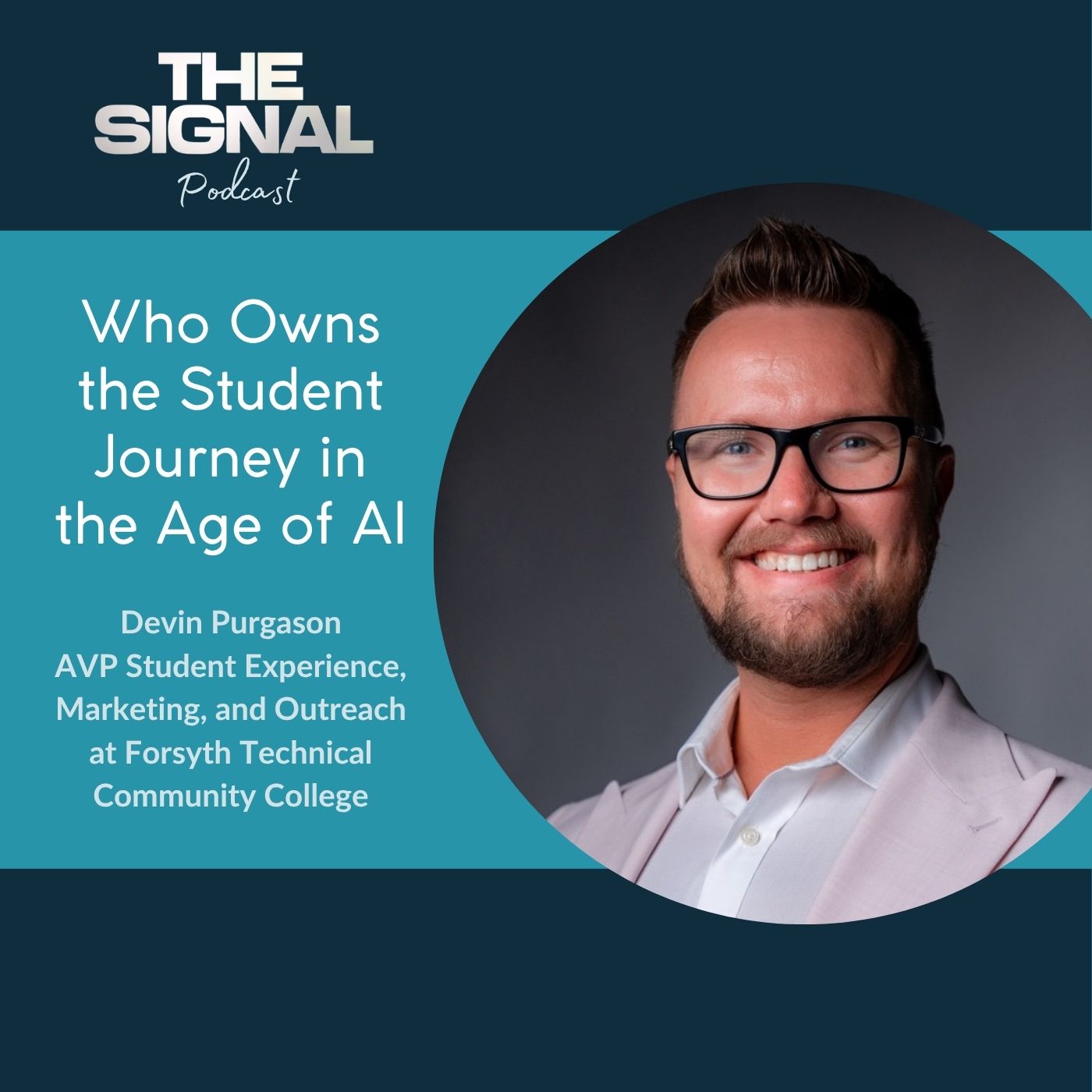
Joining us today is Devin Purgason, the AVP for Student experience, Marketing and Outreach at Forsyth Technical Community College. In his role, Devin leads teams responsible for student care, onboarding, recruiting and college relations, bringing together strategy, storytelling and technology to improve how students discover, enter and succeed in college. Devin is known for building student centered systems that combine data driven marketing with meaningful support services.
His work has earned significant recognition including Marketer of the Year honors as well as leadership awards such AS Triad business journals 40 under 40. Beyond administration, Devin also serves as an adjunct English faculty member, giving him a unique perspective that bridges both leadership and the classroom. Today we'll explore how marketing, student care, and emerging technologies like AI are reshaping the future of community colleges and and how institutions can better serve the students who need them most.
Well. Welcome to the show, Devin. It is great to have you today.
[00:02:00] Devin Purgason: Thank you, Jeff. I'm so excited to be here.
[00:02:03] Jeff Dillon: So let's start off and talk a little bit about your background. You've held several marketing leadership roles before even becoming the AVP for Student Experience and Marketing Outreach at Forsyth Tech. What experience has shaped your the way you approach student centered marketing today?
[00:02:24] Devin Purgason: Absolutely. So I think one of the biggest ways for me was honestly I lost my job during COVID and honestly that was one of the most formative things that really, I think ever happened to me professionally because it forced me to ask what I actually believed about the work. And so what I, what I kept coming back to was, was this marketing in higher education is often done to students, not four students.
So, you know, like in marketing, we build campaigns around what we want to say, but not really around what students actually need to hear. And so, you know, coming to Forsyth Tech, I had the chance to build something different from the ground up. You know, we built a student care model that puts student support services and marketing really in the same organizational unit. So the same leadership, same meetings, same accountability. And that really, I would say, forced us to reckon with the entire student journey. So not just the moment that someone necessarily fills out a form, but what happens in the weeks after. So that structural decision really changed everything for me.
[00:03:37] Jeff Dillon: You know, I think community colleges often say they're student first. Yeah. But the student experience actually spans really multiple teams. Marketing kind of shapes the expectations. And before even a student applies, you know, where it really becomes real, I think, is the student care really needs to have them feel supported once they start.
[00:04:01] Devin Purgason: Yes.
[00:04:01] Jeff Dillon: And like when the groups are in sync, the whole journey feels a little more intentional than fragmented. So Foresight Tech has built this reputation for putting students first, I think. How do marketing, onboarding, student care work together on your campus to improve that overall student experience?
[00:04:19] Devin Purgason: Yeah, so you hit the nail on the head, Jeff. Most institutions, I feel like they treat these as very different functions. Right. So marketing gets the student interested and admissions gets them enrolled, and then student services handles everything after that. Right. Every handoff is another place where a student can fall through the cracks. So we deliberately tried to collapse those walls, you know, for Scite Tech, Marketing, recruitment, onboarding, student care, they report through my division. And I know that that sounds like an org chart detail, but it's actually philosophical, I think, you know, so we're accountable for the student from the moment they first hear our name to the moment that they complete.
So practically, you know, this is we're using the same data, the same CRM, the same communication cadence. When a recruiter promises a student something in an outreach email, student care team, they know about it. Right. So there's no version of us where the brand promise and, and the actual student experience are disconnected.
[00:05:27] Jeff Dillon: You know, I think community colleges, they often serve incredibly diverse student populations. How do you design the outreach strategies that truly reach students from all backgrounds?
[00:05:43] Devin Purgason: Well, I think the first thing I'd say to that is to listen to the students that are actually there.
For Scyth Tech, our students are not only 18 year old, fresh out of high school, you know, tons of time, tons of flexibility, parents who went to college.
We have single parents, we have people who've been in the workforce for 15 years and are now just coming back to get retraining, recent immigrants, people who are nervous that college really isn't for someone like them. So our outreach has to speak to that reality. So that means that we're using various communication strategies. Texting, you know, we're not just emailing. It's. It's not just a college Fair. We're trying to meet people at their, at their workplace or their community organization, having student ambassadors who look like the students that we're trying to reach. And it means, to me, honest messaging. So we, we stop saying things like, take the step in your next journey. Instead we're like, hey, here's what it costs. Here's how long it takes. Here's what our graduates are earning.
So I think a big part of it is respecting people's time and intelligence and they pay attention.
[00:07:02] Jeff Dillon: Right. I think so many schools are, especially community colleges, are working hard to reach students, but the way they communicate, it still reflects the institutional organization rather than how students actually live and interact with information.
[00:07:20] Devin Purgason: Yeah.
[00:07:20] Jeff Dillon: Because the messages will come from different offices and through different channels like we're talking about. And so it does feel fragmented. From your perspective, what are community colleges still getting wrong about communicating with today's students?
[00:07:34] Devin Purgason: Okay, so two things, I think.
First, I think we're writing for ourselves.
If you go and read the average community college website and you know, you'll find the word transformative about six times before you find anything that really tells a student, a prospective student specifically, what their life is going to look like in two years if they enroll, you know, we need to care about their decision and care about reaching those students. I think secondly, one thing that has emerged more recently is that we are, we're really underestimating how students are discovering us or not discovering us.
So I'm sure, Jeff, you've. You've talked about this or thought about this a lot. You know, the conversation that we're having right now about Google and social media and AI and when a prospective student, you know, uses ChatGPT to, to find programs in their area, does our institution show up or even does it show up accurately?
So I feel like a lot of community colleges don't really have an answer to that question because they haven't even asked it yet. So the whole idea about agentic AI and the moving from to AEO Geo, you know, I feel like universities are really doing a great job in investing in AI strategy ed tech vendors that they are building for AI or already have lots of AI tools. Community colleges who in my opinion serve the students who have the least margin for error, we're sort of watching from the sidelines. And so I think that has to change.
[00:09:17] Jeff Dillon: Yeah, it's an interesting point.
When you talk about institution, of writing about themselves instead of the student or for a student. And I hear that, I think once you say that people have heard that before and they know that, but it usually shows up in the language in the channels, even how quickly they respond. And I think we're getting into AI. Every podcast I've done in the last six months, we get into AI and we're about nine minutes in and so we're into it already.
What's exciting now is I think these AI tools are starting to help colleges flip the model by analyzing student questions, personalizing messaging, and responding in so many ways that are much more student centered. Even using like Personas, like people know, look, you are not the Persona. Just create a synthetic Persona and ask your synthetic student, like what they think about your messaging. There's so many ways. So building on that idea, I want to talk more about the AI. What, what are some tools or approaches you think you're doing or you think colleges should be exploring to communicate with students in a way that, that reflects their needs and behaviors?
[00:10:20] Devin Purgason: Yeah, I mean we've been building AI enrollment stack, I would say for the last two years. I feel very fortunate to be at Forsyth Tech. Our president is incredibly AI forward.
She has helped us, you know, create an AI committee, you know, as soon as, honestly, when ChatGPT became publicly available, you know, in early 23, that was one of her first things. So that tech stack, you know, includes AI powered chatbot, we call that Blaze Bot and handle student inquiries around the clock.
And when we launched that, the chatbot answer rate, like being able to answer the question without human escalation, was about 53% and now it's pushing 85%. That's like thousands of student questions getting answered at 11pm that would have just sat in an inbox until the next morning. Typically AI search on our website. So rather than just having the keywords correct, it's, it's more conversational, it takes a little bit more understanding. It pulls up in that dashboard all the links that they need and, and creates follow up questions for them and really interacts with them like an LLM. Because, you know, we're seeing this all the time.
Especially, you know, SEO folk are freaking out because of all of the zero click answers that people are getting. You know, Google with their AI overviews and things of that nature. But I do want to be honest about what AI does and it doesn't do here at our institution. AI has not replaced the human relationship. It handles that transactional layer so humans on our team can focus on the relationship.
So, you know, the student who needs to know how to park or where to park, blazebot handles that. But the student who is Afraid to come back to school after a decade away. That student can have a person that has the bandwidth to actually listen to them.
[00:12:27] Jeff Dillon: It makes so much sense to just at least those first use cases you use it for, use it for those rote, tedious tasks that as human probably is going to get burned out doing or is. It doesn't make sense. A lot of colleges are interested in AI right now. We know that many are still waiting for the technology to feel perfect before they start using it. I mean, it's hard not to think that way, you know, because the stakes are so high. But the institutions that seem to be moving faster are the ones that are experimenting early and learning as they go. And that's what I appreciate about foresight and what you're doing. You, you are an early adopter. It feels like you're ahead of the curve in this area.
How are you approaching AI and these new technologies, even when the tools are still evolving? What's allowed your team to move forward without everything being perfect?
[00:13:15] Devin Purgason: I think there are different ends of the spectrum on this. I am very much a person that thinks failure is a way to learn and a way to adjust and optimize. So I have very experimental nature. I am someone who wants to try things. If it doesn't work, we see, okay, well, that's not the way to do this. I've done that with marketing campaigns. I think that testing is so important because we don't know what we don't know.
So I have been lucky enough to work in an institution that has allowed that.
You know, there's a saying, and I don't know who to attribute it to, but I've heard it colloquially many times, and it's don't let perfect be the enemy of great. And I think that is something that we do at Forsyth Tech. We don't let perfect become the enemy of great, and we learn from our mistakes. There have been AI tools that I've implemented that after a year I've said, this is not working, this is not good, this is not what our students need.
But I tell you, I learned so much in that experience.
I've learned what to do, what not to do, how to eat the meat and spit out the bones, if that makes sense.
[00:14:33] Jeff Dillon: Well, I have to give you kudos. You might not give yourself the kudos, but it has to take a champion like you that wants to get things done, but also that's brave enough to like, push the envelope and convince leadership or, you know, you have to have the support of leadership to let you, absolutely. But you have to have maybe of some. Sometimes people that are new in their roles, either they're too afraid or they're like, this is my chance. And it really depends on the, you know, how long they've been the role. What is that environment? I, I often, I'm hesitant to say this, but I say it once in a while. It's like I was in higher ed for 20 plus years and I felt like after a while I was kind of told to just bring my C game, like just stay in your box. Just, you know, you're kind of penalized sometimes for trying to think. So, you know, kudos to you and the team for like trying new things and making progress.
My version of that quote, and I don't know where it came from either is perfect, is the enemy of progress is the way I like to say it.
[00:15:22] Devin Purgason: I love that. I love that. Reframe.
[00:15:24] Jeff Dillon: A lot of colleges collect marketing data like search behavior, campaign engagement, website activity, but it often stays inside the marketing team. And I think the real opportunity is when that insight gets shared across the institution and start shaping how onboarding or, you know, advising and student support actually works. You've talked about using data driven insights to improve the student journey. Can you share an example of where marketing data directly influenced a better outcome for students?
[00:15:58] Devin Purgason: Yes. I say the clearest example that I can point to is what happened when we started tracking where students dropped off between inquiry and enrollment, not just how many inquiries we were generating. So we found that like a number of students express interest, they were stopping at a specific point in the onboarding process. And for us, that onboarding process that had people stuck was financial aid, not because they lost interest, but because that process was confusing. So the gap really wasn't much marketing. The gap was the experience that we were handing them to. Right. So that data actually was what helped us form the argument for reorganizing our division and creating this onboarding team.
So we used it to show leadership that this wasn't a top of the funnel problem, it was a mid funnel experiential problem.
And so adding that onboarding team to the umbrella was the fix. So people who are there to take them from application to the first day of class and walk them through the checklist of everything that they need to move forward. So we have gone since 2019 from a 19% completion rate to a 45% completion rate. And that doesn't really happen by accident. It happens when you follow the data, pass the enrollment, and really, I would say stay accountable for for what happens
[00:17:31] Jeff Dillon: after, you know, we talk about the data and like, it can reveal what students actually need.
[00:17:37] Devin Purgason: Yeah.
[00:17:38] Jeff Dillon: And the insight is what makes many of these AI tools possible in the first place. So I think as colleges start using these new tools or using, even using AI to analyze behavior or personalized communication to guide the journey, it raises these bigger questions about, like, where the real value is and where. Where we need to be careful. So kind of talked about this already. What's your perspective on where you think the biggest opportunities are for adopting AI and what are the risks that we should be thinking about?
[00:18:14] Devin Purgason: I think the opportunity is, is in scale.
Community colleges, we run lean. Right. So, you know, my team, I would say we do a lot. We do the work of what would be a much, much larger staff in a flagship university. Right. AI gives us the capacity to do more without adding headcount. So, you know, better personalization, better responsiveness, better data. But on the other side of that, I think the risk, and we kind of mentioned this earlier as well, is avoidance.
So institutions that are nervous about AI and decide to wait it out, I think they're going to find themselves in a really difficult position because AI is not coming for your marketing department. It's already reshaping how students make decisions. It's reshaping what content gets surfaced and what content gets ignored.
And so sitting out to me is not really a neutral choice.
So, yeah, I would say that those are.
[00:19:16] Jeff Dillon: Or. Or waiting till.
[00:19:17] Devin Purgason: Yeah, waiting till it's perfect.
[00:19:19] Jeff Dillon: Till it's perfect. Or like, oh, I'll be. It'll be clear later. Let's just wait till all the dust settles. I don't see that happening anytime soon.
[00:19:27] Devin Purgason: Absolutely. The dust gets kicked up every day.
[00:19:30] Jeff Dillon: So.
Yeah, well, let's shift a little bit here. Most people working in enrollment or marketing or student services don't get to see students in the classroom every week. I think the distance can make it harder to understand how students are actually experiencing college day to day. So you also teach as an adjunct English faculty member, right?
[00:19:53] Devin Purgason: I do, yes.
[00:19:54] Jeff Dillon: How does being in the classroom influence the way you think about student engagement and messaging? Huh?
[00:20:01] Devin Purgason: Well, I would say it keeps me honest, you know, when I am sitting across from my English students, many of whom are definitely taking a class because it's a requirement, not because they chose it, I get a very quick reminder of who we're actually serving. You know, these are not just abstract prospective students. They're real people. They have real jobs, they have real families, real reasons to be tired. You know, on a Tuesday night. And so that reality, I think has shown up in how we write, how we email, how we design this onboarding process. You know, if I'm building a communication that would confuse my students, I know that it needs to be rewritten. I also think the classroom keeps me from over investing in the marketing side of things. So like, at the end of the day, what matters is whether students persist and complete all the clever campaigns in the world. To me, they don't mean much if the experience they lead to is not worth it. And honestly, this is one of the reasons that we have marketing with our student care team with our onboarding because it gives us a direct pipeline to student facing individuals so we can change course right in the middle, you know, if we hear something from our student care representatives or onboarders.
[00:21:25] Jeff Dillon: Yeah, I don't know how big your classes are, but you almost have your own little test group out there to ask real quickly, how many of you are doing this? How many? You know, and almost normalize the use of these tools so they're not afraid to. I mean, as for English, another question comes up for me is that I've seen this kind of evolve over the last couple years where people using AI are very proud to say, I coded this with AI. Yeah, look at this thing. I coded. I'm not a coder. I put this website together, I coded. This cloud code is becoming amazing. It's a badge of honor almost. But in the English side, if you're writing something, it's still a little bit of a secret, a little bit of like, I don't want to actually tell people how much AI did here. Like, right, you know, I'll do it. Everyone's kind of knows it's happening. But why is that? Why is it that it's so accepted? Am I wrong or what do you think? No, why is that for English?
[00:22:14] Devin Purgason: I definitely agree with you there. I don't know if it's because I feel like one of the first red flags for AI was this part. It was, oh my goodness, what are we going to do? Because people can use this to write all their papers. This is plagiarism. You know, that was such a hot button issue. People, they were, oh, coding, it's cool, it can do that. So I think that that has continued on that idea of this is plagiarism, this is, this is wrong.
Whereas in some of the other areas it's seen as much more of a help, like the Internet would be or a library would be or something of that nature.
[00:22:58] Jeff Dillon: So one quick Follow up on that. If you got a paper turned into you that was grammar mistakes and sentence structure was terrible, would you think or say anything like, why didn't they just run this through AI to fix it up? Like, I would almost expect that.
[00:23:11] Devin Purgason: You know, for years I had instructors tell me, you have to use spell check. Right? You got to use spell check. So that's AI at some level. So yeah, exactly.
[00:23:26] Jeff Dillon: Well, higher ed marketing has really changed fast. Teams are now expected to manage brand and digital experience, analytics and aroma messaging, and increasingly AI driven communication. And I think it can make the modernization feel overwhelming for a lot of institutions. We've worked across communications and PR and digital media and marketing strategy. So for leaders trying to modernize their marketing teams in higher ed, where should they start?
[00:23:57] Devin Purgason: I would say that leaders to modernize their marketing team, they need to start with metrics that you're actually measuring. Right.
So if your marketing team is being held accountable for inquiries and applications and nothing else, that's the conversation to have first, because the incentives shape everything downstream. I would say second is, it's structural. So look where the handoffs are in your student experience and ask yourself, honestly, who owns that gap? Does anyone own that gap? You know, the gap between marketing and admissions, the gap between admissions and financial aid, enrollment in the first day of class, where do students disappear? And marketing, I think done well has a role to play in all of it.
And then I would, I would say third. And I know this might sound counterintuitive, but I say invest in your content before you invest in your tools.
So, you know, AI tools, CRMs, chatbots, all of them are only as good as the information that you're working with. So if your program pages are out of date and your FAQs are three years old, that technology is really just going to automate a bad experience.
[00:25:17] Jeff Dillon: Yeah, that's a good tip. You can even use AI to help you with that.
[00:25:20] Devin Purgason: Exactly.
[00:25:21] Jeff Dillon: Focus on your content first.
[00:25:22] Devin Purgason: Right, exactly.
[00:25:24] Jeff Dillon: Well, to wrap it up, one last question. Looking ahead, what excites you the most about the future of higher ed and how technology innovation can help students thrive?
[00:25:34] Devin Purgason: So I would say what excites me is that the enrollment cliff narrative, you know, the idea that community colleges are terminal decline, demographic shifts is really not matching reality right now.
Community colleges are growing.
[00:25:52] Jeff Dillon: They're doing great, right? Yeah, yeah.
[00:25:54] Devin Purgason: Students are choosing us, adult learners are coming back.
And so the idea that we're a sector on the way out or something like that is not really what the data says. And then technology, I think if we use it well, it gives us a chance to serve those students at a level we could not have managed 10 years ago. You know, personalized communication at scale, the predictive support before a student stops showing up. AI insisted help hold those things. They don't require such a weight anymore. So, you know what I'm most excited about is community colleges are the institutions right now that I think are being best positioned to capitalize on this because our mission is already student first.
We're not trying to retrofit research university culture into student success success model. We're sort of built for this. We just have to show up for the technology conversation with the same urgency that we bring to the classroom. And I think genuinely we're getting there.
[00:26:54] Jeff Dillon: You are great insights, Devin. I will put links to the Forsyth Tech website and your LinkedIn in the show notes.
[00:27:01] Devin Purgason: Awesome.
[00:27:02] Jeff Dillon: But great, great catching up with you, Devin. See you at the next conference.
[00:27:06] Devin Purgason: Thank you, Jeff.
[00:27:06] Jeff Dillon: Bye bye.
That's a wrap of this episode of the Signal. If today's conversation sparked a new idea or challenged your thinking, that's exactly the point. This show is about cutting through the noise and helping you see what's actually shaping higher ed right now. Please subscribe so you never miss an episode. And if you found this valuable, leave us a quick review. It helps more higher ed leaders find the signal. For deeper edtech insights, news and trends delivered monthly, subscribe to the Signal Monthly newsletter at edtechconnect. Com. Thanks for listening. We'll see you next time.