Episode Transcript
[00:00:00] Fiona Hayes: Number one thing, students have so much content thrown at them right now, whether that is, you know, on their own phones, at home or in the classroom. And a lot of them have just honestly checked out like we are in an age of information overload at every corner. If I want to learn something online, there's probably a million different platforms I could use to do that.
What we see is from the students in the classroom. Once they get the opportunity to connect with one another, maybe be thrown a little bit outside of their comfort zone, it challenges them.
[00:00:32] Jeff Dillon: Foreign.
Welcome to another episode of the EdTech Connect podcast. Today's guest is someone who embodies what it means to bridge innovation, education and impact.
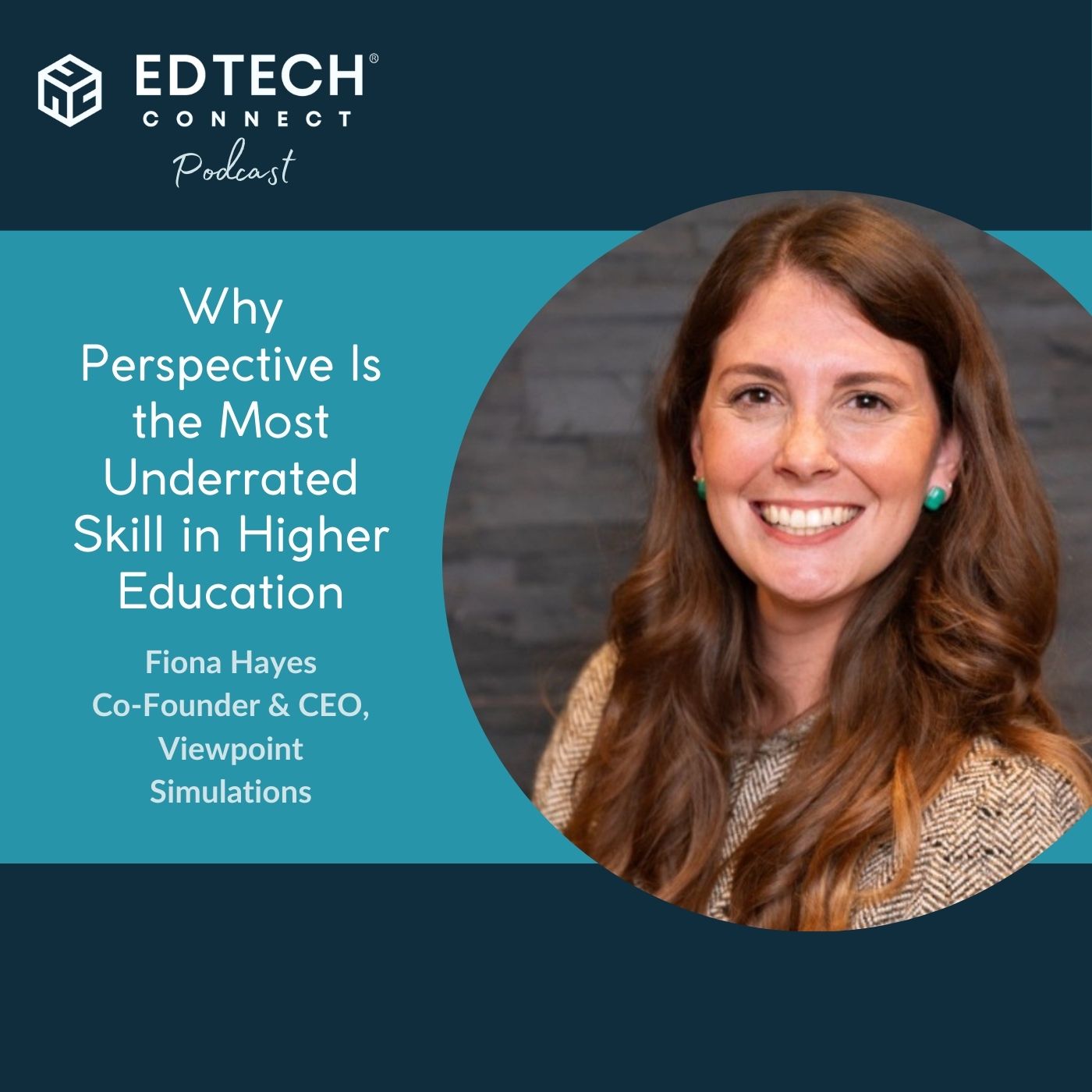
I'm thrilled to be joined by Fiona Hayes, CEO and co founder of Viewpoint Simulations, a platform bringing immersive, ready to run role playing simulations into the classroom.
With a career that spans clinical, healthcare, academic teaching and ed tech leadership, Fiona has scaled Viewpoint from an academic tool to a globally adopted SaaS solution now used by institutions like Harvard, Stanford and UC Berkeley. Under her leadership, the company achieved 225% year over year revenue growth and reached over 30,000 students.
A licensed audiologist with a doctorate and executive MBA in progress, Fiona blends operational excellence with educator empathy, turning complex learning goals into real world scalable tools. Her mission, Making education more engaging, accessible and impactful for learners everywhere.
Welcome to the show Fiona. It is great to have you today.
[00:02:39] Fiona Hayes: Thanks for having me, Jess. I appreciate it.
[00:02:42] Jeff Dillon: Well, I want to kick things off by finding out something maybe most people don't know about you that's helped shape your journey in edtech.
[00:02:52] Fiona Hayes: Yeah. So I don't know if I can say that most people don't know about this. I was an audiologist in my first life and I think now that I have transitioned out of that role, it's a little bit of a lesser known fact.
So as an audiologist, when I first started my career, I got the opportunity to open a satellite clinic and I got the opportunity to help advance a couple of different operational processes at some of the clinics that I worked with.
So for me that was really critical in just getting experience working in different environments across the same field, but with different people and on the operational side of things. And I think when I did transition to starting my own business, that had given me a lot of foundational background that you might not expect from a traditional healthcare field.
[00:03:40] Jeff Dillon: Yeah, I can see that. And your background spans healthcare, higher ed, now ed tech.
What was the spark that led you to co found Viewpoint Simulations?
[00:03:52] Fiona Hayes: Yeah, so I taught at The University of Utah. For about five years, I was clinical faculty, so I taught students how to see patients for hearing loss.
And one of the biggest challenges I had was during the pandemic, we went to Zoom teaching. And so I had to give clinical experiential learning hours to to students now in a remote setting. And we just didn't have really great tools to do that.
So that was one piece of it. I also have always loved teaching and I wanted to go back to school myself. So I went back for an mba. I got connected to my co founder at that point, and it just kind of all came full circle. We said, you know, I think there's some better ways to approach this. And here we are.
[00:04:32] Jeff Dillon: You've had a pretty uncommon path into tech. You've worked directly with students, patients, you've been in the classroom, not just the boardroom. I'm curious how that background shows up today. When you think about your time as a clinical audiologist and educator, what lessons from those roles most shaped how you lead a tech startup?
[00:04:55] Fiona Hayes: I think a lot of it is patience and creativity and how you communicate is what I've taken away. What I learned while I was teaching is that just because you say something in a way that makes sense to you, you doesn't mean that it makes sense to everybody who's listening. And so for me, being able to take a step back, think about, okay, how can I think about this? How can I express this in a different way that might translate or come across better to that individual has been really useful both in my teaching career, but then now in, you know, running a team of individuals who are all creating and contributing in. In ways that are different than I do as well.
[00:05:30] Jeff Dillon: Yeah. For folks who may not know the company yet, can you walk us through viewpoint simulations at a high level? How does the platform actually work in practice? What do you think really sets it apart in the crowded edtech space?
[00:05:44] Fiona Hayes: Yeah. So we take educator lecture content and we turn it into active learning, engaged role playing, debate, negotiation exercises.
So we can do that either for or on behalf of educators, but they can also use our platform to do that on their own. So we have a series of frameworks educators can pick from and design their own custom role playing activity for their classroom, or they can pick from a library of existing content, or they can build their own from scratch.
One of the things that we find really is a focus of ours that doesn't seem to be very common in the current landscape is we are really focused on the interpersonal piece of that so right now it feels like a lot of companies are going all in on how do we replace some of those interpersonal skills with VR, AR augmented reality type tools. And we are really leaning into how do we get these students to connect with one another better, how do we get them to understand perspectives that are different than their own, and how can we get them to come to common decisions with all of that?
[00:06:48] Jeff Dillon: I think simulations get talked about a lot. I recently talked to Christy Hyde, who does a nursing VR simulation. The real test.
What I'm, I think is actually what changes for students and faculty when classrooms adopt viewpoint. What kinds of transformations are you seeing and how students learn and engage and think differently?
[00:07:12] Fiona Hayes: I think the number one thing, students have so much content thrown at them right now, whether that is on their own phones, at home or in the classroom. And a lot of them have just honestly checked out. We are in an age of information overload at every corner. And if I want to learn something online, there's probably a million different platforms I could use to do that.
What we see is from the students in the classroom, once they get the opportunity to connect with one another, maybe be thrown a little bit outside of their comfort zone, it challenges them. And so we see better engagement, better interaction in the classroom. But then we also see those same students revisiting these topics later down the road, later down the semester, maybe a semester past, and they're still thinking about some of those conversations that came up in that context. One of my favorite things I've heard, we did an activity with George Mason University about a year and a half ago, and we asked the students, they were working through an immigration reform policy simulation. We had asked the students to take on the roles of different senators. And I think my favorite comment in that was there was one student who took on a role that was completely opposite of his political beliefs and the onset. And it was just really cool to hear him say at the end, you know, I think I learned more being in the shoes of somebody who I very vastly disagree with, but I can understand a little bit better why that person might come to that conclusion. And for me, that was the light bulb.
[00:08:41] Jeff Dillon: Wow, that's powerful. You've moved from idea to traction, real traction, pretty fast. You were generating revenue within your first three months, I think, and now support more than 30,000 students across some top tier institutions.
What decisions or strategies do you credit most for that early momentum?
[00:09:02] Fiona Hayes: So we pulled our technology out of the University of Michigan. So my co founder, Dr. Elizabeth Gerber, is an educator at University of Michigan in the Ford School. And she had actually built Viewpoint for use in her own classroom.
So over the course of probably about eight to 10 years, she had had the opportunity to test that in her classroom to really use it in several different situations. So we had a pretty strong foundation coming out of the university in Michigan when we commercialized. We also really leveraged our relationships as faculty and professors to reach out to colleagues to say, you know, here's what we're working on, what can we do better? Tell us how we can make this a better product for your teaching needs. Because we have very different fields and we're finding that it's applicable across very different fields. So where can we, where can we improve is always the first question we ask.
[00:09:49] Jeff Dillon: As you grow, there's always a pull between scale and staying close to the people actually using the product. How do you think about building systems that can scale while still keeping the educator experience kind of front and center?
[00:10:05] Fiona Hayes: Yeah. So in my mind, the only way the scales really effectively is if the educators are really excited to use it. Because we know this is a tough market of individuals to adopt new tools that take a lot of time to implement. So for me, I think having that educator feedback and that open feedback loop and thinking of our customers as partners and how we develop this, how we better this system is going to be really integral. So I don't necessarily think that there's a trade off in that. I think at some point we'll have to offer more self serve features.
But for the short term, I think it's really just getting people onboarded and excited and seeing what they can do and then the message spreads itself.
[00:10:45] Jeff Dillon: You've built a global, fully remote team, right?
[00:10:49] Fiona Hayes: Yes.
[00:10:49] Jeff Dillon: Which is no small feat. Different time zones, different cultures, different work rhythms, all while you're trying to move fast and stay creative as a leader.
What core principles help you foster that innovation and genuine collaboration when the team rarely shares the same working physical space?
[00:11:10] Fiona Hayes: You know, that is something. I'm not sure I can quite put my finger on it, but we realized really early on that we needed, we needed individuals in multiple time zones because we serve educators in multiple time zones. And one of our very early customers was based in Rwanda and we needed to be able to serve them when it's 9am there and 1am here in my time zone. So it was a natural progression to hire somebody in that time zone. And it's kind of just compounded since then we've had really great experiences for some reason, which is awesome. Viewpoint seems to attract really creative, really mission driven individuals and people who want to have better teaching and learning experiences within their home areas. And so I think that's just really enriched the ideas and the creativity that have come out in many, many ways. And it's really been fun watching that unfold. So I don't know that that answered your question, but that's what I see.
[00:12:09] Jeff Dillon: Yeah, that was great. Early stage startups rarely are a straight line. There's highs, there's setbacks and pivots and a lot of decisions made with imperfect information.
As you look back on that roller coaster so far, what leadership traits have been the most essential in helping you navigate it and keep the team moving forward?
[00:12:32] Fiona Hayes: I think the biggest thing I see is knowing where, what my strengths are and knowing what my team strengths are. So being able to recognize what my, the individuals on my team excel at and where we all could use a little bit more support.
And so I think that's the one thing that playing to your strengths. And you know, when I started Viewpoint, I also started an executive MBA at the same time. So it was the best and the worst decision I've ever made.
[00:13:00] Jeff Dillon: Yeah.
[00:13:00] Fiona Hayes: But point being that, you know, they, they spend a lot of time trying to help you think about what you're really good at. And I have tried very intentionally to complement my skillset with individuals on our team who have opposite, very complimentary skill sets.
[00:13:15] Jeff Dillon: Yeah, yeah. You've spent enough time in higher ed to see both how change happens and how it gets slowed down. And when you look at experiential learning tools like simulations, where do you see the biggest opportunities for adoption and where do you still see the most resistance on campus?
[00:13:36] Fiona Hayes: I think there's so much opportunity for adoption right now. We are in this huge shifting landscape towards experiential learning. You know, government's pouring funding into it. Educators are being requested to provide experiential learning opportunities both from the administrators at their institutions as well as the students.
Education's become really competitive landscape over the last one to two years. And so I just think there's so much opportunity to take, you know, how we've been teaching for the past hundred years these lecture based methods and turn them into more active learning opportunities and help students really practice that interpersonal piece.
So that's what I see as far as opportunity. The biggest challenge that we bump up against is getting educators who have been teaching for a very long period of time to adopt a new technology.
We know that very often administrators are asking their teams to take on new technology. We know That's a steep learning curve in a lot of cases.
And if you've been teaching the same class for 15 years and you finally got it where you want, it's really hard. It's really hard to change that and reshape that and teach it in a different way. So I think as we continue to have more educators who are really excited about this and sharing it with their colleagues, we will see that part of the process become a little bit easier. But I think we're kind of at the very beginning, early stages of helping educators see how they could maybe enhance the way they're teaching or augment the way they're teaching to get their students really engaged in the learning process.
[00:15:09] Jeff Dillon: If you could strip it down to one practical move, something institutions could start doing right now, what's one thing higher ed could change to better prepare students for real world challenges after graduation?
[00:15:23] Fiona Hayes: Yeah, I think giving them more practical application skills or even more practical application examples for how do we take the theory that we're learning in the classroom and translate this into what we'll do in our day to day?
One of the things I see is there's not a whole lot of partnership between the business sector and the education sector in many fields.
I was very fortunate in my program at the University of Utah when I was teaching because I was partnered with a research faculty member to teach a two part course.
And so we spent a lot of time connecting between the two of us, understanding what her research priorities were, what my clinical priorities were, and how we merged those. And I think there's so much potential to do that across programs and give students a better idea of what that's going to look like both from that, you know, we're researching, this is innovative, but then how do we apply this in our day to day settings and vice versa? How do we take this back and ask the right questions? So I think more of that integration between that private public or business and educational sector is really important for getting students to know what they'll do in their fields post graduation.
[00:16:31] Jeff Dillon: Yeah, you've taken an interesting approach with publisher integrated models and educator to educator distribution, which isn't how most edtech platforms go to market. Can you walk us through how that actually works in practice and why you chose that model?
[00:16:48] Fiona Hayes: Yeah, so this was not necessarily a conscious choice.
We find that the bulk of our customers at this stage come very heavily from referrals. So as we have more and more colleagues using the platform, we get more and more colleagues who want to use the platform. So for example, when we started, we thought, oh, we'll start with policy and political science. That's what the platform stemmed out of. That should be, you know, pretty easy fit. And we realized pretty quickly that there's need in other fields. So interprofessional education, business, public policy, law, we're working on engineering crisis simulations, we're working with the geology department right now on what happens in the event of a natural disaster.
So from that perspective, the educator to educator just kind of spread like fire. And that was really exciting opportunity for us. With the publishers, we can take existing content and case studies and turn it into those active learning role playing experiences that complement the content that they have already designed. It gives them a leg up because there's now an interpersonal component to that case study. And what we also know is that every time a case study gets published, it's immediately there's new information that might be released about that scenario. The educators can then go in and update that and tailor it to their own classrooms.
We have enabled the ability, not with the publisher case studies so much, but for the educators, can share peer to peer with one another. If they're passing on a class or maybe they want to collaborate across institutions with colleagues, there's an opportunity for them to share the activities that they've created with one another while redacting student information. So we just made it really easy and very shareable for both the educators and the publishers and seems to be working.
[00:18:38] Jeff Dillon: Yeah, yeah, that's great.
LMS integration can either accelerate adoption or quietly become a blocker canvas. LTI seems to have played a meaningful role in how Viewpoint got traction on campuses. How critical was that integration to your growth and what advice would you give other edtech teams? Thinking about integrating with LMS platforms?
[00:19:03] Fiona Hayes: Yeah, I think integration with LMS platforms is mission critical. That was one of the very first early priorities that we had because we knew everybody would ask that question. And again, that comes from our experience being in the education space.
The piece of advice that I would probably give is to make sure that you have some really great contacts at the Teaching and learning or instructional design center within that university because they can really help you navigate that process a lot faster than trying to do it as an outsider. So we have some really, really fantastic individuals that we connected with early on at the University of Michigan, University of Utah, who helped us in that process. And I think that made it a lot easier for us to get our foot in the door that way.
[00:19:47] Jeff Dillon: Well, I want to look ahead a bit as you think about what's next for viewpoint simulations. What's on the horizon? Any new directions, partnerships or tech shifts you're excited about as you keep building.
[00:20:00] Fiona Hayes: Two really big ones right now. So this year we partnered with the William Davidson Institute, which is the publishing arm of the University of Michigan, and they partner really closely with the business school. So it's been really fun to collaborate with some of those colleagues over there and match the existing case studies that they're doing with a viewpoint simulation that's complementary.
The other thing we're really excited about is we are working on platform V2, so we should have a new, improved version taking all of the feedback we've gotten from educators over the past year and a half and compiling it and enhancing the existing platform. So all the existing functionality will stay, but we have a brand new platform with some feature updates coming out for fall 2026.
[00:20:41] Jeff Dillon: Excellent. That is exciting to hear.
Well, I want to thank you Fiona for being on the show. I will put links to Viewpoint Solutions in the show notes and links to your LinkedIn as well. So thanks again. It was really great talking to you today.
[00:20:57] Fiona Hayes: Awesome. Thanks Jeff. Appreciate your time. Good to see you.
[00:21:01] Jeff Dillon: You too.
As we wrap up this episode, remember EdTech Connect is your trusted companion on your journey to enhance enhance education through technology.
Whether you're looking to spark student engagement, refine edtech implementation strategies, or stay ahead of the curve in emerging technologies, EdTech Connect brings you the insights you need. Be sure to subscribe on your favorite podcast platform so you never miss an inspiring and informative episode. And while you're there, please leave us a review. Your feedback fuels us to keep bringing you valuable content.
For even more resources and connections, head over to edtechconnect.com your hub for edtech reviews, trends and solutions. Until next time, thanks for tuning in.