Episode Transcript
[00:00:00] Elysia Labita: The second you name something that kind of limited niche name, you immediately lose that giant pool of people that you could have cast that broader net with.
So name it more generic, get them in and then show them that special area of focus.
And then, right, you're still feeding your unit, you're still feeding your area, but you're also showing them that you're an expert in these couple of things.
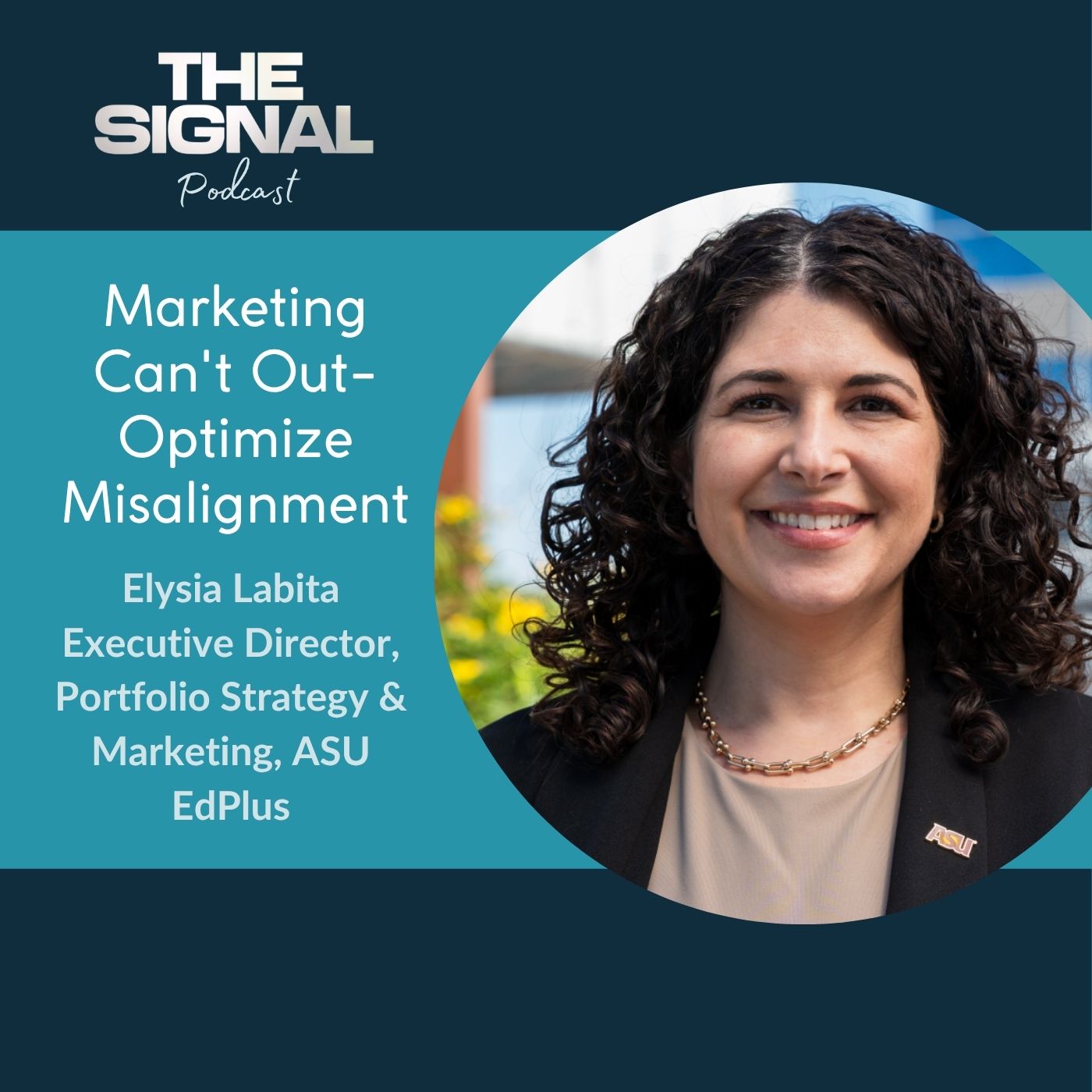
[00:00:32] Jeff Dillon: Welcome to another episode of the Signal. I'm really excited about today's conversation because our guest sits at the intersection of two worlds. I spend a lot of time on how institutions actually make decisions about what to build and how they translate market signals into programs that students want and need. Alicia Libida is the Executive Director of Portfolio Strategy and Marketing at Ed plus at Arizona State University where she leads strategic growth, academic portfolio management and marketing across one of the largest online learning enterprises in the country. More than 400 online programs serving over 118,000 students.
Over her 11 plus years at ASU, she's held a series of progressive leadership roles spanning growth, marketing, operations and now portfolio strategy and activation.
She's also a first generation college graduate who is genuinely passionate about expanding access to education.
And she recently co led a fantastic webinar called Programs are Products that I think is going to frame a lot of where this conversation goes.
So welcome to the show, Alicia. I'm so happy to have you today.
[00:01:48] Elysia Labita: Happy to be here.
[00:01:49] Jeff Dillon: You've worked across a lot of different industries before higher ed, from a state tourism office to a startup to an I institute. Is there a skill or instinct from one of those earlier chapters that you find yourself reaching for almost every day in your current role?
[00:02:09] Elysia Labita: Yeah, I think the biggest lesson I brought into HI ED is that great intentions don't create demand as much as we want them to. So I actually studied advertising at Washington State. I thought agency life sounded very exciting, did that for a year and learned relatively quickly that it was certainly exciting, but not in the ways that I had anticipated more in like, you know, hours and hours of time, unknown schedules, and lots of last minute stuff. So I kind of quickly decided the client side was more my jam. And so when I came here, I started in marketing here at asu and I kept finding myself in situations where I was asked to grow programs that weren't positioned correctly.
I could see the gap at kind of the market demand and the student needs versus the expectations. And it kept coming back to how is marketing going to solve this problem?
And so we joke a lot that, you know, higher ed, sometimes we think we're Kevin Costner, and this is the field of dreams. And if we build that degree, they. They will come. And the reality is that they don't. And, you know, I think we chatted about this a little bit in our last conversation, but you could spend a million dollars promoting a degree, and if the demand doesn't exist, the positioning is wrong, or the value proposition isn't clear, then nothing fundamentally changes. So I think that kind of oversight across industries and that insight helped me realize that I should pull back a little bit from that hyper focus on marketing. And then that's really where then the strategy, the operations, and all of those pieces started coming together. And it's not a marketing problem. It was a portfolio problem.
[00:03:48] Jeff Dillon: Right. Well, for listeners who aren't deep in the higher ed world, can you paint a picture of what EdPlus actually is and how it sits inside ASU? What does your team do that most people on a campus don't see?
[00:04:04] Elysia Labita: Sure. So I don't think most people outside of ASU have probably ever heard of EdPlus, but we're an enterprise unit within ASU focused on expanding access to education through digital learning, technology, innovation, and student support. So our primary product or responsibility is ASU Online.
This is, I think, kind of unique in higher ed in that our colleges and our faculty still own all of the degrees and all of the programs. They own all of the curriculum, all of the learning outcomes, all of those things. But what we've then done is centralize the engine to create scale and how we offer those opportunities. So ED centralizes marketing, enrollment, kind of data analysis, the learning technology, and all of those pieces so faculty can bring their ideas to life, but they don't have to actually operationalize all of that kind of one by one. And today we have more than 400 degrees online and almost 120,000 students.
[00:05:05] Jeff Dillon: Scaling an organization is one thing. Scaling an academic enterprise is something really entirely different, because quality, governance, faculty, they all have to grow alongside enrollment. Having lived through that evolution at asu, you've had a unique vantage point on what it takes to make that work. You've been at ASU for over a decade, watching ASU online go from roughly four programs to more than 400 from the inside. What was the single biggest unlock that made that scale possible without breaking the academic side of the house?
[00:05:44] Elysia Labita: Yeah, I mean, it's a daily effort on all sides across the institution, and I don't think there's a single unlock, but I think one of the biggest mindset shifts was recognizing that online Students aren't campus students waiting to happen.
So a lot of those initial conversations were based in fear. Fear of, if we put this online, we're going to have less people in the building, we're going to have less people in our lectures, we're going to have less people here because they'll go online instead. And online students were never going to relocate for the most part. They were never going to quit their jobs. They weren't going to move away from their families. They're working adults, parents, they're in the military, they're placebo.
The question, and we've seen this shift as we've worked with faculty over the years, is it's not whether they'll choose online over campus, it's whether they'll have access to higher ed at all. And if they have access to an R1D1 institution in the ways that they're hoping to.
I think that fundamentally has been the biggest unlock over the past decade. Then the second piece to that, to your point, is building that process to then continuously launch the right degrees. We launch about 30 to 40 new degree programs a year.
Sometimes the units come to us with exactly the right idea. Other times we're helping them identify opportunity through market signals and workforce demand. But it's constant work, and we've built kind of a market intelligence edit in partnership with the provost, office and other groups so that we're always communicating what that opportunity looks like. So I'd say those two things have been the biggest kind of unlock for scale.
[00:07:25] Jeff Dillon: One of the themes that I think is reshaping higher ed right now is this need to think differently about how institutions design, deliver, and really continuously improve the student experience. And it can be an uncomfortable conversation because the language comes from industries outside of academia. In a recent talk, you put it in really particularly direct terms. The talk was about this proactive idea that programs are products.
And for a dean or a provost who hears that and bristles a little bit, how do you explain what you mean? And just as importantly, what don't you mean?
[00:08:09] Elysia Labita: Yeah, no, it's. It is certainly a provocative phrase, but I think it really resonates with those of us in the academic communities that are responsible for operationalizing and growing programs. And so when I say programs or products, I'm not saying that education is a commodity. What I'm really saying is that students have more ways to learn now than ever. Right. We can use YouTube, we can listen to podcasts, we can use AI. We can take courses across a variety of providers. So it's Not a matter of whether that information exists. We're not talking about the time where the only place you can learn that thing is at a university. Those days are gone. So the question that we have to answer now is, why should students learn from us? What unique value do we then bring to that conversation?
And so I think that's where we get a little bit uncomfortable. Right.
That's not then a student thing. That's an institutional thing. And we don't like thinking about students as consumers. But what is the definition of consumer? Right. It's someone that makes a choice, and students are choosing where they consume that knowledge. And so what makes us valuable isn't the information, it's the faculty, it's the research, it's the credibility, it's the mentorship, it's the outcome. So I think it is fundamentally a shift in ways that make the industry very. I mean, even calling it industry is provocative too. Right. But we've historically celebrated low admission rates. We've celebrated kind of this exclusivity higher ed. And so I think fundamentally we're looking at a different mindset. And especially here at asu, our charter is founded in.
Our success is measured by whom we include and how they succeed. So it kind of gives us permission to think about those things differently and ask questions different ways. And I fully acknowledge that I have different permissions to think that way within this space. But, yeah, I think it. It opens up a lot of conversation, and I think we're at a. An interesting time to. To really consider.
[00:10:24] Jeff Dillon: I remember over a decade ago, when I was in higher ed, I. I presented to faculty on a new project, and I used the word customers. And like these students, they're our customers. And I was just raked over the coals. I remember that. I think it's a little easier to talk that way now. I mean, still hard sometimes, but we've come a long way.
[00:10:43] Elysia Labita: We certainly have, but it's still touch and go sometimes.
[00:10:48] Jeff Dillon: One of the hardest challenges in higher ed is deciding, I think, what to build next. Institutions are constantly balancing mission and market demand and faculty interests and emerging workforce needs. The risk, I think, is either chasing the latest trend or investing in something based solely on intuition. And that's why I was intrigued by the way you've described your approach. When you and your team look at a new program idea, you talk about looking for a signal rather than the visionary dean or the me too approach. Walk us through what a real signal looks like in the data and how it shows up differently from a.
[00:11:27] Elysia Labita: From a hunch Yeah, I think we kind of lovingly refer to it as an art and a science over here. You know, sometimes the, the data is crystal clear.
Sometimes the data says you're crazy. And, you know, your hunch is some weird, wild idea. When we, when we were looking to put Biological sciences online almost 10 years ago at this point, we had an OPM at the time and they were like, don't do that. There's no demand for that. Why would you do that? That's a weird thing to consider.
And we were like, we just think this is the right thing to do. And they launched in 2017. We now have over 8,000 students enrolled in Biological Sciences, and not only are they graduating and getting into med school, but now that we're out almost eight, nine years, they're placing in their first choice residencies and they are actually becoming doctors, having had an undergraduate degree in bioscience. So to your point, sometimes the data supports it, sometimes it maybe doesn't. So it is balancing that. But I think the strongest signal we've seen, and it really is the easiest place for people to look, is that high enrolling programs on campus will become high enrolling programs online.
That's not because they're cannibalizing campus enrollment. It's because they're serving different students. But we've seen that pattern so consistently that I think that is the strongest indicator that anyone can look at. Those students aren't waiting to come to campus, they're waiting for access.
Give them access to those degrees. And we've launched many of them, but we still have a couple holdouts.
So we still have a list of degrees on campus we didn't have online yet. And then beyond that, we're kind of constantly working with the academic units to see, you know, is it a new program or is it simply repositioning something they've had for a while? And then to your point, looking at the workforce demand, student demand, enrollment trends, search behavior, all of those things together,
[00:13:25] Jeff Dillon: one stat from your work really stuck with me. It was that roughly 40% of programs drive about 80% of enrollment. When you're sitting across the table from an institution that's like working on this, what should they actually do with a number like that?
[00:13:42] Elysia Labita: Yeah, I think this one is like a delicate balance in the conversation. Right. Because I think the immediate interpretation when I say something like that is that then I mean the 60% should go away or. Right. They shouldn't be in the portfolio. And that's not at all the lesson. I think that comes from that statistic, it's more the fact that portfolios have growth engines and then they have mission programs or other programs that are important to society, they're important to the institution, they're important to a discipline.
And not every program in that portfolio has the same job.
So I think it just changes how you're able to have that conversation then of what is this program's role in your portfolio. So when we're talking to the academic units, that really is the approach of in order to sustain this very specific niche program that is serving this very specific community need, you need another program to boost our ability to keep that one running and to kind of keep the unit above board.
And then it pivots the marketing conversation too. Right. Of we don't expect programs to behave exactly the same, so they don't all get marketing support in the same way because we know what role that that specific program plays.
[00:15:02] Jeff Dillon: Right. Let's talk a little bit about this. The program life cycle, launch, growth, maturity, sunset.
You reposition or you push for more growth. How do you help an institution recognized honestly which stage a program is actually in, especially when the emotions and the tradition are so attached to it.
[00:15:24] Elysia Labita: Yeah, well, I will fully admit that one of the advantages we have is that we have 15 years of portfolio data. So we have a lot of reference points to go back. But now that we do, what we can clearly see in that are trends. Programs do behave like products, they follow life cycle patterns.
The first couple of years show explosive growth because you're moving from zero to something. You're capturing pent up demand, you're kind of establishing space in the market.
And what we learned very quickly is that a lot of academic units were making the assumption that that growth rate from kind of year zero to two was going to continue. And they were hiring faculty and they were doing five to ten year budget planning and they were doing these things off of 200% growth assumptions.
And so we realized relatively quickly that we needed to have a, we need to set expectations relatively early in the launch process so that we could kind of catch them from reacting to that initial growth. But the reality of it is, you know, those first couple of years they grow, they start to level out a bit and then, you know, years four, five, six, you to kind of see a plateau. And then a program can do one of two things. They start to decline or they just kind of maintain. The growth rate is much slower, but they maintain. And those are your psychology, your English. Right. Your kind of degrees that are just consistently in demand and so beyond that, then we start having those conversations of how long ago did you launch, you know, what did information technology need a decade ago? And how has that industry changed today? Can we reposition position something? Do we need to rename something? Are they calling it something different? And the reality of it is industries evolve, competition evolves, students evolve. So understanding that life cycle helps us make better decisions. And again, the conversation usually starts with what changed in the marketing plans. But we're able to pull back from that and say the reality is that the market has changed. So let's look at that, how your program's positioned, and then we can have marketing conversations after we've kind of evaluated these other things.
[00:17:38] Jeff Dillon: Yeah, it sounds like a big part of your work is helping institutions, helping separate data from emotion and see programs for what they are today, not not what they were 10 years ago. And once you get to that level of clarity, it raises another challenge, I think, because recognizing misalignment is one thing, but acting on it is something else really entirely. And you think you've said that marketing can't out optimize misalignment. That's a hard message to deliver in a world where, you know, when growth stalls, the instinct is to throw money at marketing. How do you have that conversation with academic leaders and still keep that relationship intact?
[00:18:25] Elysia Labita: It's easier now than it was five years ago, I'll tell you that. I think it, it is a hard conversation. And my boss at one point in time kind of gave me a really good lesson because I have not ever been an academic. And she was like, you have to understand how it's interpreted when you tell someone there's no market demand for something. And I was like, heard, I, I under, I hear that.
So I think what we do is we, we have a lot of depth in our funnel data, so we're able to see conversion rate from inquiry all the way down then to enrollment through to persistence.
And so before we have, well, usually we schedule the meeting, right. We're happy to talk to you about marketing, we're happy to do all of these things, but we start that meeting with a conversation about, here's how your pre enrollment funnel looks. And with that, we can show that there's healthy lead volume, we can show that there's healthy, a healthy number of those leads, then go on to start an application.
And then we start to see that kind of decline down funnel and we can hone in with them on, is that above or below average for other similar programs? And if it's below why is it below?
And so with that, we've been able to kind of unravel. Hey, you're asking people for six letters of recommendation. Why? Why do we do that? Right. And it's like, well, we've always done that. And it's like, okay, but if you're thinking about a working professional who's trying to come back to pursue a master's degree, they've been out of school for a long time and you want academic references, how easy is that for them to do? Right. And again, it's not. It's not an immediate fix, but I had this exact conversation with a degree I won't name specifically, but their admission rate was in the 40% range, and there was no reason for it. None. And I said, okay, so tell me about these students that you're denying. Why do they not meet your criteria? Well, they have good GPAs.
They have all the credentials that we need, but their writing samples aren't up to par.
And I was like, okay, let's talk about that. What about their writing samples? Well, you can tell that they've been out of school for a long time.
Yep. Your average online student in this particular graduate degree has absolutely been out of school for probably 20 years.
Right. And it's not a. It's not a outcome focused degree. It's like a passion degree. It's. It's a subject people are passionate about and they're just interested in pursuing. So why is that the barrier? And so then we were able to pivot into, what's the prompt? Are you telling them exactly what kind of writing you want? Are you looking for something more technical? Are you looking for this? And we're about five or six years out from that conversation. Their admission rate is now up in the 80th percentile range, and they're no longer asking us to spend more on the marketing side. So I. So I think it's, you know, it's a tough conversation.
But showing them how you're trying to be thoughtful about it, I think goes along a long way in the conversation. So we just try to bring them along for the ride. As we try to kind of find the place where something's broken, it gets
[00:21:41] Jeff Dillon: to the question a lot of institutions struggle with. Even when leaders agree there's a problem, the next challenge is deciding what to do. And that's where it gets really hard. Because I think programs, they're not just numbers in a spreadsheet. They have faculty champions and alumni, and often decades of institutional history.
A lot are wrestling with the Zombie program problem programs with low enrollment, limited margin, but a lot of history. What's your framework for deciding whether to fix it, remix it or sunset?
[00:22:14] Elysia Labita: It's a great question.
Honestly, I lean back on a couple of things we've talked about.
The first question is where's this program at in its life cycle? And for the most part, many of these programs right are 10 plus years old. We know that they are well beyond maturity.
So the industry's probably changed, student expectations has probably changed. There's probably a lot more competitors in the space. So we, we start there. My team does of, you know, here's, here's what the kind of lay of the land looked like in 2012 when you launched this particular degree. Here's where how it looks now. There's this many more competitors, there's this many more opportunities, there's these many more things.
And then I think it helps us move into that conversation of your program's not dead, it's outdated. So if you consider these couple of things, how does that start to change potentially the trajectory?
And the nice thing about that is a lot of times when something just needs modernization or repositioning, you can do it incrementally and you can do it relatively quickly. Is there a single course we can help you build? Are you already teaching a course but we're not talking about it and how we position the degree? We've seen that a lot with AI and engineering and other things. Right. Of how do you just bring that curriculum up a little bit in a degree description? How do we bring it up so that it's higher up above the fold when someone's reading about what your degree and your outcomes are. Let's look at how we re rank the order of careers that are listed on your page and are these still the right careers and other things versus full repositioning, which takes a little bit more time, but we're able to have those conversations and then you usually have to try a couple of those things and see if you get results before you can move into the sunsetting conversation. And honestly, the majority of the sunsets we've had, which are not many, have come where the units realize themselves that that's the right decision.
[00:24:13] Jeff Dillon: One thing I appreciate about this approach, your approach is it's not just about deciding, you know, what to cut. There's, there's this tendency, I think in higher ed to jump straight to launching something new whenever growth is, is the goal. But in many cases the raw materials for growth are already sitting on campus. So you've kind of talked about this already. But the institutions, you know, they assume growth requires new programs, but many, many already exist with, with current assets. How do you identify those opportunities to evolve or modernize existing offerings before investing in an entirely new program?
[00:24:52] Elysia Labita: We have this conversation a lot, and it can be kind of controversial too, but universities like to launch degrees with really unique names, right. Of we're an expert in this new emerging field. And then they expect marketing to create demand for that. And I think one of the biggest opportunities that we overlook is exactly what you said. It's already sitting in our portfolio and it doesn't require a new degree.
Sometimes it's a couple of new courses or it's interdisciplinary kind of specializations or emphases.
And most of the time it's finding that strength and aligning it to the emerging workforce needs. And then that's where the marketing people come into play. Right. And they can kind of frame that in just the right way where it kind of starts to resonate.
And so I think what tends to kind of frustrate folks is it doesn't need to be this new degree and this very unique phrasing of words. Instead it's this very obvious degree with a concentration in this niche thing.
And what I the way I kind of try to explain it to people is the second you name something that kind of limited niche name, you immediately lose that giant pool of people that you could have cast that broader net with.
So name it more generic, get them in and then show them that special area of focus.
And then, right. You're still feeding your unit, you're still feeding your area, but you're also showing them that you're an expert in these couple of things.
And we've seen some units too where they will just do kind of unofficial emphasis areas and we can market those. And then if they see enrollment and interest pick up there, then they go through the formal kind of paperwork process of adding it officially. So I think we are pretty good at this one, but it varies depending on who you're talking to.
[00:26:54] Jeff Dillon: A lot of what we've talked about so far comes down to making smarter decisions with better information. And now at every conference or board meeting, there seems to have AI somewhere on the agenda. Some. And it's genuinely transformative and some of it feels a little, a little ahead of reality. Now where is AI and advanced analytics genuinely changing how you do portfolio strategy at asu? And where do you think the industry is, is over promising right now?
[00:27:26] Elysia Labita: Yeah. I think for us, especially in the marketing space, There tends to be a focus on content generation and kind of how we create more. And obviously that's certainly a massive opportunity, I think. But for us, the unlock has been the listening power that the AI tools bring. And the amount of information that we're able to analyze at scale is truly incredible. So we are working on a bunch of projects where, you know, historically we would go in and have to kind of have these conversations with just anecdotal evidence of we, we hear students are saying these things and we see advising patterns are showing these things, but it was hard to connect those dots. And now we're able to connect transcripts from advisor calls, from enrollment calls, from student success calls. We're able to pull in Reddit conversations, we're able to pull in, you know, different student groups across Discord and Facebook and all of these things. We're able to look at rate your professor and all of this stuff and identify actual patterns and not just bad patterns. We're able to see good patterns and then we're able to unlock best practices and other things. So where are people confused? Where are systems breaking down? Are we not communicating the scholarship in the right way? And people aren't understanding it? So we're seeing those signals faster?
And then to your point, I think then it's just identifying those signals and those patterns and it's giving us information we need to make the decision, but people are still making those decisions, not AI. So it's not finding more insights, it's really using it to find the right insights and move that into action. So that's where I think we've seen the biggest unlock and we still haven't unlocked it to its full potential, but it's been really cool to watch.
[00:29:15] Jeff Dillon: Well, I'd love to end by looking ahead. If you fast forward five years, what does a healthy academic portfolio at a typical four year institution actually look like? What's the one thing you hope edtech leaders and institutional leaders stop arguing about by then?
[00:29:32] Elysia Labita: I mean, I think the biggest one for me, and we're mostly there, here within asu, but I certainly see it as we work with academic partners across higher ed in general. But I hope five years from now we're no longer debating whether online education is legitimate and I hope we're talking about how to use it more effectively.
It's not a question of whether someone should learn online or on campus. It's are they learning, are they succeeding and are we solving the problems that society needs us to solve?
So I think the future isn't about venture, protecting that access. It's about expanding it. That doesn't mean lowering standards. It doesn't mean making education easier. It's just making it more accessible.
So that's my hope, if we can all band together to expand that access, meet people where they are, and provide more opportunity.
[00:30:25] Jeff Dillon: Yeah, great advice. I love your perspective and I will put links to Alicia's LinkedIn profile as well as her website in the show notes. So thank you so much for being here, Alicia. It was really great talking to you.
[00:30:41] Elysia Labita: Great. Thanks for having me.
[00:30:43] Jeff Dillon: That's a wrap of this episode of the Signal. If today's conversation sparked a new idea or challenged your thinking, that's exactly the point. This show is about cutting through the noise and helping you see what's actually shaping higher ed right now. Please subscribe so you never miss an episode. And if you found this valuable, leave us a quick review. It helps more higher ed leaders find the signal. For deeper edtech insights, news and trends delivered monthly, subscribe to the Signal Monthly newsletter at edtechconnect. Com. Thanks for listening. We'll see you next time.