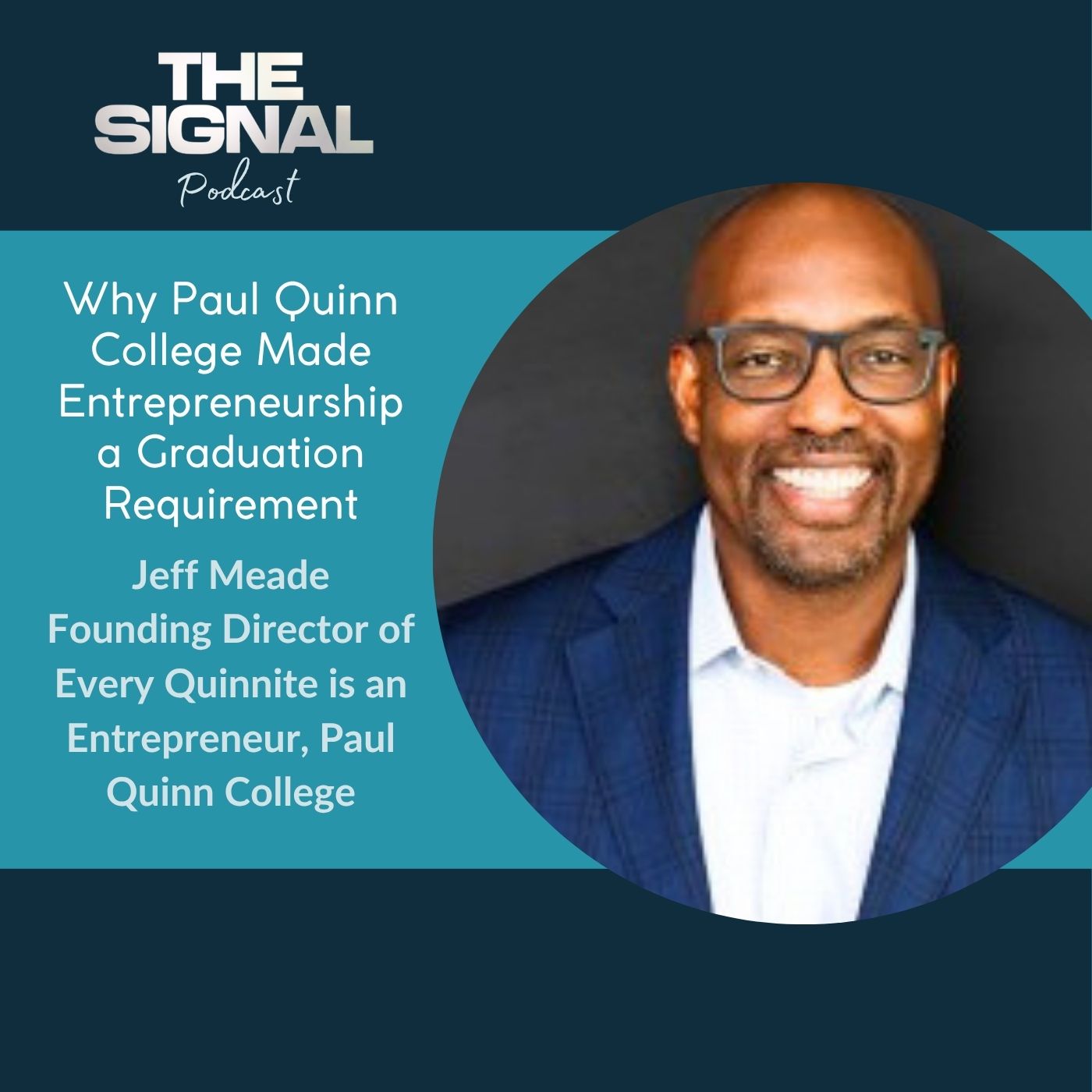
[00:00:00] Jeff Meade: The toughest part has been for students is that pivot, right? Where someone tells them that idea just isn't it right? And I think that's been the toughest part so far, because their entire academic lives, they've been trying to get A's, right? Like, these are all college students. They've done fairly well in high school. And so they're always trying to figure out, all right, let me just figure out, how do I get an A in this course? And so the challenge with entrepreneurship is you could do everything that we've talked about in class and it'll look good on paper, but then you go out into the marketplace and start talking to customers and they're like, nope.
[00:00:39] Jeff Dillon: Welcome to another episode of the Signal podcast where we dig into the people and ideas shaping the future of technology and higher education.
Today's guest is someone who is reimagining what a college degree is actually supposed to produce. Jeff Mead is the founding director of entrepreneurship at Paul Quinn College, where he's leading a bold initiative, Every Quinite is an Entrepreneur. The program ensures every student launches a venture before graduation, making entrepreneurship a core life skill rather than an extracurricular option.
With over 20 years of experience growing companies and advising businesses, Jeff has scaled agencies to multimillion dollar revenues and built client side marketing programs that gain national recognition. His work has been featured in Harvard Business Review, Fast Company, and Entrepreneur magazine. Today, Jeff is pioneering Venture Based Learning, a model that equips students with an entrepreneurial mindset, creativity, and real world experience to thrive as founders, innovators, and entrepreneurs in any field.
It is great to have you on the show today, Jeff. Thanks for being here.
[00:01:56] Jeff Meade: Thank you so much for having me, Jeff. Great name, by the way.
[00:02:00] Jeff Dillon: Yeah, I love that.
So in your LinkedIn bio, you say you're having the time of your life doing this work. What does a great day at Paul Quinn College actually look like for you? The kind of day that reminds you why you made this pivot.
[00:02:15] Jeff Meade: Yeah.
Today is hopefully going to be one of those days. Today is the first day of our summer bridge program.
And so the beauty of our summer bridge program is where we bring in freshmen earlier than the rest of the class or the rest of the students, just to get them acclimated to college.
And so I'll have about 170 students in a auditorium style classroom and they will learn about the Every Quinnite is an Entrepreneur program. They'll truly understand what it means to start and launch a business. Every student who comes to Paul Quinn has to start and launch A business as a graduation requirement. So those students who have heard about it during their recruiting process today, we'll see how real it is. So today is just one of those good days when you just get to spend time with the students and really just walk them through what the next couple of weeks going to look like before school officially starts for the sophomores, juniors, seniors and everybody else.
[00:03:13] Jeff Dillon: Yeah, yeah, yeah. One thing I've repeatedly seen in higher ed is that the people who stay aren't usually motivated by the technology itself. They're motivated by the students, the faculty, the communities they serve. I think that that sense of purpose tends to become the common thread.
You spent more than 20 years in, in the agency world before stepping into higher education. What was the moment or the conversation that convinced you that this was the most important work you've ever done?
[00:03:46] Jeff Meade: Funny enough, that moment actually happened for me on a hike.
I was actually on a hike in Japan with one of my best friends and typically when we get together we have these, as my wife likes to call it, we have these life altering discussions and she's like, I can't be a part of this because you guys will talk forever.
So thankfully we had a couple hours to talk on this hike and, and funny enough, you know, I was thinking about some things with the consultancy I was running, but he had asked me, you know, what makes you happy? And I went back and forth and just talked about kind of increasing revenue, you know, hiring some different folks and you know, some stuff with my kids, family and you know, it was kind of like, yeah, yeah, I get all that. You know, you want to make sure your family's doing well, but he's like, what makes you happy? And man, three, four hours later on that hike, I could not answer the question.
15 hour flight back to Dallas, couldn't answer it. And truly I had to just start journaling. It was frustrating that I couldn't answer a simple question like, what makes you happy? And I thought about the times in my life when I was happiest and that time was when I was an adjunct at ucla. I just loved being in the classroom, but there was definitely a part of me. I've been an entrepreneur, as you said, for two decades and you just kind of get used to a certain lifestyle. And so the thought of going back into academia full time, I was like, well, that's crazy, you know, I just don't want to reduce my salary and all that stuff. But there was something pulling me and, and really, you know, I had this idea for helping young people Start businesses. And I knew it wasn't something I could pull off on my own. I knew I had to partner with the school in some way, and I didn't know how it would look, but.
But I see what it looks like now. And so that was the moment. That hike was the moment.
[00:05:39] Jeff Dillon: There's one thing I've learned from working with colleges and universities is that mission statements are easy to write, but they're much harder to operationalize.
What separates, I think, great institutions is their ability to turn big ideas into tangible student experiences. So your commitment to entrepreneurship feels like one of those promises that's woven into the culture rather than just sitting on the website. Can you walk us through what that actually looks like operationally? What does a student's journey from freshman year to launching a real venture look like on your campus?
[00:06:15] Jeff Meade: Yeah, yeah. So the journey will start. So this is actually a great example. And I've been here a year and a half, so the journey is just starting for many students. And so last year, the freshmen, and these freshmen now, what they do is they go through like a six week boot camp with me, and they learn about solving problems. We really start with find a problem out there, Find the itch that you want to scratch, Find something that upsets you or nags at you, and really figure out a solution to that problem.
And so we spend a bunch of time on that, and then they start coming up with ideas. And so at the end of the six weeks, the goal is, can you pitch an idea to some investors that we bring in to their peers and really sell people that you actually have a solution?
And then in the fall and the spring semester, they go into a course where we actually start to build out some of these ideas. We're in year two of it now. The thinking now is, how do we get some of these ideas that can actually scale?
The ideas run the gamut, right? There's a company or a group of students who are launching a podcast. There's some other folks that want to start clothing brands. We have a group that wants to start a beauty brand. So the ideas are kind of all over the place, and I'm kind of letting them develop right now.
[00:07:31] Jeff Dillon: That student journey really highlights something bigger. I think many colleges offer entrepreneurship courses, even competitions or incubators. But what you're describing feels more integrated into the educational experience. It raises an important question, I think, about whether we're teaching entrepreneurship as a subject or using it as a framework for learning itself.
You're a leading voice, I think, in what you call Venture based learning for institutional leaders who are trying to wrap their heads around it. How is venture based learning fundamentally different from how entrepreneurship has traditionally been taught in colleges?
[00:08:11] Jeff Meade: Yeah, I've seen entrepreneurship taught like they teach other business courses. Right. It's like, read this, we're going to give you an exam on this.
And so, you know, I didn't want it to just be like a course where you can prepare for. And so venture based learning, in many ways what it is, is experiential learning, but with real stakes.
And so the real stakes are actually students seeing an idea go out into the marketplace. And so what I have seen is the toughest part, funny enough, and I didn't think this would be the toughest part, but the toughest part has been for students is that pivot, right. Where someone tells them that idea just isn't it? Right. And I think that's been the toughest part so far because their entire academic lives they've been trying to get A's. Right. Like these are all college students, they've done fairly well in high school. And so they're always trying to figure out, all right, let me just figure out, how do I get an A in this course? And so the challenge with entrepreneurship is you could do everything that we've talked about in class and it'll look good on paper, but then you go out into the marketplace and start talking to customers and they're like, nope, or something's missing. And so just like working on that entrepreneurial mindset to let them know that this is actually a good thing. Right. Because you didn't waste any money. Now you know this isn't going to work. And they've given you information to tell you how you might change it to make it more meaningful to the customer. So that, that, that has been really fascinating to see take shape.
[00:09:46] Jeff Dillon: Yeah. One of the things that stands out about venture based learning is that it moves beyond theory and creates real world accountability.
And it's one thing for a student to pitch an idea for a grade, but it's something entirely different when there are actual customers and actual stakes and resources involved.
[00:10:08] Jeff Meade: Right.
[00:10:08] Jeff Dillon: You've secured six figure funding for a student seed fund.
[00:10:14] Jeff Meade: Right.
[00:10:14] Jeff Dillon: I think how does putting real capital in students hands change the way they show up to the work? And what have you learned about how students treat real money versus a graded assignment?
[00:10:25] Jeff Meade: Yeah, they, they are allowed to dream big. I think that's the really fascinating part. We actually have this tradition at Paul Quinn and we call it the quinite introduction.
And so what students do, usually in class, when they're talking or when people come on campus, they say their name, their hometown, and the dream they have for their life.
[00:10:47] Jeff Dillon: Right?
[00:10:47] Jeff Meade: And so usually the tough part for students is usually they start talking about goals.
I want to do this, I want to do that. And what we're saying is we actually want you to dream, and we want you to be comfortable sharing that dream with people. And so what I've seen happen when there are actually funds available is it's okay to tell somebody to dream, but now when you can dream and then we're saying we actually have resources to fund that dream, it makes it that much more real.
[00:11:16] Jeff Dillon: Right.
[00:11:16] Jeff Meade: And so they're now they're like, oh, this can actually be something. Right? Like, last semester when I saw students, one group created a coaching class, and they were charging $5, and they started making a couple sales, and they were like, oh, my goodness, we can hit this milestone where we can get an investment.
It's amazing.
[00:11:34] Jeff Dillon: Yeah. I think what's fascinating, too, is that as entrepreneurship becomes embedded across a student experience, it stops being just an academic model and starts becoming this operational challenge. And higher ed has spent, I think, decades building systems to manage courses and credits and administrative processes. But supporting hundreds or thousands of students running real ventures is an entirely different proposition.
Launching real ventures at scale across the student body is really operationally complex. From a technology and platform standpoint, what does it actually take to support every student running a business? And where does most of higher ed's existing tech stack fall short?
[00:12:21] Jeff Meade: You know, it's a great question, because I think the current tech stack doesn't think about how do we actually support students launching a business, and how do we reduce friction for students launching businesses? Right. Like, when I first got here, we secured the funding and it was like, all right, create the ideas.
But we didn't have a technology layer that made it easy for people to present their idea to the marketplace. And so for us, just this last semester, I'll drop their name, but we started working with Canoe, and they're a technology platform that creates a marketplace for us. And so working with them to create a marketplace where students can display their business and we can sell products and or services. And so what it does is it creates visibility. Right. Because prior to this, and we're still building it out, but prior to that, essentially what we're asking everybody was to come up with the idea, find the customers, build a website, and that. That's a tough lift, Right. For anybody. But then you think for students and, and so as you start seeing it at scale, you're like, there's too much friction in this. How do I eliminate the friction from idea to actually go to market?
And so that's what we are working on now. And so finding Canoe was great. And the crazy thing is they just don't have that much competition. Right. Like, there's not too many places that allow us to build out a marketplace. There's a lot of marketplace providers, but what they allow us to do is kind of track movement. You know, things like people coming to the site. We can track that. And so, for the most part, we can track momentum for students. It doesn't always have to be revenue, like little things we can track. And that has been great for us.
[00:14:07] Jeff Dillon: You're way ahead of the way I was thinking when I asked that question. But I remember as a web director, students needed web space to do projects, and the web space they were often allocated just was very static and very basic. It's like they couldn't do anything with what they needed to do. But there's a lot of companies out there that we can. That schools can partner with to do that. If schools don't want to take on that security risk, basically is what we would run into. But, yeah, things have changed so much.
One aspect of entrepreneurship, I think, that often doesn't get enough attention is its role in. In expanding opportunity. Not. Not every student enters the workforce with the same network resources or access to traditional career pathways.
For some, entrepreneurship creates an alternative route to economic mobility and professional success. I think. So instead of waiting for someone to offer them a seat at the table, they're learning how to build their own world. I'm curious how you think about entrepreneurship as a tool for broadening access and creating opportunities for students from a wide range of backgrounds and life experiences.
[00:15:14] Jeff Meade: Our whole thing is, you know, we want students to be entrepreneurs of their own lives. Right. Fundamentally, our goal is to eradicate intergenerational poverty. Like that is the goal of the school. And so we. We come up with different ideas as to how to do that. And so we have two big, big tent pole programs. One is we have a corporate work program where every student who lives on campus, it is our goal to get them an internship while they're in school, so they work while they're in school, so they have the experience.
And what I love about that question is the other part is, it's one thing to have that experience, but can you create wealth for yourself and your community based on seeing opportunities? And so that's what the entrepreneurship program does.
And so, you know, like, even later today, I'll have all the students for the first time. 100% of the students in our school don't want to be entrepreneurship majors. You know, they want to study all sorts of different things. And I think this is great because what we're really trying to do is trying to help them think and act like entrepreneurs and take that mindset and that approach to whatever career they want to pursue. And so I've had folks say, you know, I want to go into education. And I start saying, well, there's so many things you can do in education.
And they're like, well, I don't want to open my own school. And I'm like, no, that's not it. It's just there's so many ways to approach this. And so we're really just trying to help them think and act like entrepreneurs in any situation they get in.
That's really the goal for us.
[00:16:48] Jeff Dillon: Yeah, yeah. That focus on preparing students for an AI driven economy raises an important question, I think, about the role of the role technology should play in higher education.
Institutions are being flooded with new tools and platforms.
They're all being promised better outcomes. But if the goal is to develop entrepreneurs, innovators, problem solvers, not all technology is really created equal. I hear from a lot of institutional leaders trying to figure out what, what technologies are actually worth investing in. From your seat. What separates technology that genuinely supports a builder mindset from edtech that just digitizes passive learning?
[00:17:35] Jeff Meade: You know, I think it's interesting is there's, there's definitely lots of people that come to us and especially to the program and, you know, their first question is, what are you doing with AI?
And it definitely is not a blind spot for us. And students definitely use AI. I mean, they're in college.
But what we're trying to do is, before we even get to the technology layer, is really help students make sure that they're solving a problem, right? And then once they do that, once they truly have a problem that somebody wants solving and that somebody will pay money to solve, then we start saying, how do we leverage the marketplace? Right? How do we leverage technology to stand up this business even quicker? And then once we do that, and so it could be easy things like it could be leveraging vibe coding tools to get a website up quicker. And we've seen students do that, and that's phenomenal because it's crazy to get out of a class at like 3:00' clock and then the next Day students have a fully built out website.
That's an impossibility. Years ago.
[00:18:47] Jeff Dillon: Example.
[00:18:47] Jeff Meade: Yeah, yeah. So that, that has been phenomenal for us. But I always push them. Don't go jumping into the tools first. Let's make sure the tool is going to make you be more efficient at what it is that you want to do, you know?
[00:19:02] Jeff Dillon: Right, right. The idea of a, of a builder mindset applies to institutions as much as it does to students.
The colleges that seem to make the most progress aren't always the biggest or best funded. They're often the ones that are willing to just think creatively, move quickly. This is from what I've seen, they build relationships that extend beyond the campus walls. You've built remarkable partnerships with organizations like Babson and Wharton, Shawn Carter Foundation. What's your approach to opening those doors as a smaller, mission driven institution? And what should other college leaders be doing differently when they think about partnership strategy?
[00:19:43] Jeff Meade: I really think this is where my, my marketing background really lends itself. For most of my career, it was all about storytelling. Right. Like, what story do we want to tell? How do we see the world? And what I'm doing now is just figuring out who are all the people that see the world the same way we do.
And so even like relationship with Jay Z's foundation, the Shawn Carter foundation, his whole thing was, and I mentioned it before, we want to eradicate intergenerational poverty.
They wanted to figure out how to teach students about personal finance. It was just a thing. They said more students need to understand money better. And so I was like, oh my God, we see the world the same way. Right. And so if that's really what you want to do, just having those conversations and saying, well, I have all these students who need to better understand personal finance. And something we want to do, it relates to the entrepreneurship program. But I also think it's just a life skill. And so just reaching out to those folks and saying, this is what I'm thinking, this is what I read about you.
Let's have a conversation. And that's really the seed of it. We're really just not afraid to reach out to folks that we think see the world the same way and start to have those conversations. And sometimes people are like, maybe not right now, this isn't the right moment. But more times than not, it's turned into something fruitful. So we're just trying to be really innovative.
[00:21:08] Jeff Dillon: What's striking, I think, is that each of these innovations pushes the institution a little further beyond its traditional role.
First, it's teaching entrepreneurship, then funding ventures and building ecosystems and partnerships around them. At some point, the question really becomes, how far can university go in creating real world economic opportunities for students?
You've started exploring acquisition entrepreneurship with students actually acquiring and operating real small businesses as part of the program. I think that's a profound shift in how college, how a college thinks about its own role. How did that take shape and where could that lead?
[00:21:49] Jeff Meade: Yeah, I love this one, because when I was consulting, my primary thing was really around helping my clients diversify their revenue. You know, people would say, oh, you know, we have this client, and this client is like 40% of billings. And I'm like, oh, timeout. You can't do that. Right?
And so that was where it felt like most clients I engaged with. That's really where we headed up. I was like, you got to diversify this. And so then I land in academia and, you know, I'm just fundraising and really playing out the strategy for where I want to take this in the next three to five years.
And then I'm looking and I'm looking at our current funding model, and I'm like, oh, my God, it's all tuition, right? Like, this isn't sustainable.
I don't think anyone from the outside who saw it would be like, wait, what? How could it be all tuition dollars? And I just think I had a different lens on it. And so for me, it was all right, well, how do we get creative with this? How could we diversify our revenue streams? And and so I go back to, all right, what do I want this program to look like? And how do we best serve our students again to get to this place where we can end intergenerational poverty? And so one idea I had was, what if we, as much as we are telling students to start businesses, and, you know, I show them different faces of entrepreneurship. It is starting a business up, it is franchising, it is acquisition entrepreneurship. So there's not one face to entrepreneurship.
But I noticed that we had to do what we were saying we wanted the students to do. And so a part of that was, let's go out and do something novel. Let's be an equity partner on some of these deals. And so the benefit for us would be if we own this asset, it would diversify our revenue stream. But now we have this business that's growing, and so I can give my students a different facet of entrepreneurship.
We're working with operators, and we're still trying to grow a fund to actually purchase different businesses and get into franchising. But with the conversations we're having with the operators, it's, we want to get our students into the business and set up an apprenticeship type model so they can learn how to operate this. So by graduation we can take them to the same franchises and say, hey, this young man, this young woman has been running this type of franchise for the last two to three years.
We will help with the some of the investment to get them started. And so it gives them a different trajectory, it gives them options, quite honestly. And even if they wanted to go work for someone else, they could say, I've been working at blank franchise doing these rotations for the last couple of years. So the experience is, bar none.
[00:24:34] Jeff Dillon: Yeah.
Throughout this conversation we've talked a lot about ambitious ideas, Venture based learning, student seed funds, acquisition, entrepreneurship, really preparing students for an AI driven economy. For some listeners, especially presidents and senior leaders, it may sound inspiring, but also a little daunting. I think the natural question becomes whether this is something any institution can realistically adopt or if it requires a unique culture and a set of resources. Let's say a college president listening today is intrigued but skeptical that this model could work at their institution. What would you say to them and what's the first move you'd recommend they make?
[00:25:16] Jeff Meade: Yeah, the beautiful part is if it's a president listening, then it really just comes down to culture.
You know, it's them giving the green light. Quite honestly.
When I met up with president Sorrell, who was president of Paul Quinn, his blessing was, let's just build it, right? Like we knew what we wanted the goal to be and it was like, let's build it. And so I think for us it was having his blessing, just like, go figure it out. And so I think you have to have the buy in from the top, right? And once you have the buy in from the top, you probably just need to. At that point, you probably got to bring in people who see the world a bit differently.
I don't know if I would see this the same way. If I was in academia for the last 20 years, maybe I would. I just think that the skill set I have from starting my own agencies and scaling those up and then helping other people scale their own agencies, I think that thinking, the fact that I scale businesses and now bring that thinking to the college and to the students, I think that's a different skill set. And so maybe it's bringing in somebody with that skill set, that's what they would need to have.
[00:26:31] Jeff Dillon: This practical advice, I think points to a Larger issue. Many of the challenges we talked about aren't really about entrepreneurship or technology. They're symptoms of a deeper question facing higher ed. It's whether we're preparing students for the world as it exists today or the world as it existed a generation ago. If we pull the lens back a little bit, what do you think higher ed gets most fundamentally wrong about preparing students for the economy they're actually graduating into?
[00:27:01] Jeff Meade: Oh, yeah, there's. Unfortunately, there's too much we get wrong.
You know, the biggest thing is really that we're not bringing companies into the fold soon enough. And it's not because we don't want to. It's just that companies don't understand how to get involved.
Right. And I think sometimes the ask that we make of companies are so big. And by big, it means, hey, we have this many students, we would love for you to give them an internship. Or every year you have a class rolling off. And so you're saying, hey, you know, we'd love for you to interview our students for jobs. That's beautiful. But there are so many other things a company could do for you and so so many other touch points they can have with your college or university just to help them better understand what's going on. And so we try to do a good job of that. And I have people from companies based on the subjects I'm teaching or not subjects, but what we're focusing on the class. And so if I'm focusing on marketing or finance, bringing in folks from corporate or who have their own businesses that can talk about that, and then what happens is they start to, you know, this. Once you get in a classroom with students, people fall in love, you know, and so they want to figure out more ways to get in involved. And that's kind of the hook. And so we just try to get creative with how many different ways can we get involved. Like, we have companies invite our students out to, you know, a round table with some of their executives. Really low lift for the companies.
All we have to do is get the students out there. And so then, you know, the execs sit down for about an hour and a half, have lunch. And they didn't have to give them any internships or anything. Right. But it's just another touch point to better get to know Paul Quinn Students so well.
[00:28:47] Jeff Dillon: Jeff, I want to wrap it up with one final question. We've talked about entrepreneurship as a teaching model, workforce strategy, a technology challenge, and even a catalyst for institutional transformation. I think what's clear is that this isn't just about what happens at Paul Quinn. The bigger question is about whether hired is at the beginning of a broader shift in how students learn, create value, and prepare for their futures. Looking five years out, how do you see venture based learning evolving across higher ed? And what, what role does technology play? And whether this model stays a Paul Quinn story or becomes a much bigger movement?
[00:29:23] Jeff Meade: Yeah, I want this to become a much bigger movement. I want people to say, oh, they pull it off at Paul Quinn. I mean, no one thinks of Paul Quinn and thinks we have unlimited resources. Right.
So I want other schools to say, oh, you know, they pulled it off and with our resources, we could definitely do it. I just think it's the way schools are going to have to adapt. And I think really what we're seeing is we don't know what, you know, the entering freshmen now. We don't know what careers jobs are going to be available for them. One, because the companies don't know. And companies are not doing the greatest job of investing in their future workforce. Right. They're trying to figure out ways to cut costs. And I think the question we don't ask companies is, you can cut these costs, but you're still going to need people in the future. Right. And so if you don't invest now, when are you going to invest?
And so I think with that, it really is, what can we do differently?
What can we do differently to partner with these companies?
What can we do differently to be innovative?
And I think as we start to look out, the big thing is venture based learning. I think it will take over because what it allows students to do is to learn when there are stakes involved.
You know, far too often when students are in the classroom, what happens is it doesn't seem real and they start questioning and saying, will I be able to actually use this out in the real world?
I think venture based learning answers that, because everything you're doing is actually out in the real world.
So I can't wait. I mean, this is why I love talking about it on podcasts like yours, because I think it's a model that can be replicated. And I do want to see it replicated at different institutions because I think it just benefits our students.
[00:31:15] Jeff Dillon: Thanks, Jeff.
I have to say, I took one entrepreneurship class in high school. I loved it. I never took any in college, but my favorite classes in college were the ones that had a. We had a client come in and we, yeah, we do a project all semester for a client. The closest thing we had. And those were my favorite and I would have jumped all over entrepreneurship class if I if I knew about them or saw them. But it's been a fascinating conversation. I appreciate you not only sharing your vision, but also the practical realities of building a model that challenges many of higher ed's long term assumptions.
For anyone listening, if you like to learn more about Paul Quinn College, I'll put the link in the show notes as well as a link to Jeff Mead's LinkedIn too. So thanks again and it's been a pleasure having you on the show.
[00:31:59] Jeff Meade: Thank you so much. It was great being on the show.
[00:32:02] Jeff Dillon: That's a wrap of this episode of the Signal. If today's conversation sparked a new idea or challenged your thinking, that's exactly the point. This show is about cutting through the noise and helping you see what's actually shaping higher ed right now. Please subscribe so you never miss an episode. And if you found this valuable, leave us a quick review. It helps more higher ed leaders find the Signal. For deeper edtech insights, news and trends delivered monthly, subscribe to the Signal monthly
[email protected] thanks for listening. We'll see you next time.