[00:00:00] Wendy Wong: I think one of the main keys is sort of like that Steve Job philosophy, right, of people sort of not really knowing what they want. So you, you sort of anticipate those users needs and you and you give it to them, right? What I did, rather than ask people what are you looking for an AI agent, I started looking out there, right? I worked with the vendor for this product. But I also went and like looked at what Google was doing, Microsoft was doing, what were you seeing out there that people are doing and then try to make those use cases available in our platform.
So when I went and talked to users, I showed them what you could do with it rather than what do you need me to do.
[00:00:43] Jeff Dillon: Welcome to another episode of the Signal. Today I'm talking to someone whose career really overlapped with mine. When I was in higher ed, I see her at conferences and as I watched her develop as a tech leader, especially with AI, I knew I had to get her on the show.
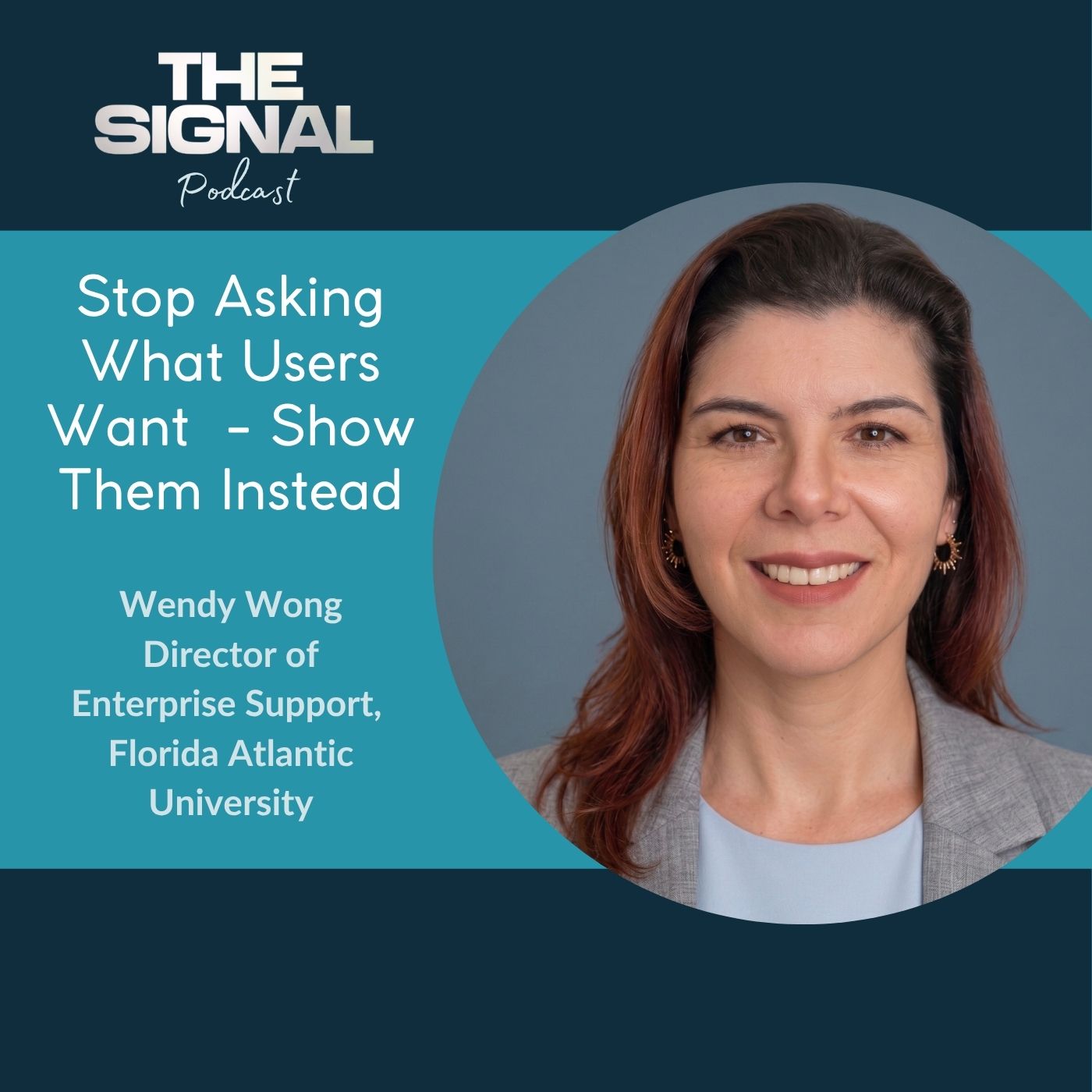
Wendy Wong is the Director of Enterprise Support and Client Engagement at Florida Atlantic University where she spent more than two decades transforming it from a back office function into a driver of student and employee experience.
Wendy has led major initiatives including FAU's first mobile app and a rapid enterprise deployments of platforms like Salesforce and EAB navigate. Most recently, Wendy led the development of L1 and no Code AI platform that is scaled to nearly 1 billion tokens processed across faculty, staff and students, driving significant growth in AI adoption across campus. Wendy now champions a campus wide low code AI strategy focused on making powerful tools accessible to everyone regardless of technical background. She leads with the philosophy that internal employee systems deserve the same design rigor as any customer facing product and believes in building technology that empowers, not overwhelms.
Wendy, it is great to have you today. Thanks for making the time.
[00:02:04] Wendy Wong: Well, thanks for inviting me.
[00:02:06] Jeff Dillon: I have to tell everybody. Something that I just realized today is that this is the 100th recording of the podcast. I've been going almost two years, so yay this 100.
[00:02:17] Wendy Wong: Yay. Congrats. That's amazing.
[00:02:19] Jeff Dillon: Thanks for being the 100th guest. Let's start with your career. You've spent 24 years at Florida Atlantic.
That kind of loyalty is kind of rare. Getting more rare these days in higher ed. What's kept you energized and growing there for over two decades?
[00:02:35] Wendy Wong: I really wasn't expecting it, but when I actually started working here, I was working at fiu, which is different. I loved it there too. And then I knew some people that came to this way and I came over and then I was sort of doing school and working at the same time and then graduated, had a great offer, didn't think I was going to stay. And then next thing you know, here I am.
Most of it really has been the fact that it's been a really great environment to just be able to reinvent yourself all the time. I've been able to switch various roles and it's all been in it. So it's been a really. That's a great thing about this department especially is the fact that, let's say we have a lot of help desk students that start out there and then we bring them in here to like kickstart their career, which many of them end up staying years as well because you could easily taste various flavors of it and say where you want to go. So like you said, you know, started in web, then I went to like some type of project management programming, low code AI. Now you can't get bored.
[00:03:35] Jeff Dillon: Our careers have a similar trajectory. As I was looking at your bio, so we met at a conference because we were using a shared platform. We're both on modalabs and then we'd see each other at other conferences. And you know, one thing I've noticed after talking with other, I mean, dozens of technology leaders on this podcast is that the people that are making the smartest decisions today usually have this perspective of having lived through several waves of change. They remember when campus portal was the front door or before smartphones even, you know, really reshaped customer expectations. You've had a front row seat to that evolution at fault. Which makes me curious, with your career arc going from web applications and portals back in the early 2000s, before most universities even had a mobile strategy, how did that early hands on work shape the way you approach technology decisions today?
[00:04:29] Wendy Wong: Well, I mean one of the great things about stuff like web and Portal is the fact that you have a very sort of user centric view, right? So a lot of the things you do today is still in the same realm. You want to make it user friendly, right? So everything you're, you're building, it has to be usable and easy to understand, which is, you know, a big thing.
You are also just in general being able to do all those pieces right? Like back in the old days, especially doing portals or even web, right? You would learn by breaking things a lot of times and you fix it, so you sort of learn how it works. So now as you're doing all this new technology, you already have all that background, so sort of easy to understand. You're not like dealing with a black box. You're building over things. So I think that has helped a lot, having all of that background.
[00:05:19] Jeff Dillon: It's interesting because I think the technology itself is only a small part of the story. I've seen plenty of great products struggle just because they weren't ready to change how they worked. And I think in higher ed especially, you know, getting adoption can be harder than building the tech. And that brings me to this, another milestone in your career. You led FAU's first official mobile app deployment.
This is where our careers are kind of overlapped. Looking back, what did that experience teach you about driving adoption for something genuinely new at a large institution?
[00:05:56] Wendy Wong: I mean, it comes back down to like, you know, meeting people where they're at, trying to almost anticipate what they need, remove friction. Right. That's always like the biggest thing. It's especially like when you're dealing with even your own tech users. Right. Are you bringing in more work for me?
And what we have to do is like really simplify and make it easy. Building plans, a lot of communication and training. I mean, those, those steps, they were something you needed long time ago before, you still need it today. Right. So a lot of those lessons that you learn have been really helpful in doing all the new projects today and also being able to. To just adjust. Right. To change.
[00:06:39] Jeff Dillon: Right. And that experience probably gave you a master class and something every campus really wrestles with. It's the technology projects are really, they're people projects. And the more I talk with CIOs and IT leaders, the more I hear that the biggest obstacles aren't technical. They're organizational.
Teams have different priorities, different metrics, and sometimes different cultures. And it seems to be relevant. In your role today, you're leading enterprise support, help desk, desktop engagement, technology, all under one roof. How do you think about unifying teams that have historically operated in silos?
[00:07:18] Wendy Wong: I mean, even though they're operated in silos, they all have one unifying mission, really. Customer experience, the user experience, really giving great service. Right. And one of the ways that we've gone about breaking a lot of those silos is let's say for like our help desk and our desktop support, we do have cross training for them. So a lot of people in the help desk also switch role and do desktop support, and vice versa. A lot of desktop support go and grab the phone and do help desk. I go, sometimes I do help desk. My cio, he does his favorite thing to do is sometimes go down there and do help desk. So we have a really good culture like that of everybody sort of helping each other out.
A lot of cross training. We have to really understand how our software works in order to be able to support it. So we do stress that a lot with our help desk. I think it's actually quite unique compared to other help desk. When I've gone to conference and I talk to people, our help desk is not just there answering the phone. Same thing with our desktop support. We really get them involved and understanding how the university software works so they're able to then help people the best they can.
[00:08:25] Jeff Dillon: One thing that I think really stands out in your role is that you're not just bringing teams together, you're creating these conditions for innovations to happen. And as someone who spends a lot of time talking with technology providers, I know most campuses default to buying software rather than building it now. And that's why what your team has done really caught my attention. Usually I try to wait a little bit to get into the AI, but we're going to get right into it. Let's talk about Owl1, FAU's no code AI agent platform. Can you walk us through what it is, how it came to be and why FAU decided to build something proprietary rather than adopt an off the shelf solution?
[00:09:06] Wendy Wong: So Nebula 1 is actually semi off the shelf, but not really. Right. It's actually by a vendor called Cloudforce and L1 is our branded version of NebulaOne. And what really drew us to there is that it sits in our Azure infrastructure, so it's already sitting in our environment, so we own it. But it was a really, really good, fast rollout. It had already all the protective guidelines around it, right, all the rules, so it met our CISO requirements. It was the best of both worlds because an enterprise application, it was ready to scale out really fast. It already had built in tracking and analytics, so we could easily see who was doing what. We didn't have to build all of that from scratch, but we're able to have complete control over it, which is what's really great. So we're able to roll out various agents, you know, decide what type of models we have there, do various types of integration that is completely on us. So it's something that we needed something fast, we needed it good. People wanted to use something out there. We didn't want them to keep going off and getting all these public tools that are right now not secure. So this was a really good alternative to have there. Hey, you want to start using AI? You want to use possibly, you know, proprietary information from fau. This is what you should be using.
[00:10:22] Jeff Dillon: What are some of the innovative or success stories you have so far? How are people using pal?
[00:10:28] Wendy Wong: One of the most this is, I had a professor recently that I had spoken to and I thought it was really interesting. We have like the basic people using them almost like little tutor bot or study aids. Right. As professors doing this type of thing. We have different types of user but this one user was actually a professor as well and she runs about maybe 50 or so TAs. Right. And a lot of these are grad students at TA and they come from different cultures and different places. So sometimes there's a language barrier, maybe there's an understanding barrier.
So she uses this agent to be a more tutoring you or teaching you how, guiding you how to be a good tutor pretty much for the class. So you're not grading assignments with it or anything like that. But the TA uses this agent to sort of give it, let's say the paper or whatever they're trying to grade and for it to give it feedback. And if they don't understand why, maybe you should be, let's say, why this one problem? Let's say the agent thinks that it should be done a certain way. It could explain it to you in various, let's say languages if it helps you better or it could like maybe make it more simplistic. So that's how the teacher built this agent is to really help their tutors, right. Understand what she is expecting of them for the class.
[00:11:51] Jeff Dillon: Yeah, I love that example. What I like about this story is that it's not just another AI pilot. A lot of campuses have experimented with gen AI, but relatively few have achieved meaningful adoption at any scale. And the tech matters. But those results, I mean your examples, there's something different about the strategy behind the rollout. You're processing nearly a billion tokens and achieving 4x increase in adoption. Those are remarkable numbers for an enterprise AI rollout. What's the key to driving that kind of adoption across faculty, staff and students?
[00:12:29] Wendy Wong: I think one of the main keys is sort of like that Steve Job philosophy, right, of people sort of not really knowing what they want.
So you sort of anticipate those users needs and you give it to them, right? What I did, rather than ask people what are you looking for an AI agent? I started looking out there, right? I worked with the vendor for this product. But I also went and like looked at what Google was doing, Microsoft was doing. What were you seeing out there that people are doing and then try to make those use cases available in our platform.
So when I went and talked to users, I showed them what you could do with it, rather than what do you need me to do? Because I very much suffer about blank page syndrome. I cannot tell you a lot of times what I want, but I could definitely tell you what I don't want. And that's what happens when you deal with users. You start showing them use cases and all of a sudden they're like, oh, I like this. Oh, I don't like this. And then now they have some frame of reference of how to do things because it's really hard. AI is scary for a lot of people. People think it's tech, which is really. Sometimes AI is so much better for people that are not super techie, because my experience as the techie people are like, I already know what I'm doing. I don't need AI. But the users, you could show them so easily now how they could bring things up really fast. So I try to make it very approachable, try not to make it sound very tech intimidating. And I think that helped a lot in driving adoption.
[00:13:52] Jeff Dillon: I love the Steve Jobs reference because it's a very bold attitude in higher ed, right? Like, it's just not normal. And I. I love that someone that's been in their job as long as you is still making big changes because honestly, I think it killed me slowly every day where we're like, stay in your box, stay in your box. Don't try. And after a while you're like, oh, why should I try anything new? I just get in trouble for it. So I love that you're pushing the box. Having a champion with as much experience as you. I use the Henry Ford one too. Nobody would have asked for a car. They would ask for faster horses. So we will show them what they want is great. I love the attitude. It's great. Those kind of adoption numbers, they don't happen by accident. One of the themes I've heard over and over from successful campus leaders is that organizations making the most progress tend to invest just as much in people as they do in platforms. And that seems to be a pretty big part of your philosophy. Your team just received Cloudforce's 2026 Frontier Award for AI Advocacy. You said the key to technical disruption is strong change management. What does good change management actually look like on the ground in a university setting?
[00:15:01] Wendy Wong: I mean, like, everything, right? Communication, putting expectations, breaking down barriers, Those are always good. One of the main, I think, reasons why the frontier work came about is that, you know, they did see that all the efforts we did to make this a reality, right? A lot of grassroots effort, you know, meeting people where they're at. We did a lot of just general examples. We would show up at offices already with examples that fit their work needs, rather than coming in with a generic example of like, oh, this is how, you know, you. You write an email, like, that's fine. But I did a big thing for the office of the Registrar and a little AI training and I showed up with use cases, let's say, of how to organize a graduation ceremony using AI, how to do, let's say, a residency form and have AI help you. These are all use cases that they could understand.
One of the things I did very much is also I really tried to normalize it and also related a lot to people.
So sometimes I wouldn't even come with a work case. I'll be like, hey, look how I use AI just to plan my travel. I went to Japan and I used it and I showed them how, like, it came up with an agenda for me. And this all of a sudden it's like, wow, I could do this.
I use it a lot to translate to my family back home because I speak Spanish, I do not write it very well, so it helps so much. And all of a sudden they started to see how you could use it and also changes that frame of reference to a lot of users in education who only think of it, unfortunately, as a student cheating tool, rather than seeing how it could help you with your everyday life.
[00:16:41] Jeff Dillon: I love those examples. Showing your colleagues and stakeholders some examples of how you're using it. Show rather than tell is pretty powerful. On the change management topic. It really leads to this other challenge that's almost universal in higher ed, and I think it's balancing innovation with risk.
In my conversations, everyone's excited about AI's potential. Well, not everyone, but we're better than we were a few years ago. But they're also trying to navigate the governance and the privacy and the academic integrity, like you said, without slowing innovation to a crawl. I'm curious how you've approached that balance at fau, but how do you make the case internally for something as disruptive as generative AI, especially when there are real concerns around this academic integrity and data privacy?
[00:17:28] Wendy Wong: I mean, there's always going to be issues with academic integrity. I do not say there isn't, because there is, obviously. But I do try to tell people it's here. AI is here to stay. You can't just Ignore it, you can't ban it. People are going to use it no matter what. So you might as well teach them how to do it. Right, right. And show them why you're almost cheating yourself if you're doing it in a different way. You know, as well as one of the things that since I work more on the IT side, like we have a lot of people that scholastically are trying to figure out how to like fit that into their course areas.
But we do try, at least, not at least we do 100% right. Do try to. We only give them tools that they have security guardrails around them. Right. So we have BAA with all the ones that we are offering, all the models that we offer have to have some type of enterprise data protection where they're being, where they're right now, you know, being given. One of the biggest issues we're having, which a lot of I know education people are having is like, I would love to give anthropic if they ever reply to me. But you know, because everybody wants cloud, but we don't advocate for that here. Like we don't offer it as from the university right now because we do not have a baa. So we want to make sure that we have all these data privacy rules and governance in there to make sure that how you're using it is safe. Right. We don't want to be like in the news of how our research data was released somewhere where it shouldn't be.
And we do have a lot of education about this too. We have it on our website where to use what type of, you know, data.
[00:19:00] Jeff Dillon: So yeah, kudos to you for tackling the governance part because that's where I see kind of a lot of challenges. Because if you don't have much, most schools don't have good governance or they're trying or. And when you lack that, it falls all the way down to that faculty member. And they're all different, they're all over the place. Right. So you gotta have some framework. So that's, I think, a big hole. I've noticed you've built an impressive toolkit over the course of your career. And what's I think interesting is that each of those disciplines brings a different lens. In higher ed, success usually isn't about having perfect methodology.
It's really knowing which principles to apply at the right moment. And it makes me think how all those experiences come together when the stakes are pretty high. So you've, you've implemented Workday, Salesforce, EAB Navigate, Microsoft Intune and now L1 some on aggressive timeframe. What's your personal framework for de risking these complex enterprise deployments in higher ed?
[00:20:00] Wendy Wong: I don't know, I may think I'm just crazy and I'm like, let's just go.
I mean, it's not that we don't de risk it. I mean I've always been super into like troubleshooting and getting things organized. But I also have a very big mentality of like sort of how I said in the beginning, I was like, you know, you got to rip that band aid, you got to try because if you don't take that risk, right, you're not going to have a reward. And a lot of times with many of these softwares and implementation, it's really been, you know, talking to users and just making sure as we do any of these rollout, right, you set expectations of what these are going to be, you phase things out, you have mvp. So all of these keywords everybody talks about, but that's what you do, right? You make sure you actually adhere to that. And I think communication and expectations has always been the keys to having these fast rollout. Also trust, you know, the users, trusting you, being there for them, showing them you're there in the trenches with them, right? Those types of things make people a little more open and accepting that it's not always all going to fall on them.
[00:21:05] Jeff Dillon: I think you see the risk of doing nothing and I think a lot of people in higher ed don't see that. Like there's so much more risk in taking on a project like there's not many. It's hard to find that champion. So you continue to be a champion, which is really commendable. One thing I've learned, you know, over the past few years is that these successful implementations don't end at the go live. It depends on whether people actually enjoy using the tools they're given.
And it often comes down to that implementation employee experience, which it doesn't always get the same attention as the student experience. And I know that's something you're passionate about, is this employee experience.
And in higher ed it it's often treated as secondary to student facing systems.
You've described treating internal tools with the same rigorous customer facing tools. What does that philosophy or why does that matter and what changes when you actually commit to that?
[00:22:01] Wendy Wong: I mean if the employee's not happy, they're probably not going to be giving the best of service right to the student. So you really need to break down those barriers. So you want to make it easy for the employee to be able to help that student. That's how it always should be, even to employ to help another employee.
[00:22:17] Jeff Dillon: Right.
[00:22:17] Wendy Wong: If you're happy working or things are easier for you, the tools are easier, then you're going to do better work. You're going to keep struggling to use a tool, you're not going to get a lot out of it, and you're not going to get a lot of work of that employee too. It's going to be really frustrating.
So we definitely always go toward doing more intuitive design, better support, take away all that internal friction.
[00:22:40] Jeff Dillon: I think great employee experiences don't happen in a vacuum. They're often shaped by partner institutions you choose to work with. I spend a lot of time with tech companies that really want to serve higher ed, but there's often a disconnect between what these vendors think campuses need and what the institutions actually value. And, and since you've been on this institutional side through so many major initiatives, you're in a unique position to answer this. And it's really from your seat. What separates a technology partner who earns long term trust from one who doesn't?
[00:23:17] Wendy Wong: I mean, a technology partner that really earns long term trust to me is one that really tries to understand your ecosystem, tries to understand how you work and meets you there.
[00:23:25] Jeff Dillon: Right.
[00:23:25] Wendy Wong: Understand especially the constraints of higher education such as budget. Right. And as you said, sometimes they're a little, you know, risk averse, but those partners are there and they help you. They have some skin in the game. The best partners that I had are ones that are actually there with you during deployment. They're there to help you, they invest on that long term adoption. They don't just like leave you once you sign the contract.
Those are really good ones. And the ones that I actually value even higher is the ones that actually have some candor. You know, they value candor over marketing hype. So it's like you're going to tell me your software cannot do abc, but you'll work with me to figure out how to work around that. Rather than I always dislike someone that tells me, yeah, I could do this and you buy it and it doesn't work.
[00:24:07] Jeff Dillon: So I just say it doesn't do it. Okay, yes.
[00:24:09] Wendy Wong: And I would value that. That's fine. It's not like I wouldn't buy it if it doesn't do one thing, but I need to know that. Right. So those are what make good partners. The ones that are like communicate, are truthful and they're there with you.
[00:24:21] Jeff Dillon: Yeah, yeah. Great advice. I think that's especially valuable because I think the relationship between a campus and its tech partners can have this huge impact on how quickly innovation happens.
Right now, every institution is really trying to figure out its AI strategy, but they're all starting from different places. Some are scaling enterprise initiatives like you, while others are still deciding where do they start? And if we're talking to a peer who's just getting started, what's the advice you'd give, you know, a CIO or IT director who's just starting to think about AI strategy. What would you tell them not to do?
[00:24:57] Wendy Wong: Don't chase the hype.
Don't, like, get something just because you heard it's cool. You have to realize if it actually fits you, that's a big thing. Like I said, everybody has a hype. But if you're not ready for it, why are you going to buy something you can't even implement correctly? Start with governance. We said that already in the beginning. You need some governance, or at least you need some understanding of what you're trying to do.
What does success look like? You need to define that as well, so you know what to aim for. Don't build from scratch sometimes if you don't have to. Like, there's so many things out there that could like, help you, especially now with AI, that everyone feels like they're falling behind. You know, just pick one flavor and start right? Pick one topic and go.
[00:25:39] Jeff Dillon: I love those examples, like especially the, you know, building it. There's only a few schools, very few schools out there that have the teams to build their own solutions and even those schools are having trouble keeping them. You know that one developer that if he leaves, you are sol.
So you maybe have a couple of them. But still great advice there. And we say chasing hype. I think of chatbots, like five years ago, that was the thing. Get a chatbot now. That's this one little use case of this huge AI scenario. So if you just waited a little longer, you could have much better solutions. So great examples to wrap it up. I have one final question for you, Wendy. We where do you see the intersection of AI surface design and the student experience heading in the next three or five years? What should higher ed institutions be doing now to position themselves for that future?
[00:26:28] Wendy Wong: I see pretty much it now going from more like a reactive to proactive. Right? You want to anticipate what the student wants. I anticipate AI helping with that and changing that. For education wise, one of the things that we could envision is student comes in and they get maybe like an AI agent that's like their agent that stays throughout the whole year and helps them with like course registration, tells them, hey, you're falling behind. You have like a little reminder person all the time, right?
Those types of things that could help you really pretty much keep the student on track and you know, just in time, you know, reminders. One of the things that I see that you should be doing now is cleaning up your data.
That's what you need to do especially to get AI to work, right? That's one of the major issues that we have, not in education, but everywhere, right. We have a lot of conflicting information.
So how do you expect the AI know to which one is the correct one? Right? So a lot of streamlining. That's one of the major things we could do now to make sure we're really ready for what's coming.
[00:27:29] Jeff Dillon: Yes, great advice, Wendy. This has been a great conversation. I really appreciate you sharing not only what FAU has accomplished, but also the thinking behind it.
We will put links to Wendy's LinkedIn as well as FAU's website in the show notes. And again, thanks for listening and we'll see you next time on the Signal. Thanks Wendy.
That's a wrap of this episode of the Signal. If today's conversation sparked a new idea or challenged your thinking, that's exactly the point. This show is about cutting through the noise and helping you see what's on going actually shaping higher ed right now. Please subscribe so you never miss an episode. And if you found this valuable, leave us a quick review. It helps more higher ed leaders find the signal. For deeper edtech insights, news and trends delivered monthly, subscribe to the Signal monthly
[email protected] thanks for listening. We'll see you next time.