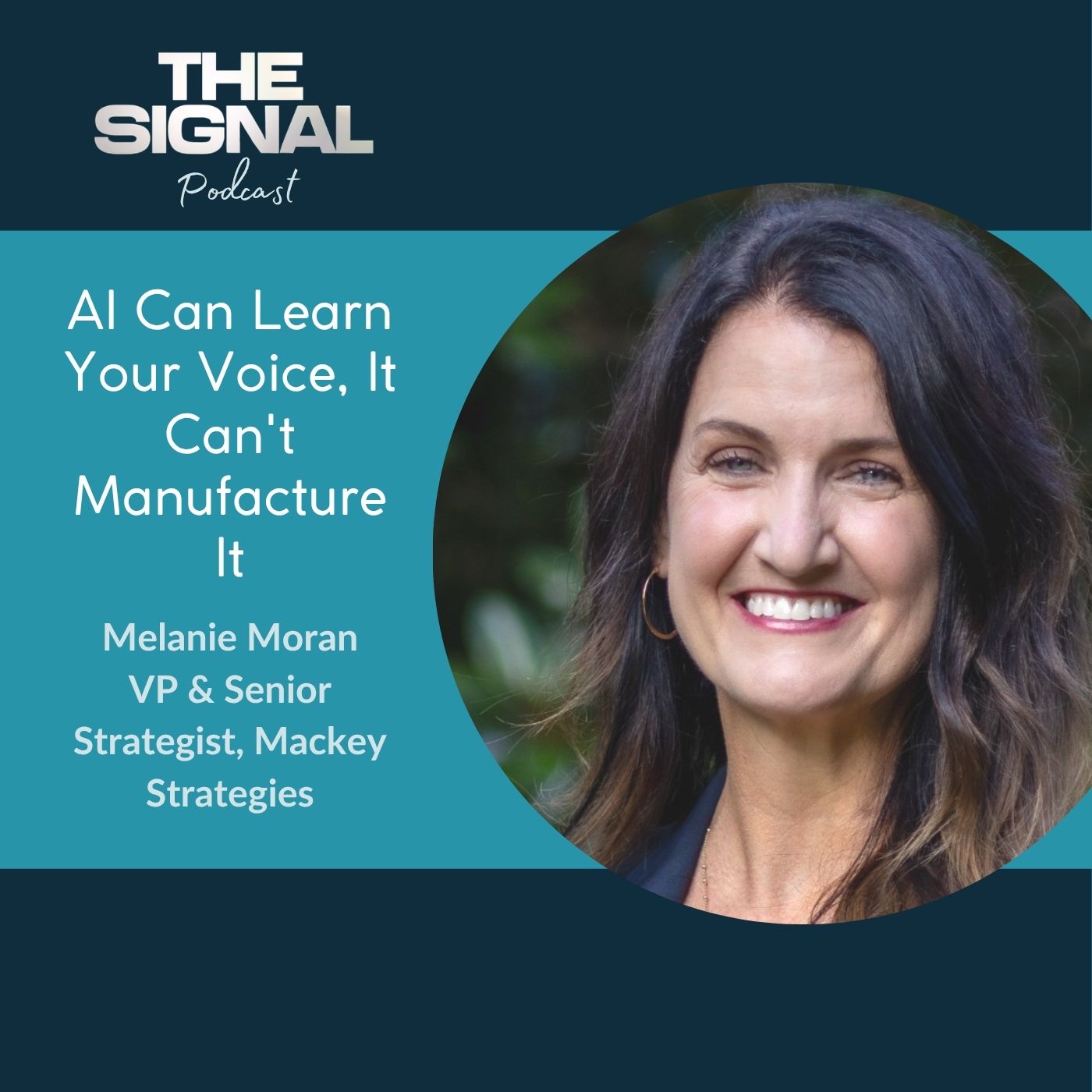
[00:00:00] Melanie Moran: When we're thinking about AI and the question is this replacing communicators, that's not the right question. I think the question is how can we help communicators free up time to think more strategically and think bigger picture? And that's AI does give us the opportunity to do that by handling some of the more repetitive, lower value work. And really that's something that most, if not all communication shops desperately need is that capacity to think strategically.
[00:00:29] Jeff Dillon: Welcome to another episode of the Signal.
Today's guest has been focused on a topic that is only getting more complicated, the relationship between campus communications and college athletics and how institutions manage brand reputation and crisis when those two worlds collide. Melanie Moran is vice president and senior strategist at Mackey Strategies. Before joining Mackey, Melanie spent nearly two decades at Vanderbilt University, rising to associate vice chancellor for university relations.
There she led executive communications, media relations, digital and social strategy, and alumni communications, including launching Vanderbilt's first major social media channels and the governance practices that follow.
Earlier in her career, she served in Tennessee state government, including as assistant to the governor for communications.
Across more than 25 years, Melanie has helped college presidents, boards and public sector leaders communicate through growth, change and crisis, always grounding the work in trust, judgment and clear strategy.
Welcome to the show, Melanie. It is great to have you today.
[00:01:43] Melanie Moran: Hey, Jeff, thanks so much. It's great to be here.
[00:01:45] Jeff Dillon: Well, let's start by talking about, I want to hear a little bit about your perspective from your background. You've worked in higher ed across many campuses for over 25 years in state government. Now you're on the consulting side. Tell me one story from your career that still makes you laugh.
[00:02:02] Melanie Moran: And the story that comes to mind is I was working in the governor's office for the state of Tennessee and we had planned a press event having to do with a new state park, bicentennial mall state park that we were launching right at the foot of the Capitol. So the state capitol in Nashville sits atop a grassy hill. And I had arranged with a local school to send school children to the event so there would be a nice backdrop, the kids could be there with the governor. And, and about half an hour before the event, I got a call that the bus wasn't coming, the kids weren't going to be there. And I was already down at the event, TV was getting set up and I looked up the top of that hill and I saw another school bus there. And I just took off running up the hill in my suit, up this grassy hill about two football fields long found the teacher and said, we're having an event with the governor at the bottom of the hill. Could you get your kids on the bus and bring them down to be part of it? And for some reason, this teacher agreed to do it. So the kids piled on the bus, they came down, they stood behind the governor, and we had our press event.
And it just. When my boss at the time said, when I looked over and saw you running up that hill in your suit, I was like, that epitomizes Melanie. She just wants to get it done. So that one always makes me laugh.
[00:03:22] Jeff Dillon: That one's good. It's a great reminder that I think communications careers are built on plenty of moments where the plan and reality don't quite line up.
[00:03:31] Melanie Moran: Yes.
[00:03:32] Jeff Dillon: And then you went on to spend nearly two decades at Vanderbilt, eventually seeing the institution from, you know, one of its senior communication seats. I imagine your understanding of what the job actually is changed along the way. What surprised you the most about how differently communications work looks from that C compared to when you started?
[00:03:54] Melanie Moran: I would say when I started, I was focused on how can I write the best story or how can I produce. A great podcast came along back in those early days. How can I get the best media pitch? And as. As the work went on and as I grew in my career, I realized it was less about what I could produce and more about judgment, about strategy, about relationships, and about building trust.
So there will always be the products and there will always be the messaging. But really, communications has its most value when we are exercising good judgment to protect the institution, to promote it, to preserve the relationships that make universities what they are, and to do so in a way that is collaborative and ensures that all the people who need to know what's happening have not only are aware, but have had an opportunity to weigh in.
[00:04:47] Jeff Dillon: Yeah. And from your recent experience, you really have this interesting perspective, I think, from the outside.
Let's talk about athletics. You know, athletics can look almost like a separate company operating inside the university, with its own audiences and media relationships and personalities and its own cadence and pace, but ultimately, it's still carrying the name and the reputation of the institution. After spending 18 months right in the middle of both these worlds. And I think you just wrapped up this assignment as the interim head of athletic communications at Vanderbilt. What do people outside the industry misunderstand about how campus information and athletics communications actually work together?
[00:05:32] Melanie Moran: The sheer volume of athletics communication surprised me coming from the university. Certainly the pace and volume was high there, but with athletics, it is a whole different ball game. Pardon the punishment. There is constantly something happening, there is always another game. There's 17 sports in Vanderbilt's case, so the pace is just non stop. It's after hours, it's on the weekends, it's around the clock.
So there's always content to be generated, stories to tell and opportunities really to make the most of. It's also really its own huge, as you said, operation in its own right. There's broadcast, we're broadcasting live events multiple times a week. There's extensive social media and extensive media relations.
And really one of the biggest differences is just the audience. The audience is gigantic for athletics in relation to the university. And they will show up in good times, they will show up in bad times, they will be highly engaged, they will want details on every single little decision and action and activity. So kind of the appetite, presence and engagement of the audience is totally different and exciting in a way. It also is daunting because there's really never any downtime. But what doesn't ever change is, as you said, it's the same university name on the buildings and on the jerseys. So you are always representing, in this case Vanderbilt. And it's absolutely essential that neither side ever loses sight of that. The best operations work hand in glove and understand that both opportunities and challenges affect both athletics and the university equally. And it's in everybody's best interest to coordinate closely and work together.
[00:07:20] Jeff Dillon: I imagine that's one of the balancing acts that you saw firsthand. Athletics needs the ability to move quickly and speak authentically to its own audiences. But the public doesn't really distinguish between the athletics brand and the university brand. When something goes wrong at some point that can become a liability, I think if the two sides aren't connected. Where does that separation serve an institution well? Where does it start to work against it?
[00:07:49] Melanie Moran: Separation makes sense really operationally. Athletics has its own rhythms, it has its own schedules, it has really its own demands. So operational decisions, quick turn decisions about what content's being planned, who's covering it, staffing, all of that really makes sense to be as close as possible to the program, to the coaches and to the athletic director.
It doesn't make sense for branding or strategy to really be separate from the university. I think that the universities that do it the best are tightly aligned. When you're thinking of that athletics program, you're also thinking of the university and the pillars of the university. The core values are reflected always in the athletics program. And I think that's something, I'm biased, but I think that's something that Vanderbilt does particularly well when you get into trouble is when there aren't the relationships necessary to make all this happen. Where you really are siloed, where communicators on campus don't know or understand athletics communications and vice versa. So you don't have a shared language or even really the relationship to come together to take advantage of the big exciting moments and also then to handle the difficult moments.
[00:09:02] Jeff Dillon: Yeah, I think this is where the separation we're talking about can really disappear almost instantly. If a moment that's involving like a coach or an athlete or a press conference might start as an athletic story, but once it takes off online, the university's name is really attached to it and the audience gets much bigger. And at that point I think the speed matters, right?
[00:09:25] Melanie Moran: Absolutely.
[00:09:26] Jeff Dillon: So does knowing who has the authority and the judgment to make the call. Like who should actually be in the room managing these broader reputation issues.
[00:09:38] Melanie Moran: Yeah, when reputational issues arise again, you don't want to be first meeting or getting to know your colleagues across campus. In that moment, relationships are what you're going to rely on so that you've talked in advance, you have agreement. Who handles crises like this? Who gets the phone call? How will we work together? So doing the work ahead of time is always going to be the answer when it comes to crisis. And then really importantly, before you decide what should we say? It's what do we know? Who knows what really happened here? What are the facts? Can we get those as complete as possible while understanding still of course, the need to move quickly and getting everyone on the the same page to understand what happened and given what happened and what will we do about it and then what will we say about it. Those things happen boom, boom, boom very quickly. But we don't skip ahead to what are we going to say before we really understand what happened and what are we going to do based on our values?
[00:10:39] Jeff Dillon: You know, athletics has always been highly visible, but now we have athletes building their own brands and the conferences are shifting and money is moving differently and stories that they can become national news almost instantly. And it seems like the old model of central communications over here in Athletics communications over there gets harder to maintain.
How should a university central communications office and its athletics department be working together
[00:11:12] Melanie Moran: differently because of that one just earlier? So establishing like regular check ins, regular cadences, tracking issues that might be bubbling up as well as opportunities so that you're developing strategies together. Each team has expertise the other needs. Athletics communications understands what's happening with the coaches, with the programs, with the Players, with the student athletes, with the huge audiences that are following University Central might have better resources when it comes to reaching audiences that aren't athletics audiences, or when it comes to maybe bigger campaigns or social media. So leaning on one another and having a real sense of who is the expert that we can deploy to address this issue and how can we really complement one another's strengths.
And then all of these things with athletics now with nil, with revenue sharing, working together with the leagues, with legislation, it all touches everything that the university does. So it's government relations, it's reputation, it's admissions, it's student life, it's all interwoven. There really is no separation anymore. So again, just keeping those lines of communication very open, establishing like regular check ins so nobody's surprised when something comes up. You've already discussed it, you're ready to go, because you know what your approach will be.
[00:12:39] Jeff Dillon: Institutional knowledge, I think we all agree, is incredibly valuable, especially in higher ed. But after you've been inside an organization long enough, some things can start to feel inevitable simply because that's just how they've always been done. An outsider doesn't have a history. This can be a disadvantage. But it could also give them permission to ask questions that people inside the institution may have stopped asking.
You've done a lot of fractional and interim communications leadership for institutions in transition. What does a university get from bringing in outside strategic council that it genuinely doesn't get from someone who's been inside the building for years?
[00:13:21] Melanie Moran: I think first of all, a fresh perspective and a perspective that's grounded in what in this case I have seen at many other institutions that can apply to what's happening at the host institution. So that fresh perspective, once you aren't enmeshed in the issues for years and years, you can really have some new insights that it's hard to have when you're in house. Secondly, because these roles are by definition temporary, you are not necessarily caught up in some of the politics and baggage that might exist when you've been working with colleagues for years and years. So you can have kind of tougher conversations because you're an outsider, because you have this fresh perspective and because you're not necessarily balancing so many political considerations.
And honestly, that I think is why institutions often will bring in that outside perspective, because it can be sometimes almost impossible, depending on the culture, to have those conversations clearly and really make progress on the issue that you're trying to solve. Because there's just. People are often too careful. But it is important and anytime I've had the opportunity to go in and work with a team on a fractional basis, the first thing I do and I continue to do is to listen and ask lots and lots of questions. Because often if I'm brought in as an interim leader, it's because there's been some kind of turmoil or disruption or a leadership gap, perhaps, and the teams and the administration really need someone to both assess the situation, but take care of that team and find out what they need, provide mentoring and guidance and sometimes advocacy to get things back on track.
[00:15:10] Jeff Dillon: I want to move into kind of a side topic here of crisis communications. One thing I've noticed about crisis communications is that the specific crisis almost matters less than how leadership responds once the pressure hits. The facts might be completely different, but suddenly you're dealing with this incomplete information, competing advice, or a very compressed timeline and a lot of emotion. This runs through your entire career, from state government to Vanderbilt to your work today. Is there a common thread in how the best leaders you've worked with actually handle a crisis moment, regardless of its size?
[00:15:49] Melanie Moran: Yeah, I think it's really three things. Number one, they don't panic. They create enough space to understand what really happened. And they give their teams and their staff the confidence to know that we're all in this together and that the leader will support them as we manage through the crisis.
Also secondly, they're willing to hear information that they don't like. The strongest leaders I've worked with ask what do I need to know? Not how do I make this go away?
And third, they understand that trust is currency in a crisis.
Trust and upholding your values are foundational and can get lost.
I've seen it happen in the midst of a crisis. So your job as a leader and the best leaders know that getting through this crisis is not for tomorrow, but it's for the institution's reputation for next year, five years, 10 years down the road. So maintaining trust and credibility is much more important in the long term than just getting through the latest news cycle.
[00:16:50] Jeff Dillon: Yeah, let's talk a little bit about AI. AI is obviously touching almost every part of higher ed right now. And communications is one of those places where the temptation to move fast is really strong. You could produce content faster, summarize information, monitor conversations, and automate all kinds of work. But communications is also really about judgment and context and trust, which are harder to hide, think harder to automate. Where do you think it's really helping communicators do their jobs? And where do you think institutions are Getting ahead of themselves.
[00:17:26] Melanie Moran: I think AI is great for getting past the blank page, for synthesizing information, testing ideas, handling some of that lower value, repetitive work. It certainly has tons of value.
I get nervous when we outsource judgment to AI or when we give over entirely leadership voice to it. Absolutely. AI can be trained to mimic voice, but I think it's still super important for leaders who are in public roles to be seen and to actually have authentic messaging, authentic voice and relationships. Those are things that communicators bring to the table that I would be very nervous about outsourcing to AI.
And really, when we're thinking about AI and the question is this, replacing communicators, that's not the right question. I think the question is how can we help communicators free up time to think more strategically and think bigger picture? And that's AI does give us the opportunity to do that by handling some of the more repetitive, lower value work. And really that's something that most, if not all communication shops desperately need, is that capacity to think strategically.
[00:18:34] Jeff Dillon: Yeah, I think the skills that make someone a strong communicator, they're not necessarily the same skills that really prepare them to lead communications organizations. As you move up, the job becomes less about producing the work yourself and more about judgment and relationships and managing people and knowing when to speak up. You've mentored a lot of people through that transition and you've said that mentoring is some of the work you're the most proud of. What's the piece of advice you find yourself repeating most to communicators who are trying to step into bigger roles?
[00:19:10] Melanie Moran: Yeah, I think often those communicators that are on a trajectory and they're, they're clearly stars and they have the opportunity to lead, they got there by being the best individual contributor. But being the best individual contributor is not going to get you to the next level. And it really hasn't even really prepared you to lead.
So when I'm talking to people who are at that point in their career, I really urge them to shift their mindset from what can I produce to what is the thinking behind it, what is the strategy behind it? What is the thing that only I can bring to this? And that kind of gets to AI as well. What is it about the work that I do that is different?
And it's not the product, it's really more of the process and thinking. Secondly, it's again, if you've been a really strong individual contributor, you might have been laser focused on your particular area.
And now's the time when you're ready to move up to learn the business of the institution, understand what the president, the provost, the athletic director, the advancement leader is actually trying to accomplish. What pressures are they under, what motivates them, and how can the work you do and the work that you lead help advance those goals?
And again, like a broken record on this, but it's investing in relationships before you need them, learning from others, building trust over years is what allows you to really perform well and get that next role when you're ready to step forward. Out of being the best writer, the best social media person, the best videographer, into the leader.
[00:20:43] Jeff Dillon: None of the pressures, I think, seem likely to be easing up anytime soon. On universities, you've spent enough time in this field to see communications teams adapt to some pretty dramatic shifts before.
So I want to wrap it up with this question. As you look at where campus and Athletics Communications are headed over the next few years, what makes you optimistic, and what's one thing you think the field still has hasn't figured out?
[00:21:12] Melanie Moran: I think one of the things that makes me optimistic is my most recent experience. I've spent the last year and a half working at a fast pace with a group of really talented, creative young communicators. They understand the audiences and they understand the platforms instinctively, and they love what they do.
So that energy, creativity makes me optimistic because there are so many great stories to tell. We are so fortunate to work in higher ed, and so to have people who want to dedicate their careers to doing that, that's exciting.
What worries me is really the pace. And I've seen this everywhere I work and with clients is really no matter the institution.
Ever since COVID we've asked communicators to produce at an extraordinary pace that can lead to burnout, and it also just kind of sucks up the room that we need for strategy development and actual thinking. So it's always going to be a puzzle for how do we create time for folks to take a step back and think and be strategic and be creative and not just absolutely constantly running to meet the latest deadline. I don't know that we've fully figured out the relationship between institutional and athletics brand, but I do think there's huge opportunities on both sides. Collegiate athletics will probably look very different in the next year, and we don't know yet what that will look like. But I think the smart institutions and the ones most likely to be successful understand that the two will be stronger always together. And I find that interesting. And I'm excited to see kind of what comes next.
[00:22:47] Jeff Dillon: Well Melanie, this has been a great conversation. I really appreciate your perspective, especially having seen communications from so many different seats government, Vanderbilt, and your work at Mackie Strategies. Now, I think your point about judgment and trust really runs through everything we've talked about. So thanks for joining me on the Signal. We'll put links to Melanie's profile and to her Mackie Strategies website in the show notes. And thanks again, Melanie.
[00:23:16] Melanie Moran: Great. Thanks so much, Jeff.
[00:23:19] Jeff Dillon: That's a wrap of this episode of the Signal.
If today's conversation sparked a new idea or challenged your thinking, that's exactly the point. This show is about cutting through the noise and helping you see what's actually shaping higher ed right now. Please subscribe so you never miss an episode. And if you found this valuable, leave us a quick review. It helps more higher ed leaders find the Signal. For deeper edtech insights, news and trends delivered monthly, subscribe to to the Signal monthly
[email protected] thanks for listening. We'll see you next time.