[00:00:00] Jay Gonzalez: We, a little over a year ago established the Neurodiversity center for Excellence, where we're creating new programming to support neurodivergent students on campus. But we're also trying to broaden our impact and reach markets outside of Curry, whether it's through partnership with other schools, employers, a lot of interest among employers to better support neurodivergent workers. And we are partnering with big biotech companies and health insurance companies and others to support them in doing it.
[00:00:36] Jeff Dillon: Welcome to another episode of the Signal,
[00:00:38] Jeff Dillon: the show where we explore the technology
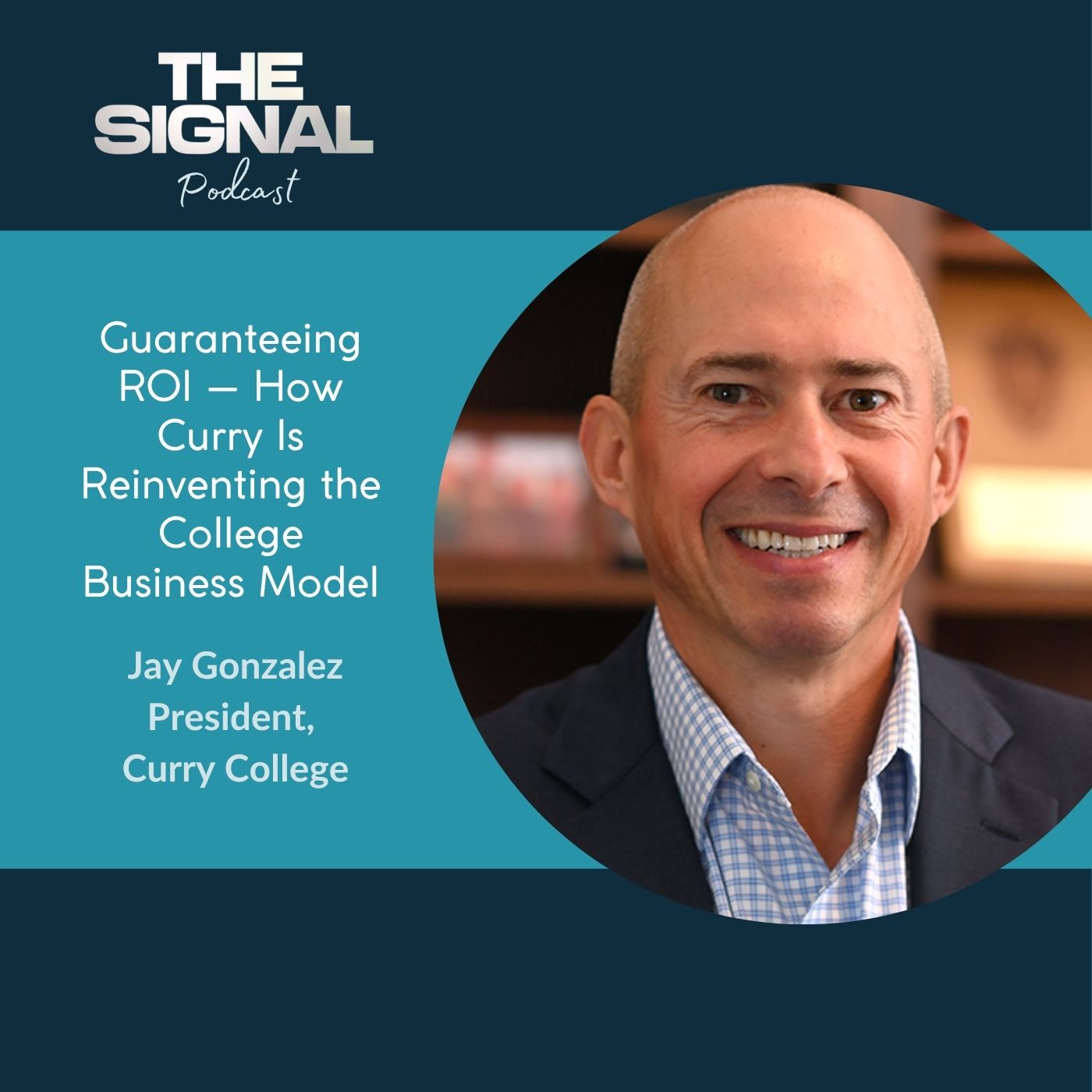
[00:00:40] Jeff Dillon: shaping the future of higher education. I'm your host, Jeff Dhillon, founder of EdTech Connect. Today's guest is someone who genuinely defies the typical college president mold, and that's exactly why I wanted him on the show. Jay Gonzalez is the 15th president of Curry College in Milton, Massachusetts, and the institution's first Hispanic leader.
Before arriving At Curry in 2023, Jay ran a $32 billion state budget as Massachusetts Secretary of Administration and Finance. He led two health care organizations as president and CEO, practiced public finance law as a partner at two prominent firms, taught law at Northeastern, and ran for governor of Massachusetts. He holds a BA From Dartmouth and a JD From Georgetown Law. At Curry, he's moved fast, launching a bold strategic plan, creating the Curry Commitment Job Guarantee program, investing in neurodiversity support, and building a new innovation infrastructure.
[00:01:45] Jeff Dillon: Welcome to the show, Jay. It is really great to have you today.
[00:01:48] Jay Gonzalez: Thanks for having me. Great to be with you.
[00:01:50] Jeff Dillon: Your resume is like unlike any college president. I've come across a gubernatorial candidate, a $32 billion budget manager, a healthcare CEO. What's the most unexpected skill from one of those past lives that you find yourself using at Curry almost every day?
[00:02:11] Jay Gonzalez: Well, yes, I'm a very unconventional candidate for this gig. For sure. I didn't make my way up through academia, but I would say the thing that I had an inkling would probably be valuable from my past experience, but it was much more so than I thought was my experience in government.
One of the things about higher ed that has turned out to be very similar is power is diffuse and there are lots of different stakeholders and interests. You've got the board, you've got faculty who have some shared governance authority and responsibilities.
You've got students, of course, and their parents and donors and alums and all kinds of different folks who care a lot about the place. And one of the things in my experience in government, where I served as one of Governor Patrick's former governor of Massachusetts cabinet secretaries, is nobody's totally in charge. And that's true of college president. You need to really understand what does everyone care about? What are their interests? And if you know you're trying to get to this place, what's the way to get as many of those folks engaged and on board to get as close as that to that place as possible? And government works that way. Higher ed is more similar than I would have imagined coming in. And I think that background and experience has been helpful.
[00:03:40] Jeff Dillon: Yeah, I totally agree. I see the same thing. It's such I've worked in different industries and it's the most decentralized with the most audiences we're trying to satisfy out of any industry I've worked in. And I think we're seeing a real inflection point right now with families. They used to ask, you know, what will my student learn? Now they're asking, what's my actual ROI on a $200,000 tuition? And it's forcing institutions to get honest about value proposition. And it's extending to every operational decision, including how you allocate budget. So I'm curious, families and students are asking harder questions than ever about whether a college degree is worth the price tag. How is that pressure reshaping the decisions you make about where to invest, including technology at Curry?
[00:04:26] Jay Gonzalez: So it is definitely the thing that students and families care most about. They're saying, if I'm going to spend all this time and money getting a four year degree, what you do, what's the job I'm going to get at the end of the day? So I think in some ways higher ed has responded with the argument for higher ed. There's a premium on earnings if you have a four year bachelor's degree, which is still the case.
Liberal arts education prepares you for lots of different jobs and to be better citizens and all that. All of which is true. But I think we need to do more than just make that argument. I think we got to hold ourselves accountable for delivering that return. That's what students and families care about. So at Curry, we've been really focused on our fundamental mission, which is graduating students prepared for career and life and doing a better job of ensuring we are doing everything we can to make sure we retain and graduate every student and deliver on our mission for every student.
So you asked about how are we investing in technology to support that. You know, one of the things we've seen is students will sometimes not make it through their experience at Curry because of mental health issues as an example. And so we have recently invested in a solution where students can access a provider, a mental health provider, 24, 7 through a partnership we have through a platform that we now offer.
We also are investing in a platform offered by one of our vendors that will allow us to house all the disparate data we have on all our different students in all kinds of different places in one system where everyone can easily access it anytime they want to know anything about a student, it's all right there.
And this platform also has, you know, uses AI to do predictive analytics around students that might be at risk so that we can intervene before they really face challenges with the hope of ensuring we're keeping them on track and doing a better job of ensuring their success.
One of the other things at Curry we're doing to speak to the ROI issue is the Curry commitment, which is a job guarantee. We basically said, as long as a student meets certain minimum requirements and engages in the career readiness infrastructure that we're investing in, we will guarantee they have a job within six months of graduating. And if they don't, we'll pay their federal student loan for up to a year or give them free credits toward one of our grad programs. And we are one of the only colleges in the country to do anything like that. And so we are holding ourselves accountable to deliver on that roi.
And I think it's what students and families expect today.
[00:07:22] Jeff Dillon: Wow, that's incredible. You know, talking about mental health too support, it's become such a critical part of the student experience.
It's almost table sticks, I think for colleges.
And I think it's an example of what I want to dig into a little bit here is most college leaders have spent their entire career inside higher ed and risen through the faculty ranks. And they've done the provost stint and they've seen the world through this academic lens. But you're an outlier. You spent your career in law and government and healthcare. And I think that give you the permission to ask questions that traditional higher ed leaders might not even see as questions. So how has that outside perspective changed in how your how you're operating and how you're using technology?
[00:08:08] Jay Gonzalez: So I'm not that well informed about how somebody who's come up through academia would approach those types of issues or what questions they might ask. But I think a couple of things from my background that have in terms of the approach that I take and the lens through which I see this work. One is the political experience. I have working in state government. Haven't been a candidate for office.
This is a very political job.
Being president of a college, both for some of the reasons was talking about before in terms of understanding the different interests and how to move the organization forward. But even just being a presence, a public presence on campus, developing external partnerships, fundraising, there's experience from the political experience I have that I think is really relevant to the job here.
The other is just bringing a business and financial lens to the work. When I was in the leadership position in state government, it was during the Great Recession, I was responsible for overseeing the state budget, ran a health insurance company that was facing various financial challenges. So everyone knows the higher ed industry is facing a lot of headwinds right now. Curry is no exception to that. And bringing that experience and mindset focus on sustainability.
You know, the whole no, no money, no mission is a really important part of the job.
And you know, how do we leverage technology to help support that? Sustainability has been part of, you know, what we've been looking at here at Curry and has to be part of our solution. So, you know, I mentioned retention of students and delivering on our mission for them and some of the technology platforms we're using to help support gifts, getting better outcomes there, that translates to revenue. You know, if we keep a student into their second year, into their third year, into their fourth year, till they graduate instead of losing them after the first year, that's three years of additional tuition revenue that we wouldn't have otherwise had.
So it not only helps us deliver on our mission, but it's a strategy for ensuring the sustainability of the college.
[00:10:20] Jeff Dillon: I think this Curry commitment is, is audacious. Most colleges talk about career outcomes and alumni networks, but they're making promises they never really have to keep. So you're doing something different. You're putting a guarantee on the table. And that's really a fundamentally different business model because you're accountable.
So a job guarantee, walk us through how that actually works. And what role does technology play in connecting students to employers and tracking whether that promise gets kept?
[00:10:50] Jay Gonzalez: Yeah, so as I was saying before, this is a two way street. We're making a big commitment to our students saying, we're guaranteeing you'll have a job within six months of graduating or we'll put our money where our mouth is if you don't. But we are requiring that they do some stuff.
They have to maintain a minimum gpa, they have to do an internship or have some experiential learning opportunity.
They have to graduate in four years. They have to engage with our career readiness programming, which is all about ensuring they have the eight NACE competencies for career readiness.
And it can include a bunch of the kind of blocking and tackling stuff like mock interviews and resume writing to, you know, communication skills, networking and events, that kind of stuff. I'm not in the weeds on all the different technology that our career and experiential learning center leverages, but it's got to be like 10 different applications helping with different parts of tracking student participation in that programming, connecting them. As you said to employers, I think we use handshake as a platform to connect our students to internship employment opportunities and to engaging with employers who are participating.
But we also have learning modules, career readiness learning modules that we're leveraging to support this work. Virtual mock interview type platforms, and a number of different technological applications that are supporting the work that our career center is doing.
[00:12:30] Jeff Dillon: Right, right, right. I think, you know, Curry has a long legacy of supporting students with learning differences.
And now you're doubling down with the Neurodiversity center for Excellence. How is technology reshaping? What's possible for neurodivergent learners? And what does truly inclusive design look like in practice?
[00:12:53] Jay Gonzalez: Yeah. First of all, Jeff, I just want to say thank you for knowing so much about Curry College.
[00:12:59] Jeff Dillon: You've done your homework. I do my research.
[00:13:01] Jay Gonzalez: You've done your homework, and I appreciate it.
So you mentioned Curry has a long standing history in supporting students with learning differences. We are the first college in the country to have a program of that nature. Started 55 years ago. It's called our program for Advancement of Learning, the PAL program.
And we are still known as one of the best colleges in the country for supporting students with learning differences. It is the neatest part of Curry. I mean, tons of students who've gone through it, parents of students, and it is truly game changing for them. And they go on to flourish here and do amazing things when they graduate.
We knew this is the most special part of Curry. As you mentioned, we a little over a year ago established the Neurodiversity center for Excellence, where we're creating new programming to support neurodivergent students on campus, both. But we're also trying to broaden our impact and reach markets outside of Curry, whether it's through partnership with other schools, employers, a lot of interest among employers to better support neurodivergent workers. And we are partnering with big biotech companies and health insurance companies and others to support them in doing it. So a lot of really exciting stuff happening at Curry in this area. And in terms of technology on the student side, we have A lot of assistive technology for neurodivergent students that help with things like how they study, how they organize their work, process related stuff. It's assistive technology that helps with like text to speech and vice versa, note taking.
And then we've got, you know, executive function type supports like digital calendars and task management type systems that help support our students who need some help with executive functioning issues. So there are a lot of different technologies. We've got this. I can visualize this wheel of supports that we show students and families in our programs that has like 20 different types of assistive technology applications that Curry leverages to support our students. The other thing we're really interested in for your ed tech friends is there are certainly opportunities for neurodivergent workers or students to be supported through technology as opposed to the kind of one on one supports that we use assistive technology. But our program is primarily based on a coaching type support leveraging AI to help with a lot of that support. We're really interested in partnering with companies looking to develop products in that space where we could leverage Curry's expertise in this area and understanding of the type of support neurodivergent students and workers need to be successful at school or in the workplace to partner in developing products that might reach many more people and broaden impact at a higher rate.
[00:16:14] Jeff Dillon: Yeah, you led me right into my next question. This is about right when we get into AI. If I can hold it off through half the podcast or not. Where it's the one thing every college is wrestling with right now, but they're all pulling in different directions. Faculty are in a defensive mode, worried about academic integrity and whether the student work is even real.
Administrators are seeing efficiency gains and are excited about. I think where this goes. And students, they've already moved on. They're using it every day, treating like, like another tool. So every institution is trying to thread that needle. But I think your situation is a little different because you can't fake it with a guarantee model. You have to actually figure out what integrity looks like in an AI era. So can, can you dive into that a little, little more? Where does Curry stand? You already talked a little about a little bit. How are you thinking about it both as a tool and as a curricular challenge?
[00:17:08] Jay Gonzalez: Yeah, well, you nailed the dynamic and we have the same dynamic here. You know, there are plenty of faculty worried about academic integrity and whether work product is really a student's work product.
And that's something, you know, we've got academic integrity policies that govern this kind of thing. But it's forcing, I think our faculty to think about different assessment tools and how we, how we ensure that students truly are learning what they should be learning and meeting the learning outcome goals.
Beyond that, we are really trying to embrace AI and encourage our community to lean into it. We launched an initiative we call Amplify AI and it's based on kind of the strategy we've taken as an institution is not some top down solution, but really encouraging people at the grassroots level to experiment and engage with it. So we've got a committee, this task force, Amplify AI task force we've created that has representation of faculty and students and staff, really looking at developing and bringing training opportunities to faculty and staff, which we've had many of.
Some we leverage from some of our trade association groups, organizing forums where people on campus can come together and talk with each other about how they are leveraging AI both in the classroom to improve pedagogy and prepare our students for a world where AI exists and exists in the workplace. And they kind of need to be ready and knowledgeable about how to best leverage it, but also on the business operations side and how are we leveraging it to be more efficient and increase productivity. So, you know, we've got this initiative, we're trying to send the message to people that we need to hug this and discover together the best ways to approach it. We've of course got policies in place and guardrails around how to do so while protecting data and privacy considerations and so forth. But I'm not going to say that we've got all the answers. We definitely don't. And you know, it's something I worry about and want to make sure certainly from the student perspective, that we are doing right by them and preparing them for a world where they're going to need to be able to leverage this tool in the workplace. But also that we're taking advantage of where AI can help us.
[00:19:40] Jeff Dillon: I think students today have a reference point that we didn't have. They've grown up with Spotify and DoorDash and TikTok and everything works, everything loads instantly.
Experiences feel pretty frictionless and they hit the standard campus student portal. And it's like stepping back in time, like clunky interfaces, outdated workflows, not yours necessarily, but in general, paper forms are buried six different places and they notice immediately. And it signals something, I think that the institution isn't thinking about me. They're not thinking about what my experience actually is. And that's a Competitive problem. Because if you're asking students to commit to a job guarantee, you also have to prove you're investing in their experience at every touch point. So I guess how are you thinking about modernizing the digital experience at Curry beyond just the classroom?
[00:20:34] Jay Gonzalez: Yeah, it's such a great point, Jeff. And I'll say I probably personally don't spend enough time thinking about that.
And I'm not.
[00:20:43] Jeff Dillon: Well, granted you are a president. I don't have these conversations with presidents. It's often a CIO or digital director. So more power to you for having this conversation. Conversation.
[00:20:51] Jay Gonzalez: I know our CIO thinks about it. And as a small institution that is resource constrained, there are obviously limits to what we can do. But you're absolutely right. Like even I go on our portal and note and it's clunky. It isn't. It doesn't put our best foot forward. Put it that way. I know one of the things that we are working on and going to be implementing soon is, is a new app that streamlines access for students to everything they need regarding campus life, academic stuff, administrative crap that they need to deal with. It'll all be in one place and easy to access on their phone. And so that, that is one of the things we're doing to address the dynamic that you're talking about. This is a smaller thing, but one of the other things that comes to mind is digital IDs. All our students still have these cards to get into all the buildings and swipe their meals and all that. And we're moving so that it's all digital on their phone. So, you know, that's a small thing, but to your point, it's I think, catching up with the times and just creates one less friction point.
[00:22:07] Jeff Dillon: We've talked about the guarantees you're providing, little bit on the data, the AI, modernizing the student experience, but there's, I think, a bigger strategic thread here. You're not trying to really optimize the traditional college model. We're trying to reinvent what college can be. And one of your five strategic pillars is the center for Innovation, which is essentially Curry saying, we're not going to rely on tuition alone, we're going to build revenue streams. I think we're going to act like an entrepreneurial institution, not just an academic one. And, and I think that's where edtech becomes really interesting. Not as something that happens to college, but as something colleges can actively build and own. So with this pillar of center, center for Innovation, designed to generate new revenue streams, it's this Fascinating concept. A college essentially building an entrepreneurial arm. What does that look like? And what could technology startups or ed tech companies play a role in that ecosystem?
[00:23:05] Jay Gonzalez: Yeah, well, so it's still early stages for us, but the vision behind it is exactly what you described. The other similarity between higher education and government is change happens slowly.
And so to get anything done quickly is hard. And so we intentionally established this space at Curry to be nimble and to try new things quickly outside of the regular approval processes which are very cumbersome for typical academic programs and that kind of thing.
So you know, whether it's non credit bearing certificate programs or professional development programs, you know, one thing we're very focused on through the center for Innovation is reaching different types of student markets. International students for certain programs is something that's been a focus during interesting times.
But this is, you know, I mentioned with our neurodiversity expertise, you know, can we be a part of partnering with ed tech companies or whoever to develop products, the next generation of products that can reach more people and change more lives. So this center for Innovation is intended to be exactly that and to get us out of the typical mode of operation so that we can explore stuff quickly.
And you know, obviously there are going to be things that are outside of our realm and we need to leverage strengths we have and assets we have. We're not going to just try something totally off the cuff that doesn't really relate to who we are. But yeah, this is trying to get our community to think differently about what we can do, how we do it.
And if there are, I'm sure there may be opportunities for ed tech companies in the ed tech world to partner with us on something and try something. And I'm sure they've got a lot more ideas than I do about what that might be. But the answer to whether we're open to considering stuff like that is yes,
[00:25:12] Jeff Dillon: you kind of hint a little bit at limited resources and a big research university has entire departments dedicated to tech evaluation.
They can afford to experiment, absorb the failures, hire specialists. But at the scale, at Curry's scale, you don't really have that luxury. I think you're making bigger bets with smaller teams and smaller budgets. And I think, you know, vendors know that, they know small colleges are really hungry for solutions and under resourced to evaluate them critically. So you got sold a lot of shiny things. I've seen the promise the world and they don't deliver much. And I think one bad bet at your scale can really hurt.
So at college the Size of curries, how do you make smart technology bets with limited resources? And how do you avoid being oversold on solutions that don't actually deliver?
[00:26:03] Jay Gonzalez: Yeah, I think even at a small college, the biggest challenge is ensuring that we are aware of every, all of these pitches that are happening across the college. And we're making a decision as an institution as to whether we want to pursue one solution or another.
And so we have a governance process, we have a committee, an edtech committee.
And any new product that we are considering needs to be evaluated by this committee that has not only some of our IT folks, but some faculty and some staff to kick the tires on and assess the feasibility of any potential solution, what the value proposition is, what the cost is, evaluate it within the context of our strategic priorities and have one vetting place so that all the different solutions that are being pitched to all the different people on our team, people aren't making individual decisions that aren't being evaluated through the lens of our institutional priorities.
And you know, that has generally worked well. There are times where someone has gone off and committed to something before going through this process and, and that is challenging, but we have, as you said, limited resources. We need to make smart decisions, smart and well informed. A decision as we can about whether or not an investment is worthwhile for us. And it needs to be evaluated within the context of our priorities and what our overall interests are.
[00:27:52] Jeff Dillon: Well, this has been really great, Jay. I want to wrap it up with one kind of open ended question here for you. You know, five years from now, if Curry is exactly where you want it to be, what does a student's day look like? What, what role did technology playing in getting them there?
[00:28:08] Jay Gonzalez: Oh, geez.
Well, I'll tell you what, what my hope for a student will be five years from now is that every single student who comes to Curry has a successful, rewarding experience here. That they're getting the, the most out of their academic experience, their extracurricular experience. They're developing close relationships with not only faculty members, but with their peers.
And that they leave here consistent with our mission, educated and well prepared for their career and for a life of citizenship with a global perspective. That's our mission. And so every day for a student, she should be filled with all the enriching experiences that feed those things that I just described. And the extent to which it's spent with hassles, administrative stuff, challenges with their own health, barriers to that experience are minimized. And in every respect, in a student's daily experience on campus, it's enabled in some way by technology.
And we need to, you know, there's no specific, but generally speaking, we need to make sure we're, we're leveraging technology thoughtfully to get that outcome. And that's what we're here for.
[00:29:31] Jeff Dillon: Well, Jay, thanks for taking the time. I think it's clear that you're not just updating the old model, you're asking fundamentally different questions about what college should be. And I think that takes courage. For more information on Curry and the commitment, head to Curry Edu. Thanks again, Jay.
[00:29:46] Jay Gonzalez: Thank you, Jeff.
[00:29:48] Jeff Dillon: That's a wrap of this episode of the Signal. If today's conversation sparked a new idea or challenged your thinking, that's exactly the point. This show is about cutting through the noise and helping you see what's actually shaping higher ed right now. Please subscribe so you never miss an episode. And if you found the this valuable, leave us a quick review. It helps more higher ed leaders find the signal. For deeper ed tech insights, news and trends delivered monthly, subscribe to the Signal monthly
[email protected] thanks for listening. We'll see you next time.