[00:00:00] Arjun Arora: What really motivated me to move away and what I was most passionate about was impact.
So a lot of these enterprise AI solutions, I did not see a clear impact, more of a social impact. So there was yes on paper, business impact and you know, you can deliver the ROI of X number of million dollars saved each month or each year, but there wasn't the human, human side or the social impact piece that I was seeing on a day to day basis. And that's really like what motivated me more towards advising in higher education.
[00:00:40] Jeff Dillon: Welcome to another episode of the Signal, the podcast where we explore the people and ideas shaping the future of technology in higher education.
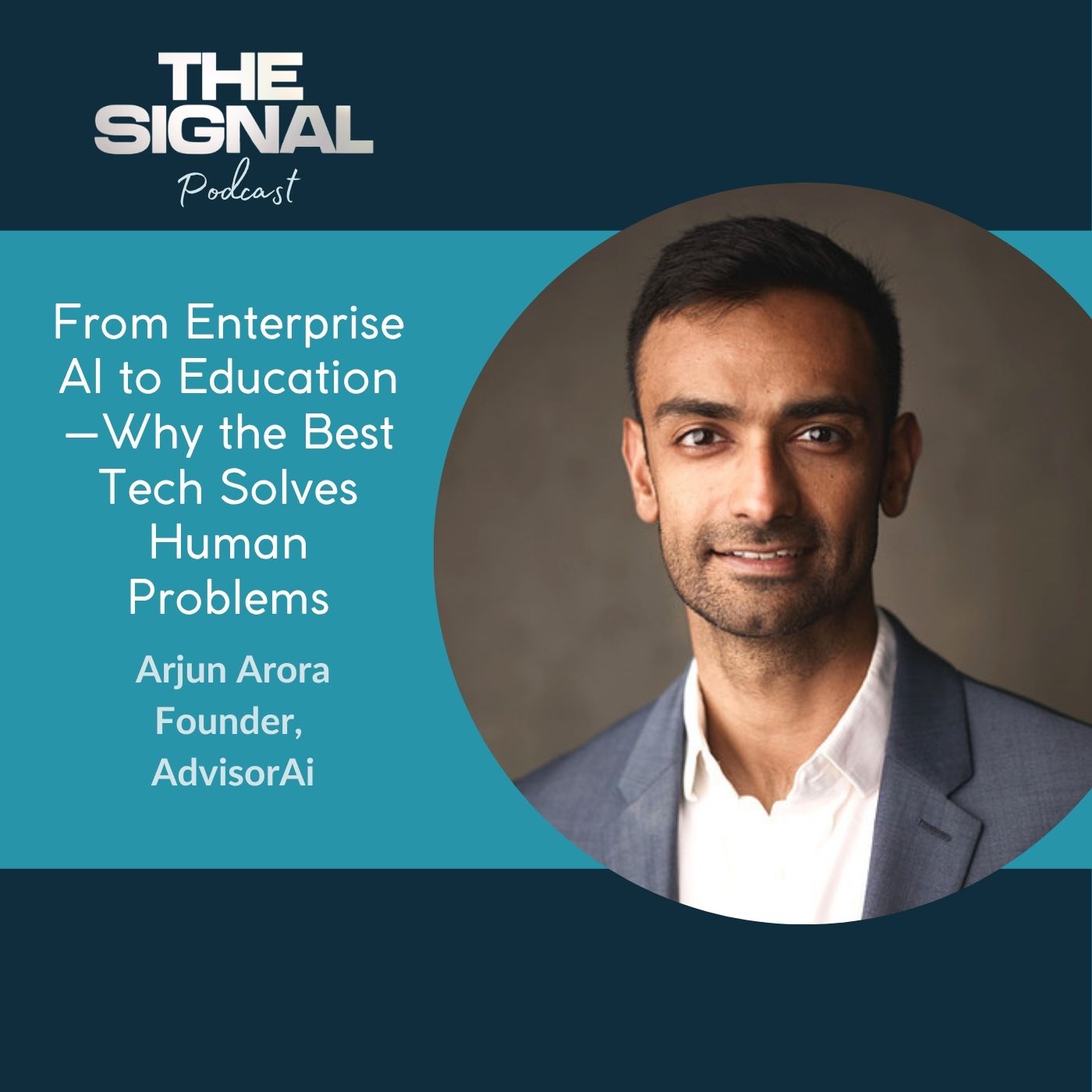
I'm your host, Jeff Dillon, founder of EdTech Connect, and if you've spent any time in the higher ed tech space, you know that student success and AI are two of the hottest conversations on every campus right now. So today's guest is someone I couldn't wait to get on the mic. Arjun Arora is the founder and CEO of Advisor AI, an AI native student success platform built to transform the way colleges support learners from enrollment all the way through to career readiness.
Arjun grew up as a first generation college student, an immigrant and a member of the LGBTQ community. And those lived experiences sit at the heart of everything he's building. With over a decade in enterprise AI, having led more than 100 large scale AI implementations for Fortune 500 companies and organizations like Datarobot and Robust Intelligence, Arjun made the leap into edtech to solve a problem he lived firsthand. Students falling through the cracks because they didn't have the right guidance at the right time.
Today, Advisor AI serves learners and advising teams across more than 100 institutions, powering over a million student inquiries a year.
Arjun, it is great to have you today. Thanks for being here.
[00:02:10] Arjun Arora: Really excited to be on here, Jeff.
[00:02:12] Jeff Dillon: I want to get a sense of, you know, you've worn a lot of hats, you know, data scientists, Enterprise AI consultant, founder. If you had to describe your career journey as a movie title, what would it be?
[00:02:26] Arjun Arora: Yeah, for sure. I really gave it a good thought and I think a movie title would be Obstacle is the Way. There's a lot of books around this topic also and I think it really helps sort of summarize my journey from undergrad and moving from India to the us moving between undergraduate and masters, going through a layoff, going through job transition, going through starting a company.
And I think that sort of all the lessons, obstacles really informed what I do now. Sort of like anything.
[00:03:04] Jeff Dillon: Yeah, I love that.
So Advisor AI was born from your own lived Experience as a first generation college student and immigrant. Can you take us back to that moment? What did the advising gap feel like from the student side and when did you know technology could actually fix it?
[00:03:26] Arjun Arora: I think there's like really two main themes or insights that inform this. The first one really is around like it was not so much a gap, but the experience I had. So actually like my advisor in my undergraduate school at Kutztown University and then at Drexel as well, both of them really informed or helped me figure out what I wanted to do, whether that was moving into data science, asking for a better salary.
So it was much more that the impact it had on my life helped me progress pretty rapidly. On the second hand, as I moved up into leadership roles in AI and technology companies over the last 10 years, I actually saw that once you have the right insight, you're much more likely to navigate and move forward quickly and when you have the right resources. But if you ask, I asked a lot of friends, colleagues, we did research across hundreds of different institutions over the last couple of years.
A lot of people feel stuck taking that next step because things are just so complex. There's like thousands of things you can do. So how can you make that process really simple, which is a great use case for technology because technology can help personalize a set of options and guide you like a gps.
[00:04:47] Jeff Dillon: Yeah, yeah, yeah. You've really had a, a front row seat to AI at the highest levels. And I'm talking about over a decade building 100 plus enterprise AI solutions for Fortune 500 companies. And that's that kind of experience most people spend a career chasing. What's interesting to me is, is not just what you've built, but it's what you chose to walk away from because you don't, you don't leave that world lightly. There's scale, there's money, there's prestige. And you stepped out of it into higher education, a space that's arguably more complex, more constrained and in a lot of ways harder to navigate. So, you know, you spent over a decade delivering 100 plus AI solutions. What made you walk away and why was student success the thing worth betting on?
[00:05:39] Arjun Arora: Yeah, well, so firstly, like, I think there are similarities with enterprises and higher education. Just, you know, things do move slow. There are multiple departments, things are complex.
Adoption of systems and tools is complex. So I would say like starting out, there are similarities. And that's part of reason for our growth over the last couple of years is building up on the similarities.
However, what really motivated me to move away. And what I was most passionate about was impact.
So a lot of these enterprise AI solutions I did not see a clear impact, more of a social impact. So there was yes on paper business impact and you know, you can deliver the ROI of X number of million dollars saved each month or each year.
But there wasn't the human side or the social impact piece that I was seeing on a day to day basis. And that's really like what motivated me more towards advising and higher education.
Because the core impact here is every student or advisor or administrator sort of, it's very. Technology is constantly front and center for a lot of the decisions.
So that's kind of what shifted me towards higher education and what we do now.
[00:07:00] Jeff Dillon: Yeah, you know, higher ed was rewarding for me, I think back to my career over 20 plus years and that's what, what kept me there for so long. But I want to go right at one of the biggest fears I hear from from campus leaders. And it really comes up in almost every conversation about AI. There's these underlying tension, excitement on one hand, but on the other a real concern about what this means for people, especially advisors, who are so central to the student experience. And the question always seems to be it lands in the space of like we're, we're automating support, are we going to automate support? Are we going to replace it? But what's interesting is the schools that seem to be getting this right aren't using AI to remove humans. They're using it to rethink how the humans are going to interact or show up. So is AI going to replace advisors? What's your honest answer to that? How does advisor AI actually change the advisor's role rather than eliminate it?
[00:08:01] Arjun Arora: So for context, like in the last three years I've met advisors across more than 200 colleges, like career services, student success advising teams, as well as administrators from community colleges, public, private, Ivy League, like.
So we have sort of co created the product from the feedback and that feedback is in two areas. Right. So it's not just the positive feedback that we want, something shiny and exciting, but it's also negative feedback I would say, which is I am concerned about my role and how that would shift.
And I think I always like to start off with there is a trend of a lot of miscommunication in the field about what I can do and the impact it can have.
I take a approach of education here. Right. So the first step there is advising, if you think of it like a workflow, right. Is exploration and initial assessment. Then there's some planning tasks, then there is mapping, maybe skills, majors, careers, and then there's evaluating and a continuous cycle of feedback from a human.
So if you think of it like a workflow, technology is great with planning and organizing and summarizing data, but anywhere where it comes alongside being accountable, being aware about what to do next, helping evaluate. Like, I don't know if engineering is a good fit or like finance is a good fit. For me, that's really critical for human intervention.
And I always like to share this, which is products need to be designed to help reinforce this concept. And if they're not built to reinforce the concept from the start, they are going to create this tension and fear that we are seeing. Right. Like a chatbot can replace advisors, which could not be far from the truth. You cannot automate that quality of support and intervention.
That is really critical to education. That's critical for people. Also, like, I'm seeing this on with campuses every week, every other week, that students actually don't want a chatbot anymore. They actually want to go speak with someone because there is a sense of isolation anxiety that is also evolving because these systems are often designed to hook you to just use it more versus really just getting you the answer so that you can go to the next step.
[00:10:35] Jeff Dillon: Mm, yeah, you're, you're in a pretty unique position in this space. You're not just building the technology, you're seeing how it actually plays out across a really wide range of institutions. And it really, I think it powers some of the largest enterprise institutions like the national association of Colleges and Employers, various community colleges nationwide, transforming really thousands of experiences each day. When you look at the data, what's one insight about students or advising team behavior that has surprised you the most?
[00:11:08] Arjun Arora: So I think that this is much more of insight in terms of really finding a good use for technology. And what I have seen a lot of the messages maybe not communicating enough of that. The technology and data will solve all your problems.
And that again, could not be far from the reality of most of the teams we are meeting with each week is technology is really like the system. The chatbot, the career exploration, the advising piece is really like the 30, 40% of this puzzle. The biggest part of actually or insight, I would say to make any program or system successful is effective back and forth and collaboration.
So actually collaborating directly with the advising teams about what are their goals, where do they want to be after six to nine months, are they moving in that right direction? Checking in every month is a clear path to success.
From all ends. And if that's not set up correctly, you could spend extensive amount of time in implementations on training and you could see some interesting data about like the majors or trends or things that are being collected in a system.
But they're never going to be as impactful. Right.
[00:12:37] Jeff Dillon: I'm thinking about the data that data points that get tracked normally, like chatbots that got launched five years ago or so. You know, they say we service 12,000 students this month. And I feel like that doesn't mean much. You know, what are the data points you think that you track that are most valuable?
[00:12:57] Arjun Arora: So stepping back, like our system is a Pathways platform. So it's helping a student from whether high school go into college, college to go graduate, or even alumni could navigate sort of next steps. And so if you think of it like a pathway, each pathway or a plan has milestones. The milestone could be go explore two or three options, map skills, connect with an advisor, connect with.
And so those are very specific milestones for each individual, which is really where often the gap exists. Right. Is planning and summarizing and creating that takes a lot of time. So most people just don't do it or take a while to do it. And that's the data we are collecting, which is, it's a system that's helping the student track and collect and summarize information as they go from all these critical stages. But it's also helping the administration and advisors direct resources, programming and support based on what trends they're seeing. So an example here could be if, you know a lot of students are asking about financial aid, the team can create resources about financial aid and distribute it or bring more visibility there. And so it's sort of this bi directional flow essentially of students tracking, but then it's informing what advisors and administrators spend their time on in terms of programming, curriculum, strategic workshops and so forth.
[00:14:30] Jeff Dillon: Yeah, as I look at what you're doing, you know, ethical AI is kind of embedded within. Within this. It's one of those phrases that gets thrown around a lot, but it's really a core pillar of what you've built, not just marketing. What does ethical AI in higher education actually look like in practice? And what guardrails does advisor AI have in place that other platforms might be missing?
[00:14:54] Arjun Arora: Yeah, like I think ethical AI has been sort of a core foundation for us from day one, really.
I think I also started off from this, I would say misalignment of how technology is designed today, which is it's designed to hook a user, it's designed to make them stay on a platform or stay engaged.
There isn't a clear path or meaningful engagement or metric there. I know a lot of the ecosystem is also incentivized to promote that. Right. So it does make sense why certain things happen that way. But ethically, I sort of stepping back is really defined as systems that are designed and deployed with more thought, accountability, intention around how this data is collected, how the models are trained, how are they deployed, how is it governed. So there's multiple stages essentially in a AI ML lifecycle that have to be measured and accounted for. Couple of main areas that sort of. We also have done recently a lot of workshops around Are, you know, is it, is it actually enhancing human connection or replacing it? Which I think we just talked about, like is there a reinforcement or easy way to connect a student to an advisory? That's one thing we do. And one main area I would say that's a key aspect. Second is risk management.
So giving an incorrect recommendation on a degree plan or incorrect recommendation if someone's not feeling well has severe consequences. So what as a company are you doing actually to not give that information and instantly direct them to a human counselor or support system? Also we have a sort of almost zero tolerance for bias and stereotype and essentially a lot of these toxic questions that may come in where the chatbot will just automatically answer it as I don't have this information or just go and connect with someone. So it's essentially you can create these roles and guardrails to restrict it and be more proactive than allowing a system to act like an advisor or counselor.
[00:17:17] Jeff Dillon: I want to shift to something that sits at the heart of enrollment and retention right now. You've pointed out that nearly half of students leave programs because they don't see a connection to where they're trying to go. It just doesn't feel relevant to their goals.
How can AI help institutions make that connection between a degree and a career feel real and tangible to a first year student?
[00:17:45] Arjun Arora: Yep. I think what we've realized and seen and observed in the last couple of years is that navigating these touch points or resources is really complex. So what I mean by that is I'm Arjun and I don't know where to get started. Especially as a first year student or a high school student. I maybe don't know, like what's the right field? Is engineering the right field? And in engineering I could possibly go into like 100 different directions.
And so where AI system or a system can really help out with is a start off with assessing your interests, then mapping career possibilities to it based on those career options or recommendations.
Automatically mapping that because Arjun's interested in a AI field, essentially mapping AI coursework and then from that coursework, creating a degree plan.
But all of that can now be done in a span of 15 minutes to 30 minutes versus something that would typically take eight to 10 weeks. Right, because you have to go to 10 different departments or you have to go to 10 different websites, labor market onad, the university website catalog. There are so many touch points that by the time someone gets actually familiar with, like where all this exists, you have lost some of the students.
And that's really where the power of technology exists, is it can front load and simplify a lot of the exploration, planning part so that everyone starting off from like a stage six or seven essentially and it's up to of course the individual of like how they navigate skills and next steps. But there's much more clarity of where you're going. There's less overwhelm also because I think when you have a plan, you're much more certain essentially about like what you're getting out of it. And if you need to make adjustments, it also gives you that capability that oh, I have built these skills over time. I can switch to, maybe my technical skills can switch over to a engineering role or becoming a doctor or becoming a lawyer or so forth. So essentially AI systems can also help accelerate transitions within similar or adjacent fields.
[00:20:13] Jeff Dillon: Higher ed is, is famously slow to adopt new technology and I, I see it every day with how institutions evaluate solutions. There's often good reasons for that. But how do you get a skeptical dean or vice president of student affairs to take a chance on, on an AI advising platform?
[00:20:35] Arjun Arora: Yeah, I think I always recommend starting off with the goals and outcome. So I think AI or non AI should be secondary. Right. So it should really start off with are you looking to improve student experience? Enrollment, retention, graduation outcomes, workforce readiness? Like what are those strategic initiatives and AI algorithms? Data are just sort of a technology or a resource to propel the teams towards that. Right. Sort of. Like I look at maybe the analogy here, it could be like I could go to the mall in a bicycle or I could go to the mall in a Ferrari. Right. It's sort of like the tool that's allowing you to get there faster.
And AI is very similar to that which is, it's a Ferrari in a sense of like you can get there very quickly versus like maybe walking or jogging or taking a bike. And so that's my read that's why like often conversation, which is start with the goals and outcome and technology and AI is a part of that equation and how you get there. And often I think maybe a second note there would be that often asking what's maybe the concern and fear or area that advisors are cautious about. Upfront is really helpful because you may be able to help address that. I would say risk upfront itself, which is this is not about just trying out a new tool. There is a clear use case that this can help with.
[00:22:14] Jeff Dillon: I think community colleges are a big part of your user base. In what ways are their student success challenges different from a four year university? And how does advisory AI flex to meet those differences?
[00:22:31] Arjun Arora: Yeah, I would say community colleges have more urgency to adapt and innovate when it especially comes to enrollment and student persistence and graduation outcomes. Right. There's much more competitive nature.
There are much more students require much more resources, capacity can sometimes be limited. And so like there is a small pool of students that they're often navigating or competing with relatively. And so there is more I would say urgency to essentially like innovate and adapt and provide the best service where how we sort of approach configuration or customizations essentially, it's essentially a Pathways platform that is customized to those milestones. So we actually customize this system to that community college's majors, their catalog or data that exists on their website, any admission resources, the milestones that I was referring to.
And so by just means of how the system is customized in that initial 30, 60 day period, it can help a community college that's a two year roadmap. It could have a four year roadmap. It could help with the MBA course. That's a one year roadmap. It could have a business student, an engineering student, an art student. And so because of the design of a roadmap and how the sort of it's a case management approach as well from the administrative lens.
It's adaptable to every institution profile. And often that's what most institutions do require, which I think you may already know.
[00:24:22] Jeff Dillon: Before you built anything, you did something that most founders don't have the patience to do. You traveled. Tell me if I'm right here. You traveled something like 30,000 miles, sat down with people across more than 200 campuses, advisors, administrators, students, and really listened. What did you hear on those campuses that you couldn't have learned from data alone?
[00:24:48] Arjun Arora: Oh, so much.
Everything I know Chef shared on the previous questions is informed by those conversations. Right. Like I think when it comes to students navigating 10 different systems, I did not have that insight. When it comes to advisors having the caseload or navigating also 10 different systems, I did not have that insight. I think the disconnect between what students are looking for, what advisors are doing, and what administrators are sharing is also becoming much more apparent because they're often working in three or four different areas or systems. And so a lot of the insights around just fragmented, complex technology, I was not aware until four years ago or three years ago about that.
[00:25:38] Jeff Dillon: You know, I think we're at a point where the value of a college degree is being questioned more, more than I've ever seen by, by students, by families, by even, even employers.
How do you think AI powered student success tools factor into the larger conversation about whether higher ed is worth it?
[00:26:00] Arjun Arora: I always like to start off with, I see that education is critical and I think there's enough data to support it. There are of course, exceptions and trends around. You can go learn concepts and skills online or through YouTube, but there is much more that a education or a degree provides you than just that course. So I think, like, I always like to start with that definition of scope, which it is really impactful and I think more communication is often needed about that.
Where essentially AI tools can help speed up the question or answering the question around the value of education is that it often takes a really long time to connect the dots. Right. But how this major helps me get better opportunities, what types of skills will I be building? And so a system can essentially help you come up with a plan. It's sort of like opening up your phone and using your GPS to go to the mall. Right. Like I can actually see how much time it will take. What are the stops maybe, or skills I will be building along the way. Right. And if you take that concept essentially that's really like, now I don't have to wait to go to the mall or get there or get to the finish line. I can compare my options up front, which essentially boosts clarity and the value that students might see, see and as well as families, parents, the community might see.
And it also helps the advisors, administrators better support that path because now they're directing resources much more specifically to, oh, Arjun wants to maybe pursue this engineering degree. So let me connect Arjun to the right resources versus maybe just capacity wise, you know, often just sharing, like, here's a checklist of things you can be explored. Right, right.
[00:27:59] Jeff Dillon: You know, a lot of what we talk about in higher ed can feel very domestic, but the underlying challenges really aren't you know, questions around access and persistence and career outcomes, they're showing up all over the world, just in different forms. You know, you are expanding internationally. What does the student success crisis look like globally? And where do you see the biggest unmet need outside of the US So
[00:28:25] Arjun Arora: I think I can sort of share where what we are seeing and the inquiries we are getting every month right now where the trends in the US are very similar to trends worldwide. So across Australia, across Middle east, across Asia, a lot of the students that are reaching out or the administrators from different colleges that are reaching out and sharing their scope and requirements have the same ask which is better career and college planning support.
And one of the maybe more prominent, I would say insights from the last year specifically is that a lot of times they're looking for more integrated solutions.
So something that would help connect again the dots between not just plan a course or plan a degree, but how does it connect careers or labor market information?
[00:29:24] Jeff Dillon: Yeah. Yeah. Well, Arjun, I want to ask you one final question to wrap this up for higher ed leaders who are just beginning to explore AI for student success. What's the one mistake you see institutions make over and over again when they try to adopt this technology and how do they avoid it?
[00:29:42] Arjun Arora: Don't spend too much time on evaluating the and the algorithms.
Spend as much time on what is the goal, what is where will this help which team members are going to be involved because those activities will drive 80 to 90% of the result.
[00:30:06] Jeff Dillon: Yeah. Well, this has been a great conversation. I've really enjoyed it. Not just the technology side, but the way you're really thinking about impact. You know, it's easy to talk about AI in theory, but you really clearly focus on where it actually makes a difference for students and advisors. So thanks for taking the time to be here, Arjun.
[00:30:24] Arjun Arora: Thank you so much for having me on the podcast, Jeff. Really appreciate the time and the questions.
[00:30:30] Jeff Dillon: And I will have a link to Arjun's LinkedIn profile and advisor AI in the show notes. So thanks everybody. Bye Bye.
That's a wrap of this episode of the Signal.
If today's conversation sparked a new idea or challenged your thinking, that's exactly the point. This show is about cutting through the noise and helping you see what's actually shaping higher ed right now. Please subscribe so you never miss an episode. And if you found this valuable, leave us a quick review. It helps more higher ed leaders find the signal for deeper edtech insights, news and trends delivered monthly. Simple. Subscribe to the Signal monthly
[email protected] thanks for listening. We'll see you next time.