[00:00:00] Betheny Gross: The higher ed sector has been primarily focused on the ways in which AI technologies can help us do what we've always been doing. Maybe a little bit faster, maybe a little bit cheaper, maybe maybe even a little bit better. I don't think that we've challenged the technology at scale yet, and I don't think we've allowed the technology to challenge us at scale yet. Obviously, you can point to some studies that say that AI tutoring is, you know, effective and that students benefit from that, the better outcomes. Again, I think that's scratching the surface.
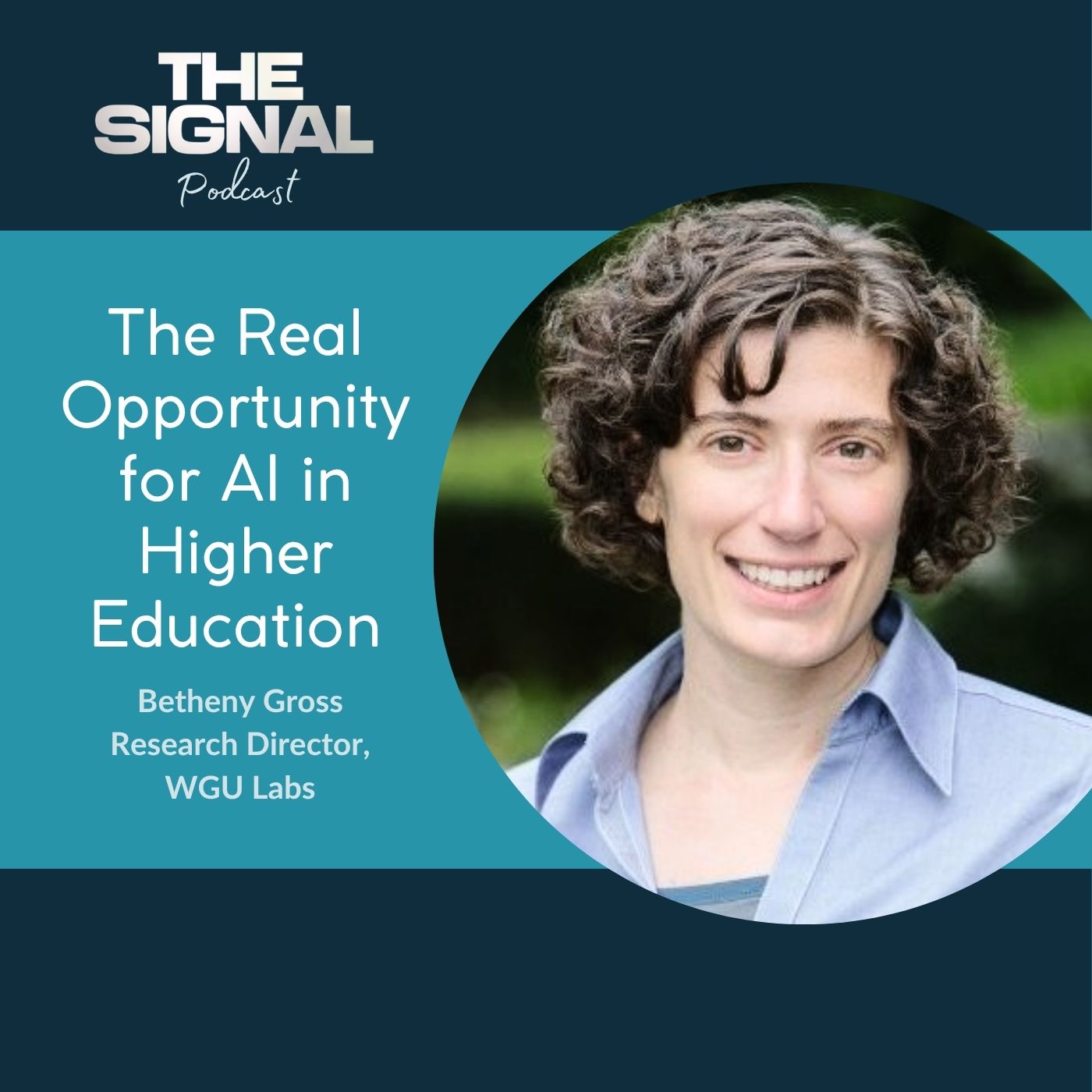
[00:00:34] Jeff Dillon: Welcome to another episode of the Signal. Today I'm excited to welcome Dr. Bethany Gross, Research Director at WGU Labs. Dr. Gross brings over 20 years of experience studying education systems, policy and reform across K12 and higher education.
Her work focuses on improving student access to high quality learning opportunities with a strong emphasis on equity by design, ensuring underserved families have the tools, information and support they need to succeed. At WGU Labs, she leads research initiatives exploring how emerging technologies, including AI, can improve student outcomes. Her work includes innovative tools like stu, a student support chatbot designed to enhance the experience of online learners. Dr. Gross has published extensively in leading journals such as Harvard Law and Policy, Educational Evaluation and Policy Analysis, and the American Educational Research Journal. Her work continues to influence how institutions think about innovation, access and student success at scale.
Hi, Bethany. Welcome to the show. It's great to have you today.
[00:01:53] Betheny Gross: It's great to be here. Thanks for inviting me.
[00:01:55] Jeff Dillon: Well, your career spans over a couple decades studying education systems. What. What first drew you into this work?
[00:02:03] Betheny Gross: First, thanks for mentioning decades. I am. I am not new to this work. That is true. So I think my story is probably familiar in the. In education.
I believe, and have believed for a long time that learning is really how we reach our potential.
It's how we figure out what we're capable of, what we're built to do and who we'll become. And, you know, growing up in rural Pennsylvania, I think I got a pretty early sense that not everybody has sort of the same opportunities and pathways forward. I was very lucky. You know, my family paid for me to go to college. I had a lot of opportunity from there. But I know people who were brilliant, who wanted to be teachers and scientists and could have been, you know, fabulous corporate titans, but they didn't get those chances. And it's not that they didn't have meaningful lives. They did. They're wonderful people. They had wonderful lives and meaningful lives, but they didn't have the choices that I think that they, they could have. Had and probably deserved. And so that's really where I, where I start with education is thinking about what access people have to what opportunities.
And you know, at labs, you know, where I am now, we think a lot about and refer to pretty constantly this 25 million people, 25 million Americans who never pursue post secondary learning at all, not in university, not in certificates, not micro credentials, nothing. And we think what could we do so that those individuals can see a learning pathway that is, that's meant for them, that will work for them, that they can afford to do, and will provide them with opportunity if they pursue it?
[00:03:46] Jeff Dillon: That's really helpful framing, I think, because a lot of institutions are still trying to connect those dots between this big picture strategy and what actually moves the needle for students. I'm curious, when you look at all that work, what have you found are the specific factors or interventions that consistently make the biggest impact on student success?
[00:04:10] Betheny Gross: I feel like that's sort of the million dollar question in education. Right.
[00:04:15] Jeff Dillon: Get right into it.
[00:04:16] Betheny Gross: What changes the course of lives for people? I, I don't think it's one thing and it's probably not even a half a dozen things. It depends on the situation and the circumstances. I do know these things. We have educational systems that are really hard for some individuals to navigate. These systems are not easy, they are complex. There's a lot of different players involved. There are a lot of different steps and administrative burdens on top of just the hard work of going to school and sustaining yourself in learning.
We do not by and large have the systems of support that can help people navigate that experience and stay sort of on track throughout their experience so that they can go on to build opportunity from it. I do know that we have a lot more work that we can do to make the learning experience high quality and effective for every student that we know a great deal about. What makes effective learning, I think we have not yet totally unlocked how to do that at scale and how to do that affordably.
So those are two big ones, I would say.
[00:05:25] Jeff Dillon: You've had this really unique vantage point, I think, seeing what works in theory, what shows up in policy and what, what actually holds up in practice. But I think there's this leap, big leap between identifying the problems and building something that can truly move the needle at scale. And that's what makes, I think, WGU labs so interesting.
Let's talk about what's the mission of WGU Labs and what's one initiative you're most excited about right now?
[00:05:55] Betheny Gross: Yeah, so at WGU Labs, we Like to call ourselves the research and development arm of wgu. Our mission is really to innovate and design new and more effective ways to provide post secondary learning opportunities at Scale at wgu. We're very fortunate to be situated at WGU which is a already a very large scale institution. There are about 200,000 students who are enrolled at WGU and what we get when we combine WGU and the scale that they operate at with sort of this, this mindset towards innovation and discovery at labs and also kind of our small and kind of agile footsteps is that we have this, that we have a place to do a lot of really, really rich real world testing and figuring out what works. So at labs we are constantly taking what we know about effective instruction, we're taking what we know about effective learning design, we are taking what we know about effective student support and assessment, building new solutions. Oftentimes these days with a lot of the emerging technology and giving them to students and seeing how they experience to them, do they work for them? Are we making the experience an opportunity? Are we improving the educational experience and outcomes for students? And we can work really closely with our students who by the way are really insightful about, about all sorts of things related to their, their learning experience and learn very quickly in that, that environment.
[00:07:31] Jeff Dillon: I think it's one thing to talk about in the abstract, the innovation, but it's, it's really another to build something that shows up in a student's day to day experience, especially at a fully online university where Support is really 20247 and that's where it gets really, really tangible. Can you tell us about the stu, the student report STU Chatbot, the STU Studio and what, what problem it was designed to solve.
[00:08:02] Betheny Gross: Right. So stu.
So very early when we started sort of seeing the potential and capabilities of what was coming through as ChatGPT, what you know, a lot of us are working now with Claude and others, we saw an opportunity to fill a pretty big gap and challenge for students, particularly students at WGU who are, I mean they're working adults. These people have a lot going on at any given time and there's even sort of this moniker at wg we call them night owls because you know, oftentimes people are sitting down in the evening after they've put their kids to bed to do their work. The issue that we're finding is that we have a lot of individuals who are first generation college students so they don't have a lot of resources around them and people who just kind of know how to do college. So many of our students need a little bit of extra navigational support. But our support and our information is like any institution kind of all over the place and really hard to find. So we wanted to create a hub for students with this information, a place where they could very readily go ask questions and get answers to things that they needed to do. Everything from I've got a bill that's due, how do I deal with that? To I've got this problem accessing the student portal. Can I get some help? And then we wanted to. We saw this as an opportunity also to fill the kind of like time, the time gap and time misalignment that often exists between our support staff and when they're awake and when our students are trying to do their work and get their questions answered.
So we kind of created this agent that has all of the WG resources sort of in it. We've been working with this tool to kind of build in our understanding and knowledge of the psychology of student success. So what are the, you know, what are the ways in which you can sort of communicate and engage people so that they can stay focused and forward thinking and not get too bogged down in their stress? And then we gave it to students to kind of work with 247 and they did. And it's been great to see that. And I think one of the most interesting things about the experience of testing with this tool, which we call stu, Testing with stu, is that we've actually found that the technology can do so much more for students than we even originally imagined.
So the tool has now been able to kind of help students prepare for meetings that they have with their program mentors, which is our version of a student advisor. So really helping them to maximize every minute that they're spending and engaging with our team of mentors.
Some students are using it to help build schedules for their week, to help help put together study plans, so things like that. So it's really become a kind of, you know, kind of a much more of a Swiss army knife resource. And we see a lot more potential for, for providing that kind of support.
[00:10:58] Jeff Dillon: I love those examples. You spend a lot of time not just building solutions, but really studying systems in your, in your career, looking at how policy, institutions and student behavior all intersect, especially during these moments of really of disruption.
I think a lot of that perspective was shaped during your time at center for Reinventing Public Education.
Looking back on that, what lessons from that center still stick with you and continue to influence your work?
[00:11:31] Betheny Gross: Yeah, I mean, the thing that I always point to is a saying that the center on Reinventing Public Education's founder, Paul Hill used to always say to us, and it really was the orienting frame for the work that we do at serpi, as we called ourselves. And then it's also an orienting frame really for the work we do at WGU Labs. Paul would always say we need to remember that public education is the goal, not a particular set of institutions.
And by that what he really meant is that like, we have an objective.
We need to be committed to making sure that every child has access to a free and high quality education.
And how we deliver that, who delivers that, all of that is changeable, but what is not changeable is our commitment to that goal, our commitment to public education.
And I think at Labs we kind of take the same point of view. We just kind of like translate it to the post secondary innovation space and we say like, our goal is to make sure every individual can see an educational pathway that will work for them, one that they can succeed on and one that they can lift and leverage to find opportunity in the workforce that's unchangeable. Our commitment is secure on that. How we deliver that commitment, what tools we use to deliver it, who is involved in delivering that, that's all to be determined and constantly improved. And that's what we really focus on at Labs is like, there are methods of doing that right now, but those aren't the last methods we need to discover.
We need to keep pushing on that until we have reached that committed goal.
[00:13:10] Jeff Dillon: You gave a great example with Stu just a bit ago, and that's the kind of thing that really cuts through the noise a bit because it's not theoretical, it's actually being used by students. So building on that, when you look at tools like STU and what you're seeing in the field, where is AI actually improving student access and outcomes today?
[00:13:32] Betheny Gross: That's a great question, and I don't think we've seen the answer yet, to be honest, and maybe a touch provocative.
I think right now the world has been and the higher ed sector has been primarily focused on the ways in which AI technologies can help us do what we've always been doing. Maybe a little bit faster, maybe a little bit cheaper, maybe maybe even a little bit better. I don't think that we've challenged the technology at scale yet, and I don't think we've allowed the technology to challenge us at scale yet. Obviously you can point to some studies that say that AI tutoring is, you know, effective and it's students benefit from that, the better outcomes. Again, I think that's scratching the surface. I think that where we will see the change and where we will see something different is the extent to which this technology opens up the pathway to learning much wider. And the way that's going to happen is by lowering costs, bar none. Like we need to, we need to lower the costs of post secondary learning. And the technology I think can help, help us do that. And we're trying to do that now. I think it can help make the principles of good learning, good learning science, when we can make them more consistently applied. And we can do that. Just to give you an example, one of the tools that we've been working on, and I know other, other teams out there are working on the same thing, is that we've been working with our partners at Learning Design alliance to develop a learning design platform. With this platform, like for instance, we know a lot about what makes for a good learning experience, what makes for a good curriculum, what makes for good learning activities. And we can kind of build that right into the system so that whether you're a new sort of teacher who's just kind of like grabbing hold of the principles and practices of good instruction, or you're more experienced, you're able to produce kind of like comparable quality learning activities and learning pathways for people. So really kind of like lifting up the quality among everyone.
You know, we're doing the same thing with assessment. Like I think we can all have experience of like having taken assessment and been like, that was actually a really bad assessment. I'm not sure what anybody learned about me from that. We're now starting to use these technologies to build like much more sort of quality, quality assured assessment mechanisms and models so that every instructor has access to the same sort of level of sophisticated learning science in what they're building.
[00:16:01] Jeff Dillon: I love that you brought up something we don't talk enough about, which is assessment not just launching an AI tool, but actually measuring whether, whether it's doing anything meaningful for students. From your research, what separates AI implementations that are being rigorously assessed and truly making an impact, the ones that are maybe falling short?
[00:16:23] Betheny Gross: I mean, I'll speak from the experience of labs, I'll do that.
So the way we approach this is that we test everything, we apply it in ways where we can, we have the ability to see whether this as an intervention or a treatment is better than the alternative that exists right now.
So we run a lot of randomized control trial studies. We will pilot things in ways that allow Us to use some of the. Some of the other quasi experimental research methodologies and really. And really look at did this change the outcomes for students in robust and meaningful ways? There is that sort of approach to our work. It's just we are putting solutions in front of students. We're seeing how it matters for them.
The other thing that needs to happen in the context of all of these AI technologies is that we need to do what is very common in the technology space around benchmarking. And that's say, what's the standard right now?
How well are we delivering on this goal for students right now? When we add this technology in, how much better do we get then? When we work on that technology some more, how much better do we get so that we actually can say at the end of the day and over time that progress has been made? I think too often we kind of just throw solutions out into our schools and into our universities, and we don't actually ask the question, like, is this actually better and in what ways and by how much? And that's, I think, what we. We try. We're trying to kind of have some discipline around.
[00:18:07] Jeff Dillon: Yeah, well, I mean, I think there's a real urgency right now. Schools feel like they need to move quick or they risk falling behind.
A lot of decisions are happening fast without a clear sense of what better actually looks like. And I think when benchmarking becomes important, you're understanding, like, not just something works, but how much better actually performs. Like, right, like you said, compared to what it had, what you had before.
So as these institutions move into AI, what are the biggest risks they should be thinking about, especially if they don't have that baseline to measure against?
[00:18:45] Betheny Gross: Yeah, I mean, there are so many risks, and it's hard to pick your favorites, but there are obvious and pretty standard risks that people talk about a lot around data security and all, like the proliferation of tools, tons of point solutions out there. You know, you could go crazy letting them many thousand flowers bloom. The two risks I think about a lot. One is really from the standpoint of learning, is that we cannot seed learning to the technology companies.
We are the experts. We in the sector, we know the science, we understand the educational process, we understand the learning process. And we need to continue to hold ownership over what that looks like and use these technologies and use everything that's going to emerge from it as a tool, a means to achieve that, you know, the objective of, of teaching and learning. They are, you know, tools, and they are not an educational system unto themselves.
And I, I Can appreciate that when you kind of sit down with Claude and start asking it questions, you think it kind of sort of seems like it could teach you, but it can't yet.
I would say the second thing we think about a lot is how to make the learning experience still feel like a coherent learning experience. I mean, we're moving into a time where there can be, there always has been an education. Like it's not our first rodeo with technology and new technology, but there's a way, you know, you could imagine moving forward and having all of these just proliferation of different tools and systems and stuff and then still ask the students to put it all together and make sense of it all.
We can't do that. And I think we really have an opportunity here to design the learning experience, to build together and build in a kind of a coordination, the learning pathway, the curriculum, the instructional delivery, the assessment systems, the student support system. So they actually all seem like it's one experience for students and not a bunch of different technologies that were bolted together.
[00:20:56] Jeff Dillon: You know, Bethany, there's a lot of focus right now on moving faster and adopting new tools. But speed doesn't always mean we're being intentional about who we're designing for, I think. And that's where I think your work around equity by design really stands out. What does equity by design look like in practice for institutions?
[00:21:18] Betheny Gross: Yeah, I mean, I think it. What it should look like is thinking about the experience that students are having and thinking about those students, even if they're not, not a plurality of students on your campus or in your institution, even if they're not even a large number. But there are those students for whom this, this experience, they have been living and are coming to it from the, the place of furthest from opportunity and saying how will they get through this? How will they experience what we're providing to them and putting in front of them? And what do they need to be successful in this learning? Ende and I think that's where, you know, I. I'll go back to kind of that 25 million individuals who've never accessed post secondary education. Again, that's why we think about them. That's why we ask ourselves and challenge ourselves to say, could we see and do we think those individuals will see themselves on this pathway we've built? Because if not, then we are not done yet.
[00:22:23] Jeff Dillon: And it's not just about financial aid. It's just. Yeah, no, I mean, how, how do universities still think they have to think holistically about supporting underserved students beyond just yeah, financial aid.
[00:22:36] Betheny Gross: I mean, in fact, there's evidence that like, even when you take all the money and all the costs off the table, there are still people who do not see the value and opportunity on this pathway.
And that's, you know, that's what we really need to think through. Why is it when we know, we know from so much research that the most reliable way to kind of shift your trajectory in life is to access education.
Why are some people, even when the costs are taken off the table, still not pursuing that?
And that's, these are the questions you need to ask.
[00:23:10] Jeff Dillon: You know, there's this broad ecosystem around students, there's families, there's their support networks, and they play a role in the student success. And that's where I think some of your work on tools for families gets really interesting. You've helped develop things like a parent teacher conference prep assistant. How do tools like this start to change the relationship between families and education systems?
[00:23:36] Betheny Gross: Yeah, and that tool is really interesting because we actually one of our learning scientists here developed that tool actually as one of our early tests of authentic assessment.
And the thinking was, well, you know, this is actually something that is really hard for candidate teachers to practice because even when they do their in service teaching, like they don't get to run a parent teacher conference. That's too, that's too significant to hand over.
So, you know, we started thinking about how is it that we might build the experience of doing that into the candidate curriculum.
And the result is that, you know, we've done this with some students at wgu. They come away from that same feeling like they've learned actually and feel a little bit more confident going in to what I'm sure is like a very stressful first year experience for, for new teachers. But hopefully. And the reason why you want to have those kind of embedded and real life experiences that are more complex and rich and can kind of take a lot of different crazy turns is so that teachers can have a better relationship with the parents of the children in their classrooms. And this is actually something that is true across a lot of work. You know, we certainly in nursing and we, you know, we've been thinking about it in the context of the need to build those hard to articulate but critically important bedside manner and relationships with, between patients and nurses. And one of the great things that we're learning as we work more in the assessment work and in the instructional work is that these tools are actually allowing us to present students with a lot of these more embedded and more real life experiences. That we hope will improve the relationship between teachers and their parents, teachers and their students, teachers and their colleagues and nurses and their patients, and across all of the disciplines that we work with it.
[00:25:41] Jeff Dillon: Well, you have a really grounded view of what's working today, and I think just as importantly as what still needs to be figured out. So to close us out, I want to zoom out a little bit and give you one final question.
Looking ahead five years or so, how do you see AI reshaping higher education and ultimately student success?
[00:26:01] Betheny Gross: Yeah, we're getting into what I call the rainbows and unicorns space.
[00:26:06] Jeff Dillon: This is the time for it. Yeah.
[00:26:08] Betheny Gross: And so what I really. What I'm really imagining and where we are pointing, sort of our spotlight is a fully personalized experience for students, one that allows us to sort of meet a student, meet an individual who maybe has been working in a field of study, maybe they've been a paraprofessional for 10 years, and they're saying, I'm ready to become that certified teacher. And we can use our assessment tools and really rich and embedded assessment tools that allow us to watch them in practice and watch them do their work and say, like, okay, I see what you're. You're capable of. Let's take account of all these skills that you have now. Let's craft a pathway for you, and as you move through that pathway, let's adjust it, you know, so if you need more time to sort of practice differentiated instruction or universal design for learning, we'll give you more time with that, and then we can pull back on some other things that you're just flying through and then really give students the chance to sort of own the data and knowledge of how their progress is working so they don't have to rely on somebody else to say, okay, you're, you know, hitting this mark. You're getting that mark. You're on track. Like, they can see it, they can know it, they can own that information, and then they take that experience, and that gets them through as efficiently as possible. I always say, like, we really. We need to make this whole process much more efficient for people. It's the only way we can keep our adult learners on track and get them into an opportunity, help them build the social connections that they need to. To really leverage that opportunity to its fullest.
[00:27:51] Jeff Dillon: Well, that is a great note to end on and I think a really helpful lens for everyone trying to make sense of where this is all headed. Thank you so much for taking the time to join us and for sharing your perspective. I think the mix of research and real world application and honesty you brought to this conversation was incredibly valuable. So I'll put links to Bethany's LinkedIn profile and WGU Labs website in the show notes. And thanks again, Bethany.
[00:28:18] Betheny Gross: Thank you.
[00:28:19] Jeff Dillon: That's a wrap of this episode of the Signal. If today's conversation sparked a new idea or challenged your thinking, that's exactly the point. This show is about cutting through the noise and helping you see what's actually shaping higher ed right now. Please subscribe so you never miss an episode. And if you found this valuable, leave us a quick review. It helps more higher ed leaders find the Signal. For deeper edtech insights, news and trends delivered monthly, subscribe to the Signal monthly
[email protected] thanks for listening. We'll see you next time.