[00:00:00] Mitchell Borges: The biggest thing that blew me away was the way students viewed content on social media from like a trust or an authenticity perspective. The amount of students that, that were coming to me during these interviews saying hey, I was going to the comment sections of Instagram posts to message people about tuition and like really important deciding factors for university because they felt that getting that information from a peer or from an alumni was a more reliable, more trustworthy source than the university.
[00:00:41] Jeff Dillon: Welcome to another episode of the Signal where we explore the ideas and leaders shaping the future of education.
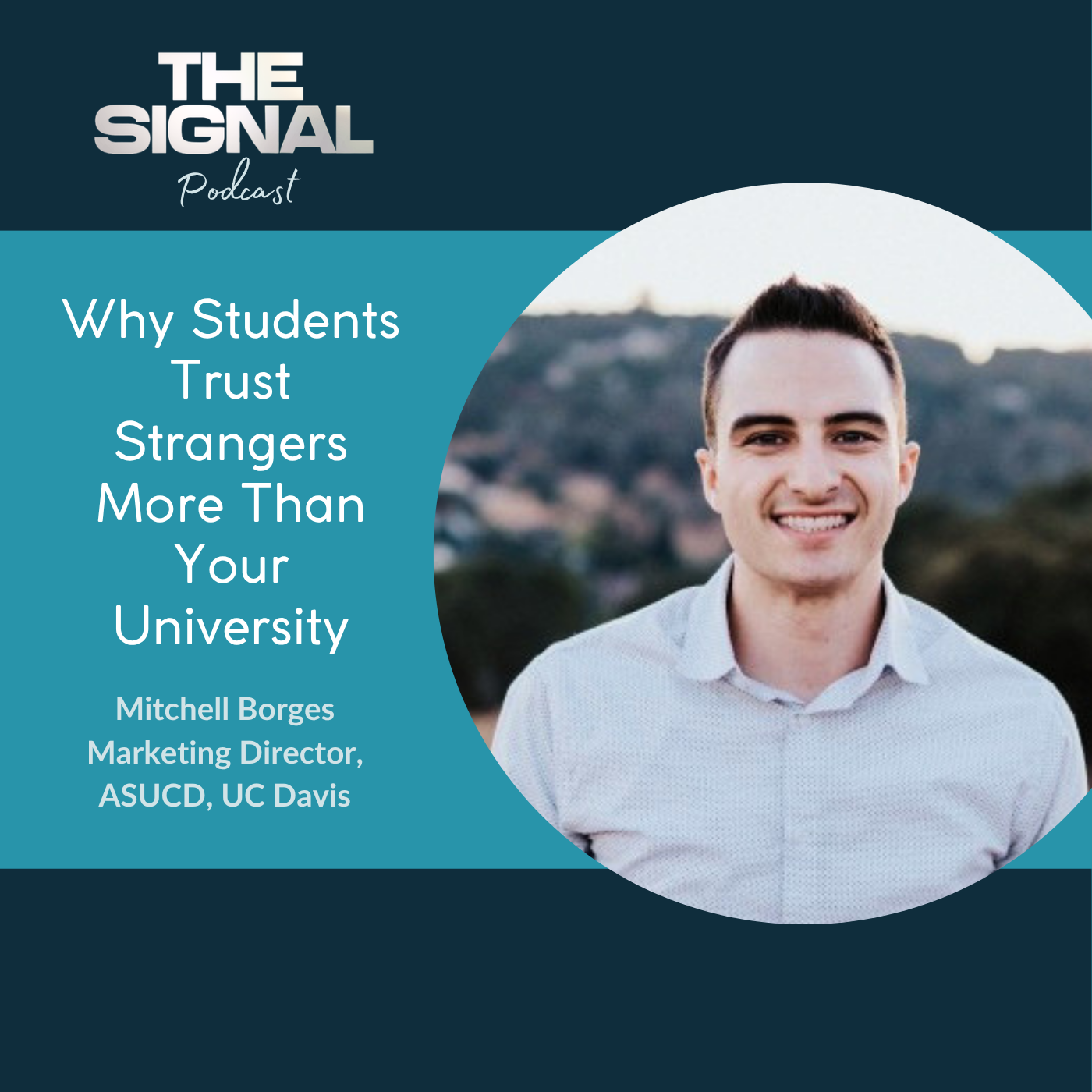
Today's guest is someone deeply embedded in both the strategy and and execution of modern higher ed marketing and whose work intersects directly with many of the challenges institutions are navigating today. Mitchell Borges is the Director of Marketing for ASUCD at the University of California, Davis where he leads a dynamic team supporting one of the largest student run organizations in the country. With a background in admissions, counseling and digital marketing, Mitchell brings a unique full funnel perspective on student recruitment and engagement. He recently earned his Doctor of Business Administration in Marketing from Grand Canyon University where his research focused on how social media influences university enrollment, particularly among out of state students. Today, Mitchell is also heavily involved in preparing institutions for the upcoming April 2026 Title II Accessibility compliance deadline, helping teams rethink how they approach inclusive digital experiences.
Welcome to the show, Mitchell. It was great to have you today.
[00:02:05] Mitchell Borges: Yeah, thanks for having me.
[00:02:06] Jeff Dillon: So let's kick things off and I want to talk to you a little bit about what drew you to, to higher ed, higher ed marketing. What keeps you excited about it today?
[00:02:17] Mitchell Borges: Yeah, ultimately I believe like the college experience can have such a positive impact on student growth and student development.
But I think I was like a lot of other students who had a hard time like navigating that process and finding the right institution. Me and a lot of my friends got locked into like what's the best institution and ultimately it's so vital to find the right fit and. But it's tough, right? Because in higher education institutions are great at teaching folks and setting people up for the like, academic rigor that's necessary to take in this information.
We're not always the best at like presenting that information and getting in front of students.
So that's why I think marketing plays such a role in being able to align students with universities the right fit for them. And I think if they find somewhere that they're aligned with, they have such a more positive experience in college. So, so I had a great experience in college, but I chalk a lot of that up to the Fact that the university I went to was really aggressive at presenting that information and without those efforts, I probably wouldn't have been there.
[00:03:21] Jeff Dillon: Yeah, yeah, okay. You know, you've had a kind of a front row seat at two very different institutions from GCU to UC Davis. Different models, different audiences, I would say, different strategies. I'm curious, when you step back and look at that full experience and from your time at those two schools, what's the biggest shift you've seen in how institutions attract students?
[00:03:43] Mitchell Borges: Yeah, there's a massive shift between how Grand Canyon University was, was promoting the university, trying to reach students versus UC Davis for sure. The biggest difference is like their audience. Right. Grand Canyon reached so many out of state students because they had that benefit of the non out of state tuition and all of that. So they were reaching far and wide and they were trying to grow as rapidly as possible because they had the room for growth. Right. Where UC Davis is so focused on bringing in the ideal candidate, bringing in the right fit. They have loads of folks that want to come over there, right. They have a lot of applicants that are interested. It's about getting the right student to be interested. So that was sort of a shift that I saw. Working on both sides was Grand Canyon. It was all about us building relationships and making people aware of like what we were and what, what we were doing. Where UC Davis is, is more saying, hey, we have awareness here in California. Just being a state school, how do we convince the right kid that we're their best option? So it was a little bit of a shift in not as much just awareness, but like, hey, we need to make sure we get in front of the right kid at the right time and convince them that we are their best, ideal option and going to set them up for success.
It's also obviously a different sales pitch. Right. GCU was so heavily focused on their student life and their engagement on campus, which is a huge part of their student success. Right. Their students do really well in an environment where they can get active and really be involved, where the student that's the best fit for Davis is looking to be really, really challenged academically and pushed in that area. So again, you're attracting a different audience, which changes that whole strategy.
[00:05:29] Jeff Dillon: You know, when I first met Mitchell, I first met you a few years ago, you know, we're somewhat local, which was really cool. And I learned about your doctoral research on how social media influences enrollment decisions. And I think what's interesting is how that work has collided with everything we've seen since the Pandemic student behavior shifting. Fast digital became this primary front door. And now AI is starting to shape what students see, what they trust, what they act on. I'm curious how you connect those dots. What are the most surprising findings from that research and how did they show up today in an AI influenced enrollment landscape?
[00:06:07] Mitchell Borges: Yeah. When doing that research, the first thing that shocked me the most was just in the data collection process. As I started looking at other universities and what they were doing on social media, I was blown away at how few universities that time actively had like, engaging content on social media. It took universities a long time to kind of adopt this.
We didn't need my study to know that high school students were on social media. Right. Like that was something that we all knew and all were aware of. But there definitely, I think it was risk. Right. There was a fear and a risk of like, hey, this is a scary new place. What do we do on this to attract students? And that's starting to shift. That's starting to turn.
But as far as results from the study, the biggest thing that blew me away was the way students viewed content on social media from like a trust or an authenticity perspective. The amount of students that were coming to me during these interviews saying, hey, I was going to the comment sections of Instagram posts to message people about tuition and like, really important deciding factors for a university because they felt that getting that information from a peer or from an alumni was a more reliable, more trustworthy source than the university who's presenting this on their website. Which is, you know, from my perspective, I'm sure more accurate. Right. But from the student's point of view, that felt biased, that felt inauthentic. They wanted to hear it from a student.
So they trusted information on social media more than they trusted the university website. They trusted that student they ran into on a campus tour who more than they trusted the enrollment counselor that was leading them on campus simply because it was that peer to peer authenticity.
[00:07:55] Jeff Dillon: Yeah, yeah. We're kind of in a crisis of trust for the last five or ten years, I think, you know, yes, schools push harder for out of state, even national reach. I think social becomes one of those few scalable ways to build that connection before student ever gets on your campus. So that audience though, is coming in from a different level of familiarity and trust, like you say. So when does that break down? How do out of state students respond differently to social media marketing compared to in state students?
[00:08:24] Mitchell Borges: The biggest difference between out of state students and in state students that I found was out of state Students are just more reliant on that digital information. Right. Ultimately, when students are making this decision, the big factors and the way this decision is kind of broken up is there's a couple phases here. The ones my study focused on was the search phase, which is where students are just initially learning and identifying schools that they may be interested in, and then that choice phase, which is them taking their top universities and making that final decision.
During that search phase, the things that really influence students are extracurriculars available by the university, university prestige and status. But then feedback from alumni, from friends, from family, like that was such a massive influencer.
Students a lot of times know somebody or somehow connected with someone at their local institution, right. So they can find someone within their in state options to say, oh my Aunt Sally went there. I'm sure I can get feedback from them on that institution.
That typically doesn't exist for the out of state options. So for that whole massive element of their search phase where they're relying on that feedback from family and friends, they have to rely entirely online for those perspectives. So when they're considering out of state options, there's way more reliance, way more weight on what they find on social media. The other thing I found is out of state students typically felt more pressure when looking at out of state universities.
[00:09:50] Jeff Dillon: Right.
[00:09:50] Mitchell Borges: A lot of times the parents were a little bit less supportive. They didn't have any other friends that were potentially going through that same search process. So they also felt more alone. Right. They didn't feel like they had the same support or the same, just the same structure around them to walk them through that out of state process where everyone was considering the end states a little bit easier.
[00:10:09] Jeff Dillon: Right. With everything we know now, with years of the social media experimentation, your research, and now AI layered on top of it, you'd think institutions would have it kind of dialed in a little, a little better, but I don't think it's always the case.
Based on your research, what are colleges still getting wrong about social media strategy?
[00:10:29] Mitchell Borges: There's a couple things. The two biggest things that stand out to me is one, leaning on students to create more of the content. I think universities are still somewhat scared to do that, but it makes a massive difference in my role. Right now I'm doing a lot of outreach to existing students on UC Davis campus and almost all of our content is student created.
[00:10:51] Jeff Dillon: Right.
[00:10:51] Mitchell Borges: Obviously there's a review process to make sure it's going to align with what we need. But content that students can run with has such a higher reach point Students can see through that layer of inauthenticity or the scripted piece so quickly. The other big thing my study pointed out was there wasn't a massive jump for students in engaging with content if a student employee was the one that was presenting it.
[00:11:16] Jeff Dillon: Right?
[00:11:17] Mitchell Borges: So if I have someone from my university wearing a polo that says UC Davis, but it's still a student that still felt authentic, that still felt genuine, even though that student was paid by the university, is likely reading a script written by a career staff like it didn't matter just because it was one of their peers saying it. It had that reach.
So that's a big piece. The other side that I would say universities are missing right now is during that search phase, those out of state students specifically were looking for engagement or content from other students that were in the middle of that process. Right. We do a really good job of sending students big care packages when they get accepted and promoting that engagement online of them posting, hey, I made it right.
I'm attending this university. I made my decision.
We don't do a good job of encouraging or facilitating students to share their search process.
Right. To go out there and promote, hey, I just toured this campus and I learned this. Or I just realized that this is something that's offered. I'm thinking about it, right? I had 94 students in my study. 100% of them said that this social media influenced their decision when making the university selection. However, very few of them said they posted anything about the university search before their actual decision.
So that leaves the university stuck with this challenge of like, we have to create the content because students aren't doing it, but they also don't trust the content we create.
So finding a way to facilitate students sharing the search process I think would be a massive catalyst and something we're really pushing right now of like, how do we have them create the content so it is authentic and it's happening at the right time.
[00:12:57] Jeff Dillon: Right.
[00:12:58] Mitchell Borges: They're not all sharing great things about the university in May.
[00:13:00] Jeff Dillon: Right.
[00:13:00] Mitchell Borges: They're doing it during the times other students are in the middle of that search.
[00:13:04] Jeff Dillon: Yeah, I can really kind of back that up. My son, my oldest son is applying to law school right now. He has some offers and. But I mean his short list is pretty big, but I had no idea like how he came up with this list. It's just, and even asking him, he doesn't really, can't even really answer it. Like, it's just kind of the word of mouth on the organic, you know, I'm sure Social influence that. But recently I was talking to a marketing team that had solid traffic, decent engagement, even a really strong social presence on paper. But when you look closer, none of it was really translating into actual inquiries or applications. They were busy but not effective. And I think a lot of schools are in that exact spot right now, especially with enrollment pressure that's mounting. For those colleges navigating enrollment challenges, what's one takeaway from your research they could implement immediately?
[00:13:58] Mitchell Borges: I think the biggest takeaway would be to, yeah, like empower students to kind of drive more of the content from universities. There's a risk, I get that like sometimes students come up with crazy ideas, but I think putting students in front of the camera, putting students voice there, that's the biggest thing people want. Right. We have the website for that professional, you know, here's what the university is telling you in a really concise way. The website's geared for parents. That's who's going to be most influenced by the website. Social media is influencing students. And just every single student I spoke with so clearly found that hey, they could see when the stuff coming from the, from social media wasn't authentic. So putting students in front of the camera, letting students engage, working on some of these trendy things that are going to actually resonate with what a student's seeing in their feed is huge. It's getting a little bit more difficult with some of these accessibility changes coming in. It certainly changes the way social content's built and makes it harder to empower students. But, but that's, I think the biggest difference maker right now is get old people like myself off the camera and get the 19 year olds on camera that are really going to move the needle.
[00:15:06] Jeff Dillon: Yeah. I mean even all your student workers use them for this stuff. Right. If we start to now talk about shifting from your research into execution, you know, you studied this, now you're living it day to day. You're leading a pretty diverse marketing operation at asucd, I think, and doing it in a really close partnership with students, which adds a whole different layer of I think, perspective and complexity. And that always creates a bit of tension, I think, between telling a great story, improving what is actually working. So leading that team, how do you balance that brand's storytelling and still have measurable performance?
[00:15:43] Mitchell Borges: Yeah, it's, it's difficult for sure, but there's a level of just like taking a risk. Right. And diving in that you kind of have to do kind of background. On my team, I lead 30 student employees. There are no career staff outside of myself that are involved in the promotion of what ASUCD is doing. And we're a massive operation on campus. When I came in, we had a relatively small social media presence. Some students were there, but a lot of our social media following was graduates and people that weren't really even our audience anymore.
And I came in and I said, let's give students the power to post some content and to really like. Like strategize was really the big thing, right. Is what are your peers watching? What is active on their accounts? What are they looking for? And there was a lot of, like, learning how to steer that conversation in a way that's going to keep it moving in the right direction. But we went from 4,000 followers to 14,000 followers on Instagram. We've got way more heavy engagement.
And, you know, not every post blew up. Right. But the stuff that did really well was stuff that I didn't think was going to be the key driving factor. Right. But it's. It's the students that really championed it, and we kind of gave them that platform to. To run with it. So that's been our biggest, biggest change. That's been our biggest catalyst for growth.
And, you know, our stuff maybe sometimes is a little bit less professional looking, right? It maybe is a little bit more fluid. But the other thing with social media is it changes so fast, right? If we put some video out there and someone feels like it didn't fit the right vibe or didn't fit the message, it's forgotten in two days because we've already posted a bunch of other stuff. So it's a place to take some of those risks in some ways, because it does move so fast.
[00:17:25] Jeff Dillon: I love that philosophy, and I think higher ed struggles with that. And I think what I've seen, from my experience, it really comes down to your leadership. You have to really have really supportive leadership, because often the leaders are a different generation. I think it's getting better, but it's not about what you like at all. And you even say you're. You're pretty young. And I feel like I'm. I've been out of it for a while where I thought I knew what students like, but I gave that up. Get the students to tell you what works. Take some risks. I love that. Let's get tactical for just a minute. You're in every day, you're working closely with students, seeing what they actually respond to, not just what we think should work in a strategy. With so many channels competing for attention right now, especially with algorithms and AI shaping what gets seen. It's harder to separate the signal from the noise.
What channels or platforms are currently delivering the strongest ROI for student engagement?
[00:18:16] Mitchell Borges: This is a little bit where we struggle because I came into an operation that was really just unorganized. We had a lot of organizational challenges that we hadn't cleaned up. So for our operation, my first objective was to kind of help us narrow our focus and get really good at one thing before we start reaching out. So we lean really heavily on Instagram and we lean heavily on Facebook, which everyone, I feel like, feels like Facebook has forgotten in this kind of lost thing. But it's. It's very easy to integrate and to share posts on both platforms. And I think we forget how influential parents are on these decisions.
Students are still, like, learning how to be independent. They're learning how to make their decisions, and parents are still in their ears all the time, kind of, kind of sneaking stuff in there. We haven't explored a ton of the other social platforms just because working with students, we're trying to teach them how to, how to really be successful there. The other odd thing that we've seen this year, that's really kind of just been a trend. I don't know if it's going to be a flash in the pan, if it's something that's going to grow, but some of these, more like traditional, like physical medias on campus specifically is oddly like, blowing up. We launched a trading card program this year where we created these physical cards that were handing out and kind of creating events around, like, coming to collect these. These collectibles. And, you know, that's been one of the biggest returns we've seen. We spend 30 cents to print a trading card, and we'll get 800 kids lined up 30 minutes after we've published it. So that's not really a digital space. That's probably not what we were. We were planning on talking about today. That's cool.
[00:19:49] Jeff Dillon: I love it.
[00:19:50] Mitchell Borges: But it's one of those weird things where, yeah, I don't know if it's going to stick. I don't know if that's going to be the future. I doubt it. But that was another idea a student brought up and said, hey, kids are trading Pokemon cards. What if we did some stuff on campus and, you know, it was cheap enough and we threw something at it? And that's been probably our biggest. Our biggest needle move for the last three or four months.
[00:20:09] Jeff Dillon: That's awesome. Yeah. Yeah, you got it. You don't know how long it'll stick, but if you can move fast, you can hit all those micro trends, I guess. Yeah. So let's shift gears a bit because there's another conversation happening right now that institutions just, they can't afford to ignore it. And we've been talking a lot about engagement and growth and performance, but there's also compliance there. There's a compliance clock ticking and the deadline is, is right now. And it's going to impact all of higher ed, from websites to apps to the tools we've been discussing.
And I don't think everyone fully realizes how close this really is. And there's urgency about this. April 2026, Title 2 Accessibility Compliance Deadlines. You told me you were working on this. And so I just want to ask you, what do you think the institutions should understand about what's coming?
[00:20:52] Mitchell Borges: I mean, it's a lot to unwrap, right? It really is. It's going to impact so many different areas of what institutions are doing. It's increasing the scope of what digital content is going to be allowed to be posted. Right. Like, there's so many implications here. The biggest one we're looking at right now is social media, which is the one that I feel like is being kind of reviewed less often right now. I hear a lot of content on, like, web content because that's obviously super visible and we're used to, like, managing web accessibility.
PDFs are obviously a challenge and trying to figure out how to navigate those and convert them to something accessible. But social media content is, I think, the biggest learning curve we're going to have to navigate. Posting on stories is incredibly difficult in an accessible way. The text on that story isn't readable. Right. So you have to have it audibly spoken. So we've tried doing voiceovers on story posts and it feels incredibly awkward.
So trying to find ways to, like, keep content active and engaging while still checking those accessibility boxes is really tough. And then this whole time I've been talking about empowering students to post and students to publish content. That's what has made the biggest impact for us. But at the same time, like, students aren't used to posting that way. Right. Students aren't used to including alt text and image descriptions and in their social media posts. So when you, you try to empower them to do stuff on our end, it's a whole new teaching process.
So I think the training has to be really intentional and I think there just has to be urgency behind this because it's going to catch a lot of people off guard. And social media, you can't, you know, suddenly shut it down for three weeks where everyone learns how to post correctly. You have to be actively moving. We've been moving forward since the start of fall as if this was already the law.
So our team has been moving forward and we have close to 60 social media accounts that we manage. It's, it's ridiculous. And I did an audit a couple of weeks ago, having gone through the entire fall and winter quarter with this process and we're still at like under 30% compliance. Right. It's still really tough. So we're getting closer. A lot of shifts, shifts are going to happen. We have a pretty big push here for the back end of it. But I don't think people truly realize how much of the social media content has to change in order for it to meet those, those requirements.
[00:23:09] Jeff Dillon: Yeah. I'll tell a quick story. When I was at SAC State right before the pandemic, we were subject to an OCR and Office of Civil Rights complaint and we weren't the primary target. We were just named additionally to some other CSUs. And I was a web director at the time. And it really showed that we did not have clear processes. There's no clear ownership if we own this. We had hours of, over months of meetings with legal. It was not fun. And I think the story, the moral was you don't have to even be the worst offender because what this does is opens doors for. Yeah, the government's going to be there and they're, they're, they're watching. But there's all these private liabilities too out there, people that are going to really be watching this. So yeah, it's good, good thing to talk about and you know, we talk about the gaps. But for marketing teams, it's not just a compliance exercise sitting with your IT or legal team. It hits right at the core of how content gets created, published and distributed. And for so many teams, it probably means rethinking the workflows, not just fixing a few pages. So are you advising teams on that process? How should marketing teams rethink their digital content and campaigns to stay compliant?
[00:24:19] Mitchell Borges: It has to start with how we're writing the content or how we're planning the content out.
Right now the habit that I see most often in higher ed is one of two things. Either we created a flyer for print, let's just stick it on Instagram as well. So we have these super text heavy graphics showing up on Instagram feeds that just aren't effective. Right. They're not Accessible, there's too much text to really accessibly present in a caption or somewhere else and they're not even high engaging. Right. Like it's not what a student's used to seeing on their feedback. And then from a video standpoint, because everyone wants to be relevant and everyone wants to be top of mind. It's all the trend stuff. Right. So it's hey, let's just hop on a trend, but do it on our campus and suddenly now it's us creating content.
Most of the trends out there right now are extremely inaccessible. Right. They've got text that's not being audibly presented. They've got text that you can't really incorporate captions with.
So getting away from that and saying, hey, let's start from the beginning process of writing content that can be presented accessibly without it looking like we're trying to reshape some posts we already had in mind to fit the accessibility bucket.
[00:25:30] Jeff Dillon: Yeah, yeah. You know, I want to close out with one bit open ended question for you here. And it's, you know, we've covered a lot from social and AI to accessibility and the reality the teams are dealing with today, it's clear that the playbook is changing pretty quickly. So looking ahead, what do you believe will define successful higher ed marketing teams over the next two to three years?
[00:25:52] Mitchell Borges: Yeah, I think the biggest thing is being able to establish authenticity first. Right. The brand that can build trust with a student first is going to be successful. What's changing is how that's happening. I think it used to be much more, you know, relationship marketing oriented. Yeah. You send out the pamphlets, you get the parent on board and the parent bugs the student enough where the student finally applies and, and you know, that used to be I think a little bit more the model and right now like that's just, it's not working anymore. It has to change. There's more pressure, there's more regular. Like there's so many more things that are changing. This like the big change I think we're going to see is, is the leveraging of influencer marketing. That's the way people build trust. That's the way brands build trust right now in a rapid and effective way is you find an influencer that's already engaged with that audience and you plug in your brand with them.
[00:26:43] Jeff Dillon: Right.
[00:26:43] Mitchell Borges: Everyone else is doing it and I think higher ed needs to be kind of jump starting into that. Right. I know we've done a little bit of it ourselves and it's always been great, but it's everyone's got so much going on, right? It's, it's how do you fit this new strategy in here? And then how do you do it in a way that you're giving that, you know, just like giving students the autonomy to kind of generate some of this content?
You have to give these influencers a lot of autonomy as well, which I think presents risks. Right. And I think a lot of universities are scared to take that. That risk.
[00:27:14] Jeff Dillon: But yeah, can you imagine if you could have Taylor Swift plug your university, what would happen? Like, that would be crazy, right?
[00:27:20] Mitchell Borges: You will be bursting at the seams.
[00:27:22] Jeff Dillon: You know what I mean?
[00:27:22] Mitchell Borges: So, like, it really does change things fast. But I haven't seen a whole lot of universities leveraging it. And it's right there, right? The opportunity exists and there's a lot of influencers that have that pool. With some students, it's just a matter of. Of partnering up.
[00:27:36] Jeff Dillon: Yeah, they want to find the. The famous alum, I think is what they're always searching for. Right. The. The celeb that can be the. The alum spokesperson. But hey, Mitchell, that was an incredible conversation. Thanks for your insights. I will put links to UC Davis Sam Mitchell's LinkedIn profile in the show notes. So great having you. Thanks.
[00:27:56] Mitchell Borges: Awesome. Thanks for having me, Jeff. Appreciate it.
[00:27:59] Jeff Dillon: That's a wrap of this episode of the Signal.
If today's conversation sparked a new idea or challenged your thinking, that's exactly the point. This show is about cutting through the noise and helping you see what's actually shaping higher ed right now. Please subscribe so you never miss an episode. And if you found this valuable, leave us a quick review. It helps more higher ed leaders find the signal. For deeper edtech insights, news and trends delivered monthly, subscribe to to the Signal monthly
[email protected] thanks for listening. We'll see you next time.