Episode Transcript
[00:00:00] Kyle Fondren: Traffic from verified human users down about 15 to 20% as to where they are normally within the cycle and flow of a semester. Microsoft Clarity has been really helpful for us having that in our sites. It's got really robust bot and AI detection and dashboarding, so we're able to understand it pretty well. But you know, I also think it's pretty exciting on the human end because it's shaving a lot of your low intent browsers. You know, it's shaven off a lot of your people who would show up as bounce rate. So the people who are coming in, you know, they're coming in with more intent, they're more engaged outside of the bot traffic are, you know, engaged. Sessions and pages per session are trending up because the people who would just bounce straight to something that they got off Google and you know, get their answer and jet they're taken care of before they even get to us. Now.
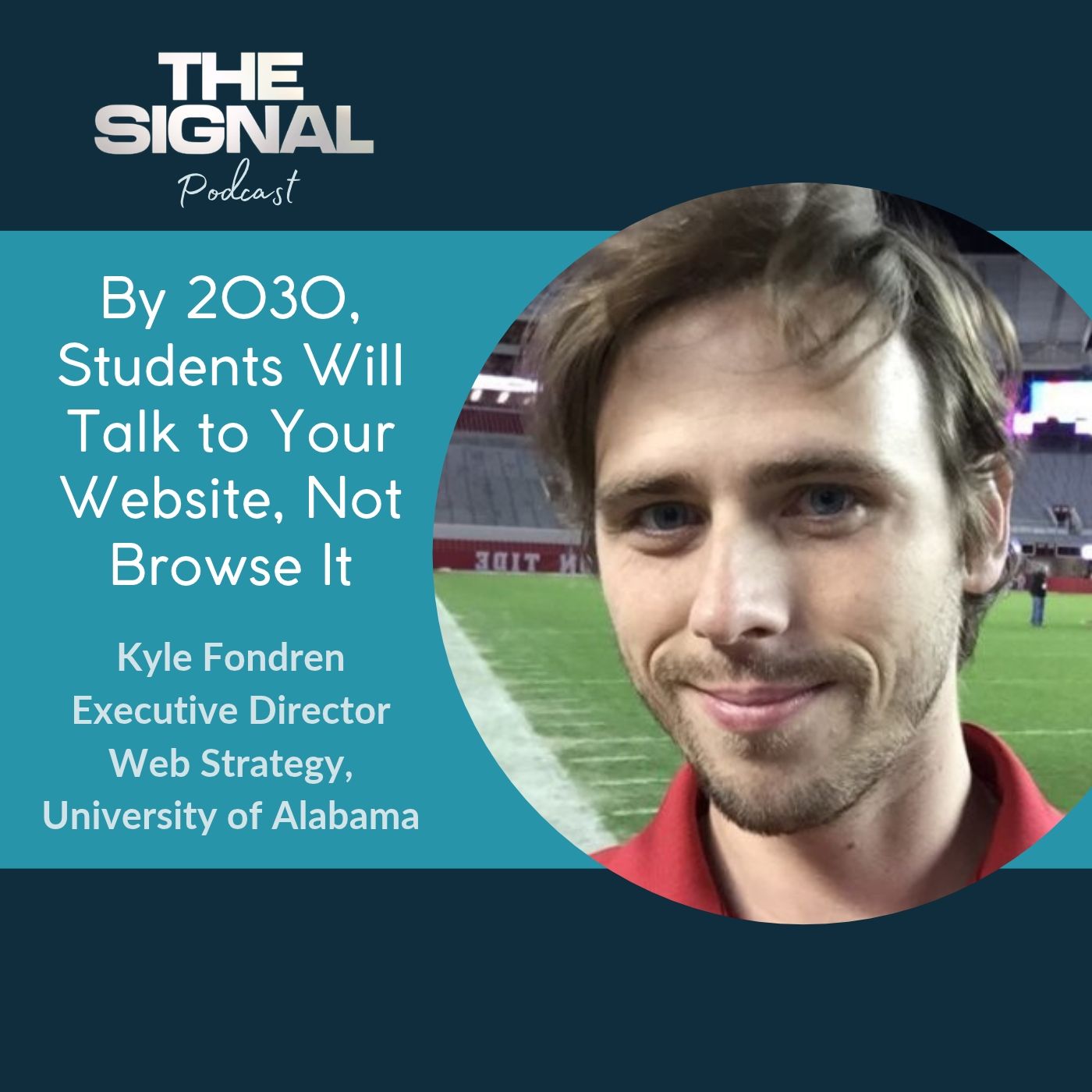
[00:01:07] Jeff Dillon: Welcome to another episode of the Signal. Today's guest was a panelist on a webinar I moderated. The talk was about what a university website will look like in 2030 and I walked away wanting a lot more time with him. Kyle Fondren is Executive Director of University web Strategy at the University of Alabama where he leads UA's global presence, its institutional design system and AI enablement across the division of strategic communications. His team of eight manages more than 20 mission critical institutional websites serving over 15 million visits a year.
Kyle built UA's web strategy function from the ground up. He also launched a division wide AI enablement program that helps communicators, creatives and developers use AI responsibly and spend more time on high value work. His 17 plus years in digital include work with Alabama football, the city of Tuscaloosa and the PGA of America, along with a gold Addy and a South by Southwest Interactive award finalist nod.
Kyle, welcome to the show. It's great to have you today.
[00:02:22] Kyle Fondren: Yeah, awesome. Thanks for the opportunity to get together and chat today.
[00:02:26] Jeff Dillon: I want to start with something you said about yourself that made me laugh. You describe what you do for websites as what Gordon Ramsay does for restaurants and I spent years managing university websites myself and I can tell you they are definitely many campus sites that could use a visit from Gordon Ramsay. There's outdated content and competing priorities and departments that just do their own thing and it's like the Wild west. What's the most Kitchen Nightmares moment you've walked into on the university website and what was the first thing you threw out?
[00:02:57] Kyle Fondren: I don't watch a Lot of tv. But I can say that, like watching Kitchen Nightmares was probably one of the biggest mistakes of my life because it's just totally killed going out to eat for me entirely.
So the most Kitchen Nightmares moment I've had in a website. Specifically, we're talking about a single colleges web presence here. Get this. Adobe Contribute plus about 350 pages for a single college.
Tons of sub subdomains.
No real rhyme or reason as to who had one or why. There would be a sub subdomain for a program but there wouldn't be one for a department.
I mean, the full spectrum of nightmare stuff for college website stuff was their internal content mingled in with the public facing stuff.
I mean, probably outnumbering the public facing stuff really, once you get down to it. Mega menus with every item getting the same billing. It was a learning experience getting the reins on that. But eventually we got that into a shape where we had. We went from about 350 pages in that thing to 33. Wow. And it was quite the whiplash for the old timers in the college, but got it done and it was in a much better place.
[00:04:08] Jeff Dillon: It reminds me of back when I was a web director. It was the faculty web pages that were just the biggest kind of nightmare. And you couldn't do much about it though. It wasn't like you could really say, okay, here's the new template that was available, but it was never used, but it was just all over the place. And that's kind of the good and the bad about higher ed is faculty can do what they want and faculty can do what they want. 1. So yeah, I think your experience with Alabama football is really interesting because athletics really operates at this completely different pace than most of higher ed. You've got incredibly passionate audiences, huge visibility, and really not much room for error.
Having worked in university web leadership, like, I know sometimes we can get comfortable with long planning cycles and community decisions and athletics doesn't really have that luxury.
What did your experience working with Alabama football teach you that would be, I mean, helpful for leaders in a digital.
[00:05:06] Kyle Fondren: Digital world? Yeah. So I don't really think it's possible to come out of working for a Nick Saban led organization without picking up a whole lot of great lessons in leadership and organizational effectiveness.
I mean, there, there's so many of them, but one that really stands out is particularly applicable to web teams and web leaders. I mean, it really just goes back to the process which is essentially, you know, a bunch of small things done the right way end up getting you Those big results that you expect from a high performing organization. And I mean, it's always fun to think about the, think at the big level and you think about your next big redesign, your next big tech moonshot. But how are you going to get that big result if like the atomic level of your design system's in disagreement? How are you going to do it if there's a whole bunch of confusion and friction in your design and code handoffs? All those things setting the standard and placing your attention on the little things, eventually that mountain that you get to that people see as the big result on the other side. And I think the other big one is leaning into evolution within the industry that you're in. So I was there during the years where the game of football was changing rapidly. Like this is when the spread offense was happening and it was breaking 50 years of football consensus. This is how we play the game. And coach evolved the team to meet the challenge at the personnel level. Recruiting totally different guys than what he knew for his entire career.
Entirely different offensive playbooks and philosophies and personalities.
And I think web teams right now are kind of at the same moment with the AI era taking off, we're kind of facing the same challenge. The whole consensus of how we've done web for 30 years in the past 10, two years is going on a 90 degree angle straight up. So how are we going to.
[00:07:16] Jeff Dillon: Yeah, I want to talk about that for a little bit. As I said in the intro, I met Kyle where I moderated a webinar and the topic was what does a university website look like in 2030? And Kyle was on the panel with, I think Joe Kwan from University of Waterloo. It was a really popular webinar. I'll put it in the show notes the recording. But my biggest takeaway from it was for years the web teams have measured success through traffic and page views and engagement. But you raised this point. You know, what happens when more of that traffic is coming from bots and AI agents? And I was shocked. I think, I don't know if we did a poll in the webinar.
I know there's data coming separately that universities are not tracking. Most aren't tracking the bot traffic. What happens when traffic is coming from bots and AI agents while actual people are visiting websites? What are you seeing in Alabama's numbers? How do you separate that?
[00:08:08] Kyle Fondren: Yeah, I mean, we're, we're seeing the same thing that most people are seeing across the higher ed stripe of the web.
Traffic from, you know, verified human users down about 15 to 20% as to, you know, where they are normally within the cycle and flow of a semester. Microsoft Clarity has been really helpful for us having that in our sites. It's got really robust bot and AI detection and dashboarding so we're able to understand it pretty well. But you know, I also think it's pretty exciting on the human end because it's shaving off a lot of your low intent browsers. You know, it's shaving off a lot of your people who would show up as bounce rate. So the people who are coming in, you know, they're coming in with more intent, they're more engaged outside of the bot traffic are, you know, engaged. Sessions and pages per session are trending up because the people who would just bounce straight to something that they got off Google and you know, get their answer and jet, they're taken care of before they even get to us now. So, you know, we're getting more of the curious people who are going to browse around and see more of us.
[00:09:26] Jeff Dillon: I like your takeaway there. Like if you get a tool useful like Clarity, it might help you not design or build for edge cases, right? The ones that don't. Yeah. Don't matter. And it raises this, I think interesting question about the future of university websites. We spent decades thinking about the human experience, navigation and visual design and accessibility and how quickly someone can find what they need.
But now there's potentially an entirely different audience consuming that same content.
So the agents don't really care about your, your beautiful homepage or your navigation. They're trying to understand your institution so that they can answer these questions like are we going to have to design for two very different audiences? Or how do you design for a reader that never sees design?
[00:10:14] Kyle Fondren: So in the webinar, my main point during the whole thing was duality. And like that's going to be the theme of moving through this next era for people in web leadership and specifically who are more on the content side, I think it creates a pretty interesting dynamic that you can, and a thought framework that you can put on it is the purpose of a page has always been really important, but now it's kind of gaining this even bigger importance because like we said, the people who are going to the site to get an answer and we're hitting those deeper pages, that audience is going to become, you know, that's what your machine audience is majority. Their whole deal is to get the best answer as fast as possible. So well structured, deeper content, they're going to flock to that so maybe you don't necessarily have to spend so much time on the pages with those purposes, thinking, okay, well, we've got the deep content, we're getting people their answers, but it's not a particularly great experience. Like, how can we doll this up a little bit?
Maybe in the future you don't really have to, and you can sort of reserve some of that visual and experience firepower for the areas of your site where the purpose isn't necessarily so much to get people an answer, it's for people to have an experience.
These are things like your homepage, your admissions homepage, your brand campaign. It kind of lets you put some more emphasis onto the experience of that. Because at the end of the day, the purpose behind those pages is to convince a human to make them feel a connection to you, to give them a taste of an experience or an experience where they go, okay, well, the AI told me that it's got my program, it's pretty well ranked, and I have a pretty good understanding of the class load that I'm going to take there. Like, what's it like to be a part of this?
And if you're able to put more of those resources into those big areas where the, those users are going to hit and make those a really standout visual experience, you're filling out that other side and closing the funnel about the visual experience.
[00:12:41] Jeff Dillon: There's this other area where I think university web leaders have really struggled for years.
You have hundreds of departments and programs, they each want their own identity and somehow you're supposed to make it all feel like one institution.
Design systems have been a big part of solving this problem. But now, with AI potentially becoming the first point of contact for prospective students, I wonder if the consistency goes past how the university looks to how clearly the information is structured and really understood. You built themes to bring brand coherence to this decentralized campus.
So if, if we're in this world where AI might summarize your site before anyone visits it, does a design system matter less than it used to or, or more?
[00:13:30] Kyle Fondren: As I see this stuff evolving, I'm more and more convinced every day that a good design system is the single most valuable piece of infrastructure that you can have as a central web team. Because selfishly for your own team, it's going to be that anchor for speeding up your friend development, speeding up your middle and back end development.
You know, the agents that you're going to have to work with in the future, they need that source of truth to be able to build within your Language, a design system gets you that. And if your design system is solving the problems the right way in one place and transferring those good decisions downstream through the rest of your web presence, that's a huge win too because you as the central team are going to be much better equipped to create components that lean into or are very well structured for the things that machines need for it to be attractive and for it to be legible. And if you build that right in the design system that's just being syndicated out through a theme, or, you know, your more technical users are using your design system to achieve that, you're kind of having your cake and eat it too with a good system.
So I think design systems are probably the most important piece of infrastructure that you have going through to the future for lots of different.
[00:14:52] Jeff Dillon: Yeah, I can understand that. When I was running university websites at Northern Arizona and Sacramento State, the tech was usually the easy part. The real challenge was getting the colleges, departments and the individual stakeholders to really agree on a common approach.
Everyone wanted the benefits of a unified website, but they, they also wanted control over their own little corner of it. And I learned that you can't solve those challenges with tech alone. It takes the relationships and trust and sometimes, you know, compromise. How did you get colleges and divisions to adopt a central framework and where did you have to to give ground?
[00:15:33] Kyle Fondren: So it wasn't necessarily that we had to give ground. I'll back up a second. So our central web team is in the division of Strategic Communications. So a lot of our web governance came through that lens from administration of protection of the brand, advancement of the brand, protection of reputation. So we wrote a really solid web policy and sort of set up a governance framework where the policy is empowering, a set of brand guidelines that our team oversees and development guidelines that our team oversees.
And then, you know, once we had the policy that was sort of the binding agent and the guidelines as the more detailed execution of that, my team really just focused on handing the, the people out there in the units what they needed on a silver platter. So you know, for your, you know, your non technical users, they just need a really good, easy, clear, logical experience to be able to input their content, have a little bit of layout control, but no real way to go outside of bounds. And that's what the design system did and the theme did. For the non technical users, very technical users, they needed the ability to extend on the theme or the ability to develop their own theme. But it's totally inbounds of the design system and having the Design system lets them essentially hands them all the front end work that they would have normally had to recreate or take their own shot at.
We all know the inherent risks in that. So we really felt like we were platform building and not really trying to take control away from any other group. You're really just trying to solve problems for the two main groups that were using it. And it's worked out pretty well for us. We've got really good saturation of our system across the presence.
[00:17:34] Jeff Dillon: Yeah, it's really great. If you could balance that.
They can't be able to break it at least very easily. The trade off of flexibility for design or control. It's something I've been talking about for a while in the context of AI and university search is most institutions have thousands of pages that nobody has looked at in years.
And it's been, that was mostly a content governance problem. But now an AI model might find a page from 10 years ago and treat it as authoritative and present that up to a prospective student as if it's current.
And so all of a sudden this outdated content isn't just cluttering up your website, it could really be shaping how AI represents your institution.
And with such a decentralized campus like you being a big R1 school, I imagine that's a pretty significant challenge. How are you deciding what stays public and what gets dated and what gets retired?
[00:18:33] Kyle Fondren: Yeah, I mean, we had a situation like this crop up a couple of months ago that we had to solve where we had our news archive site, which was essentially like the university news center. We make a cut at 2019 and everything before 2019 goes to the archive. Like, we're a public institution, we're being good stewards of history and what happened at the institution. But then our folks over in the communications team that run the news center started saying, hey, we're seeing a lot of traffic to a lot of these old articles. And I went and asked ChatGPT a question and it was serving me this old article of something that was going on, like, what do we need to do here? So eventually we a lot of internal discussion and with the help of our platform and being able to dive in on Microsoft Clarity, we were able to see, okay, I know we were trying to be good stewards here and, you know, take care of the university's history. But if bot traffic is 99% of the traffic to this site, you know, is it really serving its purpose more than it's presenting, you know, a risk surface? So we ended up deciding to take that down, make it available on request for journalists if they needed it. But we did run into a thing where old stuff was being cited, and that's just isolated to university news. You know, if you're in a situation where you've got, you know, tens of thousands of pages.
It's not just that AIs would be citing some of that older stuff as current. Your sites and content on your domain being in disagreement with each other really tanks the authority signal that the AIs are looking for to serve these answers.
If it's taking the authority score, which is something that weighs heavily for whether or not you're going to be cited. I think we're finding out more and more that just good AEO has really just been good SEO all along, for the most part. And having places in your domain that are disagreeing with each other really tanks your authority for the AI, and you're less likely to get cited in that case.
[00:20:49] Jeff Dillon: One thing I've noticed when I talk to university leaders is that there's no shortage of AI tools being pitched to higher ed right now. Every vendor seems to have an AI product or story, and every department is experimenting with something. But deciding which tools are worth investing in, especially when you're responsible for an entire division, is really a tricky challenge. You have to think about the security and the cost and the adoption and whether the tools are really making people's jobs, you know, easier.
How do you, I think you launched a, an AI enablement program for an entire division, including identifying and procuring the tools. How did you decide what was worth buying and what do you say no to?
[00:21:34] Kyle Fondren: You know, we haven't really done anything out of the ordinary with the procurement stuff of tools. I mean, it's the, it's the usual suspects. You know, we've got a good group of people on Claude, we've got a good group of people on ChatGPT.
We've got some mavericks that have both, that like to work with both of them in different ways.
We're starting to look into the area of AI representation and see if we can really find some value there in some of those tools. And then we're starting to look in the direction of our own search setup. That's really early, but as far as procuring stuff for the division, we kind of kept it pretty vanilla. You know, the big Dog LLM companies have been the ones that we've kind of jumped in.
[00:22:21] Jeff Dillon: Yeah, good to know. One thing I've learned from working with university web teams is that the tech adoption is rarely consistent across campus. You know, you might have a central team that's experimenting with AI every day while someone managing comms for an entire academic department is still just trying to keep up with the regular workload. And I think there's a real danger of creating a even bigger divide between those groups. You want people to see AI as something that can help them, not just another technology mandate coming from leadership. If you're working with it every day, the central teams are, but the comms specialist in a college isn't. How do you close the gap without forcing it on people who aren't ready?
[00:23:05] Kyle Fondren: That's a great and I can really speak on the website of Things because I think the event horizon thing that we're waiting for is for university here. We're a WordPress shop. Everybody is pretty much on WordPress. That event horizon thing that we're waiting for is whenever some level of agentic action becomes native to WordPress core, that's when it's really going to get real for us on the website of Things. And we're going to have to try to. We're going to have to try to prepare for that as best we can. And you know, I, I really don't have the answer for us right now on that. We're watching the WordPress roadmap like a hawk because that's when it's going to get really real for us as far as our interaction with, you know, people to stout amongst the departments working on content within their pages.
[00:24:00] Jeff Dillon: One of the things that makes university marketing so interesting, I think, is that it's not just promoting programs or degrees.
We're trying to communicate what makes an institution special, its culture, its history, and the experience a student can expect. Alabama has such a recognizable brand and where legends Are Made is a great example of that storytelling.
But when a prospective student asks ChatGPT about Alabama, the university doesn't really control how that story gets told. And I wonder how much of that carefully crafted brand identity actually makes makes it into the answer. How does a flagship brand story survive when AI is paraphrasing it for a prospective student?
[00:24:46] Kyle Fondren: I think one of the paths to success for getting your grand storytelling experience out there for prospective students is AI's also really, really like student outcome stories. I think moving further into telling good student outcome stories that are corroborated by third parties, corroborated by your own institutional information tracking, making sure those things are cited in those stories is one way that you can help to get that brand storytelling stuff cited and out there for people who are having that first touch experience through an AI that's going to be one vector. Things change every day. But I think that's one path that we know and we're going to pursue here to help pin it, that stuff. Because most of the time the agents are, they're going for that deeper structured answer and they're missing the storytelling entirely. That's one way to get those things together.
[00:25:54] Jeff Dillon: You know, Kyle, I've seen many trends come and go, and right now it seems like everyone's talking about headless architecture and composable platforms and AI powered everything.
But university web teams have real constraints and limited budgets and most have small staffs, you know, and systems that just have to work today, not five years from now. How do you separate the technologies that really solve the problems for the ones that just sound impressive? I guess I'm wondering like where Alabama is on the spectrum and what, what is the industry overhyping right now?
[00:26:27] Kyle Fondren: I mean, what's it not overhyping right now really? You know, I don't think I really have a great answer for this one either. I know here at Alabama, what we're doing is we're using AI to the best of our ability to really supercharge the norms, the knowns, the things that we work with to make our current products better, to develop faster, to find some novel ideas that we're just kind of out there beyond perception. But now that we're taken advantage of this stuff and we're able to deploy components and improvements and bug fixes and all those things that used to really mire us down, now that we're able to move faster, we're kind of able to see more of those ideas.
Yeah, it's really just a play it by ear thing because flying cars just happened last night, so there's no.
[00:27:20] Jeff Dillon: I thought it was AI. I'm like, oh, that's a pretty interesting AI.
[00:27:23] Kyle Fondren: No, yeah, my son was watching that with me and he was like, yeah, I want one of those for Christmas.
[00:27:29] Jeff Dillon: Yeah. Well, I want to close this out and bring it home to the conversation that started all this. Our webinar about what does a university website look like in 2030? You're a first generation student in a small Alabama town that asks an AI assistant whether UA is right for them. What do you hope happens in that moment and what's one thing web leaders should start doing this year to make it happen.
[00:27:51] Kyle Fondren: So I really hope that UA is one of the institutions that AIs can read most effectively and most clearly and be able to relay the accurate information from the site with a little bit of that Alabama branding where legends are made flavor in there with it. I think that's the ultimate win case getting that citation, turning them into that higher intent, higher engagement user that now they're, they're going to your homepage to check out your brand. They're going to experience and you know, they hit the admission site, they have a good experience there. They go back to their AI assistant. It's given them all the information about the step by step for how to apply. It's pulled that directly from our admission site. It tells them, you know, next step is going to be visiting. They go to the visit site. The visit site is an excellent branded experience that really puts on the screen what's so special about campus. They make that decision to go visit and then that's that, you know, they're, they're applying.
If I had to think now about what 2030 looks like for a university.
Yeah. That people are going to be working with their AI agents for sure. They're probably going to have them research it up front, get that list to investigate deeper. But then they're probably going to find themselves on a UA Edu that the first thing they're greeted with is like, hey, tell me about your interests and I'll go fetch exactly what you need right now and build it out in the page right here. And they're probably having a conversation with your website instead of just browsing it.
[00:29:34] Jeff Dillon: Yeah, I agree. You really got to my thought too. It'll probably be voice activator a different way. We won't be using keyboards as much, but I think there's going to be rather than maybe a generative AI summary which is so incredible right now, it's going to be more of a very micro personalized experience based on, oh, here's all the schools you might want to look at. Here's everything you might need to know in one elegant little panel right here.
[00:29:57] Kyle Fondren: So yeah, and I know what people are thinking. It's like, okay, well what's the point of the website now? Well, I mean you have to think at that second level. What is that experience, pulling that information from. It's got to be your web presence. And that, that's my opinion, is for higher ed.
Your web presence is only going to get more and more important as things evolve down this line. So fight back against anybody that says that, you know, the website isn't going to be as important anymore because they've got to understand that it's your. It's your web presence, it's the effective of your governance, it's your ability to help your units achieve the standards of tomorrow that are really going to underpin the experiences that everybody else have, even if it's not in a browser on your site directly from you.
[00:30:45] Jeff Dillon: Thanks, Kyle. Kyle, it has been a fantastic conversation. I loved having this opportunity to really continue the discussion from our webinar we did together.
Thanks for sharing your experience and joining me on the Signal. I will put links to Kyle's LinkedIn profile and University of Alabama's website in the show notes and even to the webinar we did together. So thanks again Kyle. Appreciate you.
[00:31:05] Kyle Fondren: Yeah, thanks Jeff. This was fun, man.
[00:31:08] Jeff Dillon: That's a wrap of this episode of the Sign Signal. If today's conversation sparked a new idea or challenged your thinking, that's exactly the point. This show is about cutting through the noise and helping you see what's actually shaping higher ed right now. Please subscribe so you never miss an episode. And if you found this valuable, leave us a quick review. It helps more higher ed leaders find the signal for deeper edtech insights, news and trends delivered monthly. Subscribe to the Signal Monthly newsletter at edtechconnect. Com. Thanks for listening. We'll see you next time.