[00:00:00] Andy Cresdodina: Was an analysis of 74 Cloudflare accounts, including many higher ed sites to check to see where AI is crawling and not actually citations but where AI sending visitors. 27 of the accounts were Cloudflare pro tier accounts and so I could see referral traffic from those.
But for all 74 when you look at the crawl reports and pre process them and give them to AI and carefully categorize the types of pages, the conclusion was huge. Like AI crawls your homepage way, way more than any other type of page on your site.
[00:00:38] Jeff Dillon: Welcome to another episode of the Signal. Today's guest is someone I've followed for years. If you've ever googled anything about content marketing or SEO, odds are one of his articles showed up in the results. Which, as you're about to hear, might be exactly the problem he wants to talk about.
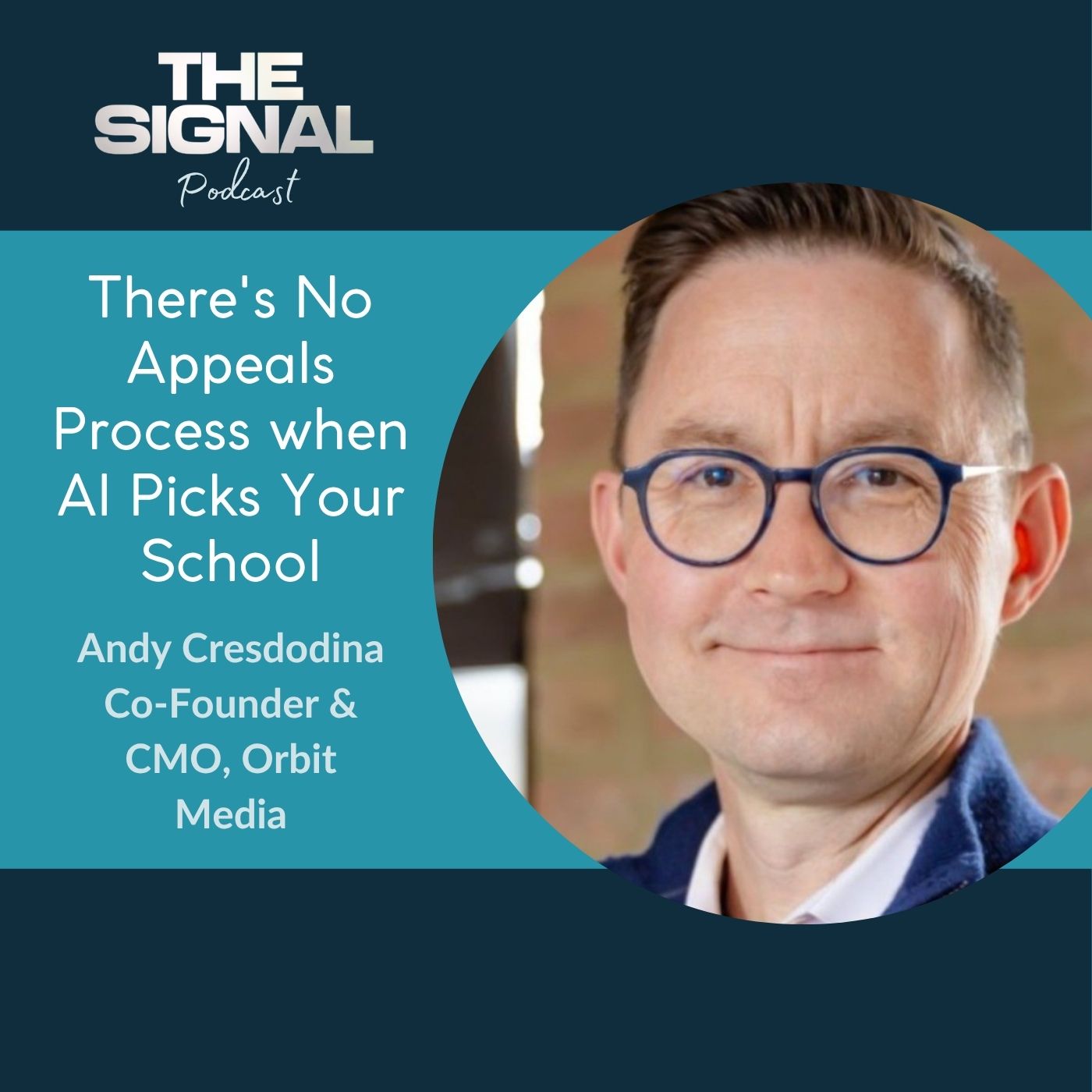
Andy Crestadina is co founder and CMO of orbit Media, a 55 person Chicago digital agency he's helped build for over two decades. He's written 600 plus articles, authored the widely used marketing handbook Content Chemistry, now in its seventh edition, and teaches digital marketing at Northwestern University. He's been named a Top Content and Digital Marketing Influencer by Forbes Entrepreneur and Semrush, among others, and speaks at more marketing conferences in a year than most people attend in a decade. But Andy's real value today isn't another SEO tutorial. It's what's happening to marketing, trust and visibility when AI stops sending clicks and starts just answering the question itself. For a college is competing for the attention of a 17 year old with a phone and a chatbot. That shift changes everything.
Let's get into it.
Andy, welcome to the show. It's great to have you today.
[00:01:57] Andy Cresdodina: Glad to be back Jeff. Honored by the invite.
[00:01:59] Jeff Dillon: So I have been following your work for for years and I have to admit you've probably answered more marketing questions than than you realize. And one thing I've appreciated is you don't really chase trends. You really look and ask the right questions. Where's marketing actually headed? So this is where I wanted to start. You know, higher ed marketers have spent 15 years or so building SEO playbooks for their edu sites. You know, and if a prospective student now just asks ChatGPT or another LLM, you know, what's the best computer science program in the Midwest? And they get one answer with no click they has the website already lost the battle?
[00:02:41] Andy Cresdodina: Yes and no. I hate that answer. But here's a perspective and a minor mind shift that might help. AI search is a Combination of search optimization and conversion optimization.
So to win in that overlapping hybrid context, we need to not just rank, but give detailed answers. Because honestly my first thought is this person's prompt is probably much more detailed than that. That sounds more like a keyword and prompts are much longer than keywords. And in the end this isn't a very transactional decision anyway. Higher ed, it's like a big lifetime choice. Choosing career, you're choosing maybe where to live, you got a lot of far from home. So I would say that really we need to publish more detailed answers that align better with our future students prompts because when they prompt with like 30 words, which is some research shows like that's a common length for prompt, then you end up concluding like, hey wait a minute, I really have to align with many more of this person's real life considerations, the kinds of questions they would ask if they were talking to an admissions officer on the phone.
So yeah, the SEO playbook, great for getting content to work within a system and AI is in fact of course a system. But just like conversion optimization, it's very much aligned with psychology. The visitor, they're buying criteria, why would they apply? Why wouldn't they apply? What are their concerns, their hopes, their dreams, the story in their life.
And that is straight persuasion, copywriting, conversion optimization, clarity, evidence, trust.
So the playbook has expanded, that's all. To win in search, you need to just add much more detail than you thought was ever necessary to these program pages. And I think that's what's going to win. Even little schools that do that can beat big schools. Maybe if they just align their content with the future students likely prompts, the big schools might be slow, they might be sleeping on those pages. And I think anyone who does that has a chance to win right now.
[00:04:34] Jeff Dillon: Yeah, if you think about it, you mentioned a 30 word search or 30 word query and it makes me think of just this evolution we've come through. If you look 10 years ago or, or even not even that long ago, the more if you're searching for keywords, the there's not much of a payoff to lengthen your, your search back in the day. Right now the longer your query is, the more payoff you're gonna get, the better, you know, response you're gonna get. And I think what makes this moment so different is for years the goal was to earn the click and now it feels like the goal is to become the source behind the answer, even if the user never visits your website. So it's a Pretty fundamental shift in how marketers think about visibility.
So you've talked about GEO being less about ranking and more about being quoted. What does a university have to actually do differently? Not in theory, but this semester to be the source an AI cites when it recommends a program.
[00:05:32] Andy Cresdodina: Yeah, I love how you framed that because you know, what is the goal here? The search goal was about clicks. Totally insufficient for driving demand. Those marketers are not full funnel marketers. The SEO is not a full funnel marketer. So the first thing of course is to make sure that we're aligned with the visitor and that we are thinking about their entire journey.
Suddenly you realize your goal is actually just to be shortlisted. That's your real goal. That doesn't show up in any reports.
It's hard to measure. You can measure citations. That's also not really a bottom line metric. But we know obviously, right. These are language systems. How do they work? Well, they're synthesizing information from all over the Internet. To what extent is that our site? That's something you can sort of discover if you do some research. To what extent is it on other sites and which sites? That's something you can discover through research.
So one thing I think a lot of brands have not yet done is sat down and like opened a beer and had like a half hour conversation with the AI about where it trains on your vertical. Pretend to be your buyer for like an hour, try it and go deep.
I publish methods on how to do this, how to discover which off site signals, what are the sources on which AI trains in a specific vertical. How does it learn about which math program is best for in the Midwest for a person who has some money in their 529, but they're kind of looking for scholarships. Scholarships. And their mom wants them to go to a public school. But dad had these dreams, like just, you're going to go deeper than you thought once you realize how the system works, what it's training on. And the best way to understand these things, unlike traditional search, is to literally just have a long conversation with the AI. Emulate the buyer journey, build a Persona. Run 25 synthetic prompts. AI will generate them for you, review them, audit them, edit them, and then look at all the responses. Have the AI output for you a list of the sources that it used to respond. It will give that to you and then you can go look at those places and confirm that you are in fact sparkling, that you're dazzling on these other places on the web where it's training on schools like yours for Future students like yours.
[00:07:35] Jeff Dillon: I have to tell the audience it's fun to watch you do this in person. We did this together late last year, I think, and it was Arizona State University, you showed us. And do these live website audits and demos of how, you know, how are your programs being found and for many different verticals. But this one, you know, you know, we're talking about higher ed and I loved watching those. So watch. Check out some of Andy's recordings or his live events. He does this all the time. One thing I've noticed with talking to enrollment marketers is that they're starting to realize it's not just a search conversation anymore. It's. It's a trust conversation. And if AI is deciding what sources to reference, then the rules around authority become a whole lot more important and a lot less transparent. If the AI overviews and chatbots start answering, you know, what's the best value public university for engineering? Who decides what counts as authoritative? Is there real risk that AI just quietly ranks and unranks institutions with no real appeals process?
[00:08:37] Andy Cresdodina: There is no appeals process.
There will never be an appeals process. There was never an appeals process for Google. And no one at OpenAI or Claude or on the Gemini team is going to respond when you ask why you're not. That's absurd. But you again highlighted a really important thing, which is this person is in consideration phase, right? The SEO is focused on traffic, but this person is actually having a longer conversation with the AI about this possible school, which I think explains why when you look at Google Analytics, AI assisted is now one of the default channel groups. Just go to traffic traffic acquisition report and to scroll over to the right on that row for AI assisted traffic default channel group. Look at your conversion rate from that. It's probably three or five or sometimes 10 times higher than Google.
Why would that be? Because the person just had like a 25 minute conversation with the AI about engineering schools.
So this is a great era for full funnel marketers. But SEOs, if that's all they're focused on, are having a tough time. Citations are not clicks. Ranking is not clicks. Clicks are not leads. Traffic is not. It's about the cheese and the mousetrap. You need both. So the things that benefit you in AI search are also simply the things that make your site more valuable to the visitor after they land. For your direct traffic visitor, for all sources of traffic, it's a different way to think about it. And I don't think it's necessarily true that SEOs are the ones who Sort of own or can claim the right or have the greatest authority. On the topic of AI search, it's
[00:10:06] Jeff Dillon: really a fascinating shift I think because for decades marketers have obsessed over, you know, the human experience.
We think about messaging, trust, emotion, reducing friction, and now there's a second audience reading our content first. And it doesn't think like a person at all. And that raises completely different set of questions.
You've written a lot about visitor psychology. What a human actually feels reading a page before they convert. Does any of that transfer when the visitor is an LLM instead of a nervous 17 year old? Or is it completely different discipline wearing the same same name?
[00:10:49] Andy Cresdodina: Well, there's one type of AI bot that just crawls the web and is training on the Internet and learning to be better at language and filling in its background knowledge. But there's another type of AI bot that is a worker on behalf of the visitor who is pulling up things live on demand when that person asks for a specific thing. So AI doesn't really have a psychology, but it adopts on behalf of the visitor the mindset, questions, concerns. It just takes that language and runs it through this giant mathematical probability matrix and then identifies other language that it starts creating in tokens of language that align with that person's prompts. So we just need to be in AI's training data to the extent that it thinks of us when that person writes that 30 word prompt, that nervous 17 year old.
So if you're a buyer, your prospect, your future student or applicant is a nervous 17 year old, why are they nervous? If you don't know that you're really going to struggle to either attract or convert this visitor. You have not done good. Objection. Handling. You haven't addressed the top concerns. You know, you need to do those things.
A quick tip for higher ed. We did this once on a project. We built websites for higher ed institutions and we knew that one of the top concerns was tuition. But we addressed it not with copy but with a call to action. You know, have a quick conversation with a financial aid officer. Ah, the visitor who lands like you can trigger a kind of a funnel. You can trigger, you can mid funnel conversion almost or that's kind of mid to bottom of the funnel. But we acknowledge that that's a concern and we give them a path. Even if that is a concern, SEOs aren't really thinking that way, but the conversion optimizer thinks that way. And when the AI reads the text like you know, 80% of students get some form of financial aid, they're going to reference that when the nervous 17 year old, if they're nervous about tuition, includes that in some of the prompts. So it's about alignment with psychology and always has been in marketing. SEOs forgot that for a 25 year period but it's back now we have to do it again.
[00:12:54] Jeff Dillon: One thing I always enjoy about talking with people who teach is they get an early look at how behavior is changing. The rest of us spend time looking at analytics and trend reports and you're watching the next generation make decisions in real time. And that perspective is incredibly valuable. You teach at Northwestern. Have you seen your own students shift how they research schools, programs, even professors using AI instead of a search bar? And what did that tell you?
[00:13:24] Andy Cresdodina: Yeah, we always ask the students, and we have a lot of international students, how they heard about Northwestern and the answers are actually much more about the brand. So that's Northwestern. So a lot of people know Northwestern. But it's weird, it's like, oh, Northwestern was mentioned in a movie. It's like, wait, what? Yeah, like pr, brand management, like brand awareness, like cultural impact, like there's Northwestern's very, very good communications and public relations. So there's just. They're very active, so their brand has great reach. And that's an advantage that you have or don't have. You can't really affect, you know, decide to be a famous university per se. There's not a clear path toward that. That's a work of decades.
But it's a case study in how brand just short circuits the whole digital funnel. Search optimizers are algorithm marketers, but brand marketers have a broader perspective and think about their place in the world and their place in the mind of a target audience. Things like share a voice and word of mouth. So not all marketing is algorithm based. Algorithm marketing in some ways the worst marketing because big tech is between you and your audience and you can't really control what OpenAI or Google's doing doing.
But there's still lots of blue ocean when it comes to relationship marketing and brand marketing and you know, word of mouth. So I think it's worth at least
[00:14:45] Jeff Dillon: mentioning that yeah, every campus I've worked with has a committee for about everything and sometimes that's what's needed.
But AI is moving so quickly, I wonder if institutions risk over planning while the landscape keeps changing underneath them. Sometimes the hardest part of a new strategy is deciding when to stop or what to stop doing. Higher ed loves the task force. If a provost handed you a blank whiteboard and said build Our GEO strategy? Yeah. What's the first thing you tell them to stop doing before you'd even talk about where to start?
[00:15:23] Andy Cresdodina: Well, let's take a moment to remember why we have a website and why we have a visitor. It's because there's a true story in the life of someone in the world that brought them to this URL and they're considering this as an option.
Okay, good. So if I'm going to fix the bottom of the funnel first, I'm going to think about that visitor while looking at that page and look at it closely from that person's perspective, then I would.
I know I'm on the right track because I've seen terrible, terrible program pages on higher ed websites. I've seen higher ed sites that fail to remind the visitor that there's a deadline to apply.
Okay, this is not artificial scarcity. Like there truly is a deadline to apply. There's a semester coming up.
Have you seen that?
[00:16:04] Jeff Dillon: Yes, yes.
[00:16:06] Andy Cresdodina: There's basics, right? Do the basics first. Because if you ask me to win at geo, even if I was successful at that, where am I sending people? What? So I would first benchmark all the conversion rates for all the landing pages for all the programs in the homepage. Done. Next, I'm going to build a Persona to analyze that page from that person's perspective.
And knowing the benchmark, I'm going to probably start with the lower performing pages. Pages with lower than expected session key event rates per URL from AI and search.
Okay, great. I know how to prioritize now. Next I'm going to give AI that super detailed Persona and a screenshot and link to that page and I'm going to have AI tell me what's missing from that page from that person's perspective. A Persona driven AI gap analysis will show me what's missing from that page. I just did about a third of what GEO is all about or AEO or whatever people call it this week because I aligned my copy with the buyer and therefore aligned it with their likely prompts. Great. Okay, so straight GEO strategy.
Now I've done good conversion optimization will be confirming that I have, you know, keyword focused content on these program pages because AI does in fact search all the time.
And I'm going to look at all the off site signals and have that little audit you mentioned where we look to see where the AIs are training on our type of school and what they seem to trust. And I'm going to review those sources and be active there.
Probably not your typical answer, but I don't know how else to win. I don't know. I'm a bottom line marketer and so I begin optimization from the bottom of the funnel up because if there's a leak in the bottom then nothing else helps.
[00:17:44] Jeff Dillon: I think it was your most recent research. You publish stuff all the time where you analyzed over half a million queries and you noted that homepages are cited more than 15 times the lower level pages. No real question here, but it was really interesting to see. So I mean I would translate to say, hey, homepages are not dead everybody. You know, we know that everyone's entering through side doors, but you better really think about your homepage.
[00:18:07] Andy Cresdodina: Yeah, that was, that was an analysis of 74 Cloudflare accounts, including many higher ed sites, to check to see where AI is crawling and not actually citations, but where AI is sending visitors. 27 of the accounts were Cloudflare pro tier accounts and so I could see referral traffic from those.
But for all 74, when you look at the crawl reports and pre process them and give them to AI and carefully categorize the types of pages, the conclusion was huge. Like AI crawls your homepage way, way more than any other type of page on your site. The total number of crawls may be higher for certain deeper pages, but as a percentage, I mean you just have one homepage. So it's crazy. Just right now, while you're listening, while you're watching this, AI is probably trying to learn about your school on your homepage. What's missing from that page? Fix it.
[00:18:59] Jeff Dillon: This whole conversation feels more, more than just a marketing conversation. For years, a university website has been one of the most valuable strategic assets. But many colleges still budget for it like it's a publishing platform instead of a competitive advantage. As discovery changes, that mindset could become pretty expensive. A lot of institution institutions still treat their website as a brochure and the content team as a cost center. Or what does it cost the university specifically to keep thinking that way for another two years while AI search reshapes this discovery?
[00:19:40] Andy Cresdodina: Well, brochures have a place in the world and on a brochure you don't have to work with systems so you can just say whatever you want. But if you're using overly branded kind of tagline type copy taglines don't train the AI to recommend your school.
So one problem, and SEOs all know this, is that the copy is overly genericized or really broad value statements or just punchy taglines. That is not helpful for the user for the AIs to train in a brand for a search engine to know what the page is about.
So yeah, it is a problem that people just think of this as like a home for the brand and it is indeed a home for the brand. But that is insufficient if our goal is growing the student body. The content team I think is it's really an investment more than a cost if you're doing it properly to get the most value from it. You need to think about more than just search again, your most valuable articles to a recent applicant being sent on an email nurture sequence after they submit deliver your content directly to the person who just converted. Like there's all kinds of ways to deliver content.
Are you taking a stand? Any strong points of view right now in politics? I've got one client in higher ed that came out strongly for something and saw huge engagement on that and lots of love from faculty besides. So yeah, there's content that you can make that AI can't make. Thought leadership, original research, prioritize those things and do it together with other partners. Jeff, you're a pro at that and that is I think a way to get much more value from a content team than just an endless series of articles that AI basically wrote half of it.
That is not the ROI from that is far lower than collaboration original research, strong opinion email nurture sequences and student content topic alignment. So you pushed a button there. Sorry about that. I get kind of worked up.
[00:21:41] Jeff Dillon: I really wanted to touch on that one because I'm thinking about schools all sound the same and we all known this forever. We joke about the campus brochure that brags about the faculty student ratios that they all claim are great and campus life is incredible and these things that could apply to any other university. But so I think now is it's so important to know your brand and how you stand out and it's a question. There's a question every I think hired marketer is wrestling with right now. This temptation to optimize for whatever seems AI is rewarding today. But universities also have a responsibility to provide information that's accurate and transparent and genuinely helpful. And I'm curious whether those goals are starting to compete with each other or whether they're actually becoming more aligned. Is there real tension between optimizing content to be citation worthy for AI and optimizing to be genuinely useful and honest for a human being. Or if those actually the same job
[00:22:38] Andy Cresdodina: they're done well well if for the keyword first SEO or geo marketer, then they're going to feel that tension because the tools are going to suggest topics that are not well aligned and the provost is going to say what is this content doing? And they're going to say, well, that's what people are looking for. So that's what we had to publish. That is the. So the keyword first strategy has some downsides and feels tension there. But if you are thinking about your audit here, I'll give you an example. If you have admissions calls recorded, any of them, let's say you've got 20 of them. There's legal things here I'm not going to get into, I'm not sure. But if you have actual call recordings that include the voice of the customer, the buyer, the applicant, and you can analyze those, export them, process them, analyze them, then that will give you better clues on what kind of content to create and what answers to put on your pages because you know it's 100% aligned. You didn't use a tool to figure out what your audience wants. You didn't lean on keyword research.
You thought about the actual customer, you thought about your student and what their top concerns are. There's just better sources of topics than keyword research.
And if you do use keyword research, and I've done hundreds and hundreds of hours of keyword research, I've done SEO for 25 years, you're going to feel some of that tension and I get it, you're going to go for it, publish it, take your shot at that high volume phrase, but add an angle to it, make it more visual, put in a strong point of view with it, better support it with data. If you're publishing something that was kind of keyword first, I hope you go 10x on that thing because if AI can write it, you just shouldn't publish it. The Internet doesn't need that again, it's already out there. So yeah, the tension is real, but not for the human focused visitor. First marketer, right.
[00:24:27] Jeff Dillon: I've spoken with some college presidents recently of some smaller schools and some other leaders as well. And they know they can't win a spending war with the big flagship universities. So they're looking for places where strategy can beat scale. And I'm curious whether AI changes the rules in their favor or simply just reinforces the advantages that the big brands already have. If you were advising a small tuition dependent college that that can't outspend a state flagship on marketing, is AI search a leveler that helps them compete or does it just amplify who have already had the most institutional authority. Yeah.
[00:25:04] Andy Cresdodina: If the prospective student goes to AI and types in a prompt, if the prompt is short, AI will simply rely on its pre training. The P in ChatGPT stands for Pre training. And it will come back with the big brands because they have the biggest digital footprint and the longest time and then they've been around forever. If the user's prompt though is much longer and more detailed, it triggers AI to go search.
And when AI searches, it may retrieve things that are, you know, they're called fan out queries. That's the nerdy technical term for what AI does when you search. It writes 10 synthetic queries and it goes searches for them all and reads everything and comes back and synthesizes and writes a summary.
So those fan out queries depending on the prompt might be pretty long. And when that's true, you know, AI is an equalizer. So you can't really go to Google or traditional search and just say, I'm looking for schools within two and a half hours of the northwest suburbs of Chicago that have long tenured teachers and offer Mandarin and have study abroad opportunities.
That's like a six parameter search with like location and distance. So for that, you know, who wins there?
All kinds of people could win that. Right? It's not just going to list the top schools.
So you just never underestimate how insanely personalized the AI experience is for the user. And that was only one prompt. You know, they might have a much longer conversation. After all, they're making a big decision.
[00:26:31] Jeff Dillon: Yeah, that makes sense. So I, I'd love to end by looking ahead because the decisions colleges make over the next few years are going to shape how they're discovered for the next, you know, decade or so. Five years from now, when a student is choosing between three colleges, what does that discovery and decision process actually look like? And how much of it happens somewhere a marketing team can't even see or influence? Jeff, you ask a great question.
[00:26:58] Andy Cresdodina: I'm going to come in on the mic for this one. That's a great question, Jeff.
[00:27:01] Jeff Dillon: I love it. Five years is a long time these days.
[00:27:04] Andy Cresdodina: It is. It's a very long time. So you're asking really for a prediction of the pretty distant future in digital.
I'm going to suggest this, and this is without much thought or care or concern about what this means for me or the Internet or digital more broadly. Our websites, probably five years from now, AIs will be so good at generating mini custom experiences that the user may expect when they prompt for AI to make for them like a custom HTML web page buyer guide.
Imagine when that person listed that weird crazy prompt I had with like the foreign language and the study abroad program and the distance and the okay, in that context, five years from now, AI will probably build like a giant guide that has a lot of criteria based on its memory and past conversations with this person is. So it'll be very custom, very personalized, very visual. And AI is going to sort of the way that right now it answers with text. It's going to make on demand visual experiences like navigable custom instant mini websites specific to that person and their needs in that, in that moment.
This changes the use of browsers, the value of the visual Internet, the nature of traffic, the nature of websites. If my prediction is true, then websites become slightly less important in terms of attracting visitors and being beautiful and they become slightly more important in their ability to feed systems all of the key information about a school.
So I don't think that it necessarily causes dramatic shifts in strategies except in that we need to change our expectations about things like traffic and conversions and start to go back to like the 1980s and 1990s marketing when you're just like get your stuff out there in the world and don't expect to get good attribution. But I can easily imagine that future where when you talk to AI, it makes for you like a full on guide.
It's going to be pretty intense.
[00:29:11] Jeff Dillon: Yeah, it already knows so much about us that people don't even realize. I can see your vision. I love those insights, your experience, your perspective. I know our listeners are going to walk away with plenty to think about and hopefully a few ideas they can put into practice. And thanks to everyone for listening. If you enjoyed the conversation, please subscribe to the Signal. We will put links to Andy's LinkedIn and Orbit Media's website in the show notes. And thanks again Andy. That was really fun.
[00:29:39] Andy Cresdodina: Anytime Jeff, Always a pleasure. Thanks everybody.
[00:29:43] Jeff Dillon: That's a wrap of this episode. Episode of the Signal if today's conversation sparked a new idea or challenged your thinking, that's exactly the point. This show is about cutting through the noise and helping you see what's actually shaping higher ed right now. Please subscribe so you never miss an episode. And if you found this valuable, leave us a quick review. It helps more higher ed leaders find the signal for deeper edtech insights, news and trends to let delivered monthly. Subscribe to the Signal monthly
[email protected] thanks for listening. We'll see you next time.