[00:00:00] Paula French: The ability to focus on a smaller set of programs is a superpower. So if you can focus on one to five programs, come up with exactly what your strategy is going to be, what your playbook is going to be, and repeat that across those focus programs, you are going to see movement much more quickly and it's going to be definitely going to be more effective than if you were just optimizing every single program page on your website.
[00:00:33] Jeff Dillon: Welcome to another episode of the Signal, the podcast where we dig into the people and ideas shaping technology and higher education.
I'm Jeff Dillon, founder of EdTech Connect, and today's guest is someone I've been looking forward to having on the show because what she and her team are researching right now is directly impacting how colleges and universities get found by prospective students.
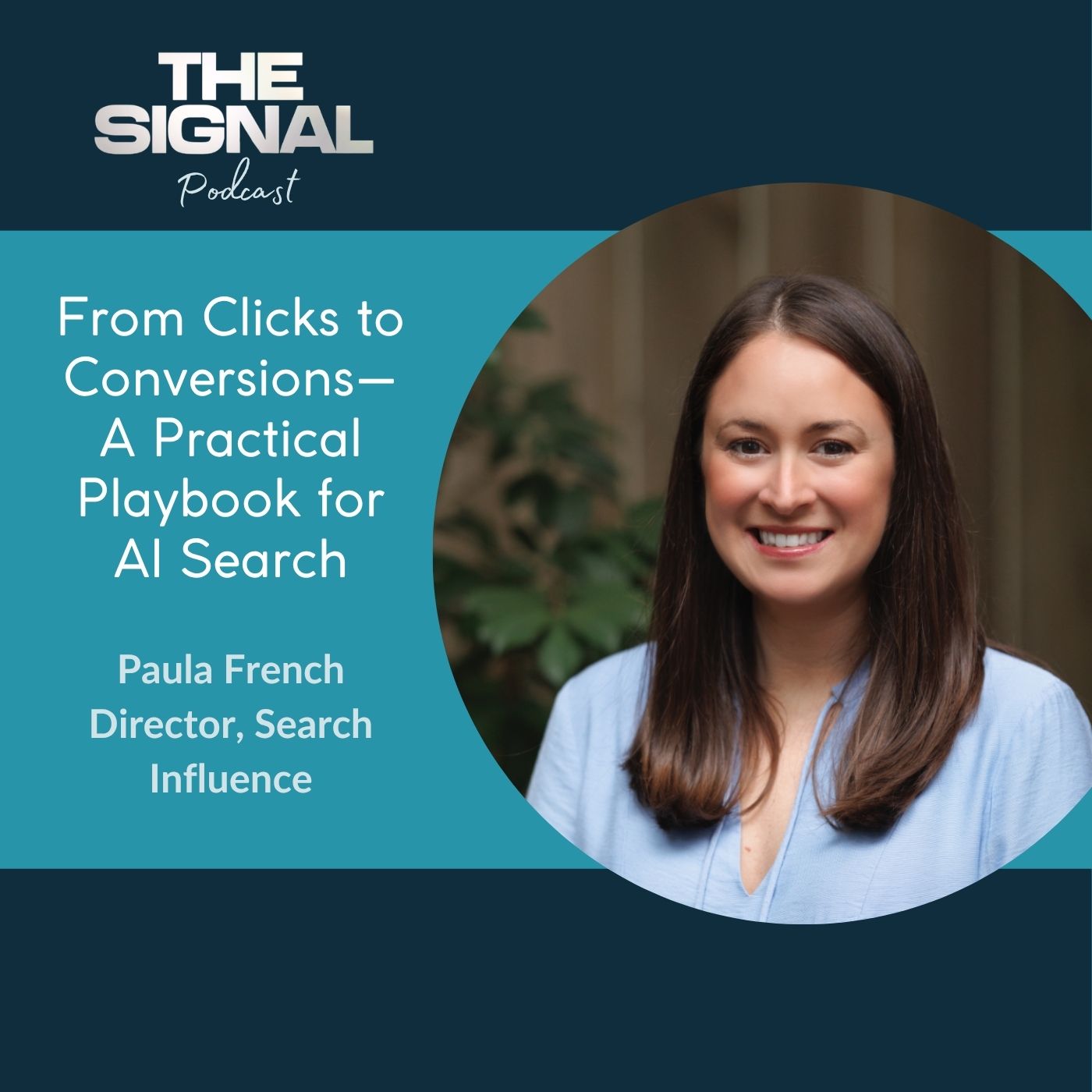
Paula French is the Director of Sales and Marketing at Search Influence, a digital marketing agency where she spent more than 16 years helping institutions in higher education, healthcare and hospitality stay visible online.
As the search landscape evolves, and it's evolving fast, Paula has been at the forefront of understanding how AI is changing the way students discover programs. Most recently, she co authored a groundbreaking study with UPSIA titled AI Search in Higher Education How Prospects Search in 2025. And the findings are eye opening for any institution thinking about enrollment and digital strategy. She's also a sought after speaker presenting at national conferences including the AMA Symposium for Higher Education and UPSIA mems.
Paula, welcome to the show. Excited to have you today.
[00:01:50] Paula French: Hi Jeff. Thank you. Excited to be here.
[00:01:54] Jeff Dillon: So you've been with Search Influence for more than 16 years, which is pretty remarkable in the digital marketing world. What drew you in early on? What's kept you so deeply invested in this, in this work?
[00:02:08] Paula French: I was really lucky that an internship that I had while I was in marketing at LSU actually led me to Search Influence. And at the time it was a pretty small, actually remote work company, which is interesting because we went to an office and are now remote again.
But because of that internship, I was introduced to this idea of search engine optimization and of the fact that, like, people, you know, actually paid companies to help them rank on Google. And that was like generally pretty early on in the world of SEO. I mean, this was 2009 and so there wasn't a lot of people who understood it at the time. And so that was something that I really actually liked was that it was something that people didn't know about. And the other thing was that it was a great combination of my marketing background and technical background. So I went to marketing, graduated in marketing from lsu. But growing up, we were on computers from a very early age, which at that time was different. Like my dad was a computer programmer as we said back then. You know, now we would call him a software developer, but we, we were on computers so young that I vividly remember learning how to spell my middle name by typing it into the command line on our DOS computer at home.
And so that's the kind of like technical like ingrainedness I have in me. And so when I came out of school and started learning, oh, SEO is this thing that's a great combination of actual marketing and true technical speak, like that just was something that really attracted me to it. And I think that I've always been in a client facing role and so I've been able to break down these really technical, complex concepts into simple language so that clients, and now at this point prospects can really understand that.
[00:04:04] Jeff Dillon: Wow, I love hearing those stories about, it's so much about your environment and what you're around at a certain time. There's a book called Outliers by Malcolm Gladwell. It's all about that. Like, but it's interesting. So for those that aren't familiar with search influence, can you describe what the, what your agency does and how higher education became such a, such a central focus for, for you?
[00:04:29] Paula French: Yeah. So search influence really focuses on SEO and digital advertising. And today that focus on SEO is on AI search very heavily. We started digging in really early into ChatGPT when it first came out, and understanding how these large language models were working and then how businesses and brands were ultimately showing up on these engines and what it took to actually have the LLMs understand your brand, understand your business, understand your products and your programs. So as far as how higher ed became a focus for search influence is really, it was after seeing a few different clients that we came to work with and the results that they were getting.
So the portion of higher ed or the aspect that we really entered higher ed through was online and professional education. So it started with SEO for those kinds of schools and we saw that the like, a lot of people think about higher ed marketing, they think about undergrads, they think about high school students deciding where they're going.
And there's not, there's not as obvious of a place for search engines in that process are definitely a part of it, but it wasn't as obvious.
And so when we entered higher ed through this like adult learner who is searching for these programs through search engines, we really came to realize this is a really awesome opportunity for these universities. And so several years after that, we started working with with another professional online ed unit at a school and really got to do full funnel digital marketing. So we were doing SEO, we were doing digital advertising, email analytics, which analytics we really do for everybody. And so they're actually the ones who introduced us to an association that's focused on this area of schools that's called upsea. So it's upcea upsea. And so we now partner with them on research annually and we share insights with their members.
[00:06:36] Jeff Dillon: Yeah, okay, gotcha. You know, I've been in dozens of conversations with enrollment and marketing teams over the past year, and there's this growing tension. I keep hearing on one hand, everyone's investing heavily in SEO and paid campaigns. On other, fewer people can really explain how prospective students are actually searching anymore, especially with AI tools changing behavior so, so quickly. So when I saw your work with UPSIA on the study, it felt like one of those first real attempts to put this data behind what's actually happening. So let's talk about this, this big research moment, and you and your team partnered with UPSIA to produce the AI search in higher education, how prospects search in 2025 that report. What. What was the catalyst for that study? And what were you hoping to learn?
[00:07:26] Paula French: Yeah, the catalyst was really questions that we were hearing from the higher ed marketers and leaders that we were talking to, you know, every day in our work, in addition to at conferences. You know, I was hosting a roundtable at one of these conferences and they were saying, like, well, are prospects actually using AI search to look for programs? And we intuitively knew the answer was yes.
But what we really wanted to do was have data to back that up and also understand how much and how. And how do they view traditional search engines as part of this process? How do they view university websites as part of this process?
We also wanted to understand how that was going to change. So we did the study last year in 2025, and we'll be doing it again this year. And it's going to be really great to have like a baseline of data and see how it's changed and kind of like overlay that over what we're seeing for our own clients so that we can see, like, what's that really telling us? Like, are our clients capturing as much market share as they can from AI search? And is there more that we should be doing differently, more changes we should be making in the strategy as a result? So we want the data so that we can help universities see this as an opportunity, but we also use the data in decision making for our clients as well.
[00:08:45] Jeff Dillon: Yeah, yeah. Gosh. You know what, what really stood out to me in your report is that it's not just some fringe behavior anymore, it's mainstream.
And I'm hearing from schools that students are showing up already, already informed in a different way, sometimes with questions shaped more by AI summaries than by the institution's own website. And I think most teams aren't fully prepared for that shift yet. So when I saw that stat, felt like it's kind of this line in the sand moment for higher ed. One of the findings that really jumped out was that I think it was one in three prospects now trust AI tools for program search and that 50% of them are using AI tools as part of their search process. So when you first saw the data, were you surprised or did it confirm what you're already seeing on the ground with your clients?
[00:09:36] Paula French: Primarily it confirmed what we were already seeing because for our established clients who had hit like a, you know, a really good point of growth with their organic traffic, they were starting to see less organic traffic. And so we knew that people were clicking less and that they were getting their questions answered through AI overviews on Google, because at the top of the page there is an AI summary. In addition to other platforms like ChatGPT and Gemini, we are also starting to see some referral traffic from those sources as well, because you can see in Google Analytics where people are clicking to your website from these other AI engines.
[00:10:16] Jeff Dillon: I think for years the playbook was pretty clear. Like, you rank well, drive the click, optimize the landing page. But now the answer is happening before the click exists.
So if you're not part of that answer, you're not even in the consideration set. And I'm hearing from teams who are starting to see traffic flatten while interest hasn't dropped. So which tells, tells me something that it's shifting upstream in a big way. So when you look at stats like, like 79% of prospects reading Google AI overviews and more than half saying they trust institutions cited there, it raises a pretty urgent question. What does that mean practically for university that's trying to show up in AI generated results?
[00:11:05] Paula French: Yeah, I think that it is a more urgent endeavor than some might like to think. Some, some are recognizing that some universities are recognizing that they do really need to jump on this and they do need to start making changes. The good thing is, is that it's not a whole new, entirely different channel, entirely new set of Things you need to be doing. Yes, there are definitely nuance things that you can be doing and should be doing to show up in AI search, especially based on the way that people are searching there. But everything you're doing for organic is helping AI. Everything you're going to do for AI is undoubtedly going to help your organic rankings. And so it's really like SEO plus that you need to be thinking about and it's not a whole new channel.
[00:11:56] Jeff Dillon: I think what's also interesting is that we're not looking at a replacement story, we're looking at a kind of a layering effect with traditional search not going the way.
But it's no longer the only front door. Prospects are bouncing between Google and AI tools and social and even peer communities, often in the same session.
And each one is shaping perception in a different way. So when I talk to teams, the ones making progress aren't asking which channel wins, they're asking how their content data, how can they get that to show up consistently across all of them? It's different mindset, I think, than the old SEO playbook. So like from your vantage point, helping institutions with digital strategy, how should colleges be thinking about spreading their visibility across these channels rather than betting everything on one of them?
[00:12:50] Paula French: Yeah, the great thing is, is that AI systems are looking at all of that stuff to understand your brand, your university, your individual schools within your university, your programs, even your instructors, which are your essentially their entities within your organization. And so everything that you're doing to build up your presence on social, on your paid profiles, on any type of like media that you're doing on your own website, on any other site that you can think of, all of that stuff influences what AI knows and understands about you and most importantly, what it is going to tell people about you. So what it understands about you and what it's going to tell people about you. So AI is generating answers based on patterns that it sees in all of this content that it has ingested. And as a university, you have more control over the patterns that AI sees than you realize because there is so much owned media out there that even your earned media that you do have, you know, there's, you have control over that to a certain extent. And so all of those things are influencing what AI understands about you. And you can make adjustments to how you're representing your programs there so that the right information and the most important information shows up in AI.
[00:14:16] Jeff Dillon: Yeah, a lot of institutions are spreading themselves thin across dozens of programs and hundreds of pages, trying to optimize everything and really ending up with nothing that truly breaks through.
So when you look at a stat like 82% of prospects favoring page one results, which I think we all kind of understand, that it really forces some tough prioritization decisions for institutions that are stretched thin on resources.
Where do you tell them to focus first to get into that consideration set?
[00:14:56] Paula French: The ability to focus on a smaller set of programs is a superpower. So if you can focus on on one to five programs, come up with exactly what your strategy is going to be, what your playbook is going to be, and repeat that across those focus programs, you are going to see movement much more quickly and it's going to be definitely going to be more effective than if you were just optimizing every single program page on your website. So if you're thinking about like what does great look like per program, you're thinking about the program page, you're thinking about supportive content on your site related to that program page. So, you know, for most people that's blog posts, but it can also be even the news section, the media section. It can and should be your LinkedIn page that you're leveraging to do articles and posts that all support that specific program.
It's your YouTube channel. Because YouTube is the number one search engine beyond Google and AI. There are tons and tons of searches happening. There is Google owned property. Google is reading everything on YouTube to understand businesses and understand the world. So you have to be placing videos on YouTube in addition to, well, optimizing them. And it's not just about being in all of these places. I mean, that is just like the tip of the iceberg of things you can be doing.
But we often see people aren't even doing that in a concerted way. And so you have to be representing your program very consistently across all of the places that you're talking about. It's in order for AI to be able to cite it back in the way you want. So it's like if you talk about your program in four different ways across those places, AI is going to have a much blurrier picture about your program. But if you have said the same thing in all of those places, that's how you start to develop that pattern and that's how AI learns to repeat that back to its users.
[00:16:50] Jeff Dillon: Yeah, I always think examples like this are where really clicks for people because otherwise optimizing for AI search can feel a bit abstract. And I think a lot of teams are still trying to translate that phrase into actual work their teams can execute. So when you See a school not just hold steady, but actually recover traffic in this environment, it usually means, I think they made some pretty intentional changes behind the scenes. You talk about Tufts University, they recovered traffic and improved visibility by optimizing for AI search. Can you walk us through what kind of optimization actually looks like? What did they do differently?
[00:17:36] Paula French: Yeah, so we were already doing traditional foundational organic SEO for them when they started to see some of these traffic dips. And so their organic traffic started to go down at the beginning of.
It may have just been the beginning of 2025 that they really started to see those traffic dips. So it took a little bit for them to really be impacted by AI search. We were already so deep into doing SEO that it was pretty easy to make some adjustments to recover. And I don't want to say easy, but it was effective to make adjustments to recover that traffic. So we changed the way that we wrote the content. We were writing it more directly for AI with certain best practices that we use, like talking about the program in a very clear way. So it's like, what does this program actually do? Who is it for and what is the outcome? Putting that super plainly, super simply at the top of the page and then adding Q and A to those program pages is, we like to joke that it's the easy button. And you will hear about Q and a FAQ in, you know, a lot of different places. But the reason why that matters is because when you're writing in that format, you're forced to get detailed and into some of the, like, deeper, nuanced things that your prospects are asking of AI engines. Your prospects have a much greater expectation of information from AI than they did of Google before when they were looking for pretty like, high level stuff. And so if you are going to be able to be in that, in that answer, or be the source for that answer, you have to be getting more detailed on your site than you were before. And Q and A is a good way to do that.
So then, like, those are the big, like program page changes we made for Tufts. That made a big difference.
[00:19:29] Jeff Dillon: Yeah. If you think about it, you're matching that semantic query type, right? It matches pretty well for those LLMs.
[00:19:35] Paula French: Yeah. And since you said the word semantic, I'll bite on that for a second. So Google made the move in 2012 from what they referred to as from strings to things. So strings were like matching exactly what you were typing into the search engine as a keyword to things, meaning entities. So your university, your school within that university, the idea of Continuing education, the idea of higher education, your instructors, all of those things are entities. And Google understands your university as programs through a web of entities. And they're all connected through what is called the knowledge graph. And so you're not optimizing directly for. I want to show up for this exact phrase because number one, people aren't searching like that anymore. And number two, Google doesn't understand you like that anymore. And so when you establish yourself as relevant for the right things in your knowledge graph, Google can then Google or ChatGPT can pick you and pick your information out more directly for whatever they're searching in relation to those topics, as opposed to just continuing education. New Orleans how we all used to search.
[00:20:52] Jeff Dillon: That's a great quick lesson on what's happened over the last decade. Plus I'm hearing from teams that their paid costs are creeping up.
Organic traffic feels less predictable.
Internally. There's pressure to prove ROI on both at the same time. So I think what's changed is that organic isn't about driving clicks anymore. It's about influencing the answer before the click even happens. So this shifts how you think about value pretty significantly. When you step back and look at the tension between paid advertising and organic search, how do you counsel institutions on where to invest as AI starts to reshape what organic even means?
[00:21:36] Paula French: The thing that I'm most excited about about AI is that it has the power to connect a university to students in a way that Google never could.
And it has the ability to drive those students to a decision.
And so with paid ads, there is amazing things happening with targeting. And the platforms do a pretty great job like finding the person, but individuals are going to AI and telling them everything about themselves. Like, I'm Paula French, the director of sales and marketing at Search Influence. I want to grow my career in this and that way. And then they're asking it all kinds of questions from that. And so this is an amazing opportunity for universities to be the answer within those very, very nuanced searches. And you can connect people to your very niche programs through SEO when nobody was searching for those niche programs before. Now people are talking to AI in this very niche way in a way that you can actually get those niche programs served to somebody.
[00:22:42] Jeff Dillon: Right, right.
[00:22:42] Paula French: That's just very different than digital advertising, which, you know, we love digital advertising, but not everybody can put ad budget behind all of their programs and especially not these niche programs. So it's also a way for you to like, give some love to some of these smaller programs or newer programs that you Wouldn't have even tried to market before.
[00:23:02] Jeff Dillon: Yeah, you're in a really interesting position because you're not just looking at data, you're out in front of a lot of these conversations with the marketing leaders in the room. And what I've noticed at conferences lately is that there's no shorter surge of interest in AI, but there's still a gap between this curiosity and the actual execution. The teams that walk away with something actionable tend to be the ones that rethink how visibility works and not just add another tactic to the list. As you go and speak at these events, I think you were at UPSIA and you're going to go to speak at ama, right?
[00:23:40] Paula French: I was at AMA and upsea two UPSEA conferences recently, AMA and the last one hopefully, hopefully this year as well. We'll find out in a couple months.
[00:23:48] Jeff Dillon: Well, when you're at these conferences, what's the message you most want higher ed markers to leave those sessions with?
[00:23:54] Paula French: I think that, you know, one is that it's not as crazy as you think to show up in AI. And you know, I kind of touched on this a little bit earlier, but you have more control over your ability to show up in these answers than you realize. And that's really where that whole thing about the patterns comes in. And you know, we want, we want AI to think and understand certain things about our university and most universities just, just aren't even putting that information out there in the way that they should in order to show up. The second thing is that prospects are making their short list through those AI answers and AI has the power to actually move them to a decision.
In the old world of Google Organic results, you know, you're searching for something, you're going to 10 different websites, you're maybe making a spreadsheet of all of the things that you like and dislike about these programs if you're that motivated to go back to school. Right. But that's a lot of work to make a decision and a lot of people would just stall out and never make the decision to move forward. You know, they're maybe just didn't go back to school or they say I'm going to work on that later. And then they never get to it because it was just too hard. It was simply too hard to compare these programs. And so I think that AI is really good news for universities in that it's going to help people actually make that decision to go back to school.
[00:25:20] Jeff Dillon: Yeah, let's get a little practical here. A lot of schools are asking what what they can actually get done before the next recruitment cycle. I've been in some of these conversations lately. Directors who don't have massive teams or budgets, but they know something shifted and they can't, they can't afford to really sit still.
If a director of enrollment marketing came to you today and said, hey, they have a limited budget and they have six months to, to meaningfully improve their visibility in AI search, what would your playbook look like?
[00:25:51] Paula French: So for one, we would say what are the programs that actually have the most room for improvement? You know, where will, what could you be promoting that's actually going to help you meet those enrollment goals? We would start with like a focus on those. We would optimize the program pages. We would do some set of blog posts to support those program pages. But you have to make sure that like those blog posts that you're putting on your site are strategic and support some of these prompts. The prompts are the way that people are searching on AI now. And you have to make sure those blog posts actually link back to the program page because sometimes they don't. Sometimes people just put blog posts up and aren't actually even driving people back to that primary page where they're going to learn about the program and ultimately convert.
The second thing we would do is to leverage some of the paid profiles that you already have. So that could be like niche.com or Peterson. So leverage those for the deeper links back to the program page. In addition to being a place where you can like restate your value prop and the like explainer about that program that's going to help build up those patterns and then similarly using YouTube and LinkedIn to do that as well. So a set of like LinkedIn articles and LinkedIn posts, a set of YouTube videos with really well optimized descriptions that are going to help build up those patterns that you want AI to see so that it is then repeating to the user the right information about your program.
[00:27:20] Jeff Dillon: Yeah. Well, Paula, one last question to wrap it up here. I want to ask you what's one thing you wish more people in higher ed truly understood about the digital landscape right now?
[00:27:30] Paula French: I'm really glad that you had this what else question because analytics and tracking is a big thing for digital marketing. And I would venture to say that a lot of marketers use the fact that digital is trackable as a way to move spend online.
Now digital is becoming less trackable. It's been becoming less trackable for a while. Google Analytics has never been perfect, but especially over the last few years with cookie blockers and privacy changes, it has just gotten harder and harder to track people. Okay, so that was before like even just something we've been dealing with for the last few years now with AI as you said early on in this conversation, the prospects are showing up to your website pretty well informed. So they never came to your site, which means you never received the like number in your traffic stats that they came to your site to learn about you. And you probably never received an inquiry from them. So your inquiry numbers are down as well. But you see still have an interested, engaged prospect now coming to your website maybe for the first time. And so all of your higher up funnel metrics are not going to look great. And us marketers who have relied on those metrics for two decades are now having to rethink how we measure success.
Ideally we were looking lower funnel already alongside all of those higher funnel metrics. And you know you can create dashboards to do that. Not everybody even has those dashboards, but you have to be looking at applications and enrollment or registration, whatever it is for your particular school in addition to some of those higher level metrics. But then you need to be introducing new metrics and you can measure your AI visibility. I was really surprised to learn at a recent conference that some agencies didn't even know that you could measure your AI visibility. And that is possible. There are a ton of tools out there to do that. We have a blog on the Search Influence site about AI tracking tools. It's one of our most visited pages right now. We're keeping it updated too. So it is possible. But like the, the sort of like the long and short of it is that you have to redefine success.
Be okay with the fact that your traffic and your inquiries are going down as long as those lower funnel metrics like applications, enrollments, registrations are still looking good.
[00:29:52] Jeff Dillon: Well, let's put a link to that AI tracking tools reference in the show notes here. This has been a really great conversation and really I take a timely one. The way prospects are searching is changing fast and the institutions that pay attention to this shift are going to have a real advantage over the next few years. And I really appreciate you grounding this in your real data from UPSIA and these real examples that gives people something to act on, not just think about. And thanks again for joining me and everyone listening. Spark new ideas, maybe a few realizations and it's probably a good thing. So thanks for your time today, Paula.
[00:30:26] Paula French: You're welcome. Thanks so much for having me. I'm happy to, happy to be sharing these ideas with universities and, you know, really just want to help people find a way to talk about this at their universities. Because a lot of people just like they know AI is important, they know they should be doing it, but they don't even know where to start. And so hopefully this gave them something that they can actually take back to their universities, talk about it with their team and make some changes.
[00:30:50] Jeff Dillon: Yeah, I'll put links to search influence and Paula's LinkedIn in the show notes. Have a great one. Bye Bye.
That's a wrap of this episode of the Signal. If today's conversation sparked a new idea or challenged your thinking, that's exactly the point. This show is about cutting through the noise and helping you see what's actually shaping higher ed right now. Please subscribe so you never miss an episode. And if you found this valuable, leave us a quick review. It helps more higher ed leaders find the Signal. For deeper edtech insights, news and trends delivered monthly, subscribe to the Signal monthly
[email protected] thanks for listening. We'll see you next time.