[00:00:00] Stefan Parker: 60% of leads come after 5 o' clock and that's kind of like your silent majority. You know, it's. If it was like 20%, 30%, you could be, okay, fine, but 60%, that's a lot of people that are basically going on your website and looking at your business and looking at what you offer. And nothing is more frustrating than a contact form that you submit on a Saturday morning that doesn't get answered until Monday or Tuesday. Nothing's more frustrating than a chatbot that leads you to a cul de sac of an answ.
[00:00:31] Jeff Dillon: Welcome to another episode of the Signal. Every admissions office knows the feeling. The student questions keep arriving long after the lights go off and too many of them land in a contact form nobody reads until the next week.
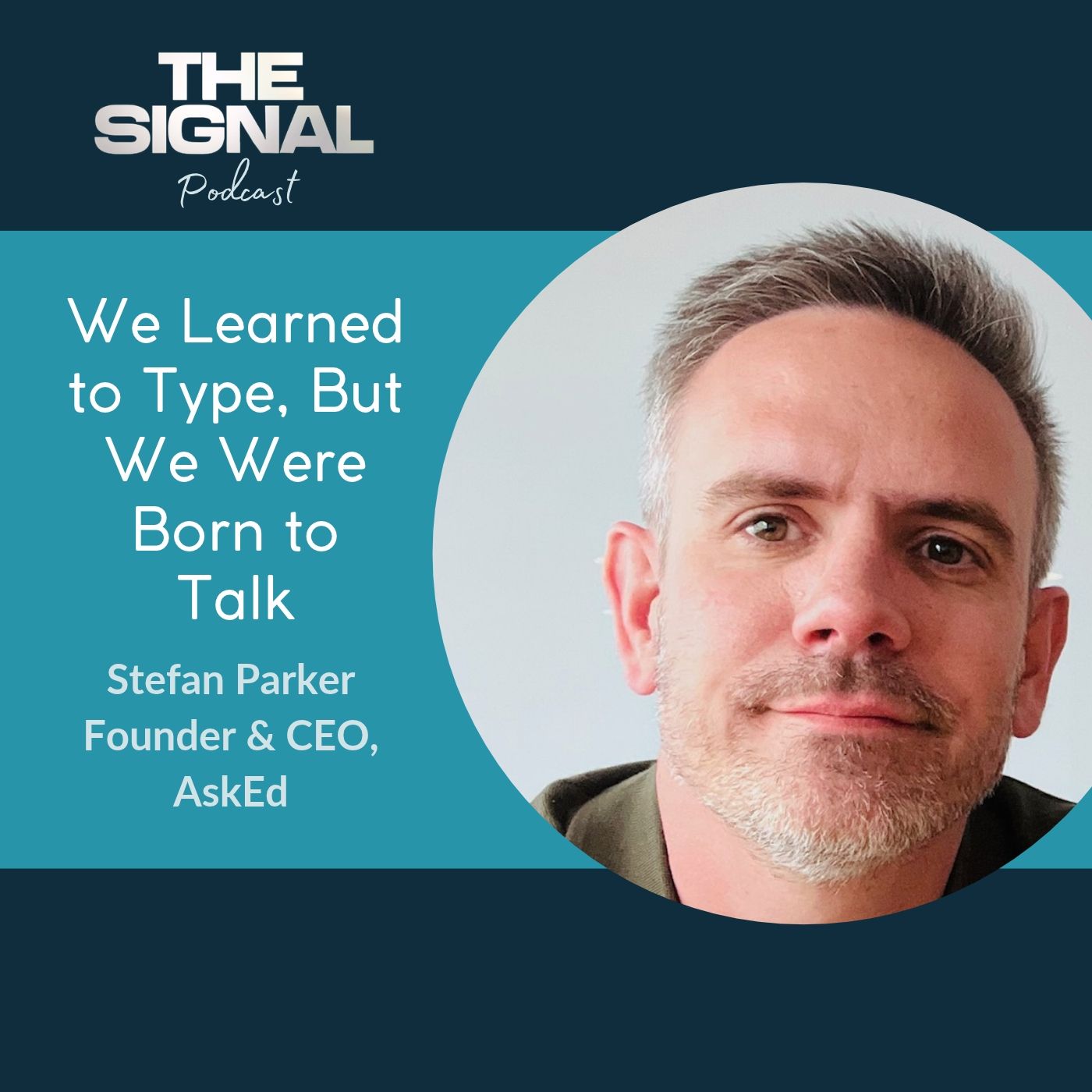
My guest today decided universities should answer the phone instead. Stefan Parker is the founder and CEO of AskEd, a London based voice AI company. On a mission to enable every student to speak naturally with an educational institution anywhere in the world, at any time, in their own language.
AskEd is making this vision a reality through multilingual voice AI student recruitment agents that hold natural, unscripted conversations with prospective students in over 80 languages. 24, 7 across phone, web or WhatsApp. In just six months, Stefan and his co founder John Crick took AskEd from concept to live deployments with educational institutions, raised £100,000 in pre seed funding and ranked the UK's number one higher education startup by F6s.
They have now progressed to securing paying clients including universities and international language schools. AskEd has also been featured in HuffPost, FE Week and London Daily News.
Stephane, welcome to the show. It's great to have you today.
[00:02:03] Stefan Parker: Great to be here, thank you. Thank you.
[00:02:04] Jeff Dillon: Well, let's start with your background. You studied psychology at Liverpool, you earned a master's in filmmaking and now you're building voice AI.
What's the thread that connects those three or how did that happen?
[00:02:20] Stefan Parker: I don't think there is really a thread. I think I've had a bit of a meandering career, maybe potentially. Well, I did psychology at Liverpool a long time ago, but I found myself the bulk of my career has been in education. In higher education?
Yeah. I spent basically the best part of about 15 years as a higher education professional. So I was a director of student recruitment, I was a commercial director, head of admissions, and along the way I did a master's in filmmaking. And even though I'm a first time founder, I'm definitely not a first time builder. So I've done a lot of Projects and built stuff. And, you know, I did a campaign a couple of years ago to get people off their social media in the month of June called Jomo June, you know, and I've made lots of films and I've done lots of projects, but this is the first company that I'm actually standing behind and I've built. So really maybe the one thing that sort of threads it together is maybe storytelling. Potentially you got to tell a story when you're making a film. And I think storytelling definitely helps when you're pitching and you're, you're talking to people about your business. But yeah, there's nothing that's really like a tangible one thing, I guess, but I wish there was. But no, I kind of, I've jumped around a little bit.
[00:03:34] Jeff Dillon: Yeah. Yeah. From my time in higher ed, there's really this big disconnect between how universities think students communicate and how students actually want to engage with us. The admissions teams, I think, are juggling like thousands of inquiries and they're answering the same questions over and over and trying to give every prospective student a personal experience.
You spent nearly six years running admissions at Met Film School.
What did being on the receiving end of thousands of student inquiries teach you that ended up shaping AskEd?
[00:04:09] Stefan Parker: I think those expectations have changed, for sure. I think students now, they work across different channels. They want instant responses, they want personalization, they're going to different places to understand what an institution does. But there are some hard and fast rules that business like, you know, higher education institutes and education providers, whether it's colleges or language schools or universities, are the fundamentals. And I definitely learned those when I was at Met Film School and also when I was at sae. So I spent about six years, six, seven years there and I spent about two years at sae and I was overseeing a lot of student recruitment. And look, I mean, I learned a lot around. There's a constant amount of pressure. You know, there's always a lack of resource. You're always tied into your, you know, your monthly and your quarterly targets. Enrollment numbers are the ultimate goal for any institution.
And you're going to events, you're trying to create high performing teams, you're trying to motivate them to pick up the phone and to, you know, to deal with every incoming inquiry. And every conversation is vital. Right. Every conversation that your team have with those prospective students can lead to quite a big turning point in a student's life. But I think that a lot of also made me realize that there's a big disconnect between what a university or a provider does in terms of how it catches those leads, how it catches that interest and the technology behind that. And that's the thing that you see now, and this is the problem that we're trying to resolve, which is that most universities, most providers are still stuck a little bit in the dark ages, I would say, when it comes to chatbots, contact forms, voicemails, you know, nothing that catches the interest in the moment. It happens, certainly not when it matters most. And nothing around multilingual.
[00:05:55] Jeff Dillon: Right?
[00:05:55] Stefan Parker: Yeah. So I think I learned that there's a lot of infrastructure there that isn't really playing into what students want.
[00:06:01] Jeff Dillon: Yeah, we spend so much time and money trying to attract these prospective students, but when they finally have a question or they show interest, we often ask them to fill out a form or wait for someone to get back to them. And students are really researching colleges between nine and five. They're doing it in the evenings and weekends and whenever they have a few minutes.
Your premise is that prospective students don't keep these regular hours. What are you seeing about when and how students actually reach out and what usually happens to those after hours questions today?
[00:06:38] Stefan Parker: Yeah, there's a lot of stuff that backs this up. So there's a report that came out from ucas and you know, UCAS is like one of the main organizations that oversees higher education admissions in the uk and it said that, I think it was how did, how was AI shaping student recruitment? So it's quite pertinent to AskEd. That's our bread and butter, really. That's the whole space that we're in. And really it was that 43% of students still relied on university websites.
So they're still using university websites. That ecosystem is still there, you know, and that makes sense because that's your shop window. You know, you're not going to commit 50, 60,000 pounds worth of tuition fees and three years of your life just based on one output of a ChatGPT search.
However, 48% same report showed that a lot of students do use AI to make comparisons and to search, but only 10% used it to make the final call.
So that shows a number of things. One, that websites still are still being used and two, that AI is quite fundamental to behavior. And also, like I think I did what I know, I wrote an article in the Huffington Post UK a couple of months ago and you know, I was outlining how 97% of British teens use AI in everyday situations. So it's really, really embedded behavior. But there's 60% of this is from our pilot data back in January. 60% of leads come after 5 o' clock. And that's kind of like your silent majority. You know, it's, if it was like 20%, 30%, you could be, okay, fine, but 60%, that's a lot of people that are basically going on your website and, and looking at your business and looking at what you offer. And nothing is more frustrating than a contact form that you submit on a Saturday morning that doesn't get answered until Monday or Tuesday. Nothing's more frustrating than a chat bot that leads you to a cul de sac of an answer.
[00:08:26] Jeff Dillon: Yeah.
[00:08:27] Stefan Parker: And if you want to speak to someone, forget about it. No one's going to call you back at 12 o' clock on a Sunday. So, you know, we're finding that it's, and it's not surprising because students keep unsociable hours.
Students are researching outside of their working hours. International students are out of different time zones, you know, so it's not a surprise that this is a big engagement blackout.
[00:08:49] Jeff Dillon: Yeah, you bring up the chatbot. And I've seen so many universities invest so much time and money into chatbots over the last few years and the results have been pretty mixed. Some are helpful, but others feel like you're kind of navigating a glorified FAQ page.
It's interesting we're seeing this generation of students who are increasingly comfortable talking to technology, whether it's Siri or Alexa or ChatGPT. I wonder if we've been so focused on making it easier for students to type their questions that we overlooked the much more natural, you know, simply having a conversation. What does the spoken conversation do for a 17 year old that, that a text box can't.
[00:09:30] Stefan Parker: Well, I think the behavior is changing. I think things like Siri and Alexa, WhatsApp, voice notes are becoming, you know, more common. I think voice AI is the only thing that kind of scales in the future. And I think emotion also travels faster through voice. You know, we're kind of as human beings, you know, we've learned to type, but we were born to talk. So there's a, there's an immediacy with voice that really is quite exciting but also quite expedient. And for us, like the most natural interface is no interface at all. It's just a conversation. You know, I think that's the shift that we're trying to promote.
And I think also things like the nuances of conversation, like confidence and hesitancy and excitement, those are signals that you can't feel in a written word.
So do I see it changing? Yes, I do, because I can see that major companies, AI companies are banking on it. They're changing a lot of their workflows to tap into that. You're seeing customer service operations, triaging services through voice as that first primary interface.
So it's inevitable for me to see that it will happen into education.
You know, if you think about when I was in education, if you're answering the same question 50 times in a week, there's a technology solution to that because it's dealing with the repetitiveness of your daily situation, where you're dealing with complexity and judgment and empathy. There's a human handoff. There was some research, actually, I'm trying to remember the percentage. It was some research by Salesforce, of all people. I think they were actually behind this.
That said 54% of students would prefer to talk to an agent if it's quicker. And there is a lot more chance of there being self disclosure in talking to an agent, even an AI chatbot, than you would a contact form because it elicits more. So that's what we're doing. We're building a product that is more relational, not informational,
[00:11:23] Jeff Dillon: and
[00:11:24] Stefan Parker: that is able to be almost create the seamless, frictionless experience of having a conversation back and forth, but ultimately with a direction to it. So there's structure behind what we build as well.
[00:11:34] Jeff Dillon: Universities have spent years building their, their brand, refining their message, making sure prospective students get the right accurate information. And now we're talking about putting an AI agent in front of those students and letting it have conversations that aren't scripted in advance. And that's a pretty big leap of faith for an institution, especially when the AI is essentially representing the university. So how do you give admissions teams the confidence that those conversations will stay accurate for this admission director who gets nervous about AI going off script with their prospective student, how do you keep it accurate and on brand?
[00:12:15] Stefan Parker: Yeah, I mean, that's a challenge that we get from institutions for sure. And I think it is your brand, it's your reputation. And this is both of the both. This is the exciting and nervous thing about voice AI. And obviously if you do it well, it's deployed correctly, it's seamless, but you can almost forgive a chatbot if it pauses. But if you have a voice agent that suddenly says something odd, you are definitely going to be much more alert to that. But we built it in a really sophisticated way, using a thing called RAG as the underpinning. Technology and thought behind it, which is retrieval, augmented generation.
And that's basically a grounded intelligence. We only borrow from the approved knowledge from the provider. And I do think there's a distinction between an unscripted conversation and an uncontrolled conversation. You know, what we want is we want there to be a spontaneous experience, seemingly a spontaneous experience between the user and the. And the agent, but it to be governed behind the scenes.
[00:13:14] Jeff Dillon: Yeah.
[00:13:15] Stefan Parker: So, you know, the. If the AI doesn't know the answer, it won't invent answers because of that thing called rag. And we do a very. We do quite a lot of. On we do onboarding and testing before we go live with any of our agents as well, which is important.
So if the agent doesn't have a reliable answer, the correct behavior is to acknowledge that and then escalate it to a human. There are other things behind this as well, which is total transparency. Everything is auditable. You see and hear every conversation.
You have a dashboard. Everything is completely transparent. So in some ways it's a very constrained layer. And, you know, the ambition isn't to create an AI that knows everything. We don't want it to be like, listen, because AI does make errors. It's to create an AI that knows exactly what it should know and then understand what it doesn't. So if it hits a wall with its knowledge, it's not going to hallucinate.
So that's the part of the guardrails that we've also built into the product. Even ChatGPT, even Claude will from the Path and will come up with things that sometimes are a bit. What's that about? I think it's a lot safer when you're dealing within a constrained architecture that we have, which is it can only talk about the one thing we give it, which is this knowledge base. And that really mitigates the risk that we see anyway. We have a very high accuracy rate as well because of that.
[00:14:33] Jeff Dillon: Stefan, I want to push on this a little further on this question of accuracy, because I think it's where the stakes get much higher. If an AI gives someone the wrong restaurant recommendations, not a big deal. But if a prospective student gets incorrect information about tuition or financial aid or visa requirements or whether they qualify, that could have serious consequences. And having worked in higher ed, I know universities are very sensitive about who is responsible when something goes wrong.
When an AI agent gets tuition or entry requirements wrong, it's a student's life decision when that happens, who owns a mistake, Is it the institution or the technology?
[00:15:16] Stefan Parker: I think the Starting point for that has to be both parties. I think it has to be the technology provider and the institution in the following way. So from our perspective, our responsibility is to design the system to ensure that there isn't any inaccurate responses and provide suitable and appropriate safeguards and make all the conversations also very auditable. Because I think what you don't want is for it to go into a big black box where you don't know what's going on. So if something does go wrong, you want to be able to read and hear and understand where it has gone wrong. And so then you can go, well, look, there we are, there's the problem. So it has to be all transparent. I think from the institution perspective, their responsibility is ensuring that the information it provides is also accurate, current and approved. In other words, whatever's on their website. Because the website ultimately is the holy grail for all students.
That's the thing you have to keep updated. Within the uk, it's that which is audited by the Competitive Market Authority, the cma. So they have to go, okay, so if a student gets an incorrect answer, where is that recorded? Where's the paper trail? And it usually always leads to a website or communication off the website.
So it's a dual responsibility, I think, personally. And that's what we work very closely when we do onboarding and with the client. And that's where we make sure that that knowledge base is completely 100% correct as well. We also give ownership of the knowledge base to the client so that if they want to upload or update or amend anything, they can do so as well. So there's a certain amount of handing over when the agent is actually out there. And then they can also pause it if they want to, and. But they can change that knowledge base that's in their domain as well. So I think it's important that both parties work together. I also think this, again, this idea of an agent out there doing things, again, it's kind of, you know, we build agents that are deployed via phone, web or WhatsApp. Essentially, those three spaces, those three channels, they can only retrieve information from a knowledge base.
[00:17:18] Jeff Dillon: Right?
[00:17:18] Stefan Parker: Change the knowledge base, the agent will only talk about that thing.
So we work all the time to refresh that knowledge base to ensure it's accurate, but the institution has to make sure it's accurate as well, because it's only going to be as good as that, that information.
[00:17:31] Jeff Dillon: Yeah, I talk about search a lot. It's just like a bad search. You know, search tools can get better but ultimately your content's, what's, what's causing the problem? Usually,
[00:17:41] Stefan Parker: yeah.
[00:17:42] Jeff Dillon: One of the things I find most compelling about voice AI is its potential to make higher ed more accessible to students around the world.
And supporting more than 80 languages is impressive, but I imagine there's a lot more to it than just translating. A prospective student in Japan might have different questions or expectations and concerns than someone applying from the uk.
And there's cultural differences and just how people ask questions. You're supporting 80 languages, I think, right?
[00:18:15] Stefan Parker: I think it's now 84 actually. But that's. Yeah,
[00:18:18] Jeff Dillon: yeah. Can AI pick up on that nuance or is it mostly just translating?
[00:18:22] Stefan Parker: I think this is where we get the most moment for wow when we demo it.
So the technology that underpins the product is powered through a very well known company called ElevenLabs. And we were very fortunate to be the recipient of a startup grant back in January or February when we were rolling out our mvp. So they're an enterprise grade audio AI company. Right. And they power voice AI across things like Meta, they partner with Deutsche bank, they're doing stuff with the UK government and they're very well regarded. And so the underpinning power of it is elevenlabs. And so it's not just translating, it's really, really sophisticated stuff. When you hear it talking in different languages, there's a lot of nuance to it in terms of dialect and speech, which is very exciting. And that's the wow factor for a lot of people. When you demo it, you say talk to it in French, talk to it in Urdu, talk to it in Marathi, talk to it in Gujarat, you know, talk to it in any language that we have.
And when you hear it talking, it's amazing. And I think, yeah, you know, from a student perspective, different from different countries having they'll have different priorities and expectations and cultural reference points and things like that. But I think ultimately the real opportunity is personalization at the individual level.
For sure. When you hear it talking in a different language, it's really exciting. But we want to respond to the person, not simply the country where they're calling from. So that personalization piece probably is more powerful than where they're coming from.
But you're absolutely right. It democratizes access by virtue that it's multilingual. And how many parents want to talk to a university but they don't speak English? How many students of course need to speak English when they're coming to an English country and it's part of their visa requirement? And so on, but how many might want to speak in their own language because it's easier for them? And this is a massive barrier for a lot of international students. And for universities that totally rely on tuition fees from international students, being only able to talk in your own, in English is kind of, I find a bit strange. So this is a product that completely overcomes that hurdle and gives direct access to the university and for that student to speak in their own tongue.
[00:20:35] Jeff Dillon: Yeah, that's a great point.
So, Stefan, this next question is something that I can relate to from my years in serving public universities. I've seen some really promising technologies that everyone gets excited about, but then they spend, you know, a year stuck in procurement or legal or IT security. And with voice, voice AI, I imagine those conversations can get more complicated because you're potentially collecting personal information from students, recording conversations, integrating with institutional systems. Universities are pretty cautious.
How are you getting through those privacy and data and governance conversations with institutions?
[00:21:17] Stefan Parker: Yeah, yeah. Well, I think one of the advantages is that obviously myself and my co founder, we spent much of our career working inside that machine. Right. So we know education institutions. My co founder, John Crick, he was part of the founding team of a very successful edtech company called Enrolli, where he was selling edtech technology into universities for a good six years. I think we understand that universities aren't just simply buying the technology. What they're doing is they're making decisions about risk, reputation, data protection, governance of that data and so forth. Of course, all those concerns are entirely legitimate. How we're overcoming it is we have a good dpa, we have very robust terms and conditions. We make it very clear where the data goes and who has access to it. But more than that, what we've done is we created an implementation as straightforward as possible.
Yes, every lead that comes through goes into a CRM. Right. That's an easy win. We can API that, that's not a problem. But above, beyond that, it literally is a line of code that goes into a website, or it's a phone number or it's a WhatsApp number.
So it isn't more complicated than that. So we don't require to go into a website redesign. There's no lengthy IT integration or anything like that. It's literally, you've got a website, fine. Here's a line of code. You customize it in our dashboard, whatever the agent is, and you put that code into your website and then it's off. It's a phone number that you call. It's a WhatsApp you can activate. So in some ways we think it's quite an elegant design because it doesn't require an overhaul of anything. And also it's pretty cheap. I think we're, we're not selling it in a really, I would say in a way that requires you to overthink it. You know, it's kind of like if you want more cover, if you want more after hours cover, if you want to be able students to talk to you whenever you want, you just simply embed it or you call it, or you put it as a WhatsApp, that's it. And the leads come in and they go to your CRM. But yeah, for sure, education is glacial when it comes to procurement processes. And also the way we get around that is we create a lot of trust, we are clear on accuracy and we're very transparent as to where that data is going.
[00:23:26] Jeff Dillon: Yeah, you know, I've spent, I've been in the U.S. most of our listeners are working at colleges or universities in the us So I think that there's an interesting opportunity to compare how the two markets approach student recruitment. You know, we spend so much time in the US or an emphasis on generating inquiries and nurturing prospects and moving students through enrollment funnel. The UK operates under a different emissions model, I think, like with different expectations of how students engage with institutions.
So what's the biggest differences between the UK and the US Recruitment that an American enrollment leader should understand before bringing in a tool like this?
[00:24:07] Stefan Parker: So I think in the US, I think you're probably going to be more amiable to something like this. I think that there's more stuff like this happening within the US education sector. I think the landscape's a lot more open to it. You know, the UK admissions process is heavily shaped by ucas for higher education, certainly for, you know, undergraduate and postgraduate. And I think in the us, you know, your landscape is probably more decentralized. Right. There are different application pathways and different financial considerations, whereas everything's probably. Yeah, certainly different in that respect.
But I think whether you're, you're recruiting a student in Manchester or Massachusetts, I'm trying to think of a place because of M.
[00:24:47] Jeff Dillon: That was good.
[00:24:48] Stefan Parker: I think the fundamental challenge is the same. I think how do you engage someone at the moment they're interested. Right. Give them useful information, understand their intent and then help them make the next step.
So I think it crosses over quite easily between different countries and that's what we're seeing actually when we're pitching to different regions. In Europe, for example, we've pitched to a couple of universities and in the US and they're asking the same questions, right. You know, like, you know, where does the data go? How does it work? What's the value of having voice? 24. 7 so, yeah, I think that the architecture of the different regions is different, but I think the student is kind of universal. You know, where there are, there are universal impulses for students at the moment, which is, I need to speak to someone. Get me on a phone, give me an answer now. Oh, I can't. Right, okay, that's great. I can't have to wait till Monday now. You know, So I think it's kind of universal problem.
[00:25:42] Jeff Dillon: Yeah. You know, whenever we talk about AI taking on more of the work traditionally done by people, there is always some concern about what that means for jobs.
Some admissions counselors hear 24.7ai agent and think replacement. So you just mentioned, kind of alluded to it. Where does AskEd hand off the student to a human? How?
How should recruitment teams rethink where they spend their time?
[00:26:08] Stefan Parker: So we're seeing that the product is gaining a lot of traction because of the pressure that student recruitment teams are facing.
So it's a tool to delegate to. So if you've got students who aren't sure but you haven't got time to be on the phone, you can delegate it to it. So why would you put a student on hold or send them to voicemail when they can talk to a voice AI agent? If you've got 1000 leads to follow up with, why not send them a number to call where they can call on their own time and at their own pace? I can definitely imagine from the student recruitment or education counselor perspective, there's like, well, hang on, what am I going to do then? But like I said at the beginning, if you're answering the same question 50 times, surely there's a technology solution and this is what it is. When it comes to like reassurance or complex advice or genuinely personal intervention that needs to be a human handoff. And actually the way we've built it is it always asks like, would you like me to forward your details onto our admissions team? There's a follow up email that happens in every conversation and it says next steps and here are the people to call. So there is a handoff that's built into the workflow that we have. Ultimately, the purpose is to make the human team more effective, not redundant. We want them to be able to use this as a way to get more students. I can tell you when I was running teams. If I had this, I'm obviously biased because I'm building this company, but if I had this and my team had like seven, eight people in my team and I was under pressure to deliver on a result in that month and I was like, right, send this number out to a bunch of people, get them to call it. If they can call it, great. And even if 10% of those thousand leads called that number and I got maybe 1% of that information that showed qualified leads, I would know where to then put the attention of my team and say call those. That 1% of the people who called back. So yeah, I think it's. Yeah. To sure make it more effective. It's optimization really, but using AI.
[00:28:08] Jeff Dillon: Yeah.
Yeah. This has been a great conversation, Stefan. I want to wrap it up by asking you to look into the future a little bit.
Five years from now, what does the very first conversation between a prospective student and university and the university sound like and what would that look like
[00:28:24] Stefan Parker: in the future? I think it will be. It won't be a forms first, it'll be a conversation first. I think you'll get to a point where it's very user orientated. I can imagine you go to a university website with a thousand pages, you click a button and you say, look, you tell me the tuition fees and that the website changes, the browser changes and instantly you find the information you want and it refreshes with that, you get a follow up email and it's very much responsive, instant responsive and personalization. I also think there'll be a point where, which is what we're building, where you have a conversation in January and then six months later you have another conversation and it remembers the conversation, but it also personalizes it and says, oh, how did you get on with the information I sent? Did you get a chance to read through the recommended reading? That would help you. It's like you go to the dentist and the dentist remembers the last time you were there. That's what agentic AI can do. Right. So that's what I think will happen. It will be not forms first, conversation first. It will be very easy to get an answer instantaneously. And I think the websites will have to change in order to become more navigable and responsive to those student expectations that want the information there and then not. Oh God, I have to find out where it is.
[00:29:40] Jeff Dillon: Yeah, I agree. It's going to be interesting in a few years. Well, thank you, Stefan, for your incredible conversation and your perspectives. I will put links to your LinkedIn and your your company website in the show notes. And again, thanks for your time. That was really fun.
[00:29:58] Stefan Parker: Thank you. Thank you very much. Cheers, Jeff.
[00:30:00] Jeff Dillon: Cheers.
That's a wrap of this episode of the Signal. If today's conversation sparked a new idea or challenged your thinking, that's exactly the point. This show is about cutting through the noise and helping you see what's actually shaping higher ed right now. Please subscribe so you you never miss an episode. And if you found this valuable, leave us a quick review. It helps more higher ed leaders find the Signal. For deeper edtech insights, news and trends delivered monthly, subscribe to the Signal monthly
[email protected] thanks for listening. We'll see you next time.