Episode Transcript
[00:00:00] Sharon Harrison: I was in a conversation several years ago and we were talking through
use cases and this particular team was tasked with, in part addressing food insecurities on
campus, housing insecurities. How can we get information to those students to help reduce that
obstacle for them, to allow them to focus on their score? I hadn't even thought about that as a
use case, but when you think about the shame element or the fear of judgment and not wanting
to ask if you can talk to something that has the information and is available when you're
available and is not going to bring shame, it's going to be very empathetic. What an interesting
way and very like, humanist way to Deploy technology.
[00:00:52] Jeff Dillon: Welcome to another episode of the EdTech Connect podcast.
[00:00:56] Speaker C: Before we jump into today's conversation, I want to set the stage.
Higher ed is under pressure from every angle right now. Enrollment swings, staffing shortages,
rising expectations from students and families, and a wave of AI tools landing faster than most
campuses can evaluate them. And in the middle of all that, there are a handful of leaders who
aren't just reacting to these shifts, they're helping shape where things go next. Today's guest is
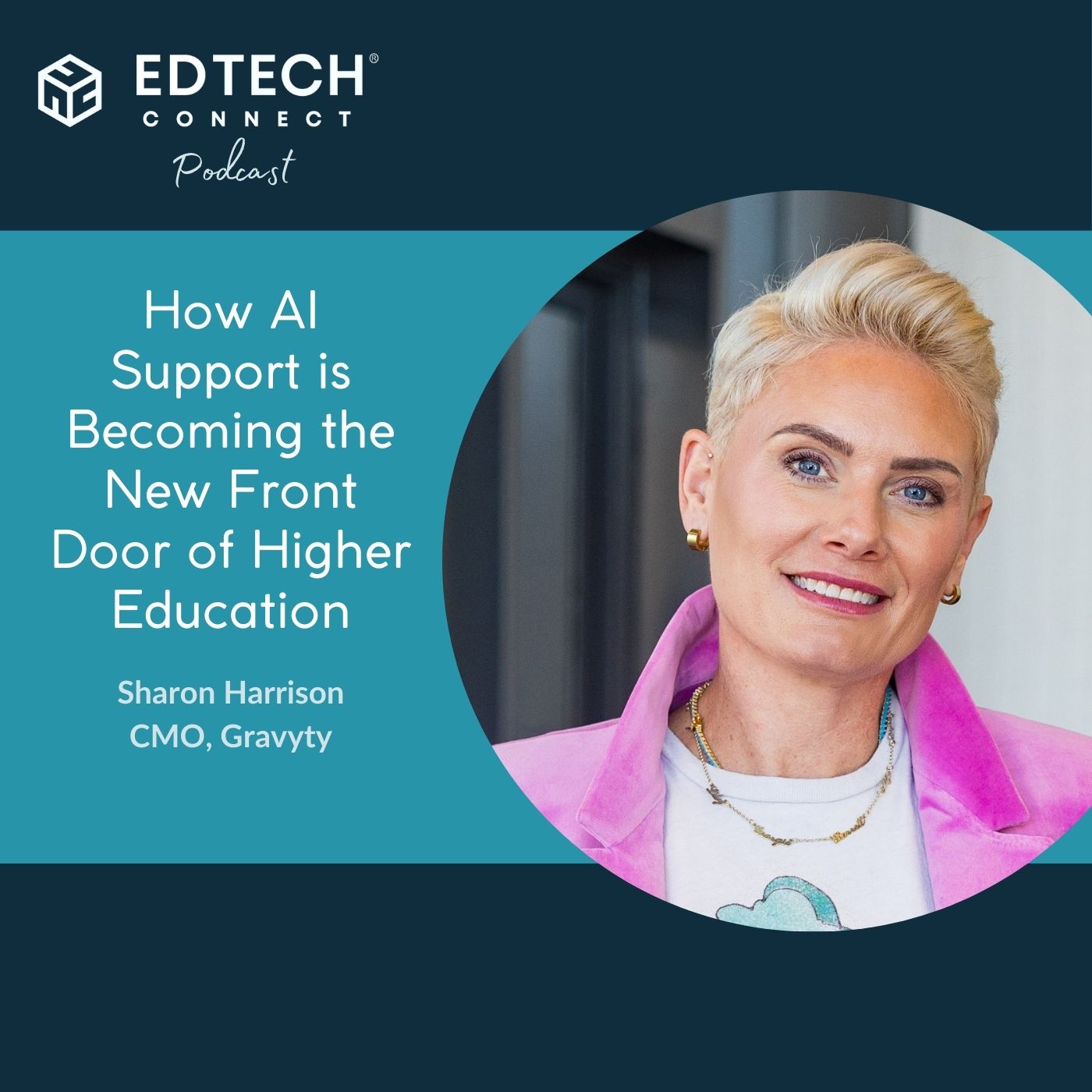
one of them. Sharon Harrison, Chief Marketing Officer at Gravity, an AI powered platform
focused on student, alumni and donor engagement. Sharon has played a key role in unifying the
brand's ivai, Ocelot and Gravity into one cohesive offering that helps institutions drive
enrollment, retention and institutional loyalty through cutting edge AI tools. With a background
spanning both sales and marketing, Sharon brings deep expertise in conversational AI, virtual
assistants and data informed strategy. At IVAI, she led efforts that generated 37 million in
pipeline and launched new products that reshaped how higher ed institutions connect with
students.
Sharon's passion lies in aligning strategy, technology and storytelling to create smarter, more
meaningful engagement experiences.
[00:02:19] Jeff Dillon: Sharon, welcome to the show. It's great to have you today.
[00:02:22] Sharon Harrison: Thanks. This is arguably the highlight of my week. Thanks for.
[00:02:27] Jeff Dillon: Well, you've been in this space, I think long enough to have seen some
trends come and go, but also long enough to see what actually sticks. Before we get into the
nuts and bolts of AI, I'd love to start with the person behind the work. What first sparked your
interest in higher ed technology and AI driven tools?
[00:02:47] Sharon Harrison: Yeah, well that's a great question because it was definitely like a sharp
right turn for me. I'd spent a long time in sports management and marketing and so this is not
really like an adjacent market, but when I came across what was then Ivy AI, what I found was,
oh, this is an opportunity to remain like Ahead of where my kids are with technology to be like
part of the digital first generation.
So selfishly, that was a motivator, but the other part of it was that I could see the longer term
path. I knew that there was going to be a significant future for AI driven technology. And I
thought, what a unique opportunity to be part of that. And then lay on the education aspect.
I have children at this point that are in every stage of the educational journey. And so I feel like I
have a unique vantage point into what are they using to teach kindergarteners to read, because
there are most definitely AI programs being utilized there. But then also, what's the college
experience like that's so helpful in the conversations I have with our institutional partners and
other members of the community, because I see it through the applicant and the current student
lens and then myself as an alumni. And so it's just, it feels good to be part of a conversation
that's geared around democratizing access to tertiary education. That feels important.
[00:04:17] Jeff Dillon: Yeah, I agree. One of the biggest moves, I think, in the market lately was
the combining of Ivy, AI and Ocelot under Gravity.
People on the outside see a merger, people on the inside probably see strategy. What was the
vision behind bringing these chatbot and AI platforms together?
[00:04:35] Sharon Harrison: Yeah, I can't take credit for the vision. I can speak to it because it has
been a journey and transformation over the course of this year. So as a little bit of background,
Ivy and Ocelot, I would say, were the number one and two. Depends on which company you
ask.
Virtual assistant providers specifically purpose built for higher education. And Gravity is the
leader in alumni engagement and fundraising. So when you look at them disparately, it's like,
well, that doesn't make sense. But when you really think about the student life cycle, the higher
education journey from prospect through to engaged giving alum, then it makes sense, right?
How are we building the community from the second we first engage with the prospect all the
way through to driving institutional loyalty, you know, with our alumni and their experiences.
[00:05:31] Jeff Dillon: I want to ask you about this evolution. When chatbots first hit higher ed, I
think a lot of people treated them like digital interns or give them a list of FAQs, point them at a
website, hope they handle the basics without breaking anything. But over the last few years, it's
really been a turning point. Students are expecting immediate help, campuses are juggling
record complexity, and AI has really moved from simple intent matching to true conversational
capability. So it feels like we've crossed from nice to have territory to core infrastructure,
especially for enrollment and student services from where you sit, how have you seen the role of
chatbots evolve in higher ed over the past few years?
[00:06:15] Sharon Harrison: Yeah. Well, I'm gonna, I'm just gonna ask you a quick question for my own
data collection purposes. Can you recall or make your best guess about the first chat bot that
you interacted with in any business sector?
Probably maybe like your bank or your cable.
[00:06:31] Jeff Dillon: I think it was retail. Like maybe, I think on a Dell or Lenovo website or
something like that is what I would think some high purchase I was making. There's a, like help.
Ask me a question. I think it was something like that.
[00:06:41] Sharon Harrison: Got it. Okay. So that's pretty, I think, the sort of baseline experience, right?
It's some kind of customer service.
I mentioned your bank, your cell phone provider, a retailer. Right. And so that was the
preconceived notion. And so I recall fondly, you know, that the first calls I was on were, well,
what is a chat box?
And it was a box, not a bot. And I would think, okay, I understand now we're going to need to do
some education about what is possible.
And so it became really important to kind of understand where the conversation was starting
from. Right. This is six years ago now, and AI was a novelty, or like you said, it was a.
I mean, maybe it's not even a nice to have at this point. It was like a little bit of an unknown. And
now it's part of the zeitgeist. It is table stakes. You know, I think there were a few things that
happened that really drove the quick evolution because it does feel pretty rapid to me. One is,
you know, the enrollment cliff, summer melt, all of these like massive factors that are directly
impacting institutions and also students. Right. Like, I never, never crossed my mind that
institutions would close, would close their doors, shut down campus. But that is the world that
we are living in. And I think we started to see the like, indicators of that years ago.
Covid. Covid drove really rapid innovation. And so it forced institutions to become digital
campuses and to drive that online experience. And so that happened very quickly once we were
a few months in and it was like, well, this isn't going away. We've got to figure something out.
Adoption became part of the ethos.
And then I think we saw open source, LLMs, GPT. And that was the boom. That was when there
was an interest in adoption, but also, of course, a heavy amount of caution. So we went back
into the education phase again. And that's where we saw the evolution from a chat Box to a
chatbot to a virtual assistant.
And I think now, and I'd love to hear your thoughts and what you're hearing, I think now we're
seeing the shift from a virtual assistant to an agent as we head towards agentic and that like fully
autonomous experience.
What are you hearing? I know that you really are part of a lot of really good conversations.
[00:09:16] Jeff Dillon: Yeah, I love Chatbox. I hadn't heard that before. So, like, that's funny. That
was, that was how it started. But one thing I've noticed talking with campuses that I think is
worth mentioning is that pain points aren't the same everywhere.
[00:09:28] Sharon Harrison: Yes, great point.
[00:09:29] Jeff Dillon: Some schools are buried in enrollment inquiries and missing prospects
because staff can't keep up. Others are watching retention soften and need more consistent
outreach to the students who are slipping through the cracks. There are advising offices that are
stretched thin trying to support students who need answers at, at all hours. And across all that, I
think AI is touching more parts of the student journey than ever. No one's arguing that, but it's no
longer just the front door support. It's becoming embedded across the whole life cycle. So I
guess I'll throw it back at you. What are you seeing? Which use cases are really gaining traction
right now, Whether it's enrollment or retention or advising or something else entirely, that's.
[00:10:10] Sharon Harrison: What makes Gravity's world complicated and fascinating, I think, because
there are really, just like you outlined, there are use cases all across campus. And those are the
things that keep administrators up at night. It's what restricts their access to funds. Certainly this
year we've seen a tighter correlation between retention outcomes and how much funding you're
able to access.
So at a higher level, it's about staffing shortages and budgetary and operational efficiency. But
then we do get into the very department specific use cases, right? They're all dealing with some
sort of budget insecurity, I'll call it, and some sort of staff shortage in some capacity. But it is, you
know, Admissions is really thinking about how do I increase the application submission rate.
Right. If you work with an online institution, it's about, we know that we have a higher rate of
submission if a student starts and completes their application within 24 hours.
Well, you definitely don't have 24 hour human support.
So what do you do in lieu of that financial aid? A completed financial aid application is the
highest indicator of enrollment. So how can we power those things to deliver against the KPIs
that the institution is thinking about? Gravity's in this great space of like B2B2C. Because we are
partnering with the institution, those users have specific needs. But also we're thinking about
what the student, the customer needs.
[00:11:54] Speaker D: And now a word from our sponsor.
[00:11:59] Speaker E: How can your next campaign soar?
With experience helping colleges and universities raise billions of dollars, Mackie Strategies
delivers communications, fundraising, and tech expertise that your campaign can take to the
bank. Mackie Strategies, build your breakthrough.
[00:12:21] Jeff Dillon: I think what's striking about the schools you work with is how much
ground that these AI tools cover. They're not just answering questions, they're catching things
staff might miss. Supporting students who study late at night, helping families who speak
languages the campus team may not. So when you add proactive outreach on top of that, I think
you start.
[00:12:45] Speaker C: To see moments where technology actually changes a student's
trajectory.
[00:12:49] Jeff Dillon: Those stories are often the ones that stick with people. What's been the
most surprising, impactful result you've seen from providing 24. 7 multilingual support or
outreach?
[00:13:00] Sharon Harrison: Yeah, I'll give you two examples, if that's okay. One is just a little bit more
anecdotal. I was in a conversation several years ago and we were talking through use cases,
and this particular team was tasked with, in part, addressing food insecurities on campus,
housing insecurities.
How can we get information to those students to help reduce that obstacle for them, to allow
them to focus on their schoolwork? I hadn't even thought about that as a use case.
But when you think about the shame element or the fear of judgment and not wanting to ask if
you can talk to something that has the information and is available when you're available and is
not going to bring shame, it's going to be very empathetic. What an interesting way and very
humanist way to deploy technology.
So that's kind of just a little anecdote. You know, we know that on average, 32% of calls come
into two financial aid teams outside of business hours.
So let's think about what that means if. Let's look at the holidays next week, right. I hope that
everybody is out of office and enjoying some downtime with family, friends, whatever. But that
means they're not answering the phone and answering emails. And this is a time of year when I
know it is in my house, when we are making sure our FAFSA information is completed. Right. Or
applications are being submitted, all these things.
And so if I have a question that is preventing me as the parent from completing that paperwork,
well, now I have to wait until you're back in the office, but I have limited time to attend to that.
And I work full time, so I can only do it in the evening when no one's available. And so now it
puts my daughter's application at risk. And I, I have a very fortunate experience. Right. Like I'm a
college grad. I do have a full time job. I'm not working a day and a night job. I speak English.
Right. I have all the things going in the right direction for me. But if 32% of your prospective
students are just waiting to find out an answer, that's a lot.
[00:15:16] Jeff Dillon: Yeah, that's powerful. That's, that's a. Interesting perspective. You know,
one theme I hear non stop from digital leaders is that they're.
[00:15:28] Speaker C: Already running a fragile ecosystem.
[00:15:31] Jeff Dillon: They've got a CRM that talks to their sis, an advising system that sort of
talks to their lms, maybe a dozen other tools stitched together with duct tape and optimism.
So when a new AI solution shows up, the first reaction is often, please don't break anything.
Schools aren't just buying features. They want confidence that this won't add friction to the
systems that they already feel maxed out on.
So with that in mind, how do you make sure your AI tools fit cleanly into what campuses already
use, whether that's their CRM or SIS or other core system?
[00:16:08] Sharon Harrison: Jeff, I love that because what you're highlighting is the sort of fragility and
the nuance of a higher ed digital ecosystem. Right. Like, I think we often picture higher ed as
the. Well, at least I do as this very sort of sacrosanct thing. It's a business.
And these are the systems that are being used by these individual business offices because
they are very focused on their goals and outcomes. I'm curious, I wonder if you're hearing the
same things in the market that I am, where there are campuses that are like, we had no idea.
We have five different CRMs across campus because our grad school is using a different one
than our medical school, than our. Right. Like, have you.
[00:16:51] Jeff Dillon: Oh, yeah, yeah, that's how it is. And the old I think answer that was like,
oh, yeah, we can consolidate. And I think a lot of schools have given up. They're like, it's
probably not going to happen. I mean, they can try here and there, but for the most part we need
to kind of accept it. Yeah, consolidate where we can. But yeah, I'm seeing.
[00:17:06] Sharon Harrison: Yeah. And right. Like the concept of consolidation, I don't even want to
think about trying to undertake that.
So what we try to do is sit on top of all of that. Right. It's about taking what's already there, all the
time and effort and care that has gone into building those systems and then feeding the data and
ensuring that there's some sort of validity and hygiene around the data.
We don't want to disrupt that to your original question.
We want to capitalize on that and make that data worth even more to the institution and layer
some insights on top of it. So it's about plugging in and making it. When I'm trying to get in for.
Not me, I wouldn't be allowed to, but when my daughter is trying to get information about her
application status, what if there's an integration between the CRM and the virtual assistant? And
so now I can say, what's the status of my application? I can be asked to authenticate through
sso. And now the bot, the chat box can come back and tell me it's pending review or whatever it
might be. Right.
So that's the objective, is to take the CRM, sis, erp, lms, itsm, housing system, HR systems.
Right. To take all of those and go. We're not here to replace them. What we specialize in is
sitting on top of them. And we are not use case or department specific in a good way. We can
get that granular and be specific to it, but we know how to work with all of. We have experience
working across all departments. That's a really important thing to think about, because the
reason institutions have landed with five CRMs is because nobody's talking to anybody else.
[00:18:51] Jeff Dillon: Right.
[00:18:52] Sharon Harrison: And so we're trying to bridge that gap.
[00:18:54] Jeff Dillon: Yeah. Digital governance is, is an ongoing challenge in the silos. And, you
know, a lot of campuses still measure chatbot success the old way. I think they'll say it answered
12,000 questions this semester, which sounds impressive until you realize it doesn't tell you who
got helped, who gave up, or whether it actually changed anything about student behavior.
So the schools that really get value out of AI tend to look deeper. They look at where the bot
prevented a case from being created, where it nudges student to take action, or where it
uncovered gaps in content policy that staff didn't know were there.
[00:19:33] Speaker C: Maybe.
[00:19:34] Jeff Dillon: And those are the signals, I think, show whether the bot is helping the
institution move forward, not just fielding volume. So I guess my question is, what metrics should
institutions focus on to understand true chatbot effectiveness beyond simple question counts?
[00:19:51] Sharon Harrison: I love the metrics that you bring up because you're connecting the dots,
right? You're thinking about the whole B2, B2C experience.
You know, we do ask our partners to pull some benchmark or baseline data. You can't know if
you're making progress if you don't even know where you started.
So how many calls are you getting? How many hours are your staff spending? Responding to
emails? How many minutes does it take for them to resolve an issue with a student? Those
kinds of things become really helpful.
Baseline data.
Houston recently deployed for four of their 11 departments. We're working, you know, we've got
to do it in phases.
And already between February and September, so however many months that is six, seven
months, 32,000 calls were deflected. Okay, so that's a number. But what does it truly mean
when we work it through? You know, we've got to start thinking about this in terms of dollars and
cents, Right. How does that impact their bottom line? Yes, it frees staff up to have higher value
conversations. Right. If we can deflect the tier 1 and some of the tier 2, then staff should be
spending their time on the tier three. Questions increase problems. But if we roll that 32,000 out
and look at 3,000 or so hours saved and then we take some really conservative salary
estimates, there's about $50,000 of savings there just from four departments, just from a very
simple rollout. What's driving that, though? And this is a little bit of an aside to the metrics point.
You also have to be thinking about how are you driving your students to use it? Right. It's the old
if you build it, they will come thought. Right? Like, you can't just stick it on the website and go,
oh, we really hope someone comes and uses it. You have to push the adoption. And so schools
like Houston or Lone Star ran social media campaigns for their students. They spun up
commercials. So we expect to see that type of engagement, that 32,000 deflection point. But
then we need to look at things like how much time would it typically take to onboard a student
worker that's going to be answering calls? Okay, well, what if we could onboard them quicker
and get that time to value shortened? You know, how many questions do your back office staff
members field about benefits and do we have people doing their open enrollment in time? Right.
So all of those things that really comes down to like, what is it that your boss is going to be
asking you about?
Let's tie it to those data points. Right. What's keeping you up at night? So it's very, very
customized, but on a high level, it's always about how many chats will it get how many unique
visitors?
Oklahoma admissions used it years ago to kind of distill out demographics so they could
understand. Okay, most of our engagement comes from these areas.
I'm making this up. I don't remember, truthfully. You know, these areas outside of Norman, we
should run special recruitment events at high schools in that area to drive increased enrollment
because we know that there's interest there. So there's all different ways to pull the data out and
analyze it again. It's just tying into what, what matters for your team.
[00:23:17] Jeff Dillon: Yeah, I think when people hear AI chatbot, I often picture a single system
doing everything on its own. But in reality, campuses need something more flexible. Some
questions are perfect for automation, some.
[00:23:31] Speaker C: Need a human touch, many are in the middle somewhere.
[00:23:35] Jeff Dillon: And I think that's where hybrid AI comes into play. It's not about replacing
staff necessarily. It's about routing each interaction to the right level support so students can get
faster answers. They can get humans in the loop when they should.
The best systems, I think, make that handoff invisible to the students. So can you break down
what hybrid AI really means in this context and why it matters for student engagement?
[00:24:02] Sharon Harrison: Sure, yeah. That invisibility is, I think, important. Right. Like you don't
want it to feel disjointed, you want it to feel very seamless because that builds confidence and
trust in the system.
So for us, that hybrid algorithm is really taking what is retrieval based AI. So earlier you
mentioned like that FAQ kind of action. Right. It needs to be very static. Ask what's the FAFSA
code and you would get back the code. Right. That was retrieval based. It was all kind of
prescribed in the bot's knowledge. The hybrid element is the result of generative AI being
available.
And so that hybrid motion is, you know, the way we build our technology is we utilize the
institution's knowledge sources. So you've already gone to the trouble of building up thousands
of pages on your website.
Let's use that. That's your source of truth. And we'll use that institutional knowledge to power
your bots responses. So where, if you go to GPT or Gemini, the knowledge sources powering
those generative algorithms are the entire Internet. And all of the information people are putting
into those models, that doesn't work in higher ed. That opens a lot of risk. And so the guardrails
around our technology are part of this algorithm. We only use the institution's content.
So the institution is the one saying, yep, this is the prescription to solve that problem. And the
bot won't go Outside of that and the flexibility of like curating the responses that are really
important and need that tight curation, we can pull those in with the retrieval responses. So it's a
handoff between the two, but very contained and allows for that conversational feeling. It's
invisible, right. You don't know what the response is coming from. But it's conversational, can
answer complex questions. So that's another aspect where it's not, you know, you can only ask
one question at a time. That's not really how humans talk. Right. You ask questions like how do I
apply? And what's the application deadline? Well, that's a complex question.
And so we need to respond to that in a conversational way. The last point I'll add is that part of
the algorithm comes down to the tone. Institutions take a lot of care and time to define as a
marketer, you know, that's brand guidelines and how you want the institution to appear. That
goes into how they write everything and how they would want their bot to respond. So we can
also curate the bots tone. If you want to sound like a pirate, we can do that. Right?
We're open to it.
[00:26:52] Jeff Dillon: Well, you know, anytime AI shows up in higher ed, I think the
conversation quickly moves past features and into responsibilities.
Leaders want the efficiency, but they are also thinking about FERPA and ADA and equity gaps
and the reality that AI can sometimes hallucinate or reinforce bias if it's not handled correctly.
Schools can't afford to make real, I mean, mistakes here. I think they need the confidence that
the technology is safe, transparent, aligned from policy from day one. What guardrails do you
recommend schools put in place to address data privacy, accessibility and bias as they adopt AI.
[00:27:33] Sharon Harrison: Yeah, so you kind of called out the big ones, right? You're going to want to
make sure that you look at the vpat, got to be current and I would say have it be a bidirectional
conversation. It should be collaborative. You as the user are on the front line. So if you see
something that is not accessible, you should be able to go back to your vendor and say like, hey,
we're helping you.
This is not meeting guidelines. Ferpa hugely important demos are a great way of kind of sussing
out, you know, the FERPA knowledge of the product team.
A SOC2 certificate is really helpful these days. Right. I'm sure the security and technical review
teams appreciate when you can come through the door with that look more than anything. I think
it's about ask a lot of questions, make sure you Understand, what is the algorithm? Where is it
pulling information from? How is it being delivered? I love that you even thought to ask about our
hybrid AI because it shows that you are paying attention to what does that algorithm look like.
That's, I think, probably the question you should lead with. Right? Like, what's powering your
technology?
Where does the AI actually show up? Because that's the other thing. All AI isn't created equal.
And just because you say you're using it doesn't tell the customer how you're using it.
[00:28:55] Jeff Dillon: Yeah, you know, every year a new capability appears. Voice AI,
generative tools, predictive modeling. Feels like we're entering the new choose your own
adventure era of chatbots. What's the next frontier you see coming for higher ed AI?
[00:29:12] Sharon Harrison: Okay, choose your own adventure books, Arguably the best books of
childhood.
The future.
I think we're already seeing a little bit of it, but I don't think it's as good as it will be. It is to your
earlier point, about institutions wanting to identify those students that are at risk.
Well, there's decentralized data all across campus. And to really understand if a student is at
risk, shy of asking them and hoping that they tell you a truthful answer, you've got to be able to
look at the full student profile. Right. You want to be able to see, are they late paying their
student account balance? Have they been going to class? What's their gpa?
Do they have a full meal plan? Are they first gen student? Let's look at across their entire, you
know, who they are instead of just looking at, you know, they're getting straight A's. Okay, yes,
that's great. But that doesn't always guarantee an outcome. And so if we can be paying attention
to all of the signals students are giving us and anticipate and initiate. So if I would love it if my
daughter, who's a junior, was not going to class and her GPA was dropping around a 2. And you
know, if she got a notification, if she got a text message because she doesn't pay attention to
anything else, she got a text message and said, hey, you know, we have tutoring services
available at this time in this building. They're free. Please come. We would love to help you. Or
don't forget your professor has office hours at this time. Like, let them know how much you care.
That is what these students want. They want to know that there's mental health services
available if they need them, because they might not be willing to ask.
So I think that's the thing. Let's take away the assumption that they're going to advocate for
themselves and let's intervene earlier. Goes back to the whole, why did I want to do this? It's
about democratizing access. If you don't know it's available, you can't take advantage of it.
[00:31:15] Jeff Dillon: I love that. Well, to wrap it up, one last question for you. Not every
institution has a huge team or a massive tech budget.
Some feel like they can't even get to step one. For a smaller institution with limited resources,
where would you recommend they start? With a chatbot or AI adoption?
[00:31:32] Sharon Harrison: Look, I mean, the salesperson in me wants to say, give me a call. We'll
figure it out. But in fairness, look at what you already have. Right? Like, even I'm guilty of this,
right? Our marketing team uses different things. I don't even know what's fully available until I
think about like, well, gosh, we were going to stand that up. Is that already available in HubSpot?
I'm not sure.
Do that audit. See what other areas of campus are using. I know that that is difficult, but getting
as much information as you can for what's already in place will ultimately shorten the
procurement cycle for you. I mean, gosh, if you could avoid going to rfp, wouldn't you love that?
Like, I don't think that's on anybody's go card for. Well, I shouldn't say that. I'm sure it's on some,
but that would be my suggestion because then it's also gone through the security and technical
review and you know, you have some shortcomings to take advantage of.
[00:32:24] Jeff Dillon: Yeah, that's good advice. Well, thank you. That was the highlight of my
week, too. Sharon, great to have you. I will put links to Sharon's LinkedIn as well as Gravity's
website in the show notes. So again, great talking to you, Sharon.
[00:32:38] Sharon Harrison: Yeah, thank you, Jeff.
[00:32:41] Speaker D: We wrap up this episode. Remember, EdTech Connect is your trusted
companion on your journey to enhance ed education through technology.
Whether you're looking to spark student engagement, refine edtech implementation strategies,
or stay ahead of the curve in emerging technologies, EdTech Connect brings you the insights
you need. Be sure to subscribe on your favorite podcast platform so you never miss an.
[00:33:04] Jeff Dillon: Inspiring and informative episode.
[00:33:06] Speaker D: And while you're there, please leave us a review. Your feedback fuels us
to keep bringing you valuable content.
For even more resources and connections, head over to edtechconnect.com, your hub for
edtech reviews, trends and solutions.
Until next time, thanks for tuning in.