Episode Transcript
[00:00:00] Speaker A: You have to have good core web vitals, right? Your site has to load, you've
got to get up there, you have to demonstrate your technical expertise. I think in a way that
universities don't have to worry about. You have to have consistent brand, right? So you show up
well in the gen AIs because your brand becomes so much right now, right? The focus is
swinging back a little bit to brand. You have to have consistent references across multiple
omnichannel platforms.
Like before it was like, oh, that's a nice to have. You know, if we happen to be aligned across
channels, there's no more siloing.
[00:00:38] Speaker B: Welcome to another episode of the EdTechConnect podcast. Today I'm
joined by someone I've admired for her ability to bridge the human side of digital strategy with
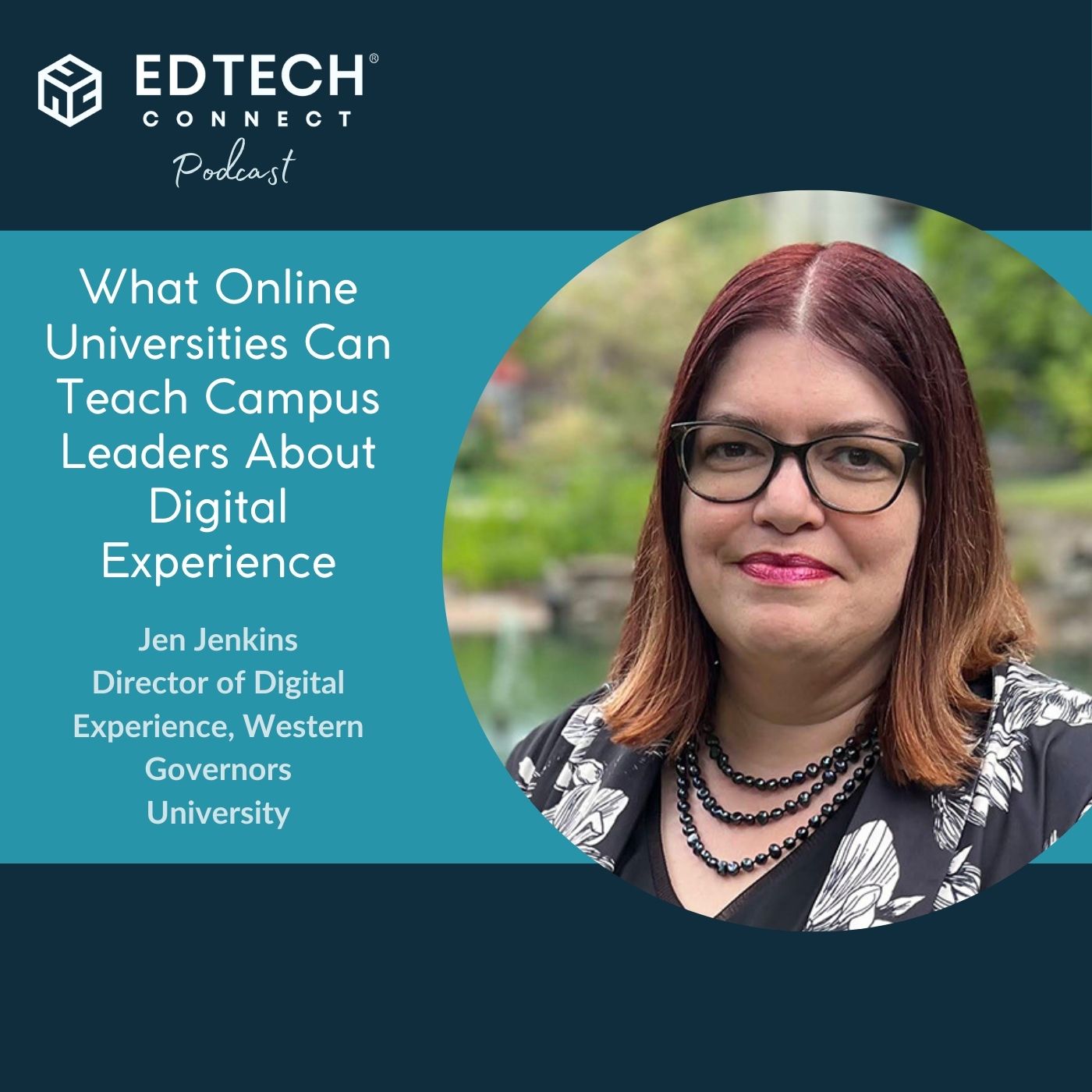
deep technical insight. Jen Jenkins is the Director of Digital Experience at Western Governors
University where she leads a team focused on optimizing web content, SEO, AEO Information
Architecture, user experience and conversion rate optimization. Before wgu, Jen spent over a
decade at University of Utah Health building user centric healthcare content experiences that
were both strategic and and empathetic. With certifications in PMP and Scrum Master, she
brings a unique project management mindset to every challenge. Jen also frequently speaks on
the future of geo, AI and digital content strategy. From transforming how universities launch new
programs to advocating for more human focused content in an AI driven world. Jen is a thought
leader with boots on the ground experience.
Whether it's healthcare or higher ed, she's all about delivering value to the end user, especially
when they're making life changing decisions.
Welcome to the show, Jen. It is great to have you today.
[00:02:01] Speaker A: Thank you.
Always a pleasure.
[00:02:04] Speaker B: So you really have a unique background that blends theater arts with
digital strategy.
How has that creative foundation influenced your work in content strategy today?
[00:02:17] Speaker A: It's such a good question, right? Because nobody thinks that the theater is
applicable or even sometimes the arts. But I find it fascinating when you think about user
experience, right? I was not just in theater. I worked in costuming, which is very specific.
I thought about costuming in terms of characters. What does this person do? What do they
need?
What would they look like? What kind of purse would they carry? Do you know what I mean?
And that's user needs essentially, right? So you look at a website and you're like, what does this
user need to get the job done? You know, so that was an interesting application I did not expect.
Kind of almost obscure, but very applicable, right? But the rest of it was just logistics.
[00:03:02] Speaker B: I'm telling you well, you. You work both in health care and higher ed.
What are the biggest content strategy lessons you've learned from each?
[00:03:12] Speaker A: They're so similar in many ways because people are making major
decisions and they're dropping a lot of money. Right.
And there are also some things that are outside of their control. We'd like to think we have a lot
of control in healthcare. You have much less than you really think.
So for the patient audience, you're really, from a content strategy perspective, trying to ease
them into this experience and empower them. Right. Which is for students, you're also trying to
empower them. But for patients, there's an aspect of emotional comfort that they're looking for.
Right. Or at least connection.
And how do you balance that? Especially when a hospital has a brand, you know, healthcare
has a brand, they sometimes want to be formal and you're like, but the patient wants to know
you.
They want to get, you know, students. You're looking to empower them as well. But it's more like,
go, ra, go. You know, so a little bit different there.
[00:04:09] Speaker B: Yeah, yeah. So you've had this unique career path, I think, because
you've collaborated with two very different kinds of experts. You're talking about students here.
Go back to University of Utah Health. You were really working with physicians who think and
communicate in this very, I think, specific way.
[00:04:26] Speaker A: Yes.
[00:04:27] Speaker B: And then at wgu, you're now working with faculty who brings a different
culture, I think, workflow, set of expectations.
So before we get into, like, the techniques you use to translate these complex ideas into clear
communication, I'd love to hear what your take on the human side of that shift is. What are the
different challenges in working with these two groups of subject matter experts?
[00:04:51] Speaker A: Again, I'm going to start with the similarities, because to me, they feel a lot
alike. Right. They're very knowledgeable about their topic, and so often they feel like they're
knowledgeable about every topic. Right. I can't remember what that type of bias is called, but
they're going to tell you how to write your ad copy and how to do everything else. Right. They're
going to tell you what the. What's going to perform well, even though it may not.
The nice thing about doctors is they look at data and they're interested in data. Right. I also find
that most of them are very invested in their patients, and I think it can be challenging depending
on who you have. I don't know for academics, if you're given the opportunity to do that as much
because you have so many students Right. Depending on where you're at.
And so I don't know if you have the one to one connection when you think about that. And I think
often from what I've heard from the academics here is they just, they don't have time to spend,
you know what I mean, building up the business, so to speak. Whereas doctors, they're all about
that drive the business.
[00:05:53] Speaker B: Right, right, right.
I can relate. I've worked with different types of end users. And you've crafted content for these, I
would consider two very different moments in a person's life. In healthcare, you're often writing
for someone who's anxious or overwhelmed or trying to make sense of symptoms. Right now in
higher ed, you're speaking to someone who's maybe imagining their future, comparing options,
thinking about long term goals. And I think those mindsets couldn't be more different. How do
you approach that content strategy shift when you're writing for someone seeking medical care
versus someone planning a future career path?
[00:06:36] Speaker A: The one thing I love about WGU is they are very serious about the
student. Right. And I told you one of the values is, you know, student obsessed student
obsession. We like to display the potential career you could have. Right. With this. So it's really
driven around what's best for the student in a sense that here's the current economic
circumstances, here's the pay scale that our students actually can achieve when they graduate
based on polling data.
It is, like you said, selling a future.
So that's an interesting thing versus a patient who often needs answers Right when they need
them. Right. Then, even though they may be hung up for three or four weeks and you know,
some patients are chronic management, so.
[00:07:21] Speaker B: Yeah, yeah, yeah. Well, maybe we could back up a little and talk a little bit
just about WGU's digital environment, what makes it unique in a digital capacity. I've learned
some things from you already in the last couple months as we've talked about your goals and
challenges. Can you just give us a little snapshot of WGU and what makes it unique?
[00:07:38] Speaker A: Yeah. I don't know about you, but back in the day we were like, I don't
know, online degrees, right? Are those accredited? Are they worthwhile? And I've been really
impressed. I come from very traditional. Right. Educational background.
I'm very impressed because what this online degree allows you to do is, you know, if you already
have a skill set you can like test through courses. You're not spending time and money that you
don't have.
You can kind of accelerate your learning or slow it down. If you need more time and that online
platform for the digital experience allows you to do that.
So that's called competency based education.
And it's also very access friendly, so to speak. Right. We have a lot of students who are first
generation college applicants. And so it allows people who may not have had the opportunity to
really look at it where maybe they don't live in a physical location that a higher education
organization is at.
[00:08:36] Speaker B: Is it true that you're pushing 200,000 students now in that range?
[00:08:42] Speaker A: I think it's higher than that, yeah. Wow.
[00:08:44] Speaker B: Wow. You've talked about how academics often require more convincing
to engage with content projects.
How do you approach getting buy in from these skeptical stakeholders?
[00:08:59] Speaker A: For skeptics, I always say, well, you always want to come in with a case
study, right? Hopefully you've already had something that works the quick win. We all know that
from a business perspective.
The other key I found with skeptics is to present the competition, guess what school of so and so
did this? And now they're getting all of this fomo.
[00:09:18] Speaker B: Yeah.
[00:09:18] Speaker A: Your time, if you invest it, will do well for you. Right? And they're actually
different, Right? You strategize for the different types of academics because some, like doctors,
are really concerned about their online profile.
So some academics as well be like, yes, I want to show my expertise and showcase it. Right?
Get me on as many articles as you can and things like that. Other academics, they're excited
about the topic, right? So it's a little bit different approach that you want to tailor.
[00:09:45] Speaker B: We've talked in the past about SEO and that plays a part in how WGU
spots demand for new degrees. I think that's a fascinating shift. How, how exactly does search
behavior inform those decisions?
[00:09:58] Speaker A: That's an excellent question. And I. It actually started the other way.
Well, maybe it was a. You know what? It's always the SEOs coming first. They're the ones that
are trending, right. To be honest with you. But the university marketing research, they would do,
right. Or market research and come back and be like, these are the degrees.
But when we're writing up things for the degrees to put on the pages and we're like, actually
users are looking for this associated terminology.
And I have to give complete credit to my predecessors. They worked out an amazing system
right? Where they came back and said, lee, guess what?
You know, more users are looking for this. Then what the term you want to call the program,
would you be interested in like trying it? You know what I mean? And they found that they could
actually prove their value there as far as meeting more users where they are at. Which is huge,
right?
[00:10:45] Speaker B: Yeah, that's huge.
I think marketers often feel pulled in two directions. Building the brand for the future or to chase
metrics for next week. How do you keep that balance without losing sight of either? Either one.
[00:11:02] Speaker A: That's something I really enjoy actually.
I like the big vision and I like the details, the nitty gritties. And that's where I think you really have
to align as a team. You need to have the big vision, your objectives and key results. What do we
want to really achieve for this next two quarters? And then you need to have good, good
tacticians who can break that down and who are monitoring regularly. It's almost two types of
work. Right. It's the ongoing operational work. How do we make sure that we're always out there
producing that you counterbalance with the where do we want to be in the future?
And that's something that I'm really enjoying right now is looking at our website and seeing
where do we want to be in the future? Which I didn't expect.
Right. Because it's crazy. Like where are we going to go in the future? You know, there's a big
one.
[00:11:48] Speaker B: It's hard to predict. People used to ask me what what a five year vision
was and I was like wow, that's really hard now five year vision. But WGU operates in a full online
world, right?
[00:12:00] Speaker A: Yep.
[00:12:00] Speaker B: Which is very different, different canvas than campuses built around in
person services. So from your perspective, what are the biggest differences in how you design
and deliver digital experiences for.
[00:12:13] Speaker A: For each environment they have to be really mobile friendly because the
expectation is that we are online.
You have to be able to deliver the experience you said you're going to deliver.
And you have to have good core web vitals. Right. Your site has to load, you've got to get up
there. You have to demonstrate your technical expertise. I think in a way that universities don't
have to worry about. You have to have consistent brand.
So you show up well in the gen AIs because your brand becomes so much right now. Right. The
focus is swinging back a little bit to brand. You have to have consistent references across
multiple omnichannel platforms. Like before it was like, oh, that's a nice to have. You know, if we
happen to be aligned across channels, there's no more siloing. We're getting forced to work
cross silo. You can't do it anymore. Right.
[00:13:02] Speaker B: I almost think of large online schools like WGU as kind of a lighthouse for
the rest of the of academia in a way because it's such a challenge. You have to be so spot on
with your digital strategy. It's a good kind of benchmark for the industry. You talked about WGU's
focus on being truly student obsessed. I'm curious how that shows up in day to day content
strategy. What does that look like in practice?
[00:13:31] Speaker A: In practice it's about saying here's someone like you and here's what
happened for them. Here's their story.
So here's an incredible thing WG does. We're all online and yet we hold physical
commencements in person. Commencements like 8 times a year in different areas of the nation.
And I haven't yet been to one, but I've heard they're amazing. You have students from all
different walks of life coming together in a community location. Some of them have already
connected online. Right. Because maybe they're in the same programs and then they come and
they celebrate together and they bring their families.
So I'm actually really excited to go to that because it is student focused. It's like you did it and
we're so. Thank you for trusting us and here's your degree and we're so excited.
And so many of them come back with stories of like, look, I've increased my salary, I have
additional responsibilities at work. So we're lucky.
[00:14:27] Speaker B: Yeah, I love that you mentioned that in healthcare what to expect content
is essential because it lowers anxiety, it builds trust. I'm curious how the same idea carries over
into online higher ed. What does what to expect look like for WGU learners?
[00:14:47] Speaker A: What to expect looks like what's right for you.
So find the right place for you is what it is in the student experience. Right.
The number one problem that our learners come with is they don't quite know the right next
place for them, the next career.
So that's what we're looking to offer as insight into the options and into the most practical
application of. Here's what's going to help you get. What exactly do you want? We're looking to
help them better define future outcomes which you don't say it like that. What would you like for
your goals to be for the next five years? What is your career plan? Right. Because if you don't
know, if you're new to this whole world of trying to either build a career or just get into it, you
don't know what you don't know.
[00:15:30] Speaker B: Yeah, I agree. A lot of content teams are really rethinking their playbooks
right now as AI and GEO start to change how people discover information.
So from where you sit, how are these shifts reshaping content strategy?
[00:15:48] Speaker A: I am really excited because we are going to be topically focused and
we're going to have to put that marker in the sand and say, this is who we are.
And you're going to have to be definite about it. You're like, we're experts on these 10 topics. You
can't just be like, we're experts on everything. We're going to help you on everything you have to
say. Here are 10 areas that we are experts in. We will get you from A to B.
[00:16:09] Speaker B: That's strong leadership. That's hard sometimes I feel like at a lot of
schools.
[00:16:12] Speaker A: Right, agreed. But it's so important.
[00:16:15] Speaker B: You talked about how brands need to win much earlier in the journey now,
if that's the new reality, what should institutions be doing to get ready for it?
[00:16:25] Speaker A: So what I'm really engaging in is a consistency audit across all of our
channels, which, you know, we worked well together. I'm not saying we're not consistent. We're
doing a review.
How are we showing up in Gen AI? You know, we're using a tool called Profound right now that
like, does a. Sends out a lot of prompting. Right. So we can see like, how is our brand showing
up, what the language is around the brand?
Because sometimes it'll get confused with like if you have multiple different channels that you're
on, the language you use around the brand could change and you can't do that anymore.
It's one of the techniques we're using. We're looking at doing some of that analysis through
some of these new tools. Right. And with AI to see what they have to suggest.
I'm really excited. I want to establish our experts a little bit more fully. Right. Identify those
experts and say, here's who we've got to see stand behind. You know what I mean? And. And
get some visible influencers, essentially. We've always had them. Right. We've always had
experts, but we have to start pitching them like influencers more.
[00:17:26] Speaker B: Right. We're living in a world now where we're bot traffic is climbing and
major platforms keep shifting their algorithms without much explanation.
Given all that, what level of technical literacy do you think content professionals need today to
stay effective?
[00:17:47] Speaker A: Every content professional needs to know their analytics. Just from a big
picture perspective doesn't mean you focus on how many users are coming to the website, but
you need to have a big picture so that when you do see drops or changes. You can sort of work
backwards from there. Was there a major algorithm change? Right. So it helps to be sort of
aware of that. Like was there a change in how the data was pushed out to the website?
Like we put in place a lot of bot management tactics right now. We're solidly aligned with IT or
ed tech as we call them, educational technology.
And we go back and look at the server logs. I think you need to be aware as a content
professional of how the information is pushed out and like where's it going from the server? Then
it goes to the cdn, the content delivery network. Right. Where can it get held up in between
there? Just so you understand all the different points of maybe one vulnerability.
It's a new thing you have to think about now.
[00:18:42] Speaker B: Well, your team covers a wide spectrum SEO, content information
architecture, analytics.
Those groups often speak different languages. How do you create real collaboration across all
those specialties?
[00:18:59] Speaker A: Everybody has to know a little bit about something, right? But you also
need a leader. We have pods. I hate calling them pods. I've got to find something different to call
them. Right. We're not pod people, but still we have pods. So we've got like a content lead,
we've got a writer, we've got an SEO in there. And then we've also got someone to help interpret
analytics. And so theoretically the lead is who interfaces Right. With the school. I mean you have
to have somebody, but they have all of these other experts to call on. You also have your UX
specialist and your conversion rate optimization expert so that they can communicate ideas. It's
really product ownership. That's the model we're looking at. Right. Or for those of you who are
sports people, like zone to zone defense as opposed to Manto man. So I don't know if that
makes sense.
[00:19:44] Speaker B: I like that. Yeah, that analogy. What are you most excited about? I mean,
you've been there a few months now, right?
What's on the top of your plate now that you're really excited about?
[00:19:54] Speaker A: You've already heard about this and maybe I'm not excited. Am I excited?
I don't know. We're, we're picking a new content management system, cms. Right. But I think
what's exciting for me is to think about the long term possibilities.
And I'm very seriously considering Headless because we can consider an omnichannel
approach. And like I said before, you can kind of get by right. With the tools you have. And you
can use hybrid. And hybrid will always be a valuable tool. But could Headless Make a big
enough difference in our student experience and in the connections between silos.
Do we need it? Will we need it five years from now? Will we wish we had gone there?
[00:20:31] Speaker B: Can you talk a little bit about what you know? I know that was kind of a
recent, like, revelation for you based on some other things you kind of learned. How do you
come to that? Like really kind of seriously looking at headless now.
[00:20:43] Speaker A: So I have always been intrigued by headless, which surprises people. I
took workshops in like 2014, you know what I mean, where we talked about the future of content
and content modeling. Right. And data modeling. But it always seemed impractical because of
the place the organization was at. Right. At the time, you couldn't do SEO. That was. It was very
difficult, at least with the way the JavaScript rendered on your front end. Right. To get SEO that
worked for you. And even now, you may still have to build a separate SEO code base outside of
your headless structure. It's also very developer focused and you have to have that balance.
So a lot of it, I think, goes back to resources.
Does that make sense? And I'm in a place now where I'm like, can we get the resources? Can
we pitch it right.
[00:21:29] Speaker B: I want to explain to our audience who may not know exactly what we're
talking about. A headless CMS is a content management system that stores and organizes your
content, but doesn't dictate how the content gets displayed. So hence the headless. It's content
warehouse keeps everything tidy in the back and then sends it anywhere you need to through
like an API in the most basic definition. Is that pretty good?
[00:21:53] Speaker A: Yeah.
[00:21:53] Speaker B: So, yeah. I think that's fascinating.
[00:21:55] Speaker A: And it's so weird to think about it. Yeah. You can't look at a template
anymore. I mean, you can. The headless systems now are actually really good. You can see a
preview, right, of how these different things that you just enter as completely separate, almost
fragments right on the background will come together. But it's a lot for you to wrap your head
around if you're not familiar with it.
[00:22:14] Speaker B: In closing, could you give one piece of advice to a university or even
healthcare organization just starting to revamp their digital content strategy? What would that
be?
[00:22:24] Speaker A: I think you. I'm always a good fan of the audit. Right. I think you want to
step back and you say, always, what do we have? Right. You even do that in like wilderness
trading. If you get back, you do an inventory. What advantages do I have?
And then you'll also want to look at who are my primary users and my priority users, who do I
need to focus on? Because when you're prioritizing, you've got to figure out what do I have and
what can I put towards my priorities so that I keep the lights on and then I get to where do I want
to go?
[00:22:57] Speaker B: Yeah, I love that. Great advice.
Great advice from a digital leader from multiple verticals. Always a pleasure talking to you, Jen.
Yeah, I will put links to Jen's LinkedIn and to WGU Edu so you can check out their site. But it
was great talking to you, Jen.
[00:23:14] Speaker A: Thank you. A pleasure.
[00:23:15] Speaker B: Bye.
[00:23:16] Speaker A: Bye.
[00:23:18] Speaker B: We wrap up this episode. Remember, EdTech Connect is your trusted
companion on your journey to enhance education through technology.
Whether you're looking to spark student engagement, refine edtech implementation strategies,
or stay ahead of the curve in emerging technologies, EdTech Connect brings you the insights
you need. Be sure to subscribe on your favorite podcast platform so you never miss an inspiring
and informative episode. And while you're there, please leave us a review. Your feedback fuels
us to keep bringing you valuable content. For even more resources and connections, head over
to edtechconnect.com, your hub for edtech reviews, trends and solutions.
Until next time, thanks for tuning in.