[00:00:00] John Fees: Schools could give your money back, but they're unlikely to do that. And I wish schools weren't as expensive as they were. So there's two problems in the way we've designed how we pay for school. You know, one is that we've told everybody that every degree is worth the same, and that's because we're egalitarian as a country. We basically provide a Pell grant and a federal student loan, 11 grand or so a year, and we tell everybody that every degree is worth the same thing. And the truth is, if you were to price loans the correct way, you would price engineers a little bit differently than accounting majors and differently than education majors and differently than art majors. But as a society, we don't value that. We want to tell everybody everything is worth the same.
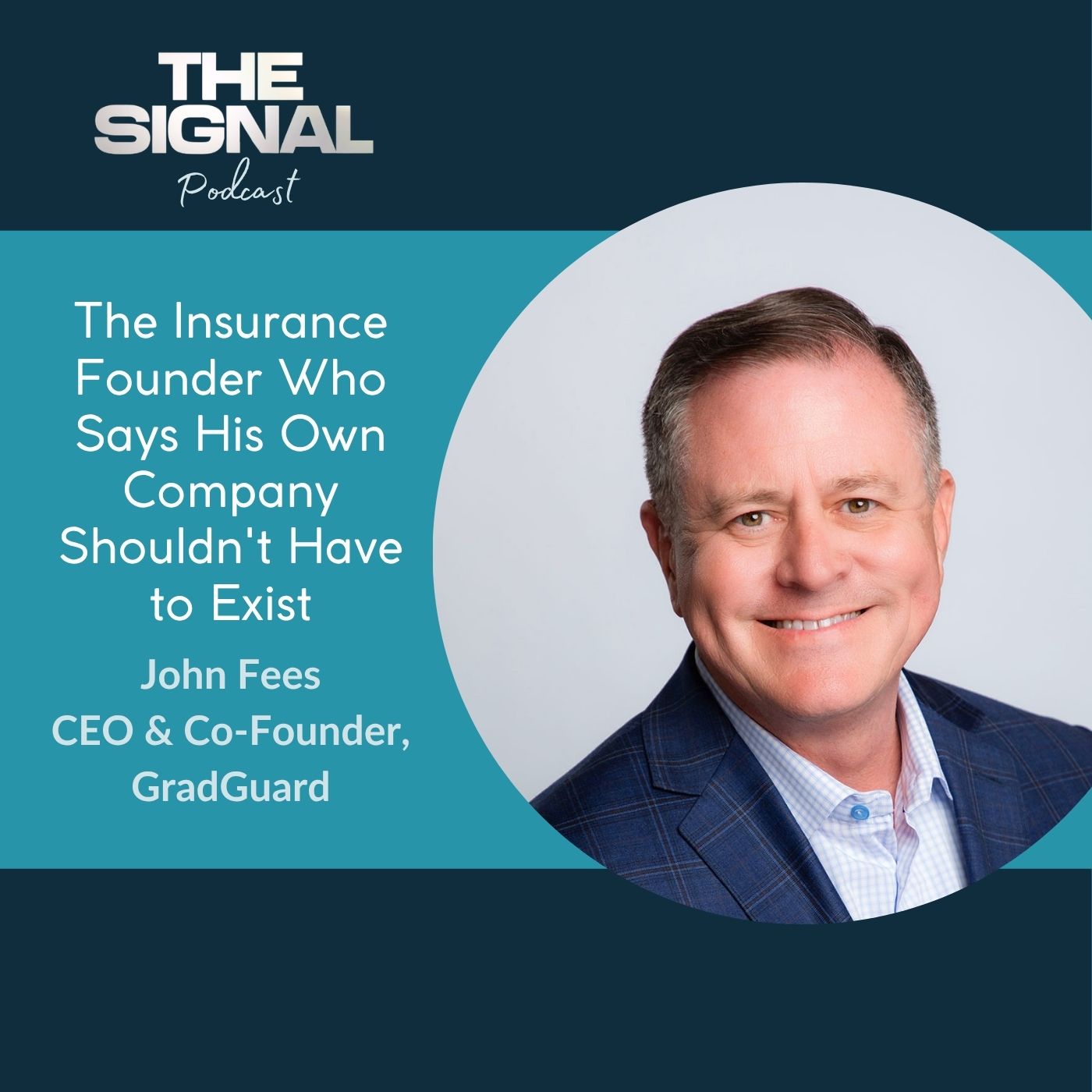
[00:00:44] Jeff Dillon: Welcome to another episode of the Signal. Today's guest has a perspective that bridges the gap between operator, policy thinker and humanist. Whether on a FinTech panel or a college admissions podcast, he connects business decisions, civic responsibility, and what families actually face when sending a kid to college. John Fees is the Co founder and CEO of GradGuard, a fintech company redefining financial protection for students and families navigating higher education. Gradguard has been recognized alongside stripe and PayPal as a central infrastructure and in the payments and higher education ecosystem, a top fintech award that reflects how far student financial protection has come. John has spent his career at the intersection of technology, financial services and education policy, building companies that solve real emerging problems in society. He's a design thinker, a civic minded entrepreneur, and a genuine believer in education as the primary driver of economic mobility.
Before Gradguard, John Co founded Y2M, a private ad network for colleges and universities that he sold to Viacom and Members Connect, which He sold to JPMorgan Chase. He's been building companies at this intersection of media, technology and education for over two decades and he brings that perspective to every conversation.
John Fees, it is great to have you today. Thanks for being here.
[00:02:10] John Fees: Thanks, Jeff.
[00:02:12] Jeff Dillon: So you've been building companies at the crossroads of education, finance and technology for like three decades now. What first pulled you into higher ed as a place to build a career rather than just another industry to sell into?
[00:02:28] John Fees: Yeah, similar to you. I mean, I worked at a university, so I worked at Arizona State University from 1993-96 in alumni and development work.
And I just, I love the work that schools do and I think I've just been really dedicated to solving problems that my friends had and a lot of my friends happened to be in universities. And when you ask them what type of problems they had in 1989 it was publishing an alumni magazine or publishing a university newspaper, which didn't seem complicated at the time. But the technology didn't exist really. So that was my first business. And then you started realizing the student loan industry had problems as well. The financial aid office is required to publish net cost calculators and all these different things. And students really were demanding choice around student lending. So we built some software around that. And then after taking a few years off, I actually we sold those companies and solved some big problems. I think one of the problems I really I heard schools talking about is enrollment issues, specifically persistence and keeping students in school. And having been involved with the student loan industry, one of the things that really worried me the last decade is we basically tell people college is worth it, but it is mostly when you graduate. And the truth is when you look at student loan defaults, the problem around student loan defaults is are not that people over borrowed as much, it's that people didn't graduate. And so that's the problem we fell in love with. And how do we help people overcome the real things that get involved with disrupting a college education? And primarily that's health related issues and even crime and other things that just disrupt this generation of students lives.
[00:04:12] Jeff Dillon: So yeah, I love that, that background. One thing I've noticed after years of talking with founders in higher ed is the most enduring. Companies usually don't start with this great product idea. They start with a problem that everyone else has learned to live with and the founders just decide they're not going to accept it anymore. And that seems to be what happened with Grad Guard you and tell me if I get his name right. Bill.
[00:04:37] John Fees: Yeah, Bill Sonneson.
[00:04:38] Jeff Dillon: Sonneson started Grad guard back in 2009. What was broken about the existing insurance options for college students that made you think there was a real company to build here?
[00:04:48] John Fees: Yeah, it's interesting. I didn't know anything about insurance, but the problem again we were trying to solve is what are the legitimate reasons why people leave school and how could we help them return?
And what ended up happening? At the time there was a company that did tuition insurance. It was called Dewar. They're still around. But Dewar would underwrite schools on a school specific basis and provide up to like 75% of your money back if you had to leave school for medical reasons. Well, that's, it's a great product. I called them up and said hey, we'd love to work with you. We have a little bit of a different approach. We'd like to provide this available to every school around the country. At the time, Dewar only worked with 160 private institutions, from Harvard to Princeton, all the elite schools. Well, I went to Arizona State.
I was interested in solving the problem for the rest of the world, not just rich people. And so our approach was to try to underwrite this on a national basis, which is it'd be. Imagine underwriting student loans for Harvard versus asu. The right way to do it is actually in a larger pool. And so that's really our big innovation was that we basically wanted to provide a way for students to secure this type of protection.
Initially, the idea was that schools could buy it, almost like an employee benefit, but for their students. You know, universities buy insurance for their employees. They could do the same thing for their students and help them overcome the mental health issues, all the issues that related to students leaving school, by the way. I can get into the reasons why people are leaving school for health reasons, but it's pretty substantial. And again, this generation is very different than when you and I went to school. So, anyway, we had to build the product, and then we had to go to schools to say, this is a good solution for you. And most of the public schools who are not tuition dependent didn't really see the problem the same way we did. Most schools weren't even tracking how many students were leaving for legitimate medical reasons. It's taken a long time. We're an overnight success, but it took 15 years.
[00:06:40] Jeff Dillon: Well, you got to get that first school, too. I think what makes your first story so interesting, or this story, is that you weren't just creating another insurance product. You're responding to this gap that was creating real consequences for students and families. But I also heard you saying something that really caught my attention, because it almost sounds like a founder arguing against his own business. You said something pretty provocative that Grad Guard shouldn't have to exist.
[00:07:05] John Fees: That's right.
[00:07:05] Jeff Dillon: Walk me through that idea. What would it take for the risks Grad Guard covers to simply disappear?
[00:07:11] John Fees: Yeah, well, schools could give your money back, but they're unlikely to do that. And I wish schools weren't as expensive as they were. So there's two problems in the way we've designed how we pay for school. You know, one is that we've told everybody that every degree is worth the same, and that's because we're egalitarian as a country. We basically provide a Pell Grant and a Federal Student Loan, 11 grand or so a year. And we tell everybody that every degree is worth the same thing. And the truth is, if you were to price loans the correct way, you would price engineers a little bit differently than accounting majors and differently than education major, differently than art majors. But as a society, we don't value that. We want to tell everybody everything's worth the same. And that's, it's got merit and I, I embrace it. But it leads to unintended consequences where people over borrow for certain degrees. And that's a problem. But it's also led to this perception that the more you pay for school, the higher the quality is.
And that theory was advanced pretty rapidly by the enrollment management industry and the consultants that are out there. For a while, Boston University cost more than Harvard, and that's just the way the model was. And then we went back to discounting. And even in Arizona, where, you know, Jeff, you and I both grew up here, there's a constitutional mandate to keep the cost of education as nearly free as possible. And yet the Board of Regents sued for an interpretation to basically be able to raise tuition.
So the reason we shouldn't exist is cost of college should not be what it is today, in my opinion, and I know people disagree with that, and I really frequently think that the other symptom we have of this generation is almost 20% of college students arrive on campus with chronic health conditions.
So you have two factors, both the high cost of college. And I know we can talk about net cost effects versus gross costs, retail pricing, but the reality is it's still largely the second largest investment most families spend in their lives. I have five kids. I know the cost of college. And when I went to ASU, it was $450, and I could work my way through. And it's just not that way today.
[00:09:21] Jeff Dillon: I remember that. I remember the tuition check every semester that we had to cut. It was $525.
And I'm like, this hurts, but it was doable. You know, you're like, I was involved
[00:09:33] John Fees: with student politics and I protested $135 increase in t the mid-80s. Right. And like, I laughed at. Because when I went to business school in Boston, my monthly parking charges were 150amonth.
So, you know, the reason Gregor shouldn't exist is that the cost of college. We thought about the public good of education as being something that really is no longer just a private benefit. For the last 30 years, education has discussed the value of higher education as basically being a million dollars more than a high school education.
Right. And we promoted that and we started talking about it that way. What it led to is this outcome of basically education is a private benefit. Right. And so what we've seen is states withholding funding, federal government withholding funding. And the reality is, I believe education is a public good. And I really believe earnestly that as a society, we really need to revisit this kind of within the whole social contract in America. I was just in Germany and London, and these other countries are doing something different. They have graduate taxes. They have other mechanisms for enabling society to get the skills necessary to contribute to their economy. And we need to start thinking this way. I know this government has just proposed a Pell grant for work or development.
There are innovative ways that we can help people get an affordable credential that really advances and strengthens our society.
[00:11:05] Jeff Dillon: Yeah, agreed. One of the biggest differences between selling into higher education and almost any other industry, I think, is that trust has to come before the transaction. Institutions are incredibly thoughtful, and anything becomes part of that student experience, especially during enrollment. So after building relationships with hundreds of campuses, I'm sure you've heard about every concern. You work with nearly 700 schools, and you've protected more than 2 million students.
When you're pitching university on embedding insurance into their enrollment process, what's the objection you hear the most and how do you answer it?
[00:11:44] John Fees: Well, it's disappointing, to be honest. If I share it honestly with you. I've spoken to VPs of Enrollment Management or VPs of Finance, and they'll literally tell me, we don't want people to be worried about paying for college. We don't want them to know the refund policy of the school. We don't want them to think about the bad outcomes. Well, that ignores the reality. The reality is very different. I suspect that the objection initially was we don't want to add any cost to college. That I totally understand. But if you're thinking about serving a Pell Grant student, they can't afford the financial loss even more.
So what really gragguard does is we provide a voluntary way for schools to protect their students. Now, your point about trust versus transaction before transaction, that's very much ingrained in our DNA. Our primary mission is to help schools educate and protect students from the risks of college life. And that education piece helps.
What we do is we help schools disclose the refund policy. Under the Department of Education rules, schools are required to tell you what the refund policy is. They're actually required to provide notice, but Most schools only do that in a passive way. When you look at the definition of notice, it actually means individually letting people know what their refund policy is. And what we do is when we work with NYU or UC Berkeley or Arizona State, we are embedded in the enrollment purchase path. When you're paying your bill and the school tells you what the refund policy is and then gives you the opportunity to enroll in Grad Guard. And it works great. And, you know, at the end of the day, it's almost unrealistic for consumers to think that schools are going to give you money back. It just. It shouldn't be kind of a theory, but we think these nonprofits is going to be able to be generous. The reality is, as we all know, about a third of schools right now are cash flow negative. They have real severe problems with tuition. And so our mandate is to help those schools be transparent, but also to help those students overcome legitimate risks.
[00:13:46] Jeff Dillon: So that really gets at the difference between selling a product and building trust. One thing I've learned covering higher ed is that institutions gravitate toward partners whose incentives align with their own. So if a university believes you're invested in student success, the relationship often is different. And I think that philosophy seems to show up in how you've built Gradguard internally as well. You talked about measuring success by claims paid rather than claims denied. That's a very different scoreboard than most insurance companies use. How do you actually build that into a company vulture at scale, it's a different scoreboard.
[00:14:24] John Fees: First of all, you find insurance carriers that are very forthright, and we removed all the gotchas. We also.
It took a while, but we work closely with the Jed Foundation. So we have a mental health crisis in this country of college students. And we talk about it a lot, and nobody wants to talk about it as a crisis any longer. But the Jed foundation does more to prevent suicide of young people than anyone in the country. And we partnered with them specifically because if you're considering withdrawing from school because I'm anxious or depressed or have some other things going on in my life, the reality is tuition insurance relieves that stress. We help you overcome that, and it doesn't become a crisis for that student. But we also had to change the language of our policies. So the insurance industry referred to mental health issues as mental health disorders. Right. There was a lot of pejorative language that actually treated mental health issues differently than physical health issues. And we solved for that. We actually changed our whole policies related to basically trying to make certain we don't diminish any one type of health issue or otherwise. We also cover students leave for legitimate reasons like job loss of a parent or death of a parent. These types of issues are all. We pay claims all the time. But the real measures success is not just paying the claim. It's a secondary effect which is do those students re enroll? And it took us a long time to get that data. But we want students that leave school to be able to easily re enroll and get a do over. And we're about 75%, maybe it's a little bit higher than that this year of students that we paid claims to re enrolled in that same school. And that's the important piece is that's the student success that we really measure ourselves by and for schools to offer this. What I find interesting and really maybe a message for everybody here is the real question is, are you tracking student medical withdrawals? We all know there's a stop out percentage of students that never like complete a real withdrawal. You're required by the Department of Ed to track this. Normally the financial aid office does. But when you actually ask those offices how many of those students re enroll in school, generally the answer is we don't know. In, in an age of declining enrollment and the enrollment clips and all these things, every student matters. And keeping those students enrolled in school is something we're really committed to with the 700 schools we work with.
[00:16:46] Jeff Dillon: I think culture is really the foundation of that. Once, once you've aligned people around the right incentives, you start thinking differently about the experiences you're creating for students, for your customers. One concept I've heard you talk about that really stood out is decision design.
Because so much of higher education is shaped by choices families don't even realize they're making. So you said a lot of choices that shape outcomes for students and families, they get made for them without them even realizing it. Can you give me an example of that that's hiding in plain sight in right now.
[00:17:24] John Fees: In higher education, we know that if you live on campus, generally speaking, those students persist at a higher rate. And so we've embraced student housing. Well, we also worry about them eating. And so we've embraced meal plans. These are forced decisions that you're required to make. You have a group of schools that also are concerned about whether or not people have access to student health plans, so they may require student health insurance. You know, so these are just a couple of them. I actually, I spoke at Nakubo a couple of years ago with all the business officers and I really said CFOs are actually decision architects. In a lot of ways, you're helping people make good decisions. And if you do that in the right way, the outcomes for all the stakeholders, the school, the students, and the family, are all better.
So we don't just sell insurance. Our goal is actually to help students make an informed decision. And so really, the framing question for a school is if you can't afford the cost of an extra semester, Grad guard is worth considering. And the missing piece here is we just don't sell insurance. We try to affordably protect people. And so the cost of coverage is only 1.2% when a school works with us. So $120 versus $10,000 of coverage. It's really affordable.
And so not every student needs it. But at that price point, it's really a good deal. And I'm convinced now, if a school doesn't work with us, my daughter's going to CU Boulder this year. They don't work with us currently. To buy coverage is twice as expensive when I go to gragguard.com because not every student has the opportunity to enroll. And our goal is to give every student the opportunity to enroll. That spread of risk is really what makes this affordable for everybody. And, you know, we work with schools that have 80% participation, right? So we have schools that are really, really high levels of participation, and those students win when they're protected by us, and the schools do.
[00:19:14] Jeff Dillon: So that idea of decision design, it really raises, I think, a bigger question.
The choices that companies make or universities don't just shape the individual experiences. They really influence how the families interact with higher ed as a whole. I've always thought that organizations serving colleges have a responsibility that goes beyond delivering a product or hitting their quarterly numbers. And I'm curious how you think about that balance. Do they have an obligation to the public that goes beyond their shareholders? Where's that line?
[00:19:49] John Fees: I think they do. We are living in a time where capitalism's under a lot of scrutiny, and I think for good reason, because there are predatory capitalists out there that are just not doing good things. You know, I think the. In the higher ed space, one of the things we're asked is, well, will you pay us for this? And I said, no, we don't pay schools. We pay claims. We're not selling auto insurance right where the alumni associations might want to promote auto insurance to your alumni. We're selling a student benefit, and we want it to be as affordable as possible so every student can benefit. And so almost like employee benefits were embedded in the system.
And one of the difficulties is working in higher ed is like working with banks. Universities are almost regulated like banks because you have to protect ferpa, you have to protect privacy of student information. And the insurance industry doesn't.
Wasn't designed that way, to be honest. And so one of the things we do, we're not the insurance company. I actually, we buy insurance on behalf of our insureds from Allianz, from Markel. These are really big billion dollar companies. And that if everybody that we insure, over half million students, had a claim this year, we'd have $2 billion of losses. Right. So we have to have an insurance company that can backstop it. But at the same time, our technology is the one that embeds ourselves within the schools and the ecosystems. So that's the trick. And that's kind of why we're. Some people think of us as Ed Tech. We're most often seen as like a fintech company. We just happen to understand how universities work.
[00:21:16] Jeff Dillon: Yeah, you're pretty unique. I mean, the responsibility feels very relevant right now because higher ed is entering this period of real demographic and financial pressure. Almost every college leader I talk to has the enrollment cliff somewhere in the back of their mind, if not in the front of their mind. And it's. It's not a future problem anymore. It's here.
So given the number of institutions you work with, how are those conversations evolving? With the birth rates dropped, I think in 2008 and 2009, now we're looking at this aroma. Cliff, are you having these conversations?
[00:21:48] John Fees: We are, in fact, traditionally the bursar or the student housing office or the chief risk office was involved these conversations. Now what we're finding is the VP of enrollment management is deeply involved and they're tracking not just recruiting students. Right. It's no longer just admissions. I love this. You know how higher ed changes their names at these functions periodically. But enrollment management is well defined. Right. It is a. If you've got an admissions office, that's just the front door you have to worry about is can you admit people that can afford to pay for all four years? And can those students that you've recruited that you've given a seat to, will they persist? Will they overcome the issues that are real and present in their lives? By the way, health issues are premier reason. If you look at the Lumina Gallup studies, health comes right at the top of the list of the reasons why students don't persist. And so that's why you have health centers as we have counseling consultation centers. But that's also why schools work with grad guard. So I think that, you know, this moment in time, we're seeing rapid growth. I mean, we're at 750 schools right now. Virtually all the of the California schools work. That's mostly Texas schools. There are still schools that we're struggling to reach. And part of it is the way schools are designed. Right. So if I call up the VP of enrollment management, they don't want to talk about insurance. They say, call the risk officer. If I call the risk office at University of Chicago or mit, they've got a nuclear power plant on campus. They've got other worries. They got worries about workers comp and a bunch of other things. So student risk is not their concern. So one of the challenges and one of the reasons why we're really trying to talk to schools more is to broaden the ownership of this. And by the way, I think we've reached a tipping point where more than likely your peer institutions already work with a graguard. So if a school's not working with us already, there's. We work with everybody. We're absolutely committed to it. But most likely there's some obstacle on a campus between the two different offices or three different offices that a consensus decision is required, that it's hard to. Hard to get somebody to say, yes, I can.
[00:23:52] Jeff Dillon: Yeah, the standard higher ed sales cycle is. Is the delay. Yeah.
[00:23:57] John Fees: Oh, I'm so busy. I've just gone to a conference or I'm coming back from a conference, or I've got an empty seat. I can't really make a decision now.
[00:24:04] Jeff Dillon: Or this person in this department needs to be looked in and that they're in transition. We just hired a new one, so we're very patient. So a lot of colleges are rethinking the systems that support the entire student lifecycle. There's increasingly competitive advantages and just about having another product, though, it's about having the infrastructure that really makes these complex processes work better for students and institutions. So Brightguard has been mentioned in the same breath as companies like Stripe and PayPal as infrastructure for higher ed payments. What does infrastructure actually mean in a space like insurance where most people think of it as a. As a product.
[00:24:42] John Fees: Yeah. So there's two or three pieces of that. One is we provide a system of record to schools. So not just insurance, but that system of record. When you work with us, we actually capture when you disclose the refund policy to school or the limits of liability if you're living on campus. So one of the other products we designed just for college students is something called renters insurance, but it's designed exactly for students. And so within our database, you'll see a school will be able to see if a student's upset about their backpack being stolen or a fire that caused all the electronics to be ruined on campus or on the dorm floor. You'll see that we told you what the limits of liability of the institution were at this time and this time. And we gave you an opportunity to purchase renters insurance. Same way with tuition insurance. We told you when the refund policy is, and then we gave you the opportunity to purchase grantguard. That's all in one database. But here's the key.
We'll also collect insurance certificates for homeowners insurance or other things. So if the school wanted to file a claim directly on that student, the knucklehead student who caused a sprinkler to go off in a Dorm and ruin $60,000, this happens all the time, and it's what we pay off the most Often the student can't pay for all the damaged computers. When we were in school, Jeff, we had no computers, we had no electronics. Didn't really matter.
My vinyl records were going to be fine. But the reality is we help schools get paid for those claims. And so when University of California, we began working with them, one of their primary goals was to reduce adversarial collections issues. We've admitted students. We want them to be successful. We don't want to put them in collections to pay for damages they've caused. And oh, by the way, almost every year, there are 2,000 fires and dorms every year. And these are. They're not going to burn the building down. They're just going to set off the sprinklers. By the way, when we were in school, too, there were no sprinklers. So these are modern problems. Now, the renters insurance is an easy one, but who's going to replace the $60,000 of computers? What we do is the school literally files a claim.
They can log in. They file a claim, we pay the school. The school then pays all the damage for the damages that occurred because you can't send a check, the $60,000 check to the. The one student, because everybody's property has been damaged. So.
[00:26:58] Jeff Dillon: Yeah, yeah, yeah. You know, it's a. Interesting way to think about it. I think the best infrastructure is really the most invisible. People only notice it when it's missing. So you've really had the opportunity to build companies outside of higher ed, which gives you this broader perspective that most, most founders serving the market don't have. I'm curious what lessons have stayed with you? It was your co founder of Next Generation Insurance and Bindable, which serve brands well outside of higher ed. What have you learned building those billing in those other markets that's changed how you work?
[00:27:30] John Fees: In college, I would say Grad garden's been my passion project. It didn't make money for a long time, it's just treaded water. But now we serve 750 schools, over 2 million people. We protected, we have a half million customers today. Like it's really working. I call that the flywheel. And our flywheel works because we're mission driven. We have the evidence to back it up that we fulfill our mission and we're credible and we're, we have got case studies and testimonials and human life lived experiences. The harder part outside of higher ed is getting that flywheel to work outside of just making more money. And so when you sell software to a big insurance company, which Bindable does, or to some of the other big media partners and organizations we work with, it isn't always. It's much more about making money and becoming more efficient. I find that difficult. I really prefer a mission based, values based work. And the best technology creates a public good. When I think about Canvas, when I think about some of the edtech platforms, they are creating a public good. And much in the way I think. I hope GradGuard is doing the same thing, but for our national network. There would be no affordable way to service this market with an affordable product that families benefit from and schools benefit from. The for profit sector. It's a race to the bottom of seeing how much more money you can make. And I guess I worry about that. And so the flywheel there is a little bit more difficult than building a meaningful flywheel for education.
[00:29:02] Jeff Dillon: Agreed. So I want to close out with this final question. John, if you were talking to a family right now who's about to send their first kid off to school who has never heard of Grad Guard, what's the one risk you'd want them to understand before moving day?
[00:29:15] John Fees: Well, first of all, I've got two freshmen starting this year, one at University of San Diego and one at CU Boulder. And I think the most important thing is know what the refund policy of the school is. Don't expect universities just because they're nonprofits to give your money back if something bad happens. Don't expect them to replace your stolen backpack. You wouldn't expect that from an apartment owner. So sometimes the notion that families have that they're being serviced by these schools are paying a lot of money to that they're going to be able to somehow help their student. They really are not in a position to do that. They should take responsibility, buy a small and affordable insurance policy.
And I say to everybody, don't go to school without grad guard. It's just especially your freshman year. The number of people that are listening today, I'm sure all know a student that's left due to legitimate reasons. They also know students have had thefts and bike thefts and backpack thefts and fires that disrupted their education. So, you know, don't go to school without graduate. That's, that's the easiest thing I can say.
[00:30:12] Jeff Dillon: Yeah. Great advice. John. Thank you so much for joining us. I really enjoyed this conversation because it really focused on helping students and families navigate one of the biggest financial decisions they'll ever make. And I love your perspective. We will include links to John's LinkedIn and to Grideguard in in the show notes. So thanks for being here.
[00:30:33] John Fees: Thank you, Jeff. Really appreciate the work you're doing.
[00:30:35] Jeff Dillon: All right, thanks. Bye. Bye.
That's a wrap of this episode of the Signal. If today's conversation sparked a new idea or challenged your thinking, that's exactly the point. This show is about cutting through the noise and helping you see what's happening actually shaping higher ed right now. Please subscribe so you never miss an episode. And if you found this valuable, leave us a quick review. It helps more higher ed leaders find the signal. For deeper edtech insights, news and trends delivered monthly, subscribe to the Signal monthly
[email protected] thanks for listening. We'll see you next time.