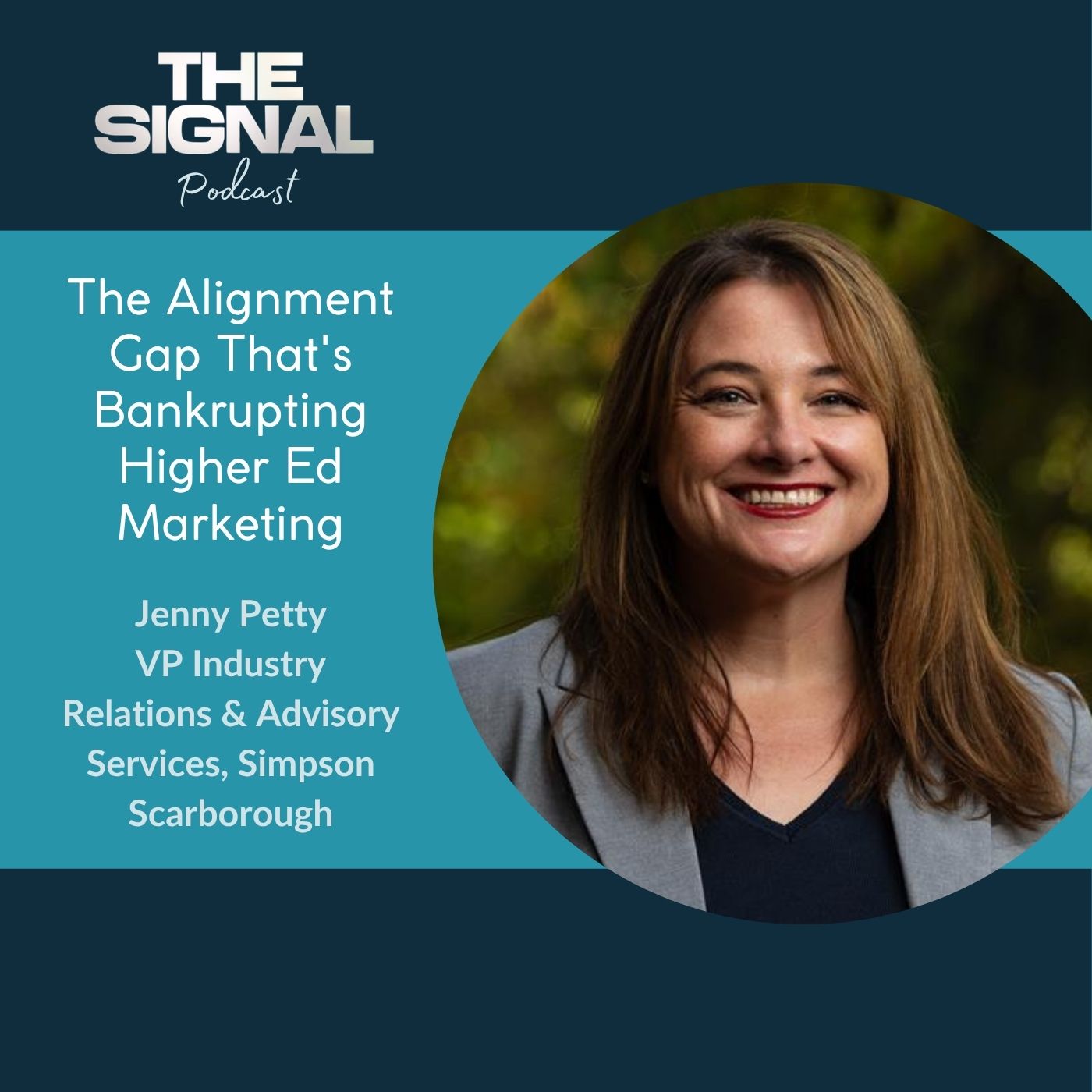
[00:00:00] Jenny Petty: I want strategy to become more honest and then I want marketing to move upstream. I know there's always going to be a certain part of our work that has to be service oriented. That's part of the work that we do. But I want marketing leaders to be helping to resolve institutional contradictions. You know, things like we have this academic portfolio and we know we have to cut because we're not getting enrollment in these places. Like, I want marketers to be at the table helping to solve that rather than just being the ones that are asked to like communicate the outcome of it when it's a decision has been made. I think our creativity is needed right now more than maybe it's ever been needed.
[00:00:45] Jeff Dillon: Today I'm joined by someone whose fingerprints are all over some of the boldest brand transformations in higher education.
Jenny Petty is Vice President of Industry Relations and Advisory Services at Simpson Scarborough, where she advises presidents, cabinets and marketing leaders, navigating some of higher education's toughest questions around strategy, organizational alignment, brand and change. Before joining Simpson Scarborough, Jenny spent more than a decade in higher education, most recently as Vice President of Marketing, Communications, experience and Engagement at the University of Montana.
There she led the Montana Made Montana Making Brand campaign and helped reverse a decade long enrollment decline, the steepest decline experienced by any flagship university in the country.
Earlier, at the University of Wyoming, she helped lead the university's nationally recognized the World Needs More Cowboys brand campaign.
Prior to working in higher ed, Jennie built her marketing career at IGT, where she grew a brand community from fewer than 200 followers to more than 1 million and worked on projects involving brands and personalities including Dolly Parton, Family Guy, and the Ellen DeGeneres Show. She's also formerly hosted the Servant Marketer, exploring the intersection of servant leadership, marketing and organizational life. In 2026, she moved from campus leadership to consulting, bringing the perspective of someone who's actually sat in the chair. She's now advising.
Welcome to the show, Jenny. It's great to have you today.
[00:02:24] Jenny Petty: Thank you so much.
[00:02:25] Jeff Dillon: You have an interesting background. You've been a coal miner, a rodeo cowgirl, and now an advisor to college presidents. How have those past jobs prepared you for your role now?
[00:02:37] Jenny Petty: So yeah, I grew up with horses, started rodeoing when I was in middle school, was really horrible at it for a long time, had to work really hard at it. It was fast. Horses are not something that is for the fear averse and then later on worked in a coal mine to help pay for college. I actually drove a haul truck for 12 hour shifts at a coal Mine in Wyoming. And I think both of those things, they showed me what hard work was like, but they also helped me get really uncomfortable in being a rookie or new to something and to show up and try anyway. And I think, you know, it doesn't for me ever gets really easier. Right. Like, you still have to have courage to do new things. But both of those things were pretty formative experiences for me. And I think now when I show up with college presidents or when I show up with fellow CMOs, I have a respect for how hard they are working and the vulnerability that it takes in these positions to show up for people, to show up for institutions, especially in a time right now where it's really. It's really hard. It's a. It's a hard season to work in higher ed.
[00:03:46] Jeff Dillon: Yeah, I love the background because higher ed has a. A tendency to believe we're a completely unique industry, and sometimes it becomes an excuse for doing things the way we've always done them. You came into this work already having learned how major consumer brands build audiences, create affinity, and really compete for attention. So I'm curious what you brought with you that higher ed wasn't really teaching earlier your career. You worked with Dolly Parton, you know, on the Family guy, the Ellen DeGeneres show, before you landed in higher ed. What did that world teach you about marketing that most higher ed communicators never learn?
[00:04:27] Jenny Petty: Yeah, so I actually came from the private sector before joining the University of Wyoming, which was my first. Well, I guess not technically my first higher ed job, because I actually worked in the marcom department when I was a student on campus at unr. But then I went into the private sector for a long time, and I worked in a lot of different areas. Healthcare and a startup and tourism, and then ended up at International Game Technology, which is a gaming company. And a big part of what they did was licensed content with big brands like Dolly Parton and Family Guy and Ellen DeGeneres Show.
And I got to work on those products and those campaigns and bringing them to a consumer audience, which for me, then coming to higher ed, I think that experience gave me a lot of different things. Right. It's like, first you. You recognize when you're in the private sector, that audience attention has to be earned. And I would say, like, when I started in higher ed, you know, over a decade ago, I think we just assumed that we deserved that attention and that we were getting it, we would get it no matter what. And so I've seen that change over time. The way that we think about communicating with prospective students what our audiences are looking like and changing.
I also think that I learned when I was in the private sector that brand is an experience, not just a campaign.
And I saw that in the way that we developed product. Right. Like we were in the business of slot machines and gaming entertainment. But the Dolly Parton slot machine not only had graphics of Dolly and stuff, but it had a built in jukebox. Like it was thinking about the consumer in that way and connecting that affinity that they have in ways that went above and beyond, just like slapping some ads together and throwing them up on Facebook. And so I learned so much when I was on that side of the house. And I think I really learned the biggest lesson was like a recognizable name can like open the door, but only meaningful experience that people experience over and over again can keep them there.
[00:06:20] Jeff Dillon: Yeah, great point. You didn't just work around big brands. You were also there during a period when the rules of digital marketing were being really rewritten, you know, in real time. Platforms have changed dramatically since then, but human behavior probably hasn't changed nearly as much. And there's one number from that chapter of your career that really jumps out. At IGT, you grew a Facebook fan base from under 200 to over a million.
What's the one lesson that digital marketing from that chapter that still holds up in higher ed?
[00:06:56] Jenny Petty: Well, even when you say that number, it just takes me back and gives me nostalgia about the good old days of social media when that was possible. You know, like we were using a pretty extensive ad budget at that time to grow an acquisition strategy. But I would say, like, what I learned during that time period was like, community matters no matter what. Right? So it's still something. Even at Simpson Scarborough, we just launched a community for higher ed marketing leaders. And it's still a place like back in the day. That's what I think Facebook provided for people. And how we were able to grow this was we had found this fan base around affinity around gaming and grew this Facebook community. And so I still see that happening today, especially for higher ed. I think that it gives us so much insight into people when we can get past vanity metrics and we can really think about the comments and like you said, the behavior and the response patterns that are happening in those communities.
And I think you can still build communities not by talking at people, but by building like shared purpose with them.
[00:08:01] Jeff Dillon: The idea of taking risks feels like a good bridge into something you've been pretty, pretty outspoken about. I've spent enough time in higher ed with marketing leaders to know they're operating under this enormous pressure, often with limited resources, lots of stakeholders, and not much room for a real public mistake. So sometimes what I think looks like caution might be fear. With a really good PowerPoint deck. Yeah, you've challenged your, your own peers on exactly that. You made the case that a lot of CMOs are afraid, not in a way they'd ever admit, but in, in a way that gets dressed up as, as kind of caution. And that's a pretty bold thing to say about your own peer group. How have CMOs reacted when they hear you say that?
[00:08:47] Jenny Petty: You know, we have a saying at Simpson Scarborough, we say say the thing.
And I'm always attracted to that sort of radical candor. And I didn't write this or document or say it to make CMOs feel bad about themselves. I wanted to almost provide a knowledge and a knowing of. I've been in that place. I know how exposed you can feel when you're in a chief marketing communications role. Everybody thinks they can do your job. From somebody's 12 year old child all the way up to like your alumni to big donor, everybody is always giving you input.
Gotta get a pretty tough skin around criticism. But what I noticed for myself when I was in the role and what I've talked to other people about is just there really is this fear of exposure.
And right now like we kind of dress it up as like we're just gonna get more buy in or we're gonna socialize this idea more or we're gonna create a committee or we're gonna say something like the campus isn't ready for this.
And I think it actually just masks an ability to stay kind of in a place of inaction and stasis and, and it's hard. Like, I don't want to say these jobs, they're so brutal. They're lonely and they're hard. And I don't want to take away from that or ask people to make risks that they don't feel comfortable with. But I do think right now most of our institutions need to be taking more risks and they need to be more bold and they need to be making, being very decisive. And I think that's where I think that executive leadership kind of shows up sometimes disguised as this idea of like prudence of being careful, being.
[00:10:19] Jeff Dillon: Yeah, yeah. And I, I think this is where it gets really interesting because fear or caution at the leadership level doesn't really stay contained there. It works its way into priorities and decision making and ultimately what Teams are actually able to, to execute. In my experience, some of the biggest problems in higher ed aren't caused by a bad strategy or bad people. They're, they're really about everyone kind of believing they're aligned when they're actually operating from really different assumptions. So you talk about this alignment gap in higher ed marketing organizations, the space between what leadership intends, what central teams design and what actually happens on the ground. Where do you see that gap show up most? And why do smart, well intentioned people fail to close it?
[00:11:07] Jenny Petty: So I experienced it personally in a lot of different ways when I was on campus. But one is in, you know, we do these big strategic planning processes on our campuses and sometimes it's like we have a five year plan or a ten year plan or sometimes there's institutions who roll from one year to the other with a flexible kind of plan.
But what I see happening over and over again and what I experienced was things like competing priorities. So it's like there's a plan but when we look at it it's like their overlap, right? And so we're saying we're going to do all of these things, but this, this dependency is needed for this, but we, this dependency is being used in this way. And so just that kind of missing each other in the airspace of the prioritization of what we're doing. You know, the other thing is like unclear decision rights. So I talk to people all the time. It's one of the things that comes up the most in my org assessment work is just people not being sure where their decision rights and where their decision making ability begins and ends. And so that creates big problems for alignment. It actually causes everybody a lot more work when we don't have clarity around decision rights or governance or things like that. The other things is this friction between centralized and decentralized groups that I see exist all over the place. And I think it serves in a lot of times as a distraction or a turf war or we love to call it silos in higher ed. But I think it actually, it's not a forcing function when we keep it like oh, it's got to be centralized or decentralized or whatever. It's like it's not a forcing function of actually what needs to happen, which I think in most cases is prioritization. And then you know, you see like things like mismatch resources or swapping a strategy out mid year but not doing any sort of trade offs. So it's like, okay, we're going to keep doing all of this and we're going to add this major thing, but we're not going to talk about what that's going to take and what we find. Yeah, you know, because you've been there. But what I find a lot. And we have a tool called the alignment index. So we're surveying CMOs to see how aligned they feel.
And that's the number one thing that they report back. It's just that they feel the most misalignment in human.
Human load. So how much they are absorbing, how much their teams are absorbing to make things still happen.
[00:13:15] Jeff Dillon: Yeah, it really does resonate with me because I come from the technology side of higher ed and I've seen technical debt accumulate over years and years. And everyone knows the problems there, but you keep patching around it because fixing the underlying issue really feels too disruptive. And I love your comparison because organizations can do exactly the same thing with people, processes and decision making. Eventually, the bill becomes due, you know, and you compare unresolved misalignment to technical debt, something that compounds quietly until it becomes one of the most expensive problems an institution has.
What's usually the moment a leader finally realizes they've been carrying that debt?
[00:14:03] Jenny Petty: So I think it. Unfortunately, a lot of the time shows up when we're almost in crisis mode, either budgetarily or there's something that is so broken, and it finally hits a tipping point where we can't deny that it's broken anymore. And that can happen in things like missed enrollment goals, missed fundraising goals, things like that, where it really does have a tie to revenue. And we start to see, oh, shoot, this misalignment. You know, I'll give you a good example. I was talking to a friend the other day who's at a school that's doing really well, and they're going to have a big freshman class, and they realized in July that they don't have enough freshman classes ready to go. So all of a sudden, you've got six weeks to figure that out. And to me, that's a misalignment between the academic enterprise and the student affairs and enrollment and student success side of the house.
[00:14:54] Jeff Dillon: Yeah, it kind of makes me think of this. This analogy. I heard some B2B SaaS, companies that sell the higher ed recommend that it's harder to sell a vitamin T higher ed than a pill. You got to sell the pill. I think there's a very natural leadership instinct to fix the mess by pulling everything back to the center. And I've seen this in higher ed with web and marketing and content tech. You know, on paper, centralization can look like the cleanest possible answer to inconsistency and duplication. But org charts have a funny way of making problems look solved before people actually experience them. That way. You warn against the instinct to just centralize everything when things feel chaotic. Why does that move feel so right in the moment and go so wrong so often?
[00:15:46] Jenny Petty: I think it gives us an illusion of control that we all really want. So I think, like you were saying, right, it makes us think it's an. It feels easy on the surface. Right. A centralization is never super easy when you're actually in the process of it. But I think it makes it feel easy. It's a design choice, not necessarily a cure.
And it's not always aligned with. I always say to people like strategy before org chart, like, what are we actually solving for before we start moving boxes around?
And I think, like, sometimes we don't want to admit that a distributed model or a hybrid model can actually work really beautifully. If we have some of those things like decision rights, clarity around strategic goals, things like that, it can work really well. And I think for a long time in higher ed, centralization was viewed as kind of like the Shangri La where we all were trying to get. And now what I see in the era that we're in is it's a lot of budgetary kind of reasons of why people are looking to centralize and they're looking for efficiencies and they're looking for ways to save.
But what I actually end up seeing in most of the centralization cases is it's a forcing function of, like we were saying, prioritization. So you think you're going to bring in college marketers into a central unit? Well, we've got to talk about all that they're doing in that college. And often it goes above and beyond what a standard. You know, they're almost like a chief of staff. They're an event planner. They're doing all these things. And are we willing to give that up to move them to the central unit?
[00:17:14] Jeff Dillon: Yeah. Anyone who's worked in higher ed knows you can't get meaningful change done without understanding the politics and relationships and competing interests. But there's a really fine line between being politically savvy enough to move the work forward and becoming focused on protecting your own position.
You've been pretty straightforward about that distinction.
Political savvy only works in the service of a mission. And the moment it starts protecting a leader's own position instead, it stops being, I Think leadership. Have you ever caught yourself close to crossing that line?
[00:17:53] Jenny Petty: Absolutely. And I think that's why it was so therapeutic to write the booklet that I wrote on operational effectiveness. Because I think when you start managing for landmines instead of the mission that you're supposed to be doing, like you were saying earlier, it has this trickle down effect. Right. So when you start operating from a place of fear or you're avoiding certain situations or other colleagues on campus because it's just too hard, your team then often absorbs that and they either have to absorb it through more work or ambiguity or dealing with your own weird vibes that you're giving off. And so I think part of that is developing the self awareness to know what your warning signs are when you might be operating from a place of fear instead, instead of political savvy. And let's, we have to be really honest, like you have, have to be political in these jobs. There is no way around it. That is part of the job.
But I think you have to have warning signs for yourself of like, what's my motivation here? You have to be really clear about like, am I building healthy coalition or am I being manipulative? And that can be a really gray area that you have to figure out. So I absolutely have been in that. I mean, and I, if anybody says they haven't, I'd love to, love to talk to them.
[00:19:09] Jeff Dillon: Yeah, let'.
And I think it's an important distinction because navigating the politics is one thing, but you eventually still have to turn all that conversation into actual change. That's where higher ed gets stuck. We're often very good at studying a problem and forming a committee and producing a beautiful set of recommendations.
Making the org behave differently on, you know, Monday morning is another matter. Yeah, you've created a pretty simple framework for thinking about that. You describe organizational change happening in three stages. Assess, align and activate. Which one do most institutions get stuck on and why?
[00:19:44] Jenny Petty: Oh, well, just like you said, assessment, we love pointing out problems. It's kind of fun. It's kind of a good time to be the one who gets to say this is broken. Right. But then to actually have to be the one to solve it is.
[00:19:54] Jeff Dillon: Yeah. No risk. Right? There's no risk.
[00:19:55] Jenny Petty: No risk. Right. Like you can, it's a lot easier to be in that. And it's not leadership. Right. Like I learned that lesson in my career, like blame is not leadership. Right. And so you have to move into those next, those next stages and those next stages. It's meant to be A flywheel. It's meant to be continuous improvement. Like we're not really ever done with this. I'm actually giving a webinar tomorrow where I'm going to talk about the laws of thermodynamics. Because my dad is an engineer, so I get really weird about things sometimes. And we're going to talk about like, you know, the energy that is needed to sustain a change. But once you get it going, right, like that's the hardest part is to get something changed and moving. Once it's moving, it's a lot easier to keep in motion. And so you know, you really want, you want people to get to the place where they're activating because it also exposes false agreement. When you get to that place of actually putting something into motion, you crack it even more. You find out even more places that if you had skipped that stage or you just went from assessment to activation, you might miss out on learning even more. That would make the issue or the project or the process even better.
[00:21:01] Jeff Dillon: Right. This framework feels even more important right now because AI is forcing marketing leaders to reconsider not just how work gets done, but what their teams should be doing in the first place. I spent a lot of time talking with higher ed leaders about AI and I think we've moved past the question of whether it changes marketing. The harder question now is how do you design the team around what humans should own and what machines can increasingly handle. You've been pretty clear that AI isn't replacing strategic judgment or the political and cultural navigation this work requires, but it's already reshaping production work. What does an AI ready marketing structure actually look like right now?
[00:21:50] Jenny Petty: Yeah, I think it looks different all over the place right now. And I think when we keep it as a just a tools conversation, we stay pretty limited. Right. Like we know that our production is going to get cheaper and faster. It already is.
But I think when we're designing for an AI ready marketing structure, we have to also think about how the human value within that organization is moving upstream. So it's things like judgment and synthesis and creativity and the institutional knowledge that an AI engine, even with everything that's out there right now, could not possibly know that. Every day at 2pm, Marie from Plant Science weeds the trail on campus in this one spot. Right? Like there's just institutional knowledge that can't be replaced. They can't build relationships. And then I don't think AI can 100% help us with things like prioritization or governance yet.
So I think we still need structures that are helping to build clear workflows, decision rights. I think we want to be using AI for our data stewardship quality standards, things like that. But I think we have to start thinking if production is no longer the constraint, then what should humans in the org actually be doing and design around that?
[00:23:01] Jeff Dillon: Yeah, yeah, I agree. I think what's interesting is that all of this can sound really clean when we talk about it as a framework, but it. It's a lot messier when you're the person sitting in the institution trying to make it happen.
You've actually lived this at Montana, where you were advising from the outside. You were accountable for the work during a really challenging period for that university.
Now that you have some distance from it, I'm curious how you diagnose what was really happening. You were going through a major brand transformation. I think looking back now, where do you think UM really stood before that work began? Was it a strategy problem, a structure problem, something totally different?
[00:23:43] Jenny Petty: Um, you know, I think that's a good question. I think UM is still an institution that is in a time of transformation. And I think it's been bold enough to do that earlier than a lot of institutions. And I think I was lucky to be a small part of that transformation when I was there and got to work with a lot of amazing people. And there's still a lot of incredible people there who are giving their lives to making that institution better and more well operated. I think like a lot of big flagship institutions, especially those that didn't have to worry about enrollment for a long time. You know, there was neglect of people, process and technologies. There was just kind of like that assumption that things would always be the way they were. And then. And then all of a sudden it wasn't.
And so I think a lot of that was just helping. I mean, we did a lot of foundational structural work. We did the brand. There was a lot of great work happening on the enrollment side, A lot of great people giving their lives to that work. But I honestly think the biggest thing we did on the marcom side with the brand work was to help the institution see themselves again in a good way and see themselves as a place that was on the rise and still had potential. And so I think there was a lot of healing that came from that work.
And there was more alignment that came from that work of finally them feeling like there was a brand that we were actually. We didn't tell them what the brand was. We reflected back to the campus community what they had told us. And so, you know, it really wasn't like, it's not like we came in and we did landing pages and it fixed. It was like really this very large effort with a lot of different people to fix some of that neglect that had happened.
[00:25:19] Jeff Dillon: You've talked about the courage organizational design actually requires, like telling a dean their program isn't exempt, or telling a team member their role is changing. What's the hardest version of that conversation you've had to have yourself?
[00:25:34] Jenny Petty: So I always think when I'm doing this work, I'm not a psychologist. I kind of wish that I was. But I often think about, you know, when I'm doing this work, like, am I causing harm? Am I looking at this through a lens of doing the best for the most people?
So I think sometimes telling. And honestly, Jeff, like, from the outside, it's a lot easier to be very candid as a consultant than it is to be on the inside. Like, let's be honest about that. But I would say it still is hard when you have to talk to somebody about major neglect or major issues that are holding them back. Or I don't like having the conversation around individual personnel. Right. Even, like, when I'm managing people, it's hard. Right. You want to have empathy. You want to see it from all the different ways. So I think having courage, courage, I think in this moment and in this work that I do is not about being super blunt, but it is about, like, having responsibility and being accountable for the choices and the recommendations that you make and the impact that those will have on the other side.
[00:26:37] Jeff Dillon: I think it's one of the things you can really only fully understand after you've sat in a chair yourself. There's a difference between knowing what needs to change and having to navigate the relationships and politics and the consequences of actually changing it. And now you've moved on from being the person inside the institution making those calls to advising the people who are sitting in those chairs. After a dozen years on the inside, you made the jump to Simpson Scarborough this year. What can you say now from the agency side that you couldn't say as a sitting cmo?
[00:27:08] Jenny Petty: I think the scope of what we expect from the CMO role has gotten out of.
I'm not going to say out of control, but I'm going to say it's changed in a way that the organizational systems and support don't match it.
So I'll talk about this when I do the webinar tomorrow. But like I analyze job descriptions from the last three years from higher Ed Barcom. Right. And they read, when you compare them to private sector jobs, they read like it's seven jobs in one. So we're asking someone to be the crisis communicator, to be media relations, to drive digital transformation, to be an enrollment partner, to, you know, it's just the list goes on and on and on. And so from the outside, I can now see the cross institutional kind of pattern where you can't have marketing trying to make up for problems with your academic portfolio or your pricing or the experience that's being offered or leadership misalignment. And I think I see that happening a lot where marketing becomes the people don't know where to put something, including blame. So it goes on the marketing and then Mark Ham is left kind of spinning, trying to, to fix it. And so I think there's an accountability piece that when we think about the scope of these roles, that needs to be addressed. But I also want to say, like, having been on the inside and experiencing that fear and exposure, I have such an incredible amount of empathy. And I tell CMOs like, I'm always going to be in your corner. Like I've been there and I understand the pressures and I want to be a partner and friend to them because I know what it, how much that, how meaningful that can be when you are in that position.
[00:28:48] Jeff Dillon: Yeah, I think this is a great place to bring this conversation home because we talked about fear and alignment and organizational structure and AI and the courage it takes to change things. But underneath all of it is this bigger question about what higher ed needs from its marketing leaders right now. And I love this phrase of yours because managing decline and calling it stability is probably going to make a few people listening slightly uncomfortable, which is usually a good sign. You've said the leaders who use these frameworks honestly build something that lasts, while the ones who don't are just managing decline in calling it stability. So what I want to ask you is a year or two from now, what do you hope has changed about how colleges think about their own marketing leadership?
[00:29:31] Jenny Petty: I hope that we stop rewarding heroic individualism and understand that we need to build operations and systems where success doesn't just rely on like exceptional people absorbing chronic ambiguity. Because that's what I see all over the place. Right. Is like, yes, marcom teams everywhere are punching above their weight, but it's because they're absorbing that work and they're taking it on and they're using their relationships and they're using their political capital and all sorts of stuff to try to make that connect. So I think that's one area. I think institutionally this is not just a marcom charge, but institutionally we need to make strategy honest. I wrote about this a little while ago, but growth stasis and managed dissent are all strategies. But what I see a lot of the time our campus is acting like they're in a growth strategy when actually they're. They're managing. They're not even managing dissent, but they are in dissent. And so there's misalignment between what they say they're doing and what they're actually doing when it comes to things like budget and resources and things like that. So I want strategy to become more honest and then I want marketing to move upstream. I know there's always going to be a certain part of our work that has to be service oriented. That's part of the work that we do. But I want marketing leaders to be helping to resolve institutional contradictions. You know, things like we have this academic portfolio and we know we have to cut because we're not getting enrollment in these places. Like, I want marketers to be at the table helping to solve that rather than just being the ones that are asked to like communicate the outcome of it when it's a decision has been made. I think our creativity is needed right now more than maybe it's ever been needed.
[00:31:11] Jeff Dillon: Love that. Well, Jenny, thank you. This is a fantastic conversation. I appreciate your willingness to challenge some of the assumptions higher ed marketing has carried for a long time. Long time. And to be so honest about what leadership and meaningful change can actually require. Thanks for joining me on the Signal. We'll include links to connect with Jenny and learn more about her work at Simpson Scarborough in the show notes. And thanks to everyone for listening. We'll see you next time.
That's a wrap of this episode of the Signal. If today's conversation sparked a new idea or challenged your thinking that that's exactly the point. This show is about cutting through the noise and helping you see what's actually shaping higher ed right now. Please subscribe so you never miss an episode. And if you found this valuable, leave us a quick review. It helps more higher ed leaders find the signal for deeper edtech insights, news and trends delivered monthly. Subscribe to the Signal monthly
[email protected] thanks for listening. We'll see you next time.