[00:00:00] Leslie Weller: We do see a lot of interest in, I guess, graduating, for lack of a better word from a Google plugin. I mean, this was something that was set up not as a strategic move, but rather just as a basic utility on the website at some point in the past.
And what we're seeing is bigger schools as well as the midsize schools are realizing that it has served its purpose and it actually creates a lot of risk for the university.
They don't have control over when Google crawls it really much of the algorithm. And without that control, it's a, it's a really critical experience on the website that the web team can't really influence.
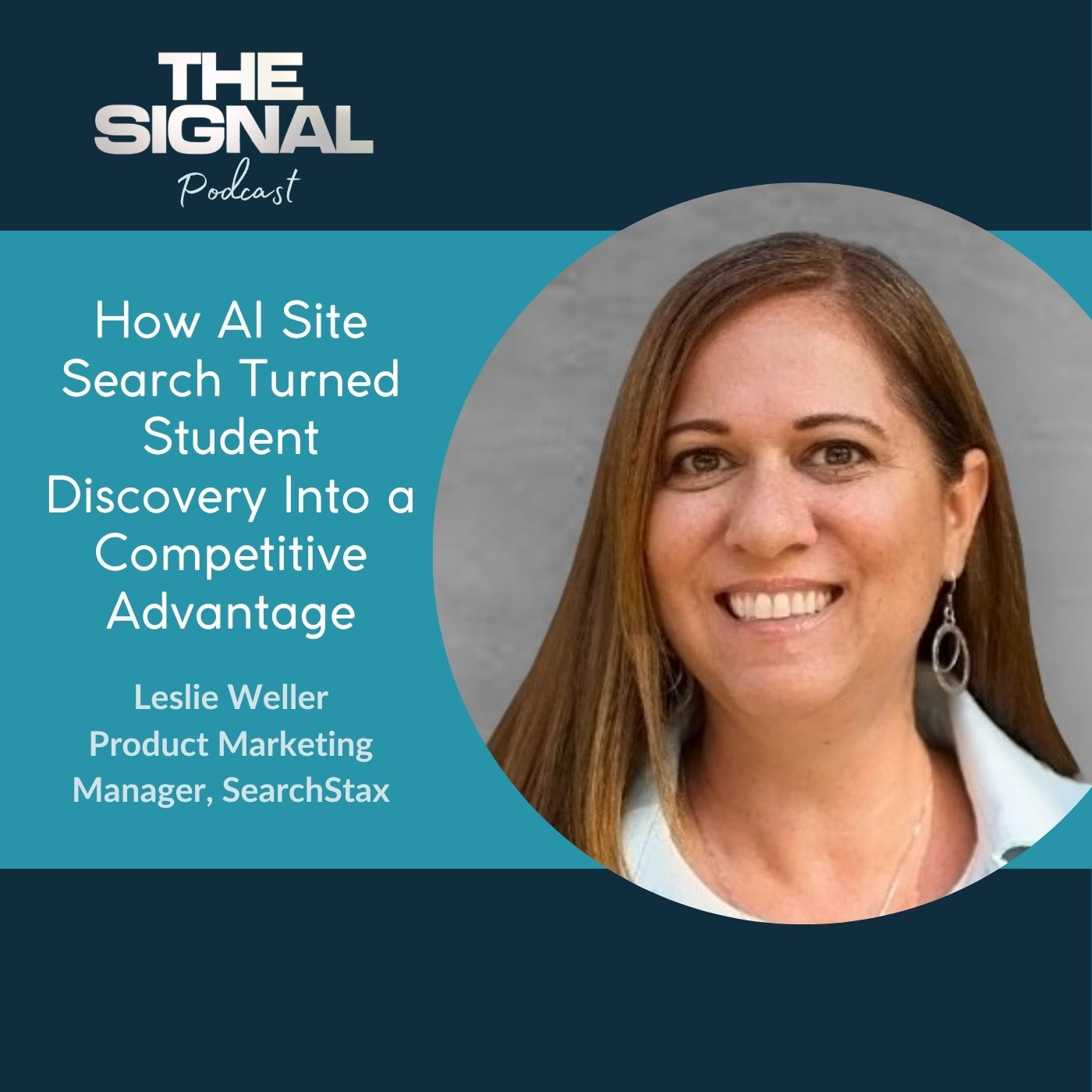
[00:00:49] Jeff Dillon: Welcome to another episode of the Signal. I'm Jeff Dillon, foundation founder of EdTech Connect, and today I'm excited to talk to Leslie Weller, a product marketing leader with over 25 years of experience transforming complex enterprise software into compelling solutions that drive real business outcomes. Leslie is the director of Product Marketing at SearchStax, where she helps colleges and universities solve one of their biggest digital challenges, making sure students and families can actually find the information they need on campus websites. Before Searchstax, Leslie held senior product marketing roles at companies like Lydix, Session AI and Canto, working across customer data platforms, AI powered tools, and digital asset management solutions. Her background is fascinating because it spans everything from enterprise software at EMC to innovative startups. Through her career, Leslie has mastered the art of making sophisticated, mission critical software easy to understand.
She's worked with Fortune 500 clients, built strategic partnerships with industry giants like IBM and Xerox, and led international marketing teams. Most importantly, she brings unique perspective on how B2B SaaS companies can serve the higher education market. In our conversation, we'll dig into how Leslie's experience in other sectors can help colleges and universities think differently about their technology adoption, where AI is headed in B2B products, and what she's learning from her work with higher ed institutions today.
Leslie, welcome to the show. I'm so glad to have you today.
[00:02:28] Leslie Weller: Oh, thank you so much. It's a pleasure to be here and thank you for the warm welcome.
[00:02:31] Jeff Dillon: I would love to start with your origin story in product marketing. How did you end up in this field?
What early experience shaped how you think about marketing today? I don't think many people think when they're a kid, like, I want to build messaging frameworks when I'm, when I grow up. Tell me your story.
[00:02:49] Leslie Weller: Yeah, thank you. I'm happy to share. I started my career more as a marketing generalist doing a lot of different marketing things.
And what got me hooked into product marketing were a couple of things.
I remember making my first product software video. So I was working with a lot of enterprise sellers who were, you know, telling our story. And when I scripted and built our first software demo video script and filmed this short one to two minute video, I got a lot of praise and a lot of excitement around the fact that we could tell the exact story that we wanted to tell to the humans we were trying to communicate the story to. And it was instantiated, encapsulated in that video and amplified.
And something sparked in me in that moment. I didn't even know what product marketing really was. That software company I was working with got acquired by a very large company. I was working for a 200 person company, got acquired by a 22,000 employee company. And so they were right, sizing everyone's jobs with this new, this new company. And they talked to me about what I do, what I was spending my time on, where I fit in the org. And they said, you're a product marketing manager. Manager. And this was a long time ago. And I was like, okay, that sounds great. I don't even know what that is. So it kind of started my, my path into product marketing and it's really been great ever since.
[00:04:19] Jeff Dillon: I think a lot of great product marketers seem to come from unexpected path rather than a traditional marketing background. Looking at your career, it feels like that broad experience probably shaped how you approach communication and problem solving.
What's the common thread that connects all these companies you've worked for and what's the biggest lesson you've learned moving between such different sectors?
[00:04:45] Leslie Weller: Yeah, absolutely. It's definitely informative to work in a lot of different fields because you take your learnings and you're able to accelerate solutioning in your next roles. Right. In your next challenges that you're trying to overcome.
For me, the patterns that I saw, the similarities really were that change management and ownership and leadership really are the key to any technology solution. So I've been in technology my entire career and regardless of the tech, you need to have strong leaders that are willing to rally everyone around change management and having that strong owner to feel responsible for am impacting and affecting that change. And that's the theme that I've seen over and over again. And so that's really influenced how I market and communicate what is necessary for each of these tech systems. Right. Enabling the person on the other end that's putting their a little bit their career reputation on the line to say we're going to make a change now and we're going to adopt this new technology and other people have to come along and arm them with those messages and with those stories and with all the information they need to feel successful, to feel like it's not a risk, but rather an additive for their career advancement.
[00:06:10] Jeff Dillon: Yeah. Before we kind of get into all the higher ed connection here, I think one thing that stands out in your background is your work with these enterprise clients. You're managing relationships with Fortune 500 companies and their C suite executives. How did that experience shape your approach to the B2B SaaS marketing you're in?
[00:06:31] Leslie Weller: I found myself very early in my career working with our executive team with these Fortune 500 companies to create like a customer advisory board. So we were bringing in and having personal conversations with CIOs from financial services institutions, leading insurance companies and having these very high profile sessions.
And then I realized even though I have talked with the CIO of Prudential or aig, if I want to go get some insurance, I still have to talk to their customer service person. So just for me, it really was really was eye opening of the importance of how every Persona is so critical because they have their own different job to be done. If I have a business strategy meeting with the VP of Verizon doesn't mean I'm going to call them up when I need to up my plan. I still have to talk to their customer service team. And every person in that org has their own motivations, their own responsibilities.
So that for me really underscored the importance of not only the Persona that you're talking to, but what is their job to be done, what is their motivation and really understanding that in order to talk with them about what matters to them and what they're trying to do.
[00:07:48] Jeff Dillon: Yeah, I think enterprise leaders tend to care less about technical depth and more about business clarity and outcomes. And I think that connects directly to something you've. I've heard you say before about making sophisticated software easier to understand at your core when your mission is to make sophisticated self, you know, enterprise software easy, easy to understand. Why? Why is it so hard? What does it take to do that really?
[00:08:15] Leslie Weller: Well, yeah, it is very true that enterprise software, it touches a lot of different avenues. Right. And that is also really relevant to what a university offers. Right. You're selling not only a four year experience, but a really a lifelong dream of all these aspiring students.
Similarly for enterprise software, you're selling a software, but you're also impacting a lot of different People within the organization, changing processes, improving broken systems and making them better.
So being able to find the high level message and pull up a theme that is going to resonate with the folks that are impacted. It's a talent, it's a skill. And it's also really critical because I always think about Donald Miller, who's a popular podcaster author, who always says, at least I'm attributing it to him, maybe he stole it, I'm not sure. But confused. People don't buy, right. And I think the same is true with students. If you students don't sign up, if they don't know what they're getting into, they're going to be hesitant. Their parents aren't clear about what their child is signing up for, they're not going to buy, they're not going to really enroll. And I think that is so true when it comes to communicating what it is that you offer, whether it's technology, software or the school services that you're offering.
[00:09:41] Jeff Dillon: You know, I think a lot of companies unintentionally market complexity instead of simplicity, especially in SaaS. And I think the challenge gets even harder in higher education where the digital environment is incredibly fragmented. So I'm going to get into what you're doing at SearchStax, because for all the listeners who don't know, I met Leslie a little over two years ago when SearchStax made this decision. It was all of a sudden a big player in this site search category for higher ed. We, a lot of other industries were already adopting this incredible site search tool. Then SearchStax came on and you were a big part of that. So what's been the catalyst to focus on this sector? What surprised you the most when you started working with colleges and universities with search stacks?
[00:10:27] Leslie Weller: Well, I joined SearchStax to really help websites improve that on site search experience.
I observed a deep need in higher ed and opportunity within higher education because I found out and learned through working with you, Jeff, and of course talking with a lot of schools that their data is so diverse. I mean it is distributed so that there's so much content, so many different schools.
Some schools have a very centralized content management system, some do not at all. Very, very distributed, decentralized infrastructure.
And the cool thing about search decks and just a website search strategy and program is that you have the opportunity to unify all of that complexity under the hood into a simple, single, clean search experience for the prospective student, for the community member that we wants information from your school and they don't necessarily know where to look and all these different sub sites. So site search becomes this unifying agent and completely aligns with what I believe in, which is clarifying that message, that story, getting them right to the answer very, very quickly while you do any kind of cleanup under the hood. That's great. That is always important. And of course now with AI, and I'm sure we'll talk about AI, that becomes even more apparent when you've got old stuff out there. All that cleanup is great, but having a unified search is such a quick win that it's been exciting to see the traction and the uptake in higher ed.
[00:12:09] Jeff Dillon: Yep. Higher ed. Yeah. Higher ed has this unique mix of decentralized content, massive disparate audiences, and really high expectations around digital experiences.
I think that's why this research that Surge Stacks did with the Chronicle felt so timely. You release this research last year and what did this research with a Chronicle reveal about how colleges are actually approaching search technology and what's, what's the gap between the importance and the reality?
[00:12:43] Leslie Weller: Yeah. Little background for those that aren't aware. So Search Decks did partner with the Chronicle of Higher Education last year. Shout out to the awesome Search Decks team. The awesome Chronicle team. The partnered really, really well to do a study interviewing a number of marketers, digital leaders throughout the higher ed ecosystem. And some of the things that we uncovered were quite interesting. So not surprising.
93% of students use websites when they're evaluating their prospective schools. And only 19% of digital teams believe that they are currently delivering a great experience on the website. So they understand that there is need for improvement.
What we do see is that 43% of website visits use the search bar. So if your school getting even just a million visitors per month, and many schools get many more than that. But if you're just getting 1 million visitors per month, then that's almost a half a million people every single month touching your search bar. Half a million people every month touching your search bar. And that's your high intent signal of what they're interested in, what they're looking for. It's first party data.
And yet in that study we found that 31% of those who responded said that they don't have access to any on site search data.
So there's a really big gap. Right. There's all these searches happening. It's exactly what someone is intending to find out from you. And if the marketing team and the digital team isn't even aware of what types of searches are even happening, it's a big blind spot. And there's a lot of opportunity there to not only improve the experience, but understand what is top of mind right now, seasonally at this time, based on what's being searched for. And then you can fill those any content gaps and really improve the search experience so that people are finding what they want as they get to your website.
[00:14:49] Jeff Dillon: Yeah, I think one thing that really stood out to me was how many schools recognize digital experience matters, but they still overlook search as a strategic tool. But we're having a lot of enrollment pressure now, and the gap suddenly becomes more important.
And the conversation that keeps coming up and everyone's almost infatuated by and distracted by almost is like AI search, talking about searching for things in ChatGPT or Gemini or Claude, using that as your search. There's almost a myth that I talk about so much like I love having you on here to help back me up here because I spend so much of my time talking about content discovery. And I wanted to get it from really the true source here that you see this traffic at campus websites on their search bar that they own on their homepage might be going down a little bit, but there's still tens of thousands of searches happening, if not more, depending on the size of the institution and their traffic.
But they're more qualified users now because they've already done some searches elsewhere.
So we're grappling with this enrollment cliff. Everyone's doing their research everywhere because there's so many places to search. There's intense competition. How does something like site search and user experience fit into a college's broader recruitment and retention strategy?
[00:16:06] Leslie Weller: Yeah, the on site search experience.
It's interesting because as you work to improve what's happening on your on site search, it has a cyclical halo effect because as you improve what is being surfaced on your own website search, you can do so with search, you can do so with the analytics and the insights to know what people are searching for, make those improvements. But as you do that, you're also now improving your content for those external LLMs. So you're tightening it up, getting rid of outdated content that happens to surface, cleaning that out. And that has a cyclical effect with the ChatGPTs, the Geminis of the world, where folks are in fact learning about maybe your university programs first. And when they come to your site, they have more intent, they have more knowledge, they're ready to go a level deeper, they want to validate as well what they're learning. People are. Of course, we're all still a little skeptical that machines are hallucinating or not completely telling us the full story. So we want to come to the source of truth, which is your website. That's what you own. You want to be able to present that true and factual data on your site. And then as you improve that on site search, you're just making the algorithms better out there in the wild and so more people can come and find you. And the other thing I will say on that before we move on is that not only is it a better brand experience on your site, not only are you improving how the LLMs are picking you up, but you're also improving your conversion of those who have heard about you, learned about you, whether they've learned about you on social media, from their friends, from whatever, when they're ready to do that research. You're improving your conversion rate because you're answering their questions when they're immediately looking for information about how long your degree is going to take, whether they're AP credits transfer. Like all these different questions that students have before they make that decision, you're making it so much easier for them to look, pull the trigger and commit to your school when they have the information that they come looking for.
[00:18:16] Jeff Dillon: Yeah, I think students also now they expect college websites to feel as intuitive as the platforms they're using every day, the Spotify and Netflix. But at the same time, these institutions are trying to modernize while navigating this rapid rise in AI. One of the insights, I think from the research I saw was that 72% of higher ed institutions plan to invest in more AI tools, yet many lack AI maturity. We went through half this podcast without talking about AI. Now we're going to get into it. What's the gap? What does that gap mean? How should colleges approach AI adoption strategically rather than reactively?
[00:18:55] Leslie Weller: Yeah, we have to think about and break it down into first principles. Right. I mean, AI, of course, is touching so many parts of all of our lives right now.
When it comes to, again, your role at the university, your role, you want to think about what it is that you're first solving for.
There's so much opportunity and we're going to see it proliferate throughout schools. When it comes to some of the big challenges around targeting and understanding your Personas, like the school's Personas, I think AI is going to give us a lot of opportunity for micro targeting. It's going to be able to see patterns that maybe we hadn't thought about before and pull in new insights and new ways to think about a lot of different segments so that we can not only create those micro segments, but also AI is going to help us more efficiently create the messaging that's going to resonate with each of those new segments. I think that that's one thing, but it's really about what it is that you're trying to solve for.
Having been at Search Stacks and being here at Search Stacks for a couple of years, I do see your site Sear Search Bar as being a great AI lever. Right. This is something that has become so natural out there in the world. As people type into Google, they're typing a few keystrokes, they see a nice list of suggestions that pop up and a really concise answer. A website on your university can do the same. In fact, we have schools adopting what we call our Smart Answers, which is a generative answering service so that you're not just getting the search results but also getting answers directly in that search bar response. So really modernizing how people experience your school, which is your brand, which is the face and oftentimes one of the first touch points before they ever step on campus and maybe they never do step on campus if they find a lot of outdated links and can't find the information that they're looking for.
[00:21:00] Jeff Dillon: So you mentioned Google and I think a lot of schools are still using a Google free tool, which I think is really scary and kind of incredible that there's all these enterprise systems that people pay for, but there's one critical front end technology that is being run by a free service recently it looks like, and tell me if I'm wrong here, but I think Search Text has brought on a lot of big clients like University of Arkansas, University of Arizona is about to go live, Ohio State, University of Illinois, tcu.
What are these big schools seeing? What is the move? And I'm not saying all these were on Google, but I'm kind of asking you two questions. Once why is there, there's this big move to move off of Google and is there a reason why these bigger universities logos are finding the value?
[00:21:50] Leslie Weller: Yeah, we do see a lot of interest in I guess graduating, for lack of a better word from a Google plugin. I mean this was something that was set up not as a strategic move but rather just as a basic utility on the website at some point in the past.
And what we're seeing is bigger schools as well as the mid sized schools are realizing that it has served its purpose and it actually creates a lot of risk for the university they don't have control over. When Google crawls it really much of the algorithm. And without that control, it's a really critical experience on the website that the web team can't really influence. And so they want to have more control over what prospective students are discovering when they're in that search experience.
That's one of the big things that we're seeing. Another thing that we are definitely seeing from like the TCUs and the University of Illinois and Central Missouri is they of course want to bring more AI into that experience as well and like have the algorithm do a lot of the heavy lifting and the work for them. So we offer a really great solution for that as well.
[00:23:06] Jeff Dillon: Tell me a little more about that. What are some of the things you're doing? What can you do strategically with AI in a, in a site search?
[00:23:12] Leslie Weller: Yeah, there's actually a number of things you can do I'll talk about. Of course, course, some of the things that SearchTax offers is a RE ranking algorithm. So if someone's typing in undergraduate degree in business, our RE ranking algorithm will notice that that is referring to bachelor's degrees. And so it will push bachelor's degree content up to the top. Even though they didn't type in the word bachelor's, they typed in undergrad. So it understands the context and the semantics of those terms to automatically rank for context and semantic understanding. Another really great AI capability within like the search stack solution is our Smart Match Assist, which is basically giving a human the ability to accept or decline a recommendation for synonyms. There's an example I know that Jeff, you love to share, which I think is really savvy for higher ed. Like there's, you know, a proposed synonym with MFA and two fa. So multifactor authentication with Two Factor Authentication. And the. The AI is suggesting like, maybe these are synonyms. Would you like these to like show up if someone types in two fa? But for higher ed institutions, that doesn't make sense. That you don't want to map, create that mapping. So you have a human look to say, no, don't do that. Because MFA would stand for Master of Fine Arts if you have a Master of Fine Arts program.
And this is just really applicable to nuances and nicknames and the language of your university. And I will say the most important one that we're seeing from an AI perspective is that generative answers. So the people don't have to go through five different PDFs or a bunch of different links to find their answer. But simply ask the question, like, how many years is your architecture degree? And they can find out quickly. If it's a four year program or a five year program with credentials. And that answer just gets generated based on your content and natural language, which is what we're all getting used to seeing now.
[00:25:14] Jeff Dillon: Yeah, I do talk about that example. I love the whole philosophy of having a human in the loop because higher ed is so far behind in this area and they want to, they see this nice shiny object in the distance that's they want it. But it's such a scary leap to think of outsourcing your search to AI. So you really have to, I think you really have to take that step, especially in this, in this industry.
The other thing I think about when I, when I look at search stacks is this stat that came up in that research was 93% of schools don't have access or track their no results searches. So when people get to a dead end in the search, they're losing that. They don't know who that is, what they're asking for. What are some of the use cases or some of the fixes you've seen when you see schools get access to that? How are schools using the data they can get from search stacks?
[00:26:05] Leslie Weller: Yeah, we have seen a number of our clients, they get this insight finally about what's happening on their search bar and using that to prioritize their content audits and using it to inform what their content cleanup strategy is going to be. So focusing on maybe those no results searches and filling content gaps with content that is important and for terms that are getting high traffic are a lot of inquiry and investment. Making sure those pages are optimized for conversion, answering the questions that students are asking, really using that data to give back to the institutions like the college, especially if they're multi college, what is happening on those different sub sites and really giving that insight into them so that they can best optimize that experience that on site search experience.
[00:27:06] Jeff Dillon: The one thing I've seen that I think you've seen too is using the site search to confirm the degrees that are being offered or the requirements for a degree. But, but really drilling down, they already know you have the degree but they want more information or they may be trying to explore like, like still if you have the degree. One school that we talk about a lot, and I know I've talked about this before is like there was a degree coming up at the top of their no results searching for dental hygiene and they didn't offer that program, but they started looking into offering that program. So either it can be used to that level and I Was just blown away when I saw that. Even setting up things like synonyms like, oh, we don't offer that degree, but have you considered we have all these other similar degrees. So AI can do some of that, but you really need access to that data. So I love.
[00:27:53] Leslie Weller: Yeah, we've definitely seen that like with animal sciences or veterinary or offering biology, similar types of degrees that they offer and doing mapping so you don't just lose them because they don't have the exact degree. And a lot of times students are coming in with maybe an idea of a job that they want, but they don't know what they need to study to get to that job. So having the mappings between the career title and the types of classes and courses and programs that you have, I think has also been something that we've seen a lot of schools adopt, which has been really, really beneficial for surfacing up those programs.
[00:28:26] Jeff Dillon: Well, Leslie, like to wrap it up, I think higher education really forces vendors to focus on trust and patience and long term value. Looking ahead, it feels like institutions that modernize digital experience effectively have a huge opportunity in front of them. What's the biggest opportunity you see for colleges and universities? Leveraging a better site search and AI powered digital experiences? What could change if they get this right?
[00:28:52] Leslie Weller: Great question and I do want to just say thank you so much for having me here. This has been so much fun.
One of the biggest opportunities that schools have is capitalizing on all of that investment that they have made to get people to your call it a digital front door. Right. They're not quite on campus yet, but your website is the next closest thing like they're getting to your website. They've got there, they have some kind of interest, they've heard about you, you sent them the mailers, they that you visited their high school campus, you've done the advertising to get them to your website.
And so site search is this tremendous opportunity to delight them, surprise them, answer their question in this very clean, clear way.
And that creates this positive impression. It makes them want to lean in more.
Find out exactly what you offer, find out the details, the deadlines, the costs like the scholarships, all of the details that they need to make that decision easier.
That all leads into higher not only enrollment, but also in the right enrollment like the people that are a good match because you're explaining who you are as a university. So the air quotes, the right people, those that are a good fit for your school are going to lean in and make that next move. So it's, it's like taking all of that investment and finishing it that that final mile just before they actually come on campus. It's an opportunity for every school and I'm super passionate about it. I couldn't be more grateful to be here to talk with you and your your audience and also just be part of the search decks and higher ed movement.
[00:30:42] Jeff Dillon: Well, I agree search is underrated. It's low hanging fruit. It. It is not an afterthought anymore. It's not navigation first anymore, I think. But this was a great conversation. Thanks again for sharing your perspective and giving us a real thoughtful look at where higher ed technology and digital experience is heading. I will put links to the Chronicle research and the Search Stack's website and your profile in the show notes. So thank you again, Leslie. It was a pleasure.
[00:31:06] Leslie Weller: Perfect. Such a pleasure. Thank you so much, Jeff.
[00:31:10] Jeff Dillon: That's a wrap of this episode of the Signal. If today's conversation sparked a new idea or challenged your thinking, that's exactly the point. This show is about cutting through the noise and helping you see what's actually shaping higher ed right now. Please subscribe so you never miss an episode. And if you found this valuable, leave us a quick review. It helps more higher ed leaders find the Signal. For deeper edtech insights, news and trends delivered monthly, subscribe to the Signal monthly
[email protected] thanks for listening. We'll see you next time.