Episode Transcript
[00:00:00] Mariah Tang: You could record a little video snippet of yourself talking about the key
points for YouTube shorts, for meta, put that in your newsletters. Share a carousel out on
LinkedIn. It's really about chunking out that content, breaking it apart and maximizing the time
you've spent and the investment in that content so that it doesn't fall by the wayside.
[00:00:24] Jeff Dillon: Welcome to another episode of the EdTech Connect podcast.
Content is everywhere, but few people understand how to turn it into true connection. Our guest
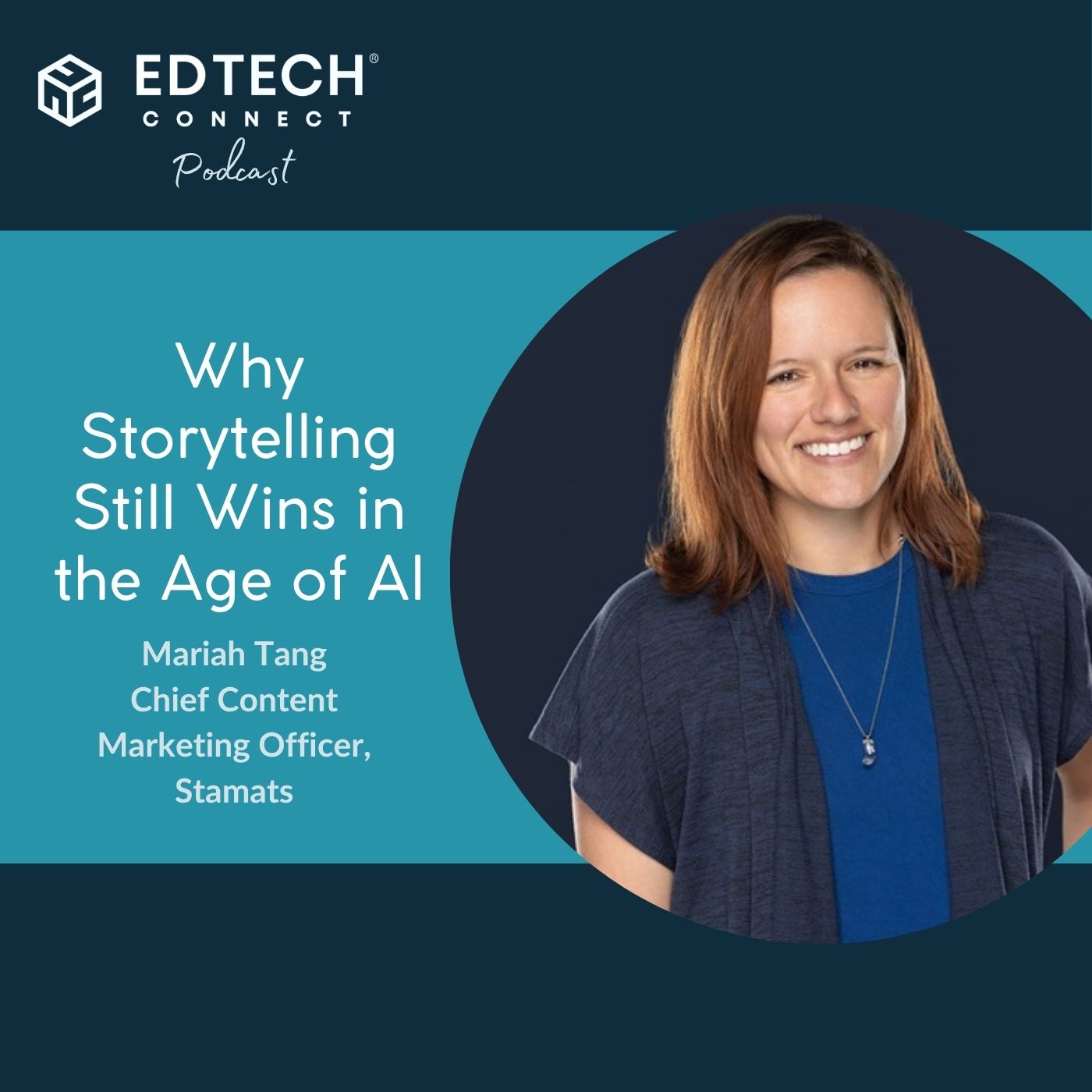
today has built her career doing exactly that. Mariah Tang is the Chief Content Marketing Officer
at Stamats, where she leads transformative strategies in higher education and healthcare
marketing. Name to top ranks, top 50 content marketing influencers and a Corridor Business
Journal 4040 under 40 honoree. Mariah brings nearly two decades of experience in journalism,
digital storytelling and brand strategy. She's an eight time content marketing world speaker and a
vocal advocate for authentic audience first communication. Her mantra? Content isn't about
clicks, it's about connection. At Stay Mates, she helps institutions craft meaningful, measurable
content that informs, influences, and ultimately drives decisions.
Whether it's navigating the future of SEO or embracing AI's role in storytelling, Mariah's insights
help brands stay both relevant and human in a rapidly evolving landscape.
Welcome to the show, Mariah. It's great to have you.
[00:01:41] Mariah Tang: Hey, thank you. I'm happy to be here.
[00:01:43] Jeff Dillon: So let's start off with something kind of different here. Just take. Tell me, if
your career had a theme song, what would it be and why?
[00:01:53] Mariah Tang: I think Back in Black by acdc.
[00:01:57] Jeff Dillon: I think that was my first cassette tape back in the day.
Oh, I love it. That's awesome. Well, you've described content marketing as being more about
people than platforms. What's the biggest mindset shift marketers need to make today?
[00:02:16] Mariah Tang: I think with all of the new tools and all of the new tracking capabilities and
everything that's high tech. And I think the biggest shift has been people need to go back to a
time when we were creating content by people for people. We've seen it time and again. Reports
on Semrush, reports from Neil Patel, Andy Crestina, all the experts out there, and even from our
own research, from our own audits and our client experiences, that generic content or you know,
the AI slop, that time frame is over.
The blogs, mentions, the media mentions, the earned media that are outranking static webpage
content. And the reason for that is because that type of content is really uniquely built to answer
questions, to speak to niche topics. They're refreshed much more regularly. So that new top of
mind content comes to light more than the typical webpage. And it's really just thinking about
structuring content to answer people's questions and not just talk about your organization or the
next thing that happened.
[00:03:20] Jeff Dillon: Yeah, I've heard the same thing. So I love that you're kind of, you know,
preaching to the choir here. In recent podcasts with your co host Stu Eddins, you discussed
search everywhere optimization. Can you break that down? What does that mean for institutions
but also for healthcare organizations as well?
[00:03:43] Mariah Tang: Yeah, I wish that I could take credit for that. It's such an awesome phrase.
I think it was Rand Fishkin who came up with that or really popularized that new term for SEO
now, search everywhere optimization.
But I think what it boils down to is that the gold standards of SEO are still the best practice. Don't
keyword, still stuff, don't post generic content for the sake of posting it. Create content that
matches the user intent, that answers questions. I think what's changed really is the place where
that SEO draws from.
So for a long time people searched on social media, you know, YouTube, Reddit, their non
Google, non Bing sites for information.
And now AI platforms, Google, other search engines are surfacing that type of content across all
platforms that users are engaging with. So you don't have to just search on Google or Bing, you
can search on Reddit, you can search on Instagram, TikTok, whatever. And that content is
coming up across different types of search. So what we should be doing as creators, as
organizations is optimizing our content for the best fitting platforms for your audience. So for
example, like a long form higher ed or healthcare blog can be sliced up into short little clips or
stats. For social media like Blue sky, you could record a little video snippet of yourself talking
about the key points for YouTube shorts, for meta, put that in your newsletters, share a carousel
out on LinkedIn. It's really about chunking out that content, breaking it apart and maximizing the
time you've spent and the, the investment in that content so that it doesn't fall by the wayside.
And like at Stamates, we call it an asset remix. It's just really creating multiple touch points from
one really stellar piece of long form content.
[00:05:28] Jeff Dillon: Yeah, I think a lot of people understand that and know that's kind of the
gold standard is to repurpose your content in these little chunks. It seems like maybe a
challenge resource wise. Do you have any tips on tools or, you know, what are your tricks on
how to do that effectively with, with a small team.
[00:05:46] Mariah Tang: Yeah, that is a great question. We, we actually just talked about this at
NCMPR conference over the past week. I think one of the biggest things you can do right up
front is to do that audience matching work. It's a little bit of intensive work upfront, but when you
do that, you can say, okay, this is our target audience for this specific topic or niche or service.
These are the areas where they're going most often. And then think about optimizing your
content to fit those specific points, platforms and topics. So I'll just throw out an example from
healthcare. If you're talking about, you know, breast cancer, what is the age group of women
that you're talking to? Probably in that 30 to 65 age group range. Where are those women
spending their time online? Probably on Facebook, Instagram, probably on Google, probably on,
you know, YouTube, where a lot of people my age, the millennial generation and our parents,
their time.
So instead of like, I need a Twitter and I need a blue sky and I need a this and then this, focus it
just down onto those platforms that, you know, people are using and start there, see if that
works, do more of what works, and then move on to the next highest priority service.
[00:06:59] Jeff Dillon: Do you have any recommendations on if you can only pick one or two that
because of resources, what are the big ones that, that higher ed and healthcare should be
focusing on? For socials.
[00:07:11] Mariah Tang: For socials, I would say, you know, a lot of students are using TikTok. A
lot of prospective students are using TikTok. Everybody kind of cringes when they hear that. But
it's, it's the way of the world. And honestly, a lot of those video focused, very visual social media
platforms use a pretty similar format. So it's not like you have to really reinvent the video for
YouTube, for Instagram, for TikTok. You can create one video, maybe tweak the captions or
tweak the size or the speed of it. And really you've created a piece of content that you can put
out and, and touch people on different platforms. Yeah, TikTok for sure. A lot of students use
YouTube. A lot of students are really into Reddit right now. It's just kind of thinking about like
what high schoolers do, you know, what college students do, you know, ask them.
[00:08:03] Jeff Dillon: Yeah, Reddit was a little bit of a surprise to me. How many students are
using Reddit in their college search journey. There's some research out that I've seen at some
conferences that it's like the big one these days for prospective college students. So I want to
talk about AI a little bit. With AI reshaping how people access information, how are you adapting
content strategies at Stamates to. To stay ahead?
[00:08:28] Mariah Tang: Yeah, we're really working with our client partners to pump up the volume
of their social content and their. Their marketing presence, following that kind of path that we just
talked about. You don't have to reinvent the wheel. You don't have to do something new every
time. That's one way that we're working with them is just, you know, optimizing the efficiency.
Because like you said, Jeff, a lot of the groups we work with are pretty small teams. One, two,
three humans per team. It's not. It's not much for a whole college, but they do a lot of work. I
would say the other shift that we're seeing is those, like the glory days of the. The send the
press release and cross your fingers is really coming to an end, especially with the pinches that
we're seeing and the. The magnifying glass we're seeing on mainstream media right now. And
honestly, the distrust that's coming out of especially those younger generations. So people are
thinking about mainstream media earned media coverage a little bit differently.
People really want that substantial, substantiated, validated story. They want the data, they want
the statistics, they want that personalized narrative. Not just, hey, our company did a thing or our
school got this new building. They want to know why it matters for them, and they don't want to
think too hard to get to the meat of that story. So making it interesting, making it entertaining,
and making it accessible, that's really the challenge, and that's what we've been challenging our
partners to do.
[00:09:50] Jeff Dillon: I have this observation that when we're using AI for things like writing
code, nobody's too shy about, like, bragging about, look, I did this using AI, like, it's out of my
wheelhouse. I did this using AI just with prompting. We know Claude's getting really good at it,
as well as many other more specific tools. But if you go to writing, it's a bit more taboo. There's a
much more of a spectrum out there because I think it's tapping into our creativity. I guess my
question to you is, like, people are less likely to say, yeah, look at this. AI really helped me write
this, this blog. No one wants to say that. So I believe it's a spectrum. Right? It's not like you
press a button, have something write a blog for you off of one small prompt is bad. That's not
what you want to do. But having AI at the very end, like you have some final polished great idea
blog you've written. You want it to check for grammar and just clarity. I mean, that's the other
end, right? I'll use AI for that, but there's a whole middle there. My question to you is if you can
tell me some secret sauce of how do you see creating thought leadership content on that
spectrum? How do you use AI when you're creating content from a thought leader perspective?
[00:11:01] Mariah Tang: Yeah, I love that question. I'm one of those people who I was really not a
big super fan of jumping in and using it. And then our clients start asking us questions, which
happens in an agency. You, you learn from your clients as much as they learn from you. And so
we challenged ourselves this year to really dive deep and think of some creative ways to use it.
So our team oftentimes, because we work across a couple of different high energy industries,
we use it for ideation. We use it to help whittle down some of these complicated topics. Like if
you're working on a very complicated story about a specific brain disease, it can help you come
up with ideas that maybe are a little different than just a what is it? How do we treat it? What's
the next step? Maybe it would recommend, you know, some nuances that we hadn't thought of
based on crawling out on the web. Another way that we've used it is to kick off some social
posts. You know, if we write a nice article, we can give it the summary and say give us two or
three starter social post or even email subject lines to think about. Sometimes when you're really
close to a piece, especially a big, long form, research heavy piece, it becomes difficult to zoom
out and it can help you narrow down and just bring up the highlights from the story.
[00:12:20] Jeff Dillon: Yeah, those are great examples. I always like to tell people, you know,
you still are the SME for whatever you're doing, so you have probably have ideas in your head.
But I do. I use AI to help me with ideation. I'll always write the first draft of my, I'll just get it out.
But I don't have to worry about the order of the format or anything. I'll have AI. Can you make
this more clear? Can you find a better example of this that I'm trying to say? So I use it. I go
back and forth. I rely on AI as kind of a writing assistant basically. And I'll have it give it the last
pass on the grammar. Make sure I don't have any typos in there. But yeah, that's great for
ideation. Like, people get stuck. Give it what you know. You'll get some ideas back.
And now a word from our sponsor.
Your audiences know the true power of your institution's story.
With deep inquiry and expert strategic and creative development. Mackie Strategies applies
decades of leadership to help you drive branding, marketing and fundraising that get results.
Mackie Strategies, moving your mission forward.
You've helped brands move from general messaging to highly niche content. Both, I guess, from
both sides. Like, I'm fully in the higher ed side, but I would like to know how higher ed can learn
from healthcare. But how do you guide. Guide them through that transition from general to the
niche?
[00:13:48] Mariah Tang: I think the key is being slightly annoying, which, you know, I'm kind of
good at. Like as, as an editor and as a content project manager. If any people that are interested
in getting into marketing hear this, that's my one takeaway. Be pleasantly persistent.
[00:14:04] Jeff Dillon: Ask the sales team. They will always say the marketing people are
annoying.
[00:14:06] Mariah Tang: So we are.
You have to be dealing with these unruly creatives, right? I just always ask, you know, what's
next? Then what? Why does this matter? What does this mean to the point of probably they're
like, my gosh, do I really have to include this? Yes, yes do. Because nobody else is talking about
it. This is your differentiator, that you have this expertise and that you have this knowledge that
you need to share out with, you know, your audience. So I'm a big proponent of ghostwriting and
subject matter expert interviews. For that reason. It can be really difficult to talk about yourself,
to talk about your work, your organization when you're right there in the thick of it every day. But
if somebody's out there asking those questions from an outside perspective, like I'm unfamiliar, I
don't know what this means. Kind of takes you out of the hot seat, lets you really think about the
depth that your group brings to the conversation and maybe helps you articulate that a little bit
more clearly.
[00:15:00] Jeff Dillon: I'm interested in you work with these two industries, primarily healthcare
and higher ed. I come from the higher ed side.
What are some things that you see on the healthcare side that maybe higher ed can learn from?
I don't know. It could be from the org side, how that's structured, process content.
[00:15:18] Mariah Tang: So I've worked in both industries for most of my career. I would say the.
The bulk of my career has been in healthcare. So 10, 15 years ago, healthcare really embraced
blogging. And it seems like an antiquated thing, but it's really not. It's actually having a
resurgence. And this makes my little heart happy because blog is my, my wheelhouse. And so I
would say the biggest takeaway from higher ed would be to follow in healthcare's footsteps in
that regard. Like you saw Matdorovich and Cleveland Clinic just explode on the scene, you
know, about 12 years ago with their Cleveland Clinics, you know, blog series. They started really
small and now she has a mega team. They put out millions of words a year. A lot of academic
health centers and a lot of smaller hospital systems have been doing this as well. And that's why
you see these articles rising to search every time that you use Dr. Google and try to figure out
what's wrong with your symptoms or whatever. I think healthcare is really missing this
opportunity to capitalize on that long form content by not putting out career focused blog stories.
What degree do I need to get a job in my neighborhood kind of thing, My region. It's a great
opportunity and I would hope that in the next year to two years, more colleges and universities
would jump on that bandwagon and start doing the blog thing. It's just amazing.
[00:16:38] Jeff Dillon: For SEO, can you share a success story where thoughtful content made a
measurable impact?
[00:16:46] Mariah Tang: Yeah, absolutely. So I think this kind of goes back to your first question,
Jeff, that how do you put out content that's niche? You know, why is that important? So we've
seen a shift over years and I'm going to go with healthcare for an example here.
You know, 10 years ago it was I need a heart month story because it's February and if we don't
post about heart month, you know, nobody's going to know about us will be irrelevant. And now
we're seeing groups really edge toward that less safe, more unique niche content. So I could tell
you about a million stories, but there's one that just rose top of mind as I was thinking about this
question.
So we work with UT Southwestern down in Dallas and the Surgeon General early this year, late
last year, put out a new report on the heart risks associated with tobacco use. It would have
been really easy to can up a couple quotes for that story and put out a statement like, cigarettes
are still bad, kids don't smoke and just move on. And we saw a lot of health systems do that, but
instead we worked with the subject matter experts to dive deep into the data of the report and
did a long form story about this specific risks associated with cigar pipe use. And chewing
tobacco, not necessarily talking about cigarettes. And so it was interesting because there are a
lot of younger people who use cigars, maybe not for tobacco, but for other things. And you know,
pipe hookah chewing tobacco is seeing a resurgence over the years. It's, it was just an
interesting take that not many organizations were taking.
And he, the spin that this subject matter expert brought to the story was this report, even though
he's been doing this for decades, is going to change the way he talks with his patients about
tobacco use. Instead of just saying don't smoke, he's going to really dive deep with his patients.
But the story ended up getting picked up by Medical Express by msn, and it earned a pretty
good conversational mind share on social media and through their email physician distribution.
[00:18:41] Jeff Dillon: To the higher ed side, how do you think institutions should be measuring
content effectiveness, especially with these fragmented audiences?
[00:18:51] Mariah Tang: Yeah, I, I love this question. And especially in higher ed, when data is
everything, you know, you bring ideas to your dean and they're like, what does this mean? But
you bring the data and they, it gives them something to grab onto. Right?
So for content marketing, for a really long time in my career, and this probably dates me a little
bit, in the beginning there wasn't really a great way to, to measure the effectiveness of your
content. I mean people would write in maybe and ask for ideas they might like your posts on
social and that was about it. Now we have all of these tracking tools and like how do you whittle
down all that data? So I recommend to groups to look beyond the clicks and I've always said
this, even when click tracking is a thing, look beyond those clicks. Look for non click metrics like
social engagement, brand sentiment. How do people feel about you? How are they talking about
you, even if they're not necessarily talking to you? And you can use tools like Meltwater and a lot
of the social media built in tools actually do that as well. Look at your reach and impressions,
look at your relevant site traffic, try to edge out the brand dimensions and look at just what
people are asking and how they're finding you for those queries. And then look at their user
activity once they arrive, which is generally easier on a higher ed site than a health care site
because of HIPAA privacy laws. I would say also look at conversions. And that kind of makes me
cringe a little bit to say that with content marketing the goal is brand awareness, you know, and
audience engagement. But at the end of the day, conversions matter, right? So look at form fills,
look at RFI requests Look at clicks to apply, you know, things like that. So I would say those are
the big ones. And then content volume. How are people reacting to the amount of content you're
sharing? Is it enough? Is it fast enough? Is it on the right topics? And consider that in the grand
scheme of your editorial calendar, I would think.
[00:20:41] Jeff Dillon: You really need the data too, because everyone wants to feel good about
their content, even they get maybe too emotionally tied to it. And data would be a way to like,
say, maybe. Let's focus on another topic here.
So what do you think is Most misunderstood about AI's role in content marketing today?
[00:21:05] Mariah Tang: I think like you said before, there are a lot of creatives who feel
encroached upon by these tools. I was a victim of this early, you know, in the year later, last
year, like, are we all going to be out of a job in a year? Is the world shifting its palette so much
that they don't care about these niche, you know, stories that they just want this fast answer?
And I, I think we're seeing that. No, that's not the case.
You know, AI is growing rapidly, but tools like Google are still holding that mind. Share. When it
comes down to the final conversion, you know, people might start with AI, but ultimately they go
to another platform. They want to hear from these organizations, from these subject matter
experts, and while, yeah, sure, like top of Funnel, they want to get that quick answer and move
on.
But when it comes down to making a decision for themselves, where am I going to get this
surgery? Where am I going to send my kid to college? They want that good, solid information
from your brand or your organization. So you're not being replaced by AI, but we can't ignore the
impact that it's having on our audiences.
[00:22:09] Jeff Dillon: Yeah, I agree with that. I heard a quote from Mitch Joel. I think he has the
longest running podcast out there, 20 years, doing a weekly podcast. But he said in a recent
webinar, he said, AI isn't here to replace us, it's here to make us superhuman. And I agree with
that. I think it's not that AI won't replace you if you don't jump on board, but it's not going to just
do it like you still own your thoughts and you can use this powerful tool, but again, it is taking
some jobs because they're just not going to be as many jobs that we need. So these people are
getting more and more effective. But I want to throw one thing where I draw the line, I guess, is I
was able to clone myself talking. I uploaded A video to a site you probably heard of. Hey, Gen,
there's many different sites out there. Just because it can look like I can talk Japanese and
German and all that. The technology is out there for us to create clones of ourself to deliver
content. Right. We all know that. We've seen them. They're going to be great. We're probably
going to see an AI movie in the next couple of years, I hear. But when I saw myself talking and
delivering content, although I thought it was pretty good like that, that's where I would say, like,
it's not authentic. Like people don't really want to see a clone delivering like webinar type
content. But that's my personal view, you know, probably end up getting there at some point.
[00:23:24] Mariah Tang: No, I agree with you. It makes me think of that show the Good Place
where they have the droid lady walking around and then she. She misfires and just becomes
mean. I feel like at the end of the day you want a real person because.
[00:23:37] Jeff Dillon: Yes, exactly.
[00:23:38] Mariah Tang: We relate to each other. Right? I mean, it's okay to use them for creative
things, it's okay to use them for administrative things. But at the end of the day, with those jobs
that are being replaced, what new jobs are going to open up? And I just continue to try to be
optimistic about it.
[00:23:52] Jeff Dillon: You've said in the past that content should close the deal. What makes
content truly conversion ready in your view?
[00:24:01] Mariah Tang: Yeah, I think when it makes you feel a certain way, and either that's a
really impactful student testimonial, or a patient experience story, or just an incredibly clear
description of a very complicated surgery, it gives you that sense of even subconsciously, if
you're not a marketing person, this might just roll right through you somehow, but gives you the
sense that somebody cared enough to put this together in a way that would resonate with me.
Not me as a consumer, but me as a person who will be affected by this. And I think when you
can make that balance between we have niched down enough to make this very specific answer
to this very specific question. When that connection happens, that's when you're conversion
ready. And it doesn't have to be like super singular or granular. It can be as easy as. I have
never understood how to apply for college and this very simple video walked me through it step
by step. And now I really want to go to your college because I feel like I will understand the
information I'm given.
[00:25:04] Jeff Dillon: Yeah, I love that. I agree. You've moved from being a writer to being The
Chief Content Marketing Officer.
What leadership lessons have shaped your journey?
[00:25:16] Mariah Tang: Oh boy.
How much time do you have?
[00:25:20] Jeff Dillon: A few minutes.
[00:25:21] Mariah Tang: I think being comfortable with vagity is really important, especially in
marketing. I'm a very type a person. You can ask my team, I'm sure they'll tell you. But with
leadership, you can't always know what's going to happen. You can't control your team's actions,
your clients actions. You have to be prepared, but agile enough to react, respond. I think that's
the biggest one. And then you can't take everything personally. And I tell myself this every day.
When I get something in my inbox that has red lines through it, I go like, oh, that one wounded
me. Right? But at the end of the day, it's a piece of content from somebody who has an end
goal. It's not about you as a writer or an editor. It's about what is the organization's goal. I think
when you can zoom out from that and say, we can learn from this and apply it to next time, that's
a growth moment instead of just like despair. And it's hard for creatives, it's really hard. But I try
to remember that when I'm giving feedback too.
Sandwich it in.
[00:26:24] Jeff Dillon: That's great feedback. Don't take it personally. And I really think there's a
lot of ways to do something right, a lot of ways to do something wrong. And I'm just looking for
like, I can't often make those final tweaks, those decisions, I defer those to other people. I'm like,
I don't care either way. They both look good to me. Well, if there's one thing you hope listeners
can take away from this conversation about modern marketing, what would it be?
[00:26:47] Mariah Tang: I think it's the approach.
So you got marketing, you've got sales, you've got admissions, you've got enrollment, and all of
those things. It's like that push and pull at the ends of the tug of rope, right? But at the end of the
day, content is in the middle. It's at the start, it's at a finish, it's all throughout that process. So
when you're thinking about what's the reason we're doing this? Everybody wants to make
money, everybody wants to secure their job. But at the end of the day, how are we going to do
that? By impacting the people on the other end, the people that are really being served by your
institution. So when you think about, I'm creating this long form article to help somebody who
might eventually need this surgery or eventually need that extra boost to say I'm ready to apply
for college, Think about that person, those people, instead of thinking about what my boss wants
and what the dean wants and what the president wants. When you get to that point and you're
thinking beyond X percent of organic traffic or x behinds and seats or heads and beds or
whatever, and you just go back to being helpful and useful, you might be really surprised at how
your impressive metrics just start to stack up. I'm not saying ignore the data. I'm not saying
never look at it, because obviously it's incredibly important to do that. But don't let it rule over
your creativity. Don't let it rule over your personhood. Because at the end of the day, that's a
good way to get replaced by robots.
[00:28:10] Jeff Dillon: I love it. Go back to the why everybody? Like, what's the ultimate goal?
Well, thank you Mariah. It was really great to have you on. I will put links to Stamats and to
Mariah's LinkedIn in the show notes. And again, thanks again.
[00:28:23] Mariah Tang: Yeah, thanks Jeff. It was a pleasure.
[00:28:27] Jeff Dillon: As we wrap up this episode, remember EdTech Connect is your trusted
companion on your journey to enhance education through technology.
Whether you're looking to spark student engagement, refine edtech implementation strategies,
or stay ahead of the curve in emerging technologies, EdTech Connect brings you the insights
you need. Be sure to subscribe on your favorite podcast platform so you never miss an inspiring
and informative episode. And while you're there, please leave us a review. Your feedback fuels
us to keep bringing you valuable content.
For even more recent resources and connections, head over to edtechconnect.com your hub for
edtech reviews, trends and solutions. Until next time, thanks for tuning in.