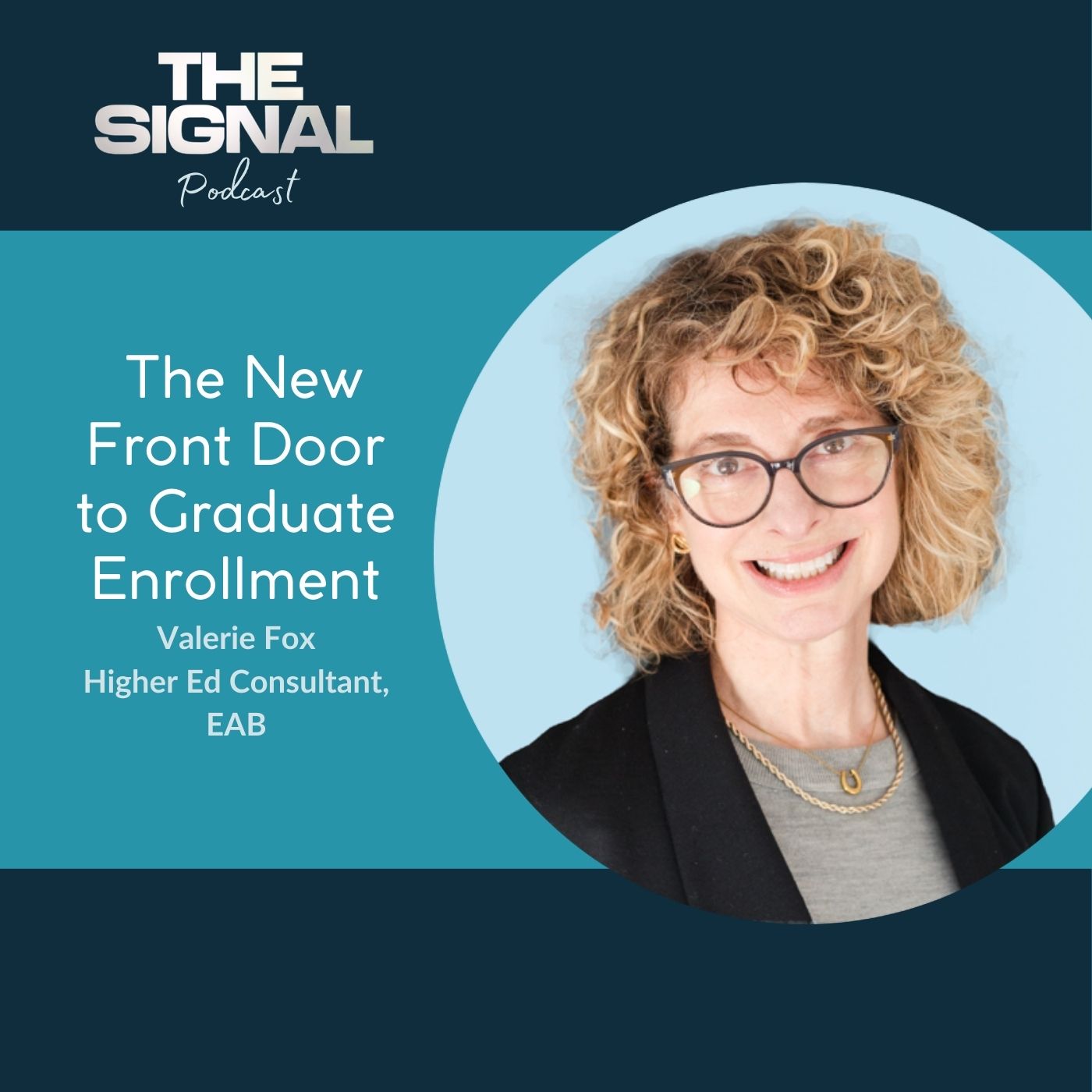
[00:00:00] Val Fox: I think the biggest shift we've seen is this surge in AI adoption, and this is
across both undergraduate and graduate students. It's really a game changer for exploration.
And if you're comparing dozens of graduate programs, and we talked about the lack of
differentiation, they're all talking about themselves the same way. You need a shorthand, you
need an assist, right? To really sort through, synthesize, compare, cut through what can feel like
an endless sea of sameness. And so to see that surge, we saw 5x growth, growth and the
usage of students saying, yeah, I'm using AI to help me identify my short list of graduate
programs.
[00:00:40] Jeff Dillon: This marks an exciting new chapter for us. The rebrand of the
EdTechConnect podcast. Same mission, Sharper Focus the Signal on Air is the audio
companion to the Signal newsletter, now read by more than 70,000 higher ed leaders who rely
on it for clear thinking on digital strategy, AI enrollment, and the future of the student experience.
If the newsletter helps you see around the corner, this show helps you hear directly from the
people building and implementing what comes next. Each week I sit down with leaders and
innovators who are using technology to move higher education forward, driving growth,
expanding access, and rethinking what's possible.
Today I'm excited to welcome someone who spent her career helping colleges and universities
rethink how they grow and compete in an evolving marketplace. Valerie Fox brings decades of
experience leading marketing strategy across higher education and consumer brands, and she
currently works with university leaders at EAB to drive enrollment growth for graduate and
professional programs.
Valerie previously served as Vice President of Marketing Communications at Bentley University,
where she modernized the institution's digital presence and led integrated marketing strategy at
the executive level. She's also the founder of Velocity Marketing, advising organizations like
Harvard Business Publishing, Yale University, Brandeis, and others on growth strategy, audience
insights, brand storytelling. With expertise spanning digital strategy, user experience, market
research, and omnichannel engagement, Valerie helps institutions align their teams and
evaluate their impact.
I'm looking forward to diving into what higher ed can learn from consumer marketing and what it
takes to truly drive enrollment growth today.
So welcome to the show. Val. It is great to have you today.
[00:02:46] Val Fox: So good to be here. Jeff. We've been circling each other for a while online
mostly, and it's lovely to be here and talk all things higher ed marketing, tech, digital, e
commerce.
[00:02:58] Jeff Dillon: Let's start with a little bit about what drew you to higher ed. You led
marketing at major universities and consumer brands. So what led you into higher ed and what
keeps you passionate about it?
[00:03:10] Val Fox: Today, that's a great question. It's. It feels like a little bit of a way back
machine moment for me thinking about my career through this kind of wide aperture. I guess you
could say that I, I had the good fortune to cut my teeth in marketing during the Internet and E
commerce boom. I mean so taking us back to the early 2000s and if there was a through line to
my career, it seems to be that I, I've been showing up when industries rules are getting broken
and I'll explain it. But I love kind of building the next playbook, which is a little bit of what I'm
doing right now. And starting with Bose.
I was at Bose when E commerce was still more of a question mark than a known entity. And I
was on a team that was really trying to figure out how do we bring what's traditionally been this
great kind of pilot. They got their start door to door and direct marketing, phone sales and things,
how do we bring that online with consumer electronics via the web. And that meant building trust
online when people still weren't comfortable transacting there. And it wasn't just launch a site, it
was really how do we translate this brand and our experience in direct digital marketing into
something that feels credible online, that people feel secure doing. And I really got hooked then
on building something new in kind of this legacy environment.
Bose was kind of like the Titanic. And I was on this team of just a few people trying to veer that
ship slowly in a different direction. And we did a lot of it was skunk works at the time and I really,
I loved that. And then I went to Forrester Research.
All of these are up in the Boston area. And I was at Forrester at a moment when social media
was exploding. This is think of 2006, 7, 8 time frame. And executives at that time were asking Is
this MySpace thing or Facebook thing, is this a real platform or is this just more chaos? Right.
And we weren't just adopting social, we were really helping companies interpret it.
And so it was about turning kind of that noise into strategy. And I got to really help build
frameworks and credibility around these emerging digital channels, which I loved. And helping
organizations really clarify what was the right fit for them, the use cases. And it was kind of the
first taste of the work I do today at eab. But that wasn't, you know, EIB wasn't dipping my toe for
the first time into higher ed. I'll just a few more stories here. I joined higher ed. I was approached
by Bentley University citing, you know, we've really got to build digital bench strength here.
We've got to elevate digital from kind of this supporting tool to primary engine. And that really
caught my.
[00:05:57] Jeff Dillon: When did you start at Bentley?
[00:05:59] Val Fox: I started there in 2012. I don't know if you remember those times. It was
kind of like higher ed making digital era.
[00:06:05] Jeff Dillon: Yeah. I was trying to get it because you and I have maybe a similar path a
little bit. I was, I started off building websites for the tourism industry and like having to convince
tourism type companies, folks, companies in Northern Arizona that these, this Internet thing,
you're near the Grand Canyon, you have a global audience, let's like get you a website. And it
was quite an interesting time. It was like the late 90s, so I'll date myself a little bit, but I've seen
it. And bringing that to higher ed, saying like, oh my gosh, we're so far behind because my first
job was in the year 2000 as a webmaster. So I took a lot of possibilities from the private sector.
[00:06:41] Val Fox: Another legacy. Like we want to hold on to what's been working, you
know, and we're talking about whether it's tourism in Arizona or, you know, higher ed in many
regards, like creating that urgency around this is one of the big uphill battles. We're doing okay,
you know. Yeah.
[00:06:59] Jeff Dillon: At Bentley, when you stepped up to this VP role, right. Bentley, you didn't
just update the website. You helped rethink how the university shows up digitally.
Transformations like that usually hinge on mindset more than technology. And so I'm curious
what the biggest shift in thinking you had to make to drive that change.
How did you make that change stick?
[00:07:22] Val Fox: Yeah. When I arrived at Bentley, higher ed was still very much brochure
and view book driven.
And the campus was really in need of, like you said, a mindset shift. You could probably relate.
We were really rebuilding and thinking about a digital presence that reflects the students, not just
kind of the operating structure or structure of a university, which too often is. Is really the case.
We had to really level up the sophistication in that sector. It's as you know, very bound to
traditions and view books and all the things. And I think what really worked there is getting more
people involved in actually seeing the experience from the student side. And I was managing.
We had a team of developers that kind of sat some over in the. In a tech shop and some in
marketing and getting them to work together and getting them to sit with prospective students or
maybe recent alums or any kind of the users that we Often assume we know a lot about, but
seeing how they were using it, getting people familiar with kind of the analytics and I think
creating that, the groundwork and the groundswell there at that level, as well as talking about it
at the leadership level from a very strategic perspective. I mean, we had a board that was largely
Bentley alum. This is a business school. They very much responded to how is this going to
move the ROI needle for us? And so I'd say that talking about it both at kind of the
implementation level and the strategic level was really important.
You know, oftentimes higher ed is like really good at kind of messaging down from the ranks, but
it isn't doing a lot to create energy and enthusiasm and, you know, a sense for where do I fit into
this? From the rank and file folks that are implementing the work. And so I really tried to do that.
And I think we did a nice job. I had great people around me who wanted to take that on and were
involved in user testing. We had a great user experience center at Bentley, so we could also tap
into those resources. And it was a really fun time to be there and kind of light that fire under
people who had. Again, we were doing very well on a lot of counts as far as undergraduate
enrollment. And we were only seeing kind of pockets of strain maybe on the graduate and adult
side where we knew we needed to sharpen our approach.
And it came in at a time when there was a real appetite. Yeah. For that. That kind of work.
[00:09:52] Jeff Dillon: You mentioned ROI and you made me think about this. I haven't thought
about it in a historical perspective, but I remember back when the websites were kind of new, it
was all about, like, traffic and clicks, and there wasn't much of an ROI discussion. And now it's
like everybody wants it, but it's hard to get.
Let's jump to eab. I want to talk a little bit about your position. You're in a unique position at eab,
working with institutions all over the country as they try to grow graduate and professional
enrollment. And I really think there's a lot of noise in the market right now with adult learners and
competition and program saturation.
From your perspective, what's the biggest misconception universities still have about graduate
enrollment today?
[00:10:39] Val Fox: That it's less just scale the undergraduate playbook. Right.
I think that's a huge misconception.
We see it play out every day. Undergraduate units are highly operationalized, highly resourced.
They're centralized. On the flip side, institutions are largely. Their approach to graduate
education, and enrollment is often very Fragmented and siloed and under resourced, under,
measured, not measured at all.
And so they've often sought help outside. We've seen a lot of schools turn to third parties like
opms to stand up online operations. And so we joke that we talk to one institution with their
graduate portfolio and operating model. And you've talked to one. There's like no two operating
models alike in this space.
And so really what I love about it is it keeps us on our toes. We're learning with every
conversation.
But there's lots of opportunity here. Lots of opportunity. And oftentimes we come in as both a
trusted, you know, resource to share insights and just help.
Often, like really small shops that are carrying a big target enrollment goal, make sense of the
market, the customer mindset, and kind of the tools that they can and levers they have to really
[00:12:03] Jeff Dillon: grow about these tools. You talk a lot about the importance of sharpening
market insights, and I think that phrase can mean different things to different leaders.
For a university that's serious about growth and positioning, what does sharpening market
insights actually look like in practice?
[00:12:22] Val Fox: Yeah, well, as it relates to grad education, I think too many institutions are
launching graduate programs based on internal enthusiasm. Right. There's no external
evidence.
It could be a faculty member who said, look, I've been talking to some students, or I have a
corporate partner that wants to stand up XYZ program.
And then they do all the work to make that happen, but then the enrollments never materialize.
And so sharpening marketing or market insights, let me be clear, really means leveraging
publicly available data, for one, in terms of conferrals. And that's a strong signal. That's IPEDS
data. That's a strong signal that does demand exists from the student end employer data,
Bureau of Labor Statistics data on the employer side. Are those skills in demand? Right.
So you're grounding these decisions in actual market need, and you're looking at it from, you
know, your own region.
You're looking at pricing patterns and competitive density, all those things on a program by
program basis. So. So, you know, I love to hear when schools are actually putting new program
proposals through those paces. That's a really strong sign that they've operationalized this in
kind of a thoughtful way. But often we're brought in when that hasn't happened. And there's a
portfolio that really needs some kind of, you know, just shoring up and validation. Is this kind of
the right fit for where you are today? And by the way, you know, there are new Entrants coming
in every year or two. So it's not a set it or forget it model. You need to constantly be reevaluating
what's happening in your, in your market. You know, otherwise, launching a program, if you're
not doing this and you're still launching program, you're really kind of, you know, it's not about
strategy. It's really. You're just hoping that the students will emerge. And that's a tough position to
be in for a lot of institutions.
[00:14:12] Jeff Dillon: We all, I think, agree, like most people I talk to, that higher ed is crowded
in many cases starting to sound the same. When every institution claims community and
outcomes and innovation, it gets harder to stand out. From your vantage point, how. How can
universities truly clarify and strengthen their. Their brand story in a way that feels authentic and
differentiated?
[00:14:38] Val Fox: How much time do we have today, Chad?
I know we could spend a lot of time on this one.
[00:14:43] Jeff Dillon: You got about 20 more minutes here.
[00:14:45] Val Fox: All right, the top line on this. No, I think you've shared some great
examples, right? Like, oh, we have supportive faculty, academic excellence, strong outcomes.
Right. And those aren't differentiators. Those are really kind of the category or sector minimum
students expect that. Right. And so, you know, if you're looking at how you message certain your
institution and or programs relative to your competitors, you can cover up your logos and they all
sound the same. That's really not being differentiated. So I think to strengthen the brand story,
institutions really have to ask, what are we doing that's distinct from our peers?
That's thing one and thing two. Is. And is there overlap with that distinction with what students
really want, are telling us they want, need?
So it's kind of the vast majority, I think, of business schools, for example, claim strong roi.
Certainly students care about that. But I was working with one school where all the students
were building online portfolios and adding to it with demonstrable skills in each class. And I
thought, now that's pretty distinct in the market. You could say roi. And here's an example. And
not many schools would do that. And so you could see that they're kind of the idea of building
this moat around what you're doing by getting more and more specific and giving examples.
And that's something that students respond very well to. And so could they make that even
harder structurally for competitors to come in and say, oh, okay, well, we'll just add an online
portfolio.
Maybe they add something else. They have industry partners that come in and confirm those
skills in each class and give students badges or something, or having alumni offer to interview
and recruit students.
When we talk about compounding kind of these claims that schools are making, making the
claim specific and attractive to students is one thing. And then compounding them so you almost
create kind of this barrier or moat so that competitors aren't swooping in and copying what you're
doing. And I think, you know, we too often stop at the, okay, we have our institutional pillars,
we're done.
That's institutional branding. And I'm talking to enrollment leaders and deans and academic
leaders who care about enrollment and program growth and they want to know, can I do this for
my programs? And I said, you have to, not should, you really have to. And it, you know, sits
under that institutional branding. It should never contradict it, but it needs to start getting really
specific. And it needs to also just be, you need to be very clear about who the kind of student
you're serving and, or want to serve. And then it's aligned with what they care about.
[00:17:26] Jeff Dillon: I think that's a challenge is specificity because there's so many opinions in
higher ed and everyone has a voice, which is our model in higher ed. And it just kind of seems to
like water it down all the time. But if, if you think about it, you know, I think the audience itself is
shifting, especially when you look at adult and professional learners who are balancing work and
family and real career pressure. Expectations around flexibility and value and speed feel
different than I think they even did a few years ago.
What are you seeing right now in terms of those audience expectations changing?
[00:18:04] Val Fox: Yeah, we run many surveys of prospective students and then the space I
spend my days in which is speaking to prospective graduate online and adult degree completer
students. So think shorthand is anyone who's not in the 18 to 21 year old traditional
undergraduate bucket. Right. And the biggest changes we're seeing with that audience right now
is this shift towards efficiency, autonomy, digital first decision making.
Students are more efficient. They're using AI rapidly adopting that to continue doing all of this on
their own. They're not. You know, when I got started in 2012 and in higher ed, you know,
admission counselors were still really busy, students were reaching out to them. Right. And now
we've just kept, continue to adapt to all of the self service tools we have out there. Right. The,
the, all the tools we use, whether it's Uber or Netflix, they know exactly where we're going, what
we want to watch next. It's like we expect that kind of immediate gratification in answers and so
we Use higher ed websites the same way. And on the graduate adult side, 80% of applicants are
stealth in that space, meaning they're not showing up at an info session or a webinar before
applying. They're doing all of their own research. And so you could see how that alone is
fundamentally shifted kind of the mindset and also how schools need to react and adapt to that.
So that's a big one.
[00:19:36] Jeff Dillon: I talk about that a lot. Val, you mentioned the expectations of a Netflix or
Spotify. Like it comes down to often, it's content discovery.
So although these LLMs are providing so much information and people feel like, oh, they're not
searching anymore, they're just using LMS to give them answers when they reach your site.
Although that may have dipped a little bit, the number of people at your site, at a certain point,
they're more qualified. They already know and they're trying to confirm it, and they're trying to
make the next step so the traffic is even more critical. And since we're competing with these
brands that have all the money and they only have one mission, which is get them to click the
button like it's such an unfair fight, but it's still that expectation. You're right. That's been set.
Let's talk about this data. So this is really cool. You recently looked at data from more than 8,000
prospective graduate and adult learners to understand how they're actually making decisions
right now, it really paints a much more nuanced picture than the traditional funnel. When you dug
into the stealth shopping behaviors and the role AI is starting to play in search and discovery,
what surprised you the most?
[00:20:51] Val Fox: I think the biggest shift we've seen is this surge in AI adoption. And this is
across both undergraduate and graduate students. It's really a game changer for exploration.
And if you're comparing dozens of graduate programs and we talked about the lack of
differentiation, they're all talking about themselves the same way.
You need a shorthand, you need an assist, right? To really sort through, synthesize, compare,
cut through what can feel like an endless sea of sameness. And so to see that surge, we saw 5x
growth in the usage of students, saying, yeah, I'm using AI to help me identify my short list of
graduate programs in schools. And then we actually also survey marketing leaders in higher ed.
We just ran a survey of 120, you know, VPs and chief marketing officers of marketing. And what
surprised me there is in response to what we hear students doing, which is, yes, we are using
more AI when we Ask these marketing leaders, where are you investing? We see that six in ten
have told leaders have said yeah, we're researching AI powered search visibility. Like we care
about this enough to research it. But only a third have actually dipped their toe in and conducted
a visibility audit. Are starting to kind of really adopt or implement.
Going from curiosity to execution is there's still a big gap there and I think that's where the risk
lives for higher ed. You know, if AI is becoming the new front door for college discovery, you
know, really kind of think of it as supercharged search, then institutions that aren't actively
ensuring they're visible there's are really going to fall behind in a big
[00:22:29] Jeff Dillon: way building on that research.
If prospective students are using AI to shape their early decisions, we know they are. A lot of
that activity is happening before, before the institutions even know that they're in the mix. And it
raises the stakes for how we use technology and data. So how do we use marketing technology
and analytics? How can they be used more strategically, not just tactically when it comes to
driving enrollment growth?
[00:22:59] Val Fox: Yeah, I'm surprised when I see both EAB and third party research that
shows that a lot of marketing leaders are not tying web traffic back to investments they're
making. They're not often not able to make direct linkages between your efforts and impact for
their institution. And so I'd say the first thing is understanding what success looks like on your
website and moving away. I think you mentioned earlier vanity metrics, right?
How do you move away from just. We can't be talking just about page views or clicks or
impressions anymore. I mean those are vanity metrics that anyone can shore up pretty easily
and throw a lot of money at and just goose those numbers.
What you should really be measuring are the things that are keeping the lights on, driving your
enrollments forward. If you are making those investments in service to enrollment. Right. So that
would be application starts, requests for inquiries. You know, you really need to have a keen eye
on those and keep tabs and well, what efforts are accelerating those kinds of behaviors on our
site.
So I think that's really important is really making sure you can create a bright line between your
marketing units, work and those kinds of behaviors, digital behaviors.
[00:24:27] Jeff Dillon: And I see it as marketing technology and analytics are kind of the
enablers. And then the real growth still comes down to the execution and the leadership.
You've worked with institutions that have really accelerated enrollment in meaningful ways and
others that struggle to gain traction. From your perspective, what separates the organizations
that truly transform from the Ones that stall.
[00:24:52] Val Fox: I think the ones that transform learn how to prototype their way forward.
They're agile, they're adapting. The data I shared earlier about some of these institutions and
leaders still in research mode. How do we get them off the blocks and try something? Right. You
know, I think we're really good in higher ed at debating our way forward. Bose was probably very
academic in a lot of ways, but we never waited for certainty. I mean we piloted, we defined
success metrics, we tested, measured, refined. It was really disciplined experimentation.
And in higher ed, I think, you know, the institutions that are accelerating growth are the ones that
are running pilots instead of multi year committees. Right. They're defining what success looks
like before they launch.
Really clear on how to allocate and tie budgets to experiments.
Not just sure things. You know, you're constantly experimenting and refining and aren't accepting
or just adopting a set it and forget it kind of mindset. And I think most critically is they're willing to
stop doing things that they're truly measuring. They're willing to stop doing things that no longer
work.
And that's often a very unpopular so hard stand in higher ed. But it's one you have to take. And
it's often why you're brought in to sometimes deliver bad news and deliver kind of analysis that
says, hey, look, here are the areas that you need to de invest and here are new growth
opportunities for you.
[00:26:21] Jeff Dillon: I always say it's never too late to make a good decision. People make a
decision, they're like, ah, we got to stick with it. I'm like, no you don't.
That transformation, I think it rarely lives in one department in just one. It cuts across marketing
and admissions and academic leadership and often the cabinet. And what usually I think where
friction shows up is when you're trying to align across functional teams around growth.
What's the key to building real momentum instead of this quiet resistance?
[00:26:53] Val Fox: Quiet resistance or benign neglect or, or loud resistance? Sometimes, I
know, sometimes it's very loud and thorny.
I think creating a shared baseline vision of market conditions. Right. There are a lot of
assumptions, I believe that resistance isn't often disagreement. It's just people operating with
completely different assumptions about the market, the competition, what students actually
expect, and so elevating foundational knowledge.
I was shocked at the campus I was on when EAB came on and did lead some strategic advisory
sessions. Like I saw the board and a lot of leaders eyes get real big around some of these kind
of just systemic issues in the industry that we hadn't been talking a lot about. And it really, I think
grounded us in the shared understanding we could use to reach some, you know, you're never
going to get perfect consensus, but at least having the same vision of what external reality looks
like. Right. What AI discovery looks like today, digital behavior shifts. This is getting into
wheelhouses that not all of us, we weren't brought into these positions, know everything about
all of this. But you know, higher ed, there's a lot of experts in higher ed and so we're not always
great at admitting what we don't know. But it's like I think we need to get comfortable learning
new things to accelerate conversations and make these decisions less personal and just more.
Yeah. Are we agree that we want to move this work forward? And you know, campuses love
complexity. Right. And so I think it's the native language on a lot of campuses. It's signals,
rigorous thought, what we're all trained on. But I like using frameworks to kind of just compress
complexity. And so, you know, whether it's a two by two, a pyramid, a decision tree, something
to come in and just orient everyone around, hey, here's clarity. Can we rally around this? That
tends to also accelerate conversations and decisions around leaders who are often super busy.
And I think, you know, there's no one right way to do it. I think trying to, if I had to summarize, it's
shared understanding and reducing complexity and if everyone knows what the end goal is, if it's
enrollment growth, if it's reputational shifts or strengths, it becomes a lot less complicated.
[00:29:19] Jeff Dillon: Agreed. Well, let's end with a forward looking lens. The next three to five
years are going to be a test for a lot of enrollment assumptions across higher ed. If you could
give one piece of advice to leaders who are serious about growing enrollment in that window,
what would it be?
[00:29:38] Val Fox: I'm going to be a little biased because I spent a lot of my time here, but I, I
think it's a valid for 90% of the institutions I, I speak with and I speak with dozens every month.
And I believe that, you know, if the goal is really enrollment growth here, it's not going to be
coming from the best programs because the reality is a shelf life on a unique program is maybe
two, three years these days before copycats merge or the biggest ad spend because most
schools aren't looking to be the next southern New Hampshire. Right. It's really by, you know,
who has the clearest, most optimized digital front door that's open for AI now. Right. And leaders
need to stop treating. Kind of what I'd say is, you know, separate work streams for website or for
brand strategy or for enrollment strategy. That's often lived under different units. And those units
don't always talk and work together for the reasons we shared. And so those work streams need
to be tightly integrated because they all work in concert, you know, to really amplify your brand
on the channels, the AI driven channels that you need for students to find you.
[00:30:45] Jeff Dillon: Yeah. Well, thank you. It was great having you on the show. I will put links
to your LinkedIn and EAB's website in the show notes.
And what a pleasure talking to you. Thanks again.
[00:30:56] Val Fox: Great to be here. Thanks, Jeff.
[00:30:58] Jeff Dillon: Bye Bye.
That's a wrap of this episode of the Signal. If today's conversation sparked a new idea or
challenged your thinking, that's exactly the point. This show is about cutting through the noise
and helping you see what's actually shaping higher ed right now. Please subscribe so you never
miss an episode. And if you found this fun, valuable, leave us a quick review. It helps more
higher ed leaders find the signal for deeper edtech insights, news and trends delivered monthly.
Subscribe to the Signal monthly
[email protected] thanks for listening. We'll see
you next time.