Episode Transcript
[00:00:00] Michael Leggs: We will hopefully redirect our students attention to ethical use of AI and we would direct our instructors attentions away from surveillance and policing because that is one of the things that I think needs to go away in five years because we're creating environments where our students, they don't trust us and they know it's implicit that we don't trust them if we have all these tools set up. So I would like to see surveillance and policing tools just abolished in five years and refocus on using AI if I want to say for good, not evil.
[00:00:47] Jeff Dillon: Welcome to another episode of the Signal. Most of the AI conversations I have in higher education happen with CIOs and academic leaders.
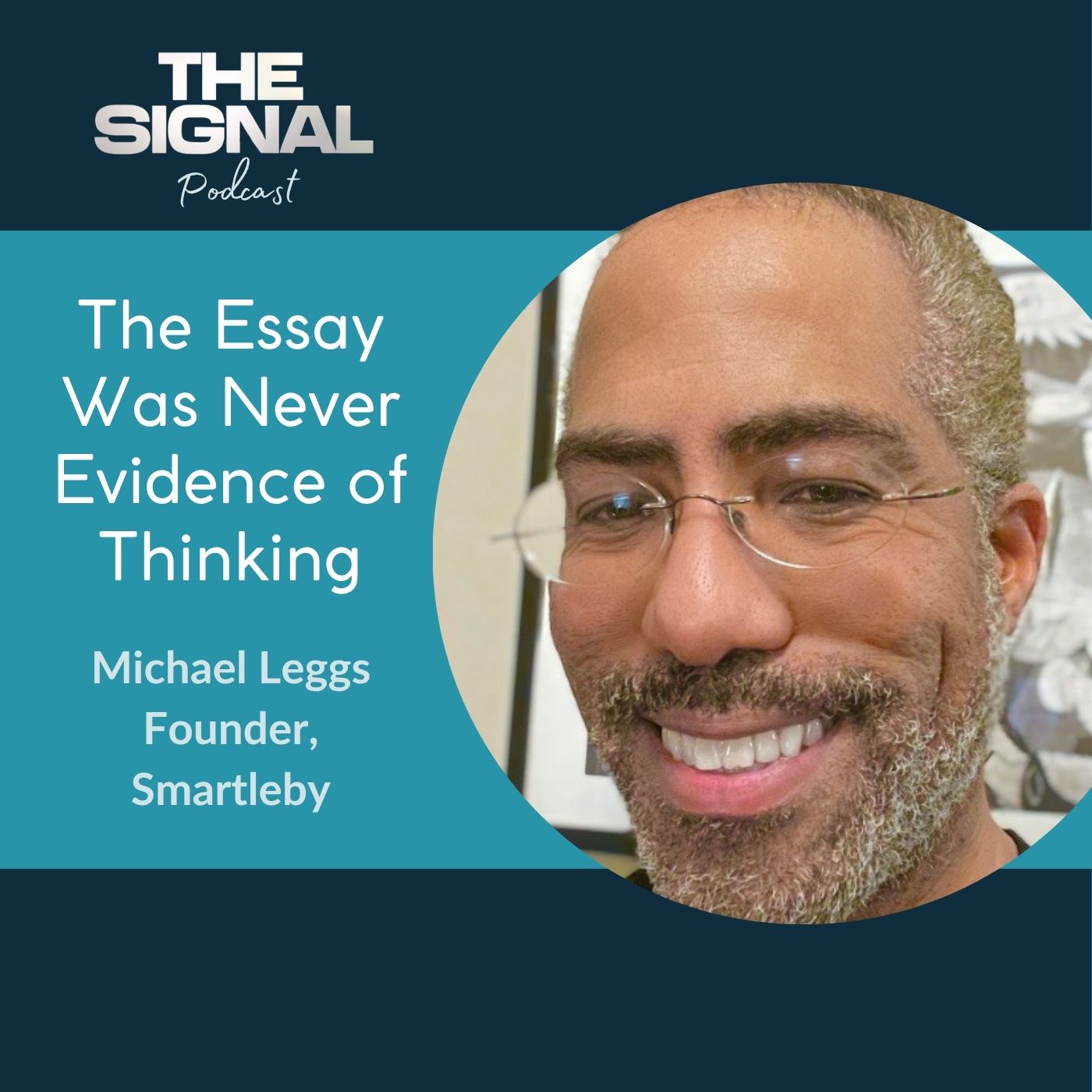
Far fewer happened with the person who's actually reading the papers. My guest today has been doing exactly that for 21 years. And his experience in the classroom has led him to a very different diagnosis of higher education's AI problem. Michael Leggs has taught English at St. Paul College since 2005. He's the founder of SmartAlby, an AI powered revision tutor designed to help students strengthen their writing through guided reflection. Without writing for them, Smartly grew directly out of the problem he was seeing in his own classroom. How do we use AI to make students better writers rather than simply better producers of text? Michael is also the founder of wintermind, has a background in interactive media and a digital strategy, recently served as editor in chief of Scribe Worth magazine, and is under contract with Kendall Hunt to write a college composition textbook. His argument is the one I want to dig in today. The deeper AI problem in higher education isn't cheating, it's curriculum and assessment design.
Michael, it is great to have you on the Signal. Thanks for being here.
[00:02:07] Michael Leggs: Well, thank you for having me. I'm. I'm really looking forward to our conversation.
[00:02:11] Jeff Dillon: So I want to start with the name of your company. SmartAlby. As in Bartleby Melville's copyist who responds to every assignment with, you know, I would prefer not to. It's a funny name for a revision tutor. Unless that's the whole point. Tell me about the name.
[00:02:27] Michael Leggs: Well, you're on the right track. It is named after Bartleby the Scrivener, the Melville story where Bartleby refuses and he says, I would prefer not to. And then so along the same lines, I thought, hey, smart will be.
It refuses to do the work for students. And instead, basically it's. It's doing that so that it can give back the authorship to the student. And so really kind of, if you think about it, one of the defining features of Smartlby is actually what it doesn't do, so.
[00:03:01] Jeff Dillon: Right. I love that. I want to look back on your career here too. How you started, it's kind of backward from most people's. You were. You were buying interactive media for Westlaw in the mid-90s, which was early. Then you went and taught freshman composition for a couple decades. What pulled you out of the industry and into the. Into the classroom?
[00:03:20] Michael Leggs: Well, I guess it's kind of like a bookend. I started off, I had my, you know, I received my degrees in English, and then I said, okay, well, you know, I came up. I moved from Kansas to Minnesota and just found the first jobs that I, you know, so I can make money. So I just fell into the legal publishing.
And then at one point, I was tapped on the shoulder to be trained to be a media planner. And so I got into that kind of, you know, just kind of serendipitously. And then after I'd worked in that for years, you know, I just kind of. It's almost kind of like a cliche, you know, it's like, well, I felt the longing for teaching, you know, to teach and have that kind of reward from teaching. And so I just started looking at opportunities to teach as an adjunct. And actually, I was willing to take a pay cut of about 60% so I can teach.
And I guess, luckily I didn't have to take the big pay cut, so. But that brought me. That is like a kind of a bookended version of my history.
[00:04:23] Jeff Dillon: And 20 years in the classroom gives you something it's hard to replicate from the tech side. You start seeing the same struggles over and over across different students and different semesters. And at some point, I think, I imagine you stop seeing those as individual student problems and start really wondering, well, the tools and processes we're giving them are probably part of the problem. So I'm curious whether there was a tipping point for you. You've read a lot of student papers. Was there a specific moment, stack of drafts or a single conversation where you thought, hey, this is something I can fix with a rubric. I have to. I have to go build something.
[00:05:02] Michael Leggs: Yeah, I mean, you know, basically it was. I'd say, gosh, I can't. It seems like it was back in 2022, where, at least in the institution where I teach, AI usage by students seemed to be mushrooming.
And it was something that I realized that, you know, at that point, we're, as instructors, you know, we receive the student essay and we grade the essay, and that is where you treating that end product as if it's evidence of thinking. And that's one of the things is when AI came along, the student could press a Button, go into ChatGPT and type a very basic prompt. Of course, the better prompt, better output, but they can type basic prompt and generate a paper. And so now we're faced with the dilemma of, you know, we used to treat that product by the student as evidence of thinking, but now AI can simulate that. And so when we look at the end product that AI produces, can we really say that's evidence of thinking and it's. No, no, it's not. It's evidence of, you know, probability statistics and, you know, it's not. So what do we do from that point? And that was the kind of tipping point is we can't just look at the artifact and say, this is evidence of thinking. So we have to go back to the process and say, let's look at the student's revision process. Which I always view the revision process as a thinking process.
And so it's more about process assessment. That's where I see the shift needs to go, especially with the prevalence of AI nowadays.
[00:06:44] Jeff Dillon: Yeah, there are a lot of tutoring assistant types of solutions on the market. Tell us, what are the big things that SmartAlby does different or how do you stand out in this market?
[00:06:56] Michael Leggs: You know, I'd say probably one of the distinctive elements of smartob is something you probably can't see. It's that it's developed by, you know, me came from my experience as a teacher on the front lines. I, you know, I have experience of being in the classroom, knowing the types of tools that can help me be more effective, and also knowing which tools are, I guess you could say, instructionally scalable because we get so many different technical kind of tools to use to enhance our teaching, but a lot of them are just technically scalable, but not instructionally scalable. And so that's one of the things that it seemed to be very important.
[00:07:41] Jeff Dillon: So much of the higher ed AI conversation I've been a part of, it starts with the technology. What do we allow? What do we ban?
How do we detect it? You're asking a more uncomfortable question about whether AI is exposing weaknesses that were already there and how we teach and measure learning. So I want to dig into that a little bit. Your core argument is that AI isn't a cheating problem, it's a curriculum and assessment design problem. Can you say more about that? Because most institutions are still treating it as a conduct issue.
[00:08:13] Michael Leggs: Well, just from my experience, what I've observed is with the prevalence of AI and student use of AI, the cases we had have seen so far a lot of more academic integrity violations. And so we're talking about these students aren't using this ethically.
And so I think it was kind of a knee jerk reaction by the institutions to say, okay, the instructors are saying this, they're saying, I'm seeing more AI generated essays, help me, you know, help us. And then so the first thing they would do is like, we'll get you some, some tools for surveillance and detection. And so I think that was just like an immediate response. I think that's kind of, if you kind of think of it like, I don't know if there's a, say like a problem, you kind of triage at first and then you say, okay, now, you know, when all the dust settles now what do we really want to do for long term fix or long term solution?
I do believe we're kind of in the triage type of stage with this.
[00:09:21] Jeff Dillon: I'm interested in your model. I've seen many clever startups and a lot of AI focused companies have a couple ways where they go really directly to the faculty member and try to get as many faculty at different schools, but they'll also have an enterprise license or, you know, sell directly to leadership or both. How does it work? Are you selling directly to faculty or is it at the institutional level or both?
[00:09:47] Michael Leggs: Well, at this point I'm actually selling it to faculty. There's a time frame where we have to adopt materials, you know, books and certain resources for our courses. And so I'm trying to get in front of the faculty and colleges, two year and four year colleges and universities so that they can take a look at the features and see if they're interested in taking it for, you know, just a trial with one class. And so what I have is we're doing a first round, I'm going through and trying to find faculty founding members who can act more like design partners as we improve the, the software platform. And so it's at the faculty level at this, at this time, that makes sense.
[00:10:35] Jeff Dillon: I've seen this take off with different companies too, where all of a sudden a leader at a school will say, hey, 25 of our faculty are using this product. Maybe we should get a site license. And that's a. Yep, that's a good situation to be in. When a technology creates uncertainty, I think higher ed tends to reach for something it can really control.
Detection software gives you a product to buy or a policy to write and a number to point to. But redesigning how we teach and assess learning is a lot harder. It requires like time and faculty involvement and probably some uncomfortable conversations about the assignments we've been using for years. If it's really a design problem, why is almost every institution's first movement to buy detection software? Is that money well spent or is it an expensive way to avoid a harder conversation?
[00:11:24] Michael Leggs: Well, I mean, I think that their response to buying this detection software is basically, you know, they're looking at it from a higher level kind of view. And really where I teach, we have a. Instructors have, you know, autonomy to develop their own materials and to shape them for whatever, you know, learning goals they have for their students. And so, you know, I see the redesign of our course materials, our courses and assignments, that's on the instructor level. And so, you know, when I look at, I've been teaching for, at St. Paul College for 21 years and before that I taught at Kansas State University for a little while when I was a graduate student. And I don't know if I'm ashamed to say, but I have some assignments that I have, you know, kind of tweaked a little bit, but some that I've used as long as, you know, long ago as 20 years. And so if I look at some assignments, some elements of those assignments really need to be revised to fit into this new, the new classroom where AI is, is present because we have to change the way we design our classes and design our assignments. And I, you know, I see that there's a need for more focus on process analysis.
[00:12:42] Jeff Dillon: For a student who is sitting behind a screen, I think the easiest path is obvious. It's paper into an AI tool. Tell it to make this better.
The problem is that this finished paper may improve while the student doesn't. So if SmartLB is trying to protect the learning that happens during the revision, I want to understand how you actually design for that mechanically. What is the tool doing differently from a student pasting a draft into ChatGPT and asking it to improve the paper?
[00:13:13] Michael Leggs: Well, at the very fundamental level, the student will upload their paper and they can upload the rubric, they can upload also the assignment brief that the teacher, the instructor gives them. So you have all of these and then so what Smuggleby does, it goes through those materials and then it evaluates that student's paper based on those criteria. It returns in bullet pointed revision prompts and it points to specific parts of their essay and says, you need to, you know, revise your thesis so that it is more debatable. Think about xyz. And so it'll come through with very specific revision prompts. And so I think that's one of the major differences. And also you can carry on a, if you want to call it a revision dialogue with, you know, smarter be. If you have questions about its recommendations that it's making, you can have a conversation with it and ask it questions. But as we mentioned earlier, it won't give you answers. It will take that Socratic approach. It will ask you questions so that the answers are revealed to you through your own thinking. And so it won't provide answers, it won't rewrite paragraphs, it won't even suggest rewriting a phrase. So it really keeps the authorship with the student.
[00:14:38] Jeff Dillon: I think that's a, that's an important distinction because AI as a partner, not a replacement, has really become almost a default claim for these tools. But you're saying that preserving student thinking and actually proving it are really are two different things. Especially as the technology gets better, I think the line between assistance and substitution gets harder to see.
So, you know, every AI writing tool says it helps rather than replaces. How would you actually know SmartAlby had crossed the line? What's the signal that tells you a student stopped thinking?
[00:15:12] Michael Leggs: You know, that's a really, it's kind of a difficult question. I mean, I guess, you know, all of the analytics that SmartAlby can provide, you know, they can show evidence of revision and revision can be evidence of thinking, but all of this is based on layers of inference. So I'm not really quite sure if I can honestly say, well, I know when the student stops thinking, I can maybe make an inference by looking at the analytics.
[00:15:40] Jeff Dillon: Fair enough.
There's also this equity aspect here and I think that gets overlooked. We tend to talk about AI as though every student is starting from the same place with the same time and confidence and language skills and even access to support.
At an open access institution, you see a much wider range of circumstances and that makes AI really powerful, potentially very helpful. But it could also create a whole new set of gaps. So you teach at an open access institution. A lot of your students are first gen working or writing in a second language in your classroom. Is generative AI closing the gap for the students or widening it?
[00:16:22] Michael Leggs: Well, I think it can close the, you know, it can close the production gap, if you want to think about that. Where students, if they're given that technology, they can produce using whatever. If we want to consider the whole spectrum of the ways in which they can produce. You can totally do, just click a button, let AI do 100% of it, but there's a spectrum in between where you can say, well, they can produce more effectively with AI assistance.
And so I do think that the production gap is closing. I think one of the things you may be alluding to is that just the overall, like, kind of democratization of AI and, you know, if it's. The technology is going to be available to people across all different socioeconomic levels. And so I'll say, yeah, production gap. And probably as an offshoot of that, we can hope that the tools that we have can help us close that learning gap too.
[00:17:20] Jeff Dillon: Yeah, I think this is where we have to really get practical. It's easy for those of us at conferences to say we need to rethink assessment for the AI era, but somebody has to actually do the work. And if the answer is really just asking faculty to spend more time with every student, we've created a solution that may be pedagogically right, but really operationally impossible. Yep, redesigning assessment sounds great on a panel, but in practice, it's more in class writing, more conferencing, more oral defense. And all that lands on faculty who are already carrying heavy loads, adjuncts maybe are paid by the course. Who pays for this, this new model,
[00:18:02] Michael Leggs: this redesign, the whole redesign. As I, you know, as I see it, it can start at the grassroots level with instructors sharing their ideas on how they're redesigning certain types of assignments in their courses. So it can start at the grassroots level with the instructors, and then it can work its way up. If there's some type of, maybe common type of assignment type or something like that that can be used across a department, then we can develop those things. But yeah, I'm really a big fan of just starting things off at grassroot level.
[00:18:36] Jeff Dillon: Yeah, yeah. And if we're, if we're asking students to bring more of their actual thinking into the process, then we really have to assume trust becomes a big part of this. A rough draft isn't the same thing as submitting a search query. It can contain unfinished ideas and mistakes and personal experiences and things a student never intended for anyone beyond their instructor to see.
So they really deserve a clear answer about where this writing goes. If they're drafting somewhat intimate documents with half formed thinking, sometimes personal material, what happens to that writing inside your system? And what do you tell a student who asks?
[00:19:15] Michael Leggs: One of the major concerns is that, oh, yeah, if you're submitting your work to something that is an AI powered platform, is it using your content to train the AI? And in this case it's not.
And this is, you know, the, the information, the essays, they are, you know, they have a persistence, but then after the course is over, then all that content for that student is then archived and then it is deleted. So we don't keep anything for training or anything like that.
[00:19:49] Jeff Dillon: You know, I think, I think this is one of the strange challenges of teaching right now. The fundamentals of good writing haven't suddenly changed, but the environment students are writing in absolutely has. And when the technology is moving faster than the publishing cycle, writing something meant to last for years becomes a pretty interesting problem.
You're writing a composition textbook for Kendall Hunt right now. The technology under that subject is changing every few months. How do you write a book about teaching writing that isn't obsolete by the time it's publishes?
[00:20:26] Michael Leggs: Yeah, that's an important concern. It's like AI, as you mentioned, is just hurdling so fast toward infinity, you know, we can't keep track of it. But the book that I'm writing, it's built on the, the foundations of writing rhetoric, you know, the good old stuff. But what I'm doing is, I'm trying to, while I'm introducing AI and SMART will be as a component that can augment what's already there. So the way I'm writing it, the way I'm putting it together, is that it can be used without SmartAlby, but it does have prompts within each chapter where a student can use those prompts. And you know, if they are logged into smartbee, they can use that, that feature, but it's, they're not going to be at a deficit if they don't. So it's one of those kind of teachers can actually make it optional. I think that probably the most effective way is to make it, you know, mandatory in the class so that the teacher can get a lot of the aggregated analytics and then kind of figure out where each class is, where they're at.
[00:21:32] Jeff Dillon: Right, right. So we spent a lot of this conversation talking about what AI is forcing higher education to reconsider, whether it's assessment, authorship, revision, even what we mean when we say a student can write. But I want to end by looking past the disruption, because if these tools keep getting better, the real question isn't how we keep AI out of the composition classroom. It's really what becomes more important to teach. Because AI is here five years from now, a First year student sits down in your composition course. What does that class look like and what is it teaching that a model just can't do for them, huh?
[00:22:09] Michael Leggs: Well, I would say back classroom probably one of the things is that smarter we will have outlasted everything in five years. And so people would be using that and you know, in five years from now it would be kind of, I don't know, with how fast things are moving, it'd be maybe a little arrogant of me to say, yes, this is how it should be. Because whatever I say could probably not age very well. But I would say that just a very basic level, I would say that assistive AI would be used in my class. We would make a very big distinction between assistive AI and generative AI, just as I'm doing now with my students.
And I just think that we will hopefully redirect our students attention to ethical use of AI and we would direct our instructors attentions away from surveillance and, you know, policing because that is one of the things that I think needs to go away in five years because we're creating environments where our students, you know, they don't trust us and they know, you know, it's implicit that we don't trust them if we have all these tools set up. So I would like to see surveillance and policing tools just abolished in five years and refocus on using AI if I want to say for good, not evil.
[00:23:35] Jeff Dillon: I love that. Michael, this has been a great conversation. I really appreciate your perspective as someone who's not just thinking about AI and theory, but actually working through these questions with students every day. Thanks for joining the Signal. I will put links to Michael's LinkedIn profile and SmartAlby in the show notes and we'll see you next time. Thanks, Mike.
[00:23:55] Michael Leggs: Okay, well, thank you for having me.
[00:23:58] Jeff Dillon: That's a wrap of this episode of the Signal. If today's conversation sparked a new idea or challenged your thinking, that's exactly the point. This show is about cutting through the noise and helping you see what's actually shaping higher ed right now. Please subscribe so you never miss an episode. And if you found this valuable, leave us a quick review. It helps more higher ed leaders find the signal for deeper ed tech insights, news and trends delivered monthly. Subscribe to the Signal monthly newsletter at edtechconnect. Com.
Thanks for listening. We'll see you next time.