Episode Transcript
[00:00:00] Speaker A: If you remember, there was all the panic about kids watching too much TV and they were supposed to make them all dumb.
That was when I was a kid, right? And then everybody was concerned that they're playing too many video games that will gonna make them stupid.
Well, that's the generation that is the most productive right now. Young people, you know, 30 or 40, they all had this childhood with games and now they're nostalgic about it.
[00:00:28] Speaker B: Welcome to the EdTechConnect Podcast. Your sour for exploring the cutting edge world of educational technology. I'm your host Jeff Dillon and I'm excited to bring you insights and inspiration from the brightest minds and innovators shaping
[00:00:43] Speaker C: the future of education.
[00:00:44] Speaker B: We'll dive into conversations with leading experts, educators and solution providers who are transforming the learning landscape. Be sure to subscribe and leave a review on your favorite podcast platform so
[00:00:57] Speaker C: you don't miss an episode.
[00:00:58] Speaker B: So sit back, relax and let's dive in.
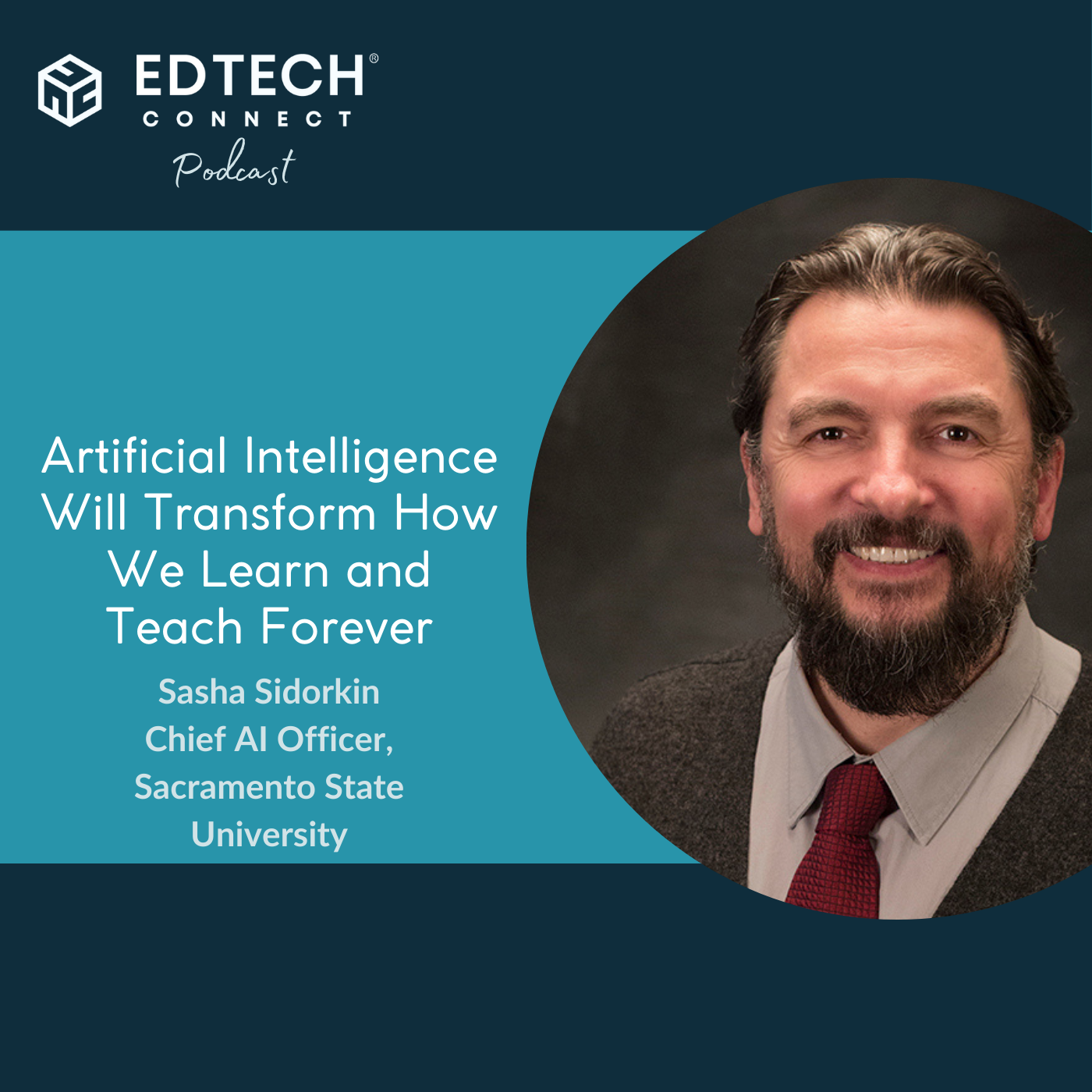
[00:01:05] Speaker C: Dr. Alexander Sasha Sidorkin is a university leader with global experience in innovation, institution building and community engagement. Most recently, he served as Sacramento State's inaugural Chief AI Officer, launching the campus wide National Institute on AI in Society and guiding faculty through early generative AI pilots.
Before that, he spent seven years as Dean of SAC State's College of Education, preparing thousands of teachers and counselors while steering successful accreditation reviews.
His early leadership included deanships at the Higher School of Economics in Moscow and Rhode Island College, plus directorship of the School of Teacher Education at the University of Northern Colorado.
Sasha holds a PhD in education from the University of Washington and an MA in peace studies from Notre Dame and advanced degrees from Russian institutions. A multilingual AI realist, he publishes and speaks widely on practical ethical adoption of emerging technologies in learning and workforce preparation.
So welcome to the show Sasha. It was great to have you today.
[00:02:25] Speaker A: Thank you for having me.
[00:02:26] Speaker C: Let's start with your background. You began your career in Russia. You earned a PhD in Seattle and eventually landed in California. What first sparked your interest in education and then later in AI?
[00:02:41] Speaker A: Well, my first degree was I'm a teacher, history and youth development from Russian institution in Siberia. So I guess I was interested in it from the beginning.
I was trained as educational scholar, so I studied education professionally. My interest kind of shifted from year to year. I started this philosopher of education then I also did some social studies social science research in education and I was always interested in technology and kind of big trends in education. So when AI came out at the end of 22 and I started playing with that, I immediately saw A huge impact on education.
Some people, I guess, took much longer to see it, but from my first few hours I said, oh my God, this is going to probably change a lot.
And I, at some time I was head of the research lab on educational innovation, so I kind of know how innovation spread. And I thought, well, this one is unusual. So.
And I started to invest more in it and I wrote a book called Embracing Chatbots. Yeah, that's I guess how my interest developed.
[00:03:53] Speaker C: So you said you were head of the research lab. What were you tackling first at that lab? And why were you prioritizing things the way you were?
[00:04:03] Speaker A: Yeah, that was in Moscow, where I worked in Russia when Russia was still relatively normal country. So we tried to understand how education changes, what kind of innovations are penetrating and not penetrating education and why.
So we were keeping an eye on what kind of new technologies are coming in.
And to tell you the truth, I was a big critic of educational technology because we had many waves of innovation coming in from technology side and each one of them promised a big revolution in education. Almost none of them materialized.
So we were trying to really understand hard why that doesn't change.
Education doesn't change. We also studied the kind of administrative or policy innovations like choice in education, like charity schools and all of that, basically trying to understand how educational industry is different from others when it comes to adopting innovation. So that was a big research question we had.
[00:05:04] Speaker C: Do you see any big differences between just studying AI in Russia or the way another country handles it versus here in the US?
[00:05:13] Speaker A: Yeah, when I was in Russia, there was no AI yet, not publicly released AI anyway, so we didn't study it there. So. Yeah, but I think globally the reaction to AI is almost the same. There's a little bit of a division between more developed and developing countries, but there is in all developed world, it's about the same challenges and dilemmas people have.
[00:05:36] Speaker C: And so most of your AI work has been in since you've been in California. You've done a lot being the chief AI officer and then heading SAC State's National Institute of AI in Society.
And I'm interested, you call yourself an AI realist. Which current AI claims make you roll your eyes the most?
[00:05:58] Speaker A: Well, actually, all extreme predictions are really not plausible. And like I said, I studied innovation. I know all the hype. I recognize the hype where I think, oh, there's going to be, you know, like extreme claims.
I think it was Elon Musk that said, oh, there will be no human teachers anymore. AI is better than the teacher so this kind of overly positive kind of. And we are just very close to AGI, which is generalized intelligence and we'll have no jobs, nobody will be working in 10 years and all of that.
So this is of course nonsense. Like Elon Musk and others who think that AI will replace teachers, they really misunderstand the nature of education like many educational reformers, by the way, because education is really a relational kind of enterprise. It's where you enter relation with other human beings and that creates the basis for learning. People don't learn just in an abstraction, they learn in context of relationship with other people and that AI cannot provide. Also people who make all these big claims tend to be from the industries that benefit most from, from people investing money, a lot of in AI. So there is probably an over investment right now bubble which will burst eventually.
And on the other extreme are people who saying that oh, this is going to be, it's going to do medication, kids going to be lazy, people are going to be stupider than their parents because AI will do all the thinking for them. This again is based on kind of misunderstanding of sort of basic human conditions. In modern history we had no instances where the next generation was stupider than the previous one. It just never happened. And I am old enough to remember at least three or four different panics.
If you remember there was all the panic about kids watching too much TV and that was supposed to make them all dumb.
That was when I was a kid, right.
And then everybody was concerned that they're playing too many video games that were going to make them stupid.
Well, that's the generation that is the most productive right now. Young people, 30 or 40, they all had this childhood with games and now they're nostalgic about that. Then we thought that the social media is going to make everybody dumb. Even Google search was going to make everybody stupid. None of that happened. So when they say oh AI is this thing is going to make us into morons. I'm sorry, it's just not how human minds works and how societies develop.
[00:08:36] Speaker C: I love those examples. And back to your Elon Musk comment. I think I would support that too in the sense that, you know, 10, 15 plus years ago we started pushing online learning, right? You can take some classes from. This is kind of a little bit old fashioned now even like we all, we've, we've accepted that for the most part. And so there was this argument it came from, I think it was Newt Gingrich way back in the day. He said all we need is a Few great instructors. Because now we can teach the world with just, you know, we can teach thousands of people. And sure, that kind of took off. But to support your fact, like we still have teachers, why do we not have like, you know, one teacher that teaches physics that's the best in the world? It just. You need to personalize.
[00:09:17] Speaker A: So yeah, and not just Newt Gingrich, actually, some serious people. Like there was a Clayton Christianson, remember the guy who wrote the book, Book about disruptive innovations. Very good, actually. Book and everything. Even he thought that we're going to have 10 universities in the world in 20 years because of that.
Again, that's based on just misunderstanding what we do in education. And it's unfortunate that he wouldn't even understand.
[00:09:43] Speaker C: Where have you seen the biggest instructional Wins with gen AI tools like ChatGPT or others? And where do the instructors still.
[00:09:53] Speaker A: Well, maybe we should not start with wins because the technology turned out to be extremely disruptive to education.
So right now, most people experience this as more of a pain in the butt than anything else. Most educators in K12, it's mostly upper grades and kind of middle school and upper school. It doesn't really do anything to basic literacy in elementary school and higher education especially.
It's really painful because it makes a lot of assignment that we had for students, exercises, assignments and assessments that we use, kind of irrelevant. So it wiped out our toolbox. And that's very disconcerting because, you know, if you used to assign essays, which is a standard typical kind of for developed world assignment, you can't really do that anymore. You have to revise it, rethink it. And nobody has time or energy or understanding how to revise and rethink. So right now the majority of educators are very concerned and I think they have a right to be concerned. It's a serious issue.
However, there's always a small minority of educators, you know, 5 to 10%, who jumping into any new technology and just try to figure out how it could be used.
So their reaction is like that.
So, okay, I can't teach certain things anymore. What else can I teach the students?
And I think that would be kind of a healthy, normal educator's reaction that I really appreciate. What can I still do? And they finding numerous ways of using AI. I think the majorities try to police the AI and forbid using AI and all of that. This active minority is just revising their assignments in the way that you do them. With AI. For example, you can say, I want you to write this paper with AI, do this research with AI. But you need to give me the records of your conversation with the AI engine. And from the record you can see how their mind expands, how they grow from kind of a basic primitive prompts to more advanced sophisticated prompts. And you can kind of see how their wheels are turning. They're learning how to use that. So what in effect is happening is that the new world with AI makes it necessary to create new learning outcomes. Kind of the goals of education, like what skills, key skills that we're teaching now. And what turns out to be is like writing with the eye is as interesting and complex and challenging and advanced skill as writing. Those are two different skills, though they're similar in many ways, but they're two different sets of skills. And of course, the most advanced professors and teachers in schools, they realize that and they teach the kind of a new skill. And they have a variety of different projects that people do. Mostly they're working with AI. And what you develop is the ability to kind of disaggregate task.
Like this thing I want to do myself and this thing I'm going to delegate to AI. And so this interactions and ability to.
I call it the executive thinking. Right. So everybody becomes kind of a.
It's an orchestration rather than just doing everything yourself.
So that's the new skill and people will work toward it. And I think the one promising, of course development is those people who understand the new skills, they really work on them. But there is also another very important application. It's the AI Also, it's a disability accommodation tool as well.
So not just disability, but there's a lot of kids who are disadvantaged in traditional educational system because they either dyslexic or there's another six different learning cognitive
[00:13:38] Speaker C: English as a second language or something like that too, right?
[00:13:41] Speaker A: Exactly. The learners as a second language, dyslexic and certain forms of autistic kids, they cannot write, they cannot communicate in written language very well.
So for them it's a lifesaver because they still have ideas very often and in some cases extremely creative, interesting ideas, but they cannot express them. So they've always been put down by the school because you can't write just so in English professional kind of prose. So that kind of accommodation is. Is extremely important. And the disability access community actually working actively on developing those things.
[00:14:18] Speaker C: I have to have to agree with. You know, prompting is a skill I love teaching myself how to help me with my writing.
When you bring up this classroom attitude, there's some research that just came out from Elon University. I think it was episode 32 of this podcast. I talked to Lee Rainey. One of his surveys questions was, he asked a bunch of leaders in higher ed, is it cheating if a student uses a prompt to write an essay? It was very vague and largely takes that response and that output as your assignment. It was half and half. I split half and half with what the faculty thought.
So it just makes me think that, like, we've always struggled in higher ed with digital governance, and now we have, like, kind of have to build AI into that. And in the absence of any real guidelines or policies or rules at an institution, all of these decisions are falling down to the faculty. Right? We have faculty all over the spectrum.
So how do you see governance and, like, are. Do you know of any schools doing this? Well, like, what's your view on helping faculty have some guardrails or some basic strategies that align with the institutional priorities?
[00:15:35] Speaker A: So there are two questions. With policies, we are. It's too early to really implement binding policy because like you said, we don't have a consensus in the profession.
Like, what, which users are allowable or not?
When people say using AI for writing, there was really maybe 12 different ways of doing that, right? So. And when you say, I'm against it, like, which one are you against? Because there's brainstorming, right? There is maybe doing research, literature review, formulating your idea, and all of this could be done with or without AI. So we don't agree. And if we accept any kind of prescriptive policy, half the people will be unhappy with that.
So consensus first, policies later. So right now, most institutions give wide latitudes to individual faculty. But I think the most important here for faculty members is to be rational and explain why certain things are allowed or not allowed. And you can. I mean, I'm not an extremist. I think there are cases when you say, I don't want you to use AI here, because if you do, you're missing this foundational skill that you will need for other things later on. So if you can explain it to students, they are much more likely to comply than if you say, I hate AI. No AI in my class. It's all cheating. So this is very, very weak position. You just call everything cheating and forbid it and try to police it. Faculty members have to be rational about that. Of course, once you start thinking through your syllabus, like, why am I saying no here? Am I preparing students for the world where there is no AI?
Or am I preparing them for the world where everybody's using AI already at their work.
Right. So what skills am I trying to.
So then of course it becomes more sophisticated, more nuanced, your decisions like where to allow or not allow.
[00:17:30] Speaker C: I want to go back to your comment on policy, how you think it's too early because there's not consensus.
Will there ever be consensus? Do you think we need to wait for that? And kind of the second part, depending on how you answer that first part is like who should own this policy on campus? Is it a faculty senate or central IT or someone else?
[00:17:52] Speaker A: Oh, definitely not it.
No.
We have a shared governance tradition in higher education in the United States. So faculty senate usually is the place where those debates are happening. And I have to say that many senates are very reasonable. There were number of institutions that kind of rush into banning it. Not too many.
And they all abandoned that policy by now, which is good.
So most of them are like us, like SAC State, which says that you have to explain it to students, but it's your decision.
So the total consensus is not possible. We never have that in higher ed, but we can have sort of a majority understanding of what's allowable. But. But also what's more difficult. It's not just difference of opinions of people, but also their disciplinary differences.
Use AI for writing business cases or say accounting is very different than English or creative writing instruction.
And I doubt that these people will ever agree on what is acceptable, what is not.
So the policy of the future will be more recommendations like this is the ways to do this. But it's still up to you to have a policy in every course and explain it. I think that's again, this is the most important. Can you really defend it?
[00:19:14] Speaker C: Yeah, I like that point. Like if you're going to give some very broad guardrails, at least provide an explanation as to why you're doing something in your classroom.
[00:19:23] Speaker A: And I think people are asking for policy because they don't want to accept that responsibility of figuring out why.
So in a way it's a kind of looking for a crutch and it's really not that healthy. You as a disciplinary group and each department need to sit down and figure out what is it we're trying to do here? What are learning outcomes? Are they still the same as before? And then building from that kind of end result, what we want to teach the students, then you can kind of build up the assignments. What are we going to do? Allow, not allow, teach them how to use AI because that's the most productive.
[00:19:59] Speaker C: I want to talk a little bit about Students or, you know, even higher ed in general, fearing that data feeding large language models is pretty risky from a privacy standpoint. You know, this became a little more kind of in the spotlight, I think, when Deepseek came out, you know, a few months ago, because all of a sudden there's this model from China that can, that works really fast. There's questions about if it's scalable enough and. But it's open source, but it's in China. How do you balance the innovation with, with privacy assurances in higher ed?
[00:20:37] Speaker A: So what happened is, is the general anxiety about the disruptive nature of AI, I think translated into this exaggerated, really concern about privacy.
And also the fact that AI companies, they use the data to train their model.
So people assume that somebody there, there is like a big database to store all your stuff and anybody can hack it.
So this concern is exaggerated for several reasons. One is that you can opt out of it. You know, just say, do not use my data for training. And if you do that, then the risks are the same as any kind of online platform.
So far until now, there hasn't been any single documented leak of data from AI, major AI that would be used for any kind of nefarious purposes. There were a lot of reports, but if you really look through them, there's nothing there.
So the way that they use data, they kind of chew it up, they split it into different bits and they use that to train their models. They cannot reconstruct your stuff unless somebody hacks into your account and reads your logs of your conversation.
[00:21:45] Speaker C: Yeah, that makes sense. Like everything's already out there. You know, it's just, I worry a little bit. I don't, I don't worry. I guess to say that I can see people, they have all this access to the university information, like lists and now that I can easily analyze spreadsheets, you know, when I use it for that use case, I'll just take out the name. Like, treat it like any time you would another piece of data, you wouldn't publish your list on the web with the names of the people. If you're trying to analyze the data, you know, anonymize it before you take that extra step.
[00:22:16] Speaker A: Yeah, absolutely. I mean, it's like your bank account, right? Somebody can hack it and steal it or your credit record. So that's the same thing. But you're absolutely right. There are existing regulations that people should be using. There is a. We have this ferpa, which is the privacy of information. There's also HIPAA when the medical interactions are involved. And they, they require exactly what you said. Common sense, kind of a safety.
Don't use real names, don't use Social Security numbers, anonymize the data before putting it anywhere, not just into AI, but any kind of Stata or any, any other statistical software that we might be using.
[00:22:53] Speaker C: Yeah, and I think we have that feeling already that, like, if I'm emailing someone something, I don't want to put personal identifying information. It's like, if that can't be on the newspaper headline, don't be emailing it.
[00:23:04] Speaker A: Exactly.
[00:23:05] Speaker C: We have the same attitude toward. I think maybe they don't, maybe they don't know, but people have the same attitude about an LLM, you know.
[00:23:11] Speaker A: No, you're absolutely right. It's a good analogy. Don't put anything there that you wouldn't put in the email.
[00:23:16] Speaker C: So, you know, going back to this idea of like an equity kind of an equalizer for students, because that's what I first thought when I saw this, I'm like, wow, anyone should be able to provide. I used to say C level work and now I think it's B, B plus level work. the very least.
How do we ensure?
Because that was my original feeling. I'm very optimistic, like, this will help everyone. But I talk to people that are trying to help first generation students, students who don't have access to technology.
And it's not as easy for them to embrace this technology.
Maybe it's the devices they have. What steps do we take to ensure that AI narrows rather than widens these equity gaps?
[00:23:59] Speaker A: That's a good question, because it has potential to do both.
So I have to say that institutions are trying to get access. Like, for example, the entire CSU system bought kind of a paid version of ChatGPT for every student. It's a half a million almost students and faculty and staff. It's a good move. People criticize them for that, but I don't think they're wrong on this. But right now we are in the situation where everyone who has Internet access can also access free versions of tools and students learn to hop between, like free versions. There's five or six major models, so you move from one to another when you run out of free usage. They're actually fairly similar to each other.
And I don't think Deep Seek is any more, any less secure than anything else, unless there's something we don't know about that they're not disclosing. But yeah. And you know, grok is awesome. ChatGPT, Claude.
And then there is also, of course, Gemini, which is a Google product. So they're all kind of comparable.
[00:25:01] Speaker C: My latest kind of thoughts are that I constantly use ChatGPT, but I'll often use Claude as my final step. Claude is incredible at building things. Like, I have an idea to build an ROI calculator for a client and I know everything in my head. I know what I want to build. I mean, it will build it in the framework I want it to build. It's quite incredible. So it does make me think, though. And I wrote an article on this about how we've accepted so quickly that AI has surpassed humans in coding. We all have admitted, like, it's pretty much there. I think there's, you know, a hundred coders in the world that maybe could beat AI right now or something like that.
But in the creative sense, like with writing, we don't talk about that as much. It's almost a little more taboo. Why is that?
[00:25:47] Speaker A: Yeah, well, writing is very emotional and sensitive kind of thing. Coders never had those delusion, it works or it doesn't. Yeah, it works or it doesn't. And if you copied from somewhere else or you wrote it, it really didn't, didn't matter. So the culture is very different. And also, I think AI is much better at coding than at creative writing. So AI is awesome in technical and bureaucratic writing. So when asked to write a poem, and you'll see that, nah, it's really not that there yet.
But I think there was also, you know, writing is two and a half, 3,000 years old. So we, our civilization, learned to kind of blend thinking with writing and with language. It's very hard for us to acknowledge that the stupid machine can write as the same or better than us.
[00:26:36] Speaker C: In some cases, it's hitting too close to our humanity.
[00:26:40] Speaker A: Exactly.
[00:26:41] Speaker C: This is the fear we all have. It can replace us. And I agree, it's like for the truest of true creative forms, like a poem or real creative writing, it's not there yet. But everything, all the stuff in between, like little persuasive writing and sales and marketing, all that is, is it's incredible that even if you don't think it's better, it often is. And you have to like test and say, wow, they were right. Because I told it to write something that was engaging, that would encourage this type of interaction.
And it did it different than I would have done. And it's weird to see people also
[00:27:14] Speaker A: forget that there are huge swaths of human culture that are not related to writing.
And, you know, there is oral traditions. There are people that speak in languages that aren't written down, are not stupider than us. They just live in different worlds and they're still very intelligent. Intelligence is like the ability to solve a problem in the new context that you're encountering. And in this way, you know, if you and I were thrown somewhere in the Arctic where the native people live, we would probably be dead within an hour. Or somewhere in the Amazon jungle, the same thing.
So they're very intelligent for their settings. And our setting happens to be connected to writing.
So if we adopted to this technology of writing, and that's important to us. But like I said, there are a lot of brilliant people. Brilliant people, inventors, entrepreneurs who never did well in school because they were dyslexical or whatever. So their brilliance of thought is not necessarily connected to brilliance in writing. It is statistically likely to relate, but it's not. There are also quite a few people that you and I both know that write really well in smooth English prose, but they have nothing to say to the world. And they're kind of, you know, they're doing a good job and kind of have decent careers because nobody noticed before that they. Oh, really? You have nothing to say? And of course, those people are personally threatened because their skill is to write, it's not to think. So it's a large group also. Relatively large group. And now if we're competing on the level of ideas, different people will come to the front.
[00:28:51] Speaker C: Well, I want to ask you one more question. Looking ahead to close this out. If you were designing a professor of 2030 starter kit, what AI competencies would you have topped the list?
[00:29:06] Speaker A: Yeah, I would say here's the list of assignments that you can do with AI use in it, where you have to explain students how to do it with AI and you help them to use AI. But they need examples, they need like. And that's what we're working on. Many of us, like collecting all these use cases.
Like, we have a little preprint that I have AIEDU archive and there are many other places where you can kind of share that. It will take a few years to accumulate enough knowledge to make that kit plausible.
[00:29:36] Speaker C: Well, thank you for being on the show, Sasha. It was great to have you. And I will put the links to your site and your LinkedIn profile in the show. Notes, everybody.
[00:29:45] Speaker A: All right, thank you, Jeff. Good questions.
[00:29:54] Speaker B: We wrap up this episode. Remember, EdTech Connect is your trusted companion on your journey to enhance education through technology.
Whether you're looking to spark student engagement, refine edtech implementation strategies, or stay ahead of the curve in emerging technologies. EdTech Connect brings you the insights you need. Be sure to subscribe on your favorite podcast platform so you never miss an inspiring education informative episode. And while you're there, please leave us a review. Your feedback fuels us to keep bringing you valuable content. For even more resources and connections, head over to edtechconnect.com your hub for edtech
[00:30:31] Speaker C: reviews, trends and solutions.
[00:30:33] Speaker B: Until next time, thanks for tuning in.
[00:30:44] Speaker A: Sam.